702 A Couple of Christmas Factor Trees

Since the sum of its digits equals nine, 702 is divisible by nine.

  • 702 is a composite number.
  • Prime factorization: 702 = 2 x 3 x 3 x 3 x 13, which can be written 702 = 2 x (3^3) x 13
  • The exponents in the prime factorization are 1, 3, and 1. Adding one to each and multiplying we get (1 + 1)(3 + 1)(1 + 1) = 2 x 4 x 2 = 16. Therefore 702 has exactly 16 factors.
  • Factors of 702: 1, 2, 3, 6, 9, 13, 18, 26, 27, 39, 54, 78, 117, 234, 351, 702
  • Factor pairs: 702 = 1 x 702, 2 x 351, 3 x 234, 6 x 117, 9 x 78, 13 x 54, 18 x 39, or 26 x 27
  • Taking the factor pair with the largest square number factor, we get √702 = (√9)(√78) = 3√78 ≈ 26.49528.

702 is the product of consecutive integers: 26 x 27 = 702. Numbers that can be expressed as such products are known as Pronic numbers.

It seems only natural to make factor trees based on those two multiplication facts:

702 Factor Trees

Today’s Find the Factors puzzle also looks like a couple of small Christmas trees.

702 Puzzle

Print the puzzles or type the solution on this excel file: 12 Factors 2015-11-30

———————————————————————————

Here are more facts about the number 702:

It is the sum of consecutive prime numbers 349 and 353.

It is also the sum of the seventeen prime numbers from 7 to 73.

And because 13 is one of its factors, 702 is the hypotenuse of Pythagorean triple 270-648-702. Notice that the short leg is a permutation of 702.

———————————————————————————

702 Logic

Level 4 Christmas Puzzle #699

  • 699 is a composite number.
  • Prime factorization: 699 = 3 x 233
  • The exponents in the prime factorization are 1 and 1. Adding one to each and multiplying we get (1 + 1)(1 + 1) = 2 x 2 = 4. Therefore 699 has exactly 4 factors.
  • Factors of 699: 1, 3, 233, 699
  • Factor pairs: 699 = 1 x 699 or 3 x 233
  • 699 has no square factors that allow its square root to be simplified. √699 ≈ 26.438608.

Here is a Christmas puzzle for you to solve. It’s numbered 699 to distinguish it from every other puzzle I make:

699 Puzzle

Print the puzzles or type the solution on this excel file: 12 Factors 2015-11-30

———————————————————————————

Here are a few thoughts I’ve had about the number 699:

699 is the smallest number whose digits add up to 24.

Every odd number greater than 1 is the sum of 2 consecutive numbers. 699 is the sum of 349 and 350.

Every number that is divisible by 3 is the sum of 3 consecutive numbers: 232 + 233 + 234 = 699.

Also 699 is the hypotenuse of Pythagorean triple 315-624-699. Which factor of 699 is the greatest common factor of those three numbers?

699 is palindrome 272 in BASE 17; note that 2(289) + 7(17) + 2(1) = 699

———————————————————————————

699 Logic

696 There are lots of goodies in this Christmas Stocking

  • 696 is a composite number.
  • Prime factorization: 696 = 2 x 2 x 2 x 3 x 29, which can be written 696 = (2^3) x 3 x 29
  • The exponents in the prime factorization are 3, 1, and 1. Adding one to each and multiplying we get (3 + 1)(1 + 1)(1 + 1) = 4 x 2 x 2 = 16. Therefore 696 has exactly 16 factors.
  • Factors of 696: 1, 2, 3, 4, 6, 8, 12, 24, 29, 58, 87, 116, 174, 232, 348, 696
  • Factor pairs: 696 = 1 x 696, 2 x 348, 3 x 232, 4 x 174, 6 x 116, 8 x 87, 12 x 58, or 24 x 29
  • Taking the factor pair with the largest square number factor, we get √696 = (√4)(√174) = 2√174 ≈ 26.38181.

Today’s puzzle is meant to look like a Christmas stocking or boot that can be filled with lots of little treasures.

696 Puzzle

Print the puzzles or type the solution on this excel file: 12 Factors 2015-11-30

———————————————————————————

What other facts did I find about the number 696?

696 is the sum of all the prime numbers from 71 to 103. Do you know what those eight prime numbers are?

696 is also the sum of consecutive odd numbers 347 and 349 which just happen to also be consecutive prime numbers.

Because 696 is a multiple of 29, it is the hypotenuse of Pythagorean triple 480-504-696. What is the greatest common factor of those three numbers?

696 is a palindrome in two different bases

  • 696 BASE 10; note that 6(100) + 9(10) + 6(1) = 696
  • OO BASE 28; note that O BASE 28 is equivalent to 24 in BASE 10, and  24(28) + 24(1) = 696

———————————————————————————

696 Factors


321 I Heard the Bells on Christmas Day

321 is made solely from three consecutive numbers so it can be evenly divided by 3.

  • 321 is a composite number.
  • Prime factorization: 321 = 3 x 10⁷
  • The exponents in the prime factorization are 1 and 1. Adding one to each and multiplying we get (1 + 1)(1 + 1) = 2 x 2 = 4. Therefore 321 has exactly 4 factors.
  • Factors of 321: 1, 3, 107, 321
  • Factor pairs: 321 = 1 x 321 or 3 x 10⁷
  • 321 has no square factors that allow its square root to be simplified. √321 ≈ 17.916
I heard the bells
Print the puzzles or type the factors on this excel file: 10 Factors 2014-12-08

One Christmas day about the time of the Civil War, Henry Wadsworth Longfellow wrote a poem he titled “Christmas Bells”. 5/7 of that poem later became the song known as “I Heard the Bells on Christmas Day”. You can read the poem’s complete original text here.

I heard the bells factors

19 Last-Minute Gift

Today’s Puzzle and a Last-minute Gift Idea:

It’s Christmas Eve or even Christmas day, and maybe all of your shopping didn’t get done. Maybe you didn’t want to drive anyplace because of bad weather, or your favorite stores were closed early for the holiday. Well, if someone on your list likes number-placing puzzles (like Sudoku or Kakuro), then I have a last-minute gift idea for you, and it’s free. I design a number-placing logic puzzle based on the multiplication table called FIND THE FACTORS. If you have a computer, the internet, and a printer, you can print a little holiday booklet filled with these puzzles and give it as a gift. If the person on your gift list is many miles away, you can even send the booklet electronically. This last-minute gift is good for the brain and can be good for the memory. The level 1 and level 2 puzzles can be solved by children 3rd grade and up, but most of the higher level puzzles will be challenging for everyone regardless of age. 

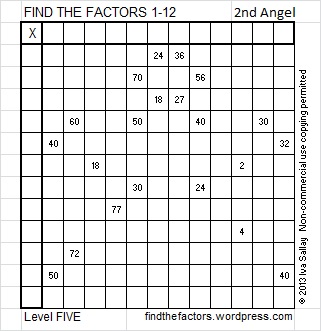
Here is a  puzzle created to look a little like an angel just for the holidays:

2nd angel

To solve the puzzle above simply write the numbers 1 – 12 in the top row and also in the first column so that those numbers are the factors of the given clues. Okay, maybe it isn’t quite that simple. You have to know basic multiplication facts and use logic to figure out where the numbers go, and yes, I may try to trick you. But you and the people on your gift list have enough skills and persistence to find the one and only correct solution.

Now glancing at the puzzle above you may think you know all the answers, but…

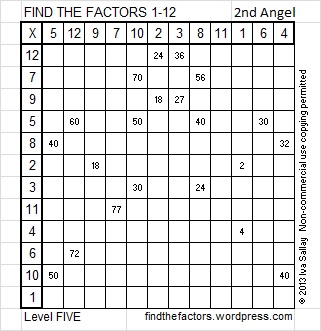
This is what the solved puzzle looks like. Some of those factors may surprise you. That is why using logic is so important when solving the puzzles. (Once the factors are found, filling out the rest of the table is optional.)

angel factors found

Click 2013 Factor Holiday to download a copy of the puzzle booklet. Some of the puzzles in the booklet are a little easier than the one above because they are a lower level or they only use factors up to 10. Have a very Merry Christmas and a Happy New Year!

Factors of the Number 19:

  • 19 is a prime number.
  • Prime factorization: 19 is prime.
  • The exponent of prime number 19 is 1. Adding 1 to that exponent we get (1 + 1) = 2. Therefore 19 has exactly 2 factors.
  • Factors of 19: 1, 19
  • Factor pairs: 19 = 1 x 19
  • 19 has no square factors that allow its square root to be simplified. √19 ≈ 4.3588989

How do we know that 19 is a prime number? If 19 were not a prime number, then it would be divisible by at least one prime number less than or equal to √19 ≈ 4.4. Since 19 cannot be divided evenly by 2 or 3, we know that 19 is a prime number.

19 is never a clue in the FIND THE FACTORS puzzles.

More About the Number 19:

19 is the fourth centered triangular number. There are 19 squares in the graphic below:

Why? Because 1 + 3(1) + 3(2) + 3(3) = 19.

19 is also the third centered hexagonal number.
Why? Because 1 + 6(1) + 6(2) = 19.
Imagine lines forming concentric hexagons in the drawing from the tweet below:


Related articles with other ideas for last-minute gifts:

17 Christmas Angels

  • 17 is a prime number.
  • Prime factorization: 17 is prime.
  • The exponent of prime number 17 is 1. Adding 1 to that exponent we get (1 + 1) = 2. Therefore 17 has exactly 2 factors.
  • Factors of 17: 1, 17
  • Factor pairs: 17 = 1 x 17
  • 17 has no square factors that allow its square root to be simplified. √17 ≈ 4.123.

How do we know that 17 is a prime number? If 17 were not a prime number, then it would be divisible by at least one prime number less than or equal to √17 ≈ 4.1. Since 17 cannot be divided evenly by 2 or 3, we know that 17 is a prime number.

17 is never a clue in the FIND THE FACTORS puzzles.

Many Christmas trees in the United States have been up and decorated for weeks. Some of them have a beautiful angel on the top to remind us of the angel that visited the shepherds. In Hungary, the angel is remembered in a different way. There the Christmas tree is put up on Christmas Eve. Tradition says that angels are the ones who decorate the tree with the delicious candies called szaloncukor. The candies are wrapped in specially prepared white tissue and fastened to the tree with white yarn. See the related articles at the end of the post for more information about this fascinating tradition.

The angel puzzles that I’ve made for this post have a few extra clues so they will be easier to solve. The first level 5 puzzle even has many of the same clues as the level 4 puzzle. Nevertheless, be careful because each level 5 angel has a few tricks up her sleeve. Still if you can write the numbers 1 to 12 in both the top row and the first column so that those numbers are the factors of the given clues, then you’ve solved the puzzle. There is only one solution to each puzzle. Click 12 Factors 2013-12-19 for a printable version of these and a few other puzzles.

2013-12-19.42013-12-19.5

2013-12-19.72013-12-19.9

Hungary:

United States:

16 Silver Bells

16 is a composite number, and it is 4 squared. 16 = 1 x 16, 2 x 8, or 4 x 4. Factors of 16: 1, 2, 4, 8, 16. Prime factorization: 16 = 2 x 2 x 2 x 2, which can also be written 16 = 2⁴.

Since √16 = 4, a whole number, 16 is a perfect square.

When 16 is a clue in the FIND THE FACTORS puzzles, use either 2 x 8 or 4 x 4. Only one of those sets of factors will work for any particular puzzle.

“Silver bells, silver bells.
It’s Christmas time in the city.”

2013-12-16.42013-12-16.7

Find the Factors is a type of logic puzzle. To solve one of the above puzzles, place the numbers 1 – 10 in both the top row and in the first column so that those numbers are factors of the given clues. For each puzzle, there is only one solution. Click on 10 Factors 2013-12-16 to find these and a few more puzzles, as well as last Monday’s solutions.

Some of these Related articles have the lyrics or soundtrack to Silver Bells:

15 is the Magic Sum of a 3 x 3 Magic Square

15 is a composite number. 15 = 1 x 15 or 3 x 5. Factors of 15: 1, 3, 5, 15. Prime factorization: 15 = 3 x 5.

When 15 is a clue in the FIND THE FACTORS 1 – 10 or 1 – 12 puzzles, use 3 and 5 as the factors.

If you added the first nine counting numbers together, what sum would you get? What is 1 + 2 +3 + 4+ 5 + 6 + 7 + 8 + 9?

Would you get the same answer by adding (1 + 9) + (2 + 8) + (3 +7) + (4 + 6) + 5?

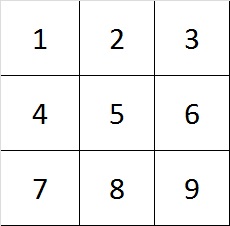
These are two of the many fun questions you can explore when you try to make a magic square. What is a magic square? If you can place the numbers from 1 to 9 in the box below so that the sum of any row, column, or diagonal will equal the sum of any other row, column, or diagonal, then you will have made a 3 x 3 magic square. The sum of a row, column, or diagonal in a magic square is called the magic sum.

1-9

Clearly it is not a magic square yet. In fact, only one of the numbers is positioned where it needs to be. Which number do you think is already in the correct position?

When it becomes a magic square, what will the magic sum be? One student noticed that in its current state the sums of the rows are 6, 15, and 24. The sums of the columns are 12, 15, 18. The sums of the diagonals are 15 and 15. Since 15 occurs most often, could the magic sum be 15? One way to determine what the magic sum should be is to add the sums of all three rows and then divide by the number of rows. Since 1 + 2 + 3 + 4 + 5 + 6 + 7 + 8 + 9 = 45 and 45 ÷ 3 = 15, then 15 is indeed the magic sum.

Here are a few easy-to-remember steps to construct a 3 x 3 magic square quickly.

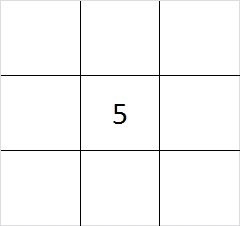
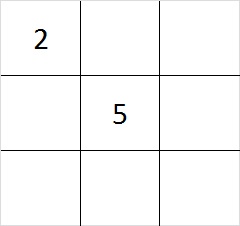
Step 1: Draw a tic-tac-toe board and put 5 in the middle.

step 1 magic

Step 2: Put one of the even numbers in one of the corners.  You have four different choices, 2, 4, 6, or 8. The illustration is for the number 2, but any of the even numbers will work.

step 2 magic

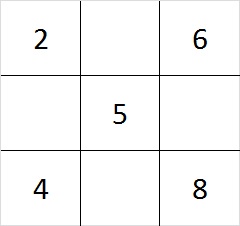
Step 3: Subtract your even number from 10 to find its partner. 4 + 6 are partners and so are 2 + 8. Put the partner of the number you chose for step 1 in the corner that is diagonal to it.

step 1 magic

Step 4: Put the other two even numbers in the remaining corners. Yes, you have two choices where to put the numbers. Either choice will work.

step 4 magic

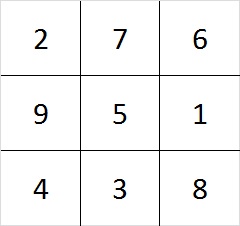
Step 5: Since 6 + 8 = 14 and 15 – 14 = 1, put 1 in the cell between the 6 and the 8. Do similar addition and subtraction problems on each side of the square to determine where to place the 3, 7, and 9. You can work clockwise or counter clockwise, or skip around the square doing the addition and subtraction problems; it doesn’t matter.

This finished magic square looks like this:

step 5 magic

Check it out! Every row, column, and diagonal adds up to 15!

As we created the square, we made choices. First we chose between 4 even numbers, and later we had 2 more choices. Notice that 4 x 2 = 8. There are 8 different ways to make a 3 x 3 magic square! (However, they are all really the same square turned upside down, rolled on its side, viewed from the back. etc.)

There are 880 different ways to make a 4 x 4 magic square. Look over the related articles at the end of this post to learn more about magic squares that are bigger than 3 x 3.

Speaking of magic squares, when I look at the square logic puzzle below, something magical happens. This puzzle has nine clues in it, and all of them are perfect squares. I can use those nine clues to construct a complete multiplication table. If you finish the same puzzle, your multiplication table will look exactly like mine because this puzzle has only one solution.

2014-01-06.1

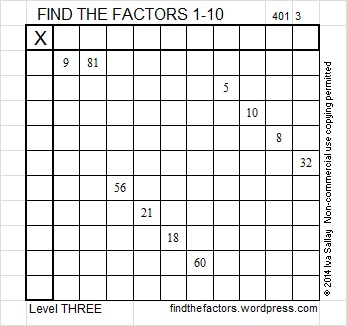
The level 3 puzzle below is only a little bit more difficult. To solve it place the numbers 1 – 10 in the top row and again in the first column so that those placed numbers are the factors of the given clues. Again there is only one solution, and you will need to use logic to find it. Click 10 Factors 2014-01-06 for more puzzles and last week’s answers.

2014-01-06.3

May we all find a little bit more magic in our lives!


14 Oh Christmas Tree

14 is a composite number. 14 = 1 x 14 or 2 x 7. Factors of 14: 1, 2, 7, 14. Prime factorization: 14 = 2 x 7.

When 14 is a clue in the FIND THE FACTORS  1 – 10 or 1 – 12 puzzles, use 2 and 7 as the factors.

O Christmas Tree, O Christmas Tree,

How lovely are your branches…

Do Christmas factor trees have lovely branches?  It depends on how they are constructed. For example here are 2 of the many possible factor trees for 1680. I think one of them is more lovely than the other.

1680.21680.1

This blog is actually about a logic puzzle that is based on the multiplication table. Today we have puzzles that look like Christmas trees, garland, lights, or blocks and a bright star for the very top.

Directions to solve the puzzles: In both the top row and the first column place the numbers 1 – 10 so that they are factors of the given clues. It may be more challenging than you think, especially for the higher level puzzles. If you click 10 Factors 2013-12-09, you can print the puzzles in color or black and white from an excel spreadsheet or you can type the answers directly on the spreadsheet. You must have a spreadsheet program on your device to access the file.

2013-12-09.12013-12-09.2

2013-12-09.32013-12-09.4

2013-12-09.52013-12-09.6