389 How to Know if a Prime Number is the Hypotenuse in a Primitive Pythagorean Triple

  • 389 is a prime number.
  • Prime factorization: 389 is prime.
  • The exponent of prime number 389 is 1. Adding 1 to that exponent we get (1 + 1) = 2. Therefore 389 has exactly 2 factors.
  • Factors of 389: 1, 389
  • Factor pairs: 389 = 1 x 389
  • 389 has no square factors that allow its square root to be simplified. √389 ≈ 19.723

How do we know that 389 is a prime number? If 389 were not a prime number, then it would be divisible by at least one prime number less than or equal to √389 ≈ 19.723. Since 389 cannot be divided evenly by 2, 3, 5, 7, 11, 13, 17, or 19, we know that 389 is a prime number.

If a Pythagorean triple is a primitive, then its hypotenuse is always an odd number. Sometimes it is also a prime number. How can we know if a particular prime number, such as 389, is ever the hypotenuse of a Pythagorean triple?

Divide the last two digits of the prime number by 4 and look at the remainder:

  • If the remainder is 3, then that prime number will not ever be the hypotenuse of any Pythagorean triple.
  • If the remainder is 1, then it is the hypotenuse of a primitive Pythagorean triple! Find the proof here.

The last two digits of 389 is 89, and 89 ÷ 4 = 22 R1, so 389 and every other prime number ending in 89 is the hypotenuse of a primitive Pythagorean triple. What are the other two sides of this particular triangle? First we will figure out what two square numbers equal 389, then we will use those two numbers to figure out what two square numbers equal 389 squared:

Have you ever noticed that 1 is the first square number, 1 + 3 or 4 is also a square number, and 1 + 3 + 5 or 9 is yet another square number? This principle can be summarized by writing 1 + 3 + 5 + . . . + (2n – 1) = n squared.

Square Numbers - Sums of First Odd Numbers`

I’ll use this fact to determine when 389 is the hypotenuse of a primitive Pythagorean triple. I’ll subtract 1 from 389, then 3 from that result, and continue to subtract the next odd number until I get a perfect square. I should find the perfect square before I reach 194 (about half of 389).

So let’s begin:

389 to 289

At this point I know that 17² + another square equals 389. There are a few methods I can use to find the other perfect square.

  • I can find the other square by subtracting: 389 – 17²
  • I can take the last odd number used, 19, add one, then divide by two and then square that number.
  • Or I can continue subtracting odd numbers as before:

289 to 100

All of these methods give us 100 or 10² as the second perfect square. Notice that (33 + 1)/2 = 17 as well.

Now we have enough information to determine the other two numbers that make up the Pythagorean triple with 389 as the hypotenuse.

  • All of the numbers, a – b – c, in the triple can be found using the formulas Euclid provided more than 2000 years ago. Let 10 = n; and 17 = m.
  • a = m² – n² = 17² – 10² = 189 
  • b = 2mn = 2(10)(17) = 340
  • c = m² + n² = 17² + 10² = 389
  • thus 189 – 340 – 389 make a primitive Pythagorean triple. We know it is a primitive because 389 is prime and has no other factors besides one and itself.

373 Prime Numbers and Pythagorean Triples

  • 373 is a prime number.
  • Prime factorization: 373 is prime.
  • The exponent of prime number 373 is 1. Adding 1 to that exponent we get (1 + 1) = 2. Therefore 373 has exactly 2 factors.
  • Factors of 373: 1, 373
  • Factor pairs: 373 = 1 x 373
  • 373 has no square factors that allow its square root to be simplified. √373 ≈ 19.313

How do we know that 373 is a prime number? If 373 were not a prime number, then it would be divisible by at least one prime number less than or equal to √373 ≈ 19.313. Since 373 cannot be divided evenly by 2, 3, 5, 7, 11, 13, 17, or 19, we know that 373 is a prime number.

  • 373 is the short leg of only one Pythagorean triple, the primitive 373, 69564, 69565
  • Prime numbers are never the longer leg, but
  • 373 is the hypotenuse of exactly one Pythagorean triple: 252, 275, 373

Here is the Odd Pythagorean triple sequence I’ve blogged about this week with the prime numbers highlighted in yellow:

Odd Primitive Primes

There are 24 odd prime numbers less than 100. The odd numbers less than 100 in this sequence produce 21 prime numbers as their hypotenuses! I think that is amazing especially since 40% of the time the hypotenuse turns out to be a composite number whose last digit is five! Here are some observations that apply to THIS sequence only:

  • When the last digit of the short leg is 3 or 7, the last digit of the hypotenuse ends in 5.
  • When the last digit of the short leg is 5, the last digit of the hypotenuse ends in 3.
  • When the last digit of the short leg is 1 or 9, the last digit of the hypotenuse ends in 1.

There are only 18 prime hypotenuses when we use about the same number of triples from this Even Primitive Triple Sequence.

Even Primitive Primes

18 primes out of 49 numbers listed is slightly less impressive than 21 primes out of 48 total numbers, but again 40% of the hypotenuses end with five and have no choice but to be composite numbers.  Here are some observations that apply to THIS sequence only:

  • When the last digit of the short leg is 4 or 6, the last digit of the hypotenuse ends in 5.
  • When the last digit of the short leg is 0, the last digit of the hypotenuse ends in 1.
  • When the last digit of the short leg is 2 or 8, the last digit of the hypotenuse ends in 7.

I had no idea that Pythagorean triples would produce so much trivia!

371 What Pythagorean Triple Comes Next?

Could 371 be a prime number? Let’s do a quick prime number test on it.  2^371 (mod 371) = 340, not 2. Therefore, 371 is definitely a composite number. Scroll down to see its factoring information.

What Pythagorean Triple Comes Next

If you can figure out the simple pattern that these odd Pythagorean triples make, you can predict the next one in the sequence FOREVER by squaring only one number, and without ever taking a single square root! Look at the blue and red squares in the graphic above.

  • 4 + 5 = 9 = 3², and 3, 4, 5 make a Pythagorean triple.
  • 12 + 13 = 25 = 5², and 5, 12, 13 is also a Pythagorean triple.
  • 24 + 25 = 49 = 7², and 7, 24, 25 is another Pythagorean triple, and
  • 40 + 41 = 81 = 9², and 9, 40, 41 is yet another Pythagorean triple!

What Pythagorean triple comes next? The answer is found by taking the next odd number, 11, squaring it to get 121 and dividing the 121 by 2. We round down to 60 for the 2nd number and round up to 61 for the 3rd number. Thus the next Pythagorean triple would be 11, 60, 61.

No matter how many times we repeat this pattern, we always get primitive Pythagorean triples. We can put all the triples in order to make a sequence that I call the Odd Primitive Pythagorean Triple Sequence:

The Odd Primitive Pythagorean Triple Sequence

Every odd number is the short leg of at least one primitive Pythagorean triple! Here’s how I came to realize this amazing fact:

Last week I was thinking about the difference of two squares applied to integers in general

Difference of Two Squares

as I looked at this multiplication table.

The Multiplication Table

Everyone knows that the numbers in the boxes outlined in red are perfect squares, but most people do not realize that the numbers inside EVERY other colored square on this multiplication table can be expressed as the difference of two squares. The larger of those two squares will be the perfect square that is the same color.

For example, look at 5 x 11 or 55. If we count as we follow the light blue diagonal stripe from 55 to 64, we count 3 squares. That means that 55 = 64 – 3².

As I looked at the multiplication table I realized that some even numbered squares are colored and some are not, but EVERY odd number square is in color! That means that EVERY odd number on the table can be expressed as the difference of two squares in at least one way.

The light blue 9 from 1 x 9 is four squares away from the 25 that is outlined in red. 9 = 25 – 4². Since all those numbers are perfect squares, we can write 3² = 5² – 4² or the equivalent in Pythagorean Theorem form   3² + 4² = 5².

When an odd number is squared, the resulting perfect square is ALWAYS an odd number. Since all odd numbers can be written as the difference of two squares, The square of all odd numbers can be written as the difference of two squares. In other words, every odd number is a leg in a Pythagorean triple!

Let’s look at the factoring information for 371 and use it to find some Pythagorean triples.

  • 371 is a composite number.
  • Prime factorization: 371 = 7 x 53
  • The exponents in the prime factorization are 1 and 1. Adding one to each and multiplying we get (1 + 1)(1 + 1) = 2 x 2 = 4. Therefore 371 has exactly 4 factors.
  • Factors of 371: 1, 7, 53, 371
  • Factor pairs: 371 = 1 x 371 or 7 x 53
  • 371 has no square factors that allow its square root to be simplified. √371 ≈ 19.261

371 is odd and has two odd prime factors. Here are some Pythagorean triples involving 371 as the short leg:

  • 371, 68820, 68821 (This triple is a primitive from the odd primitive sequence.)
  • 371, 1380, 1429 (A primitive, not from the odd primitive sequence. I’m also making a note that √(1380 + 1429) = 53 and √(1429 – 1380) = 7.)
  • 7, 24, 25 multiplied by 53 becomes 371, 1272, 1325
  • 53, 1404, 1405 multiplied by 7 becomes 371, 9828, 9835

371 is also the hypotenuse of a Pythagorean triple: 196, 315, 371 which is primitive 28, 45, 53 multiplied by 7.

368 and a Few Sequences

368 is a composite number because it is even. Scroll down for its factoring information.

Sequences can be illustrated in pictures, but they are most often simply a list of numbers such as 23, 46, 69, 92, 115, . . . . .

Those numbers are the multiples of 23 listed in order. If we continued writing the numbers in that sequence, we would see that 368 is the 16th number listed.

We also know that 368 is an element of many other sequences even though it isn’t one of the typed numbers:

  • The sequence of all counting numbers: 1, 2, 3, 4, 5, . . . .
  • The sequence of all even counting numbers: 2, 4, 6, 8, 10, . . . .
  • The sequence of numbers that are multiples of four: 4, 8, 12, 16, 20, . . . . (This is the yellow sequence in the graphic below.)
  • The sequence of numbers that are one less than the multiples of three: 2, 5, 8, 11, 14, . . . .
  • The sequence of numbers that are one less than the multiples of nine: 8, 17, 26, 35, 44, . . . .

What's the next value

386 is NOT an element of any of the following sequences that involve even squared numbers:

  • 3, 15, 35, 63, 99, . . . . (The blue sequence in the graphic above)
  • 4, 16, 36, 64, 100, . . . .
  • 5, 17, 37, 65, 101, . . . . (The red sequence in the graphic above)

The yellow, blue, and red sequences above can be made into an array that contains only Primitive Pythagorean Triples!

Even Primitive Pythagorean Triple Sequence

Except for the 3, 4, 5 triangle that is listed first, every multiple of 4 is the short leg in a primitive Pythagorean triple! The other leg and the hypotenuse are based on a square with sides that are 1/2 the length of the shorter leg. Since the shorter leg is a multiple of four, that square length will always be an even number. Also note: 368 is divisible by 4 so 368, 33855, 33857 is a primitive that would be included in this sequence array.

The sequence contains only primitives, but it does NOT contain EVERY primitive whose short leg is a multiple of four. For example Pythagorean triple, 20, 21, 29, is not in that sequence array.

Let’s look at all the factoring information for 368:

  • 368 is a composite number.
  • Prime factorization: 368 = 2 x 2 x 2 x 2 x 23, which can be written 368 = (2^4) x 23
  • The exponents in the prime factorization are 4 and 1. Adding one to each and multiplying we get (4 + 1)(1 + 1) = 5 x 2 = 10. Therefore 368 has exactly 10 factors.
  • Factors of 368: 1, 2, 4, 8, 16, 23, 46, 92, 184, 368
  • Factor pairs: 368 = 1 x 368, 2 x 184, 4 x 92, 8 x 46, or 16 x 23
  • Taking the factor pair with the largest square number factor, we get √368 = (√16)(√23) = 4√23 ≈ 19.183

We can make a sequence array from the Pythagorean triple primitive 3, 4, 5 and its non-primitive multiples (which includes 276, 368, 460):

A Pythagorean Triple Sequence Array

We can find other Pythagorean triples that contain the number 368. Notice that 368 has several factors that are multiples of 4. They are 4, 8, 16, 92, and 184. Each one of them has its own primitive triple which can be multiplied by its factor pair partner to produce non-primitive triples that include 368 as well.

  • 3, 4, 5 multiplied by 92 is 276, 368, 460
  • 8, 15, 17 multiplied by 46 is 368, 690, 782
  • 16, 63, 65 multiplied by 23 is 368, 1449, 1495
  • 92, 2115, 2117 multiplied by 4 is 368, 8460, 8468
  • 184, 8463, 8465 multiplied by 2 is 368, 16926, 16930

In future posts I’ll write about how to find other Pythagorean triples like

  • 23, 264, 265, a primitive Pythagorean triple with an odd short leg. This primitive becomes 368, 4224, 4240 when multiplied by 16 (23’s factor pair partner).
  • 368, 465, 593, another primitive Pythagorean triple not included in the colored sequence array above and
  • 184, 513, 545, which when multiplied by 2 becomes 368, 1026, 1090.

Pythagorean triples aren’t just a bunch of “SQUARE” numbers. They are simply counting numbers that satisfy the equation a² + b² = c², and they are really COOL!


The 100th Day of School

Kindergarten and first-grade students from coast to coast celebrate the 100th Day of school. They read books about 100 and the 100th day of school. They bring collections of 100 items to school, and they also complete many 100th day worksheets.

My blogging friend, Paula Krieg, designed a fabulous art project for second-grade students. I just had to update this post and share her work with you. Her project would also be perfect for the 100th day of school for the mid-elementary grades. In the video near the end of her post, she explains her 100¢ art project. Her post includes detailed instructions, templates of everything needed to complete the project, and links showing completed projects. Check it out!

I like the Hap Palmer song about coins. It happens to teach important multiplication facts, including some about the number 100. Third graders could learn these multiplication facts on the 100th day of school. This song would also go very well with Paula’s 100¢ project above:

You will also love the games, puzzles, art projects, etc. suggested in MathGeekMama’s 100 Math Ideas for the 100th Day of School.

What about students in 4th or 5th grade or even middle school or high school? Can older students celebrate the 100th day of school? I think so! Share some of the following information with them:

Here is the basic factoring information for the number 100.

  • 100 is a composite number.
  • Prime factorization: 100 = 2 × 2 × 5 × 5, which can be written 100 = 2²× 5²
  • The exponents in the prime factorization are 2 and 2. Adding one to each and multiplying we get (2 + 1)(2 + 1) = 3 × 3 = 9. Therefore 100 has exactly 9 factors.
  • Factors of 100: 1, 2, 4, 5, 10, 20, 25, 50, 100
  • Factor pairs: 100 = 1 x 100, 2 x 50, 4 x 25, 5 x 20, or 10 x 10
  • 100 is a perfect square. √100 = 10

Here are a few of several possible factor trees that can be made for the number 100:

What about the factors of all the numbers from 1 to 100? Here’s a clever chart giving those factors. Click on the tweet to see the whole chart.

What do you think the area of the following shape will be?

You got it, 100 cm².

Since √100 = 10, a whole number, 100 is a perfect square. Did you know that 100 can be written as the sum of TWO OTHER perfect squares?

  • 36 + 64 = 100. In other words, 6² + 8² = 10²

36, 64, and 100 were all included as clues in the very first puzzle I published on this blog:343-1

Note: When 100 is a clue in a FIND THE FACTORS puzzles, always use 10 × 10. Even though 100 has other factors, 10 × 10 is its only factor pair in which both factors are ten or less.

100 is the sum of a few different types of consecutive numbers:

  • 100 = 18 + 19 + 20 + 21 + 22; that’s the sum of 5 consecutive numbers
  • 100 = 9 + 10 + 11 + 12 + 13 + 14 + 15 + 16; that’s the sum of 8 consecutive numbers
  • 100 = 22 + 24 + 26 + 28; that’s the sum of 4 consecutive EVEN numbers
  • 16 + 18 + 20 + 22 + 24 = 100; that’s the sum of 5 consecutive EVEN numbers
  • 1 + 3 + 5 + 7 + 9 + 11 + 13 + 15 + 17 + 19 = 100; that’s the sum of the first 10 ODD numbers

  • (1 + 2 + 3 + 4)² = 100; that the square of the sum of the first four numbers
  • 100 = 2 + 3 + 5 + 7 + 11 + 13 + 17 + 19 + 23; that’s the sum of the first 9 prime numbers.
  • 100 = 47 + 53; that’s the sum of two consecutive prime numbers
  • 1³ + 2³ + 3³ + 4³ = 100, that’s the sum of the first four cubes

100 is the hypotenuse of two Pythagorean triple triangles:

  • 60² + 80² = 100²
  • 28² + 96² = 100²

But 100 is a leg in SEVERAL other Pythagorean triples:

  • 75² + 100² = 125²
  • 100² + 105² = 145²
  • 100² + 240² = 260²
  • 100² + 495² = 505²
  • 100² + 621² = 629²
  • 100² + 1248² = 1252²
  • 100² + 2499² = 2501²

That last one is called a Primitive Pythagorean triple because the greatest common factor of 100, 2499, and 2501 is one. Can you find the greatest common factor of any of the other triples?

Here’s the ONE non-trivial way 100 is the difference of two squares:

  • 26² – 24² = 100, and that’s because (26 + 24)(26 – 24) = 100

100 is a palindrome in five different bases (Palindromes read the same backward or forwards such as “Madam, I’m Adam” or “race car”):

  • 10201 in BASE 3 because 1(3⁴) + 0(3³) + 2(3²) + 0(3¹) + 1(3º) = 100
  • 202 in BASE 7 because 2(7²) + 0(7¹) + 2(7º) = 100
  • 121 BASE 9 because 1(9²) + 2(9¹) + 1(9º) = 100
  • 55 BASE 19 because 5(19¹) + 5(19º) = 100
  • 44 BASE 24 because 4(24¹) + 4(24º) = 100

If you convert 100 from base 10 to these other bases, you will get:

  • 40 in BASE 25
  • 50 in BASE 20
  • 400 in BASE 5

We can find numbers that have 100 factors by using prime factorizations. This chart lists some candidates for the smallest number with 100 factors. Notice that to make each option as small as possible, the largest exponent goes with the smallest prime number in each prime factorization. Can you order these nine numbers from smallest to greatest?

The smallest number to have exactly 100 factors is 45,360. Can you list all 100 of those factors?

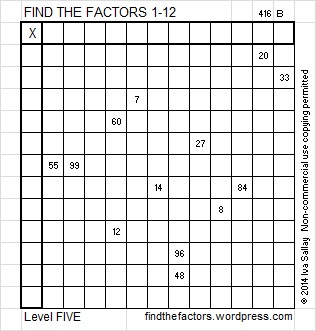
Now for today’s puzzle. . .100 isn’t one of its clues, but can you find the one and only place where 100 belongs in this mixed up multiplication table?

2014-16 Level 5

This week’s puzzles and last week’s solutions: 12 Factors 2014-04-21

I hope you fully enjoy the 100th day of school!

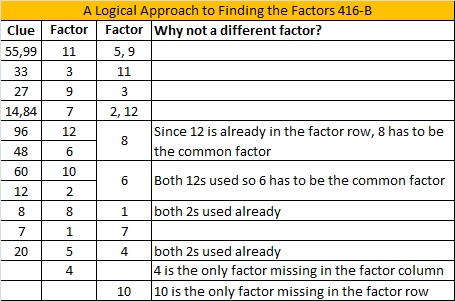
2014-16 Level 5 Logic