Countdown to 2023:
The last 10 seconds of the year, we like to countdown from 10 to the new year. I like a mathematical way of counting down so I try to make an equation with the numbers from 10 to 1 that equals the coming year. This year I could have based my countdown on last year’s countdown and said
(10-9+8×7×6)(5-4)(3)(2)+1 = 2023,
but this is a blog about factoring so I want a countdown that takes you to the prime factors of 2023 first. Here’s my countdown: (Note: Even though I used 1 as a factor twice in the countdown, I am very much aware that 1 is not a prime factor of any number.)


A Puzzle for 2023:
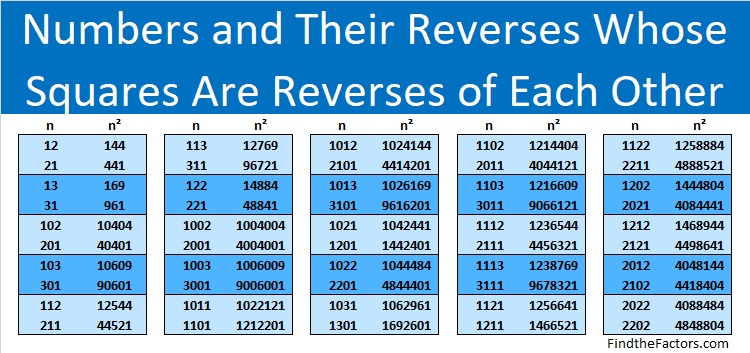
2023 has something in common with 2022. When either number and their reverses are squared, something interesting happens…it’s almost like looking in a mirror!

Only 50 numbers less than 10000 can make a similar claim to fame:
Factors of 2023:
- 2023 is a composite number.
- Prime factorization: 2023 = 7 × 17 × 17, which can be written 2023 = 7 × 17².
- 2023 has at least one exponent greater than 1 in its prime factorization so √2023 can be simplified. Taking the factor pair from the factor pair table below with the largest square number factor, we get √2023 = (√289)(√7) = 17√7.
- The exponents in the prime factorization are 1 and 2. Adding one to each exponent and multiplying we get (1 + 1)(2 + 1) = 2 × 3 = 6. Therefore 2023 has exactly 6 factors.
- The factors of 2023 are outlined with their factor pair partners in the graphic below.

More About the Number 2023:
What do 2023 tiny squares look like?

2023 is the sum of consecutive numbers in five different ways:

And it is the sum of consecutive odd numbers in two ways:

2023 is a palindrome in base 16 because
7(16²) + 14(16) + 7(1) = 2023.
This tweet demonstrates that the prime factors of 2023 have a relationship with the digits of 2023.
2023 is the only number that is equal to the sum of its digits multiplied by the square of the sum of the squares of its digits, where the sum of its digits and the sum of the squares of its digits are also its prime factors.#HappyNewYear#HappyNewYear2023 pic.twitter.com/fHnd6nEQhp
— Maths Ed (@MathsEdIdeas) December 27, 2022
I saw this tweet on Twitter and immediately recognized something else cool about 2023.
What a lucky #year2023 ! – at least according to #maths 🙂 Join our #NewYear party, share your ideas on how to #MATH -ise 2023: 🔴 https://t.co/PR8TdG1ZD3 pic.twitter.com/aNRBf6aBpl
— Vitaliy Kaurov (@superflow) December 27, 2022
That might seem like a lot of mathematical mumble jumble, but with a little bit of explanation, it can be understood. And even though I made the problem look scarier because I substituted 2+0+2+3 for 7, some older elementary students who already understand powers, factorials, and/or remainders, will get it. I’m confident you can too.

You could also give the following list of facts to older elementary students and ask them to use it to find the remainder when they divide 823,543 by 5040.
1×5040 = 5040
2×5040 = 10080
3×5040 = 15120
4×5040 = 20160
5×5040 = 25200
6×5040 = 30240
7×5040 = 35280
8×5040 = 40320
9×5040 = 45360
Because its factors, 17 and 289, are hypotenuses of Pythagorean triples, 2023 is also the hypotenuse of some Pythagorean triples:
952-1785-2023 which is 119(8-15-17) , and
1127-1680-2023 which is 7(161-240-289).
Ureczky József also pointed out in the comments of this post, that 2023 is the short leg in SIX Pythagorean triples, and thus
2023² = 2046265² – 2046264²
2023²= 292327² – 292320²
2023² = 120377² – 120360²
2023² = 17255² – 17136²
2023² = 41785² – 41736²
2023² = 7225² – 6936²
One of those triples is a primitive triple. Can you determine which one?
Ureczky József shared one more amazing fact in the comments that I’m replicating here:
2023=9³+8³+7³+6³+5³+4³+3³+2³-1³
More Mathematical Tweets About 2023:
These tweets are more or less in the order I saw them, not in order of mathematical difficulty. I will add more as I see them.
2023 is coming up so here’s a fun math fact about that number:
It only has one hole in it so it’s going to look ridiculous if you make New Year’s glasses out of it.
— Howie Hua (@howie_hua) December 19, 2022
Decided to use my 3D printer to figure out how the hell we’re doing this. pic.twitter.com/A48kq1pxUv
— Jesse McLaren (@McJesse) December 27, 2022
#simplify pic.twitter.com/ejgxg5VyVd
— SKG (@sonukg4india) October 10, 2022
For calculus teachers looking for a math-dorky integral problem for when school restarts in January, revise this problem to find the location of the vertical line for the function y = x^2022. The two areas will be equal at x=2022/2023 !
— Chris Harrow (@chris_harrow) December 23, 2022
GERMAN
MATH OLYMPIAD
Which one is the largest? pic.twitter.com/1FVgasG8n9— KHALID (@KH2020H0) December 27, 2022
A harshad number in a given number base is an integer that is divisible by the sum of its digits when written in that base.
2022 and 2023 are both harshad numbers
[read more: https://t.co/8KIOul135X] pic.twitter.com/HkJr8pbKC2
— Massimo (@Rainmaker1973) December 26, 2022
(2+0+2+3)²⁺⁰⁺²⁺³
≡ 2023 mod (2+0+2+3)!Or to put it another way, the remainder of (2+0+2+3)²⁺⁰⁺²⁺³ ÷ (2+0+2+3)! is 2023.#HappyNewYear #HappyNewYear2023 pic.twitter.com/HskVDVYLAS
— Maths Ed (@MathsEdIdeas) December 29, 2022
2023 is the first year in the Gregorian calendar that starts and ends on a Sunday that is also a lucky number* and a multiple of the sum of its digits.#HappyNewYear #HappyNewYear2023
*https://t.co/ojrAogpbXz pic.twitter.com/BHxbKD3jQt
— Maths Ed (@MathsEdIdeas) December 28, 2022
Math up your countdown to 2023
= ((10+9)×(8+7)÷(6-5)+4)×(3×2+1)
= (10+(9×(8−(7−6×5))))×(4×3÷2+1)
= (10+(9×(((8−(7−6))×5)−4)))×(3×2+1)
= (10+9)×(8+7+6)×5+4!+3+2−1
= 10×(9+8×7−6+5!+4!)−3×2−1
= 10×9×8×7÷6÷5×4×3+(2+1)!+0!#HappyNewYear#HappyNewYear2023 pic.twitter.com/zta6RRZh9r— Maths Ed (@MathsEdIdeas) December 30, 2022
Here’s a Sudoku I made for 2023 with clues using only the numbers 2,3, and 23. The solution, a PDF version, and an easier version of the puzzle with more clues can all be found at: https://t.co/e1Qt5e7xwS#math #Puzzle #mtbos #sudoku #Maths #puzzles pic.twitter.com/o6M0laX4qZ
— David Nacin (@quadratablog) December 30, 2022
2023 is the sum of the reverse of 3 consecutive primes (931+941+151), has consecutive pairs of digits that each sum to a prime (2+0, 0+2, 2+3), and prime factors that concatenate to make a palindrome (2023 = 7×17×17 → 7||17||17 = 71717).#HappyNewYear#HappyNewYear2023
— Maths Ed (@MathsEdIdeas) December 30, 2022
Here’s a post about a miraculous property of 2023, my search for other similar numbers, and why #ChatGPT doesn’t yet pose a problem for maths teachers. #HappyNewYear2023 #Maths https://t.co/174iix2TNO pic.twitter.com/W5aunm8dAN
— Owen Elton (@owenelton) December 30, 2022
Love ‘2023 selfie fractions’ https://t.co/oTxBOYTeVj https://t.co/VUOP4SLQM8 pic.twitter.com/mCJIwr4m2h
— SteveLoMMXXII (@MaxTheMaths) December 30, 2022
Here’s the easier version of my 2023 New Year’s Sudoku. The solution, a PDF version, and the harder version of the puzzle can all be found at: https://t.co/e1Qt5e7xwS#math #Puzzle #mtbos #sudoku #Maths #puzzles pic.twitter.com/azp81osOjA
— David Nacin (@quadratablog) December 30, 2022
Sierpiński Hashed 17^2 x 7#workinprogress
🖼️ A sneak peek of my next project named “The Power of a Triangle”.
🎨 Oil on four out of 17×7 canvases connected as a whole, to be displayed 17 times in 2023. #artwork 🎨 #geometry 📐 #oiloncanvas pic.twitter.com/YvuJtJGpMQ
— Ana Nives Radovic (@ananives) December 29, 2022
2023 Maze New Year’s Eve is in just a couple days! Download this free puzzle for your kids by clicking on the picture above. It will take you to Google Drive. The file is a PDF. The first… – https://t.co/KeP0SGZYIC #EddiesGames #Games pic.twitter.com/OsRok6WcAo
— Eddie’s Games (@DeniceTamila) December 30, 2022
Aww what?! This is super cool and now I have free licence to nerd out about triominoes in 2023 🤓💗 https://t.co/qp9AOIYeuJ
— Ayliean (@Ayliean) December 30, 2022
https://t.co/zp5HMgArRY pic.twitter.com/OhWUV4ecaF
— Olivier Longuet (@OLonguet) December 28, 2022
Free Creativity Challenges for the New Year: https://t.co/a9jKx3hvu9#elementaryteacher #stemteacher pic.twitter.com/CXpSRtMGN7
— Carly And Adam (@carlyandadam) December 30, 2022
Problem #17. The year 2023 is just around the corner! #Algebra @JustinTrudeau @dgvincent @CouncillorWard5 pic.twitter.com/Mo2M80Iz0k
— 🇨🇦 Virtual Math Tutor (@vmathtutor) December 30, 2022
A nice thing about 2023 is that it may look like a prime number, but it is not. A nicer thing is that 4 years later we get a prime number for a whole year. And as a bonus it is a twin prime, so we just have to endure 2028 to reach its twin 2029
— Shantanu Pathak (@shantanupathak_) December 29, 2022
The number 2023 is 17*7*17
17 is special because it’s the only prime number which is the sum of four consecutive primes. You probably know why 7 is.
There are many other reasons why these numbers are special.
Thank you. You’re welcome.— Heritage Olayinka ⠕ (@XpertHeritage) December 17, 2022
2023 is gonna be unique because 23 is a prime number
— ً (@JoshuaValenzo) November 11, 2022
2011=Prime Number(P.N.)
2012=2×2×503
2013=3×11×61
2014=2×19×53
2015=5×13×31
2016=2×2×2×2×2×7×9
2017=P.N.
2018=2×1009
2019=3×673
2020=2×2×5×101
2021=43×47
2022=2×3×337
2023=7×17×17
2024=2×2×2×11×23
2025=45×45
2026=2×10¹³
2027=P.N.
2028=2×2×3×13×13
2029=P.N.
2030=2×5×7×29— ÉTR (@LIFE_VAGRANT411) January 2, 2022
Además del ya presentado (9+8)×7×(8+9), 2023 equivale a muchos palíndromos. Estos son los más simples:
2023=181+1661+181
2023=999+5×5+999
2023=2×8+1991+8×2
2023=8×8×8+999+8×8×8
2023=9×9×9+565+9×9×9— Antonio Roldán (@Connumeros) December 30, 2022
2023 is coming up so I thought I’d share a fun math fact about that number:
2023=2022+1
— Howie Hua (@howie_hua) December 30, 2022
#Haftasonu #cuma #yeniyıl #2023 #matematik #geometri
2023’e son bir gün.
👋🙂https://t.co/x0RIdywejZ pic.twitter.com/74d1jHFu0l— Pratik Matematik (@besdakikadamat1) December 30, 2022
To make the number 2023 just write the numerals 2, 0, 2 and 3, in that order: 2‖0‖2‖3 = 2023,
where p‖q = p×10^(⌊log₁₀q⌋+1)+q
— see https://t.co/4LKfzc7TXp.#HappyNewYear #HappyNewYear2023 pic.twitter.com/cmPrsOjbw6— Maths Ed (@MathsEdIdeas) December 30, 2022
See more at: https://t.co/3lyVOyzN3D
or https://t.co/akWMXKB2nD— INDER J. TANEJA (@IJTANEJA) December 30, 2022
Que tengas un año 2023 de mucha FE.
F = 2 +0 +2 +3 = 7
E = 2² +0² +2² + 3² = 17F×E×E = 7×17×17 = 2023
FE² = 2023#Maths #Fe— Lalo (@Educanul) December 31, 2022
ZERO👽‘23
2023°+10×09×08×07×06×05×04×03×02×01×00→2023°
— maco (@maco05636886) December 31, 2022
Traditionally, my last puzzle of the year. 🥂 🧩 ♥️ #HappyNewYear2023 #mathiratti pic.twitter.com/FiokYOMYUo
— Diego Rattaggi 🇨🇭 (@diegorattaggi) December 31, 2022
Statistically, entering a new year. Happy new year -2023 wishes to all. #Mathematics #math #Maths #HappyNewYear #HappyNewYear2023 pic.twitter.com/7giuN102Iq
— Srinivasa Raghava ζ(1/2 + i σₙ )=0 (@SrinivasR1729) December 31, 2022
2023 = (2+0+2+3)(2²+0²+2²+3²)²
— Gregorio Morales (@gremor) December 31, 2022
Happy New Year 7×17×17!
🎆 🎇 🎆 🎇 🎆 🎇 pic.twitter.com/ZqBli3dqZi— Mathigon (@MathigonOrg) December 31, 2022
Happy Cube Year Everyone! 🥳
2️0️2️3️Just two more years and we have a beautiful sum of cubes.#HappyNewYear2023 pic.twitter.com/ObzUXhWKSh
— Tamás Görbe (@TamasGorbe) December 31, 2022
Correction: Thanks to @SirmaRoca mentioning there’re more, I did find three more using algebra and then I used wolfram to verify:
(9 solutions in total)
(2023,17136,17255)
(2023,41736,41785)
(2023,120360,120377)
(2023,292320,292327)
(2023,2046264,2046265)https://t.co/GuKoKJ5K1m— 10. Soru (@OnuncuSoru) December 31, 2022
Ring in the new year with a brand-new puzzle by yours truly.
Check out my 2023 Puzzle! https://t.co/eR4p87wHfc #mtbos #iteachmath #puzzlingclassroom pic.twitter.com/OqhQBptIyj
— Sarah Carter (@mathequalslove) December 31, 2022
2023 en base 10 se factoriza como 7·17² y en base 16 se escribe 7E7. pic.twitter.com/uIJ8jBGruP
— fun with functions (@funfunfunctions) December 31, 2022
23 en base 7 se escribe 32.
Ocurre con 23 y 2023 que si a cada uno le sumamos el número resultante de invertir el orden de sus cifras obtenemos sendos palíndromos. pic.twitter.com/GWnamvmRjD
— fun with functions (@funfunfunctions) December 31, 2022
New TikTok video: Is 2023 perfect, abundant, or deficient? pic.twitter.com/ValwbRfcT6
— Howie Hua (@howie_hua) December 31, 2022
¡Feliz Año Nuevo!
Happy New Year!
(2 + 0 + 2 + 3) × (2² + 0² + 2² + 3²)² = 2023— Ignacio Larrosa Cañestro (@ilarrosac) December 31, 2022
Happy (depending where you live) Fibonacci Year! 1/1/23 https://t.co/UPZQQsvPao
— Sara VanDerWerf (@saravdwerf) December 31, 2022
𝗛𝗮𝗽𝗽𝘆 𝗛𝗮𝗿𝘀𝗵𝗮𝗱 𝗬𝗲𝗮𝗿! pic.twitter.com/xoHNk8ZjFf
— Angel Manuel Ramos del Olmo (@AMRamosDelOlmo) December 31, 2022
#2023yeniyıl #NewYear2023 pic.twitter.com/hhXJgOfVij
— Ceyhun Köylüce (@MathCeyhun) December 31, 2022
– Buenas. ¿Cómo ve usted el 2023?
– Pues lo veo como un prisma cuadrangular de lado 17 y altura 7.
2023=17²•7
Y así es la cosa de las Matemáticas.¡Feliz año! 🎉🥳 pic.twitter.com/Cd7flFGQVp
— Alejandro Gallardo ۞ (@alegallardo28) December 31, 2022
1/1/23 Happy #FibonacciDay
Knock.
Knock.
Knock knock.
Knock knock knock.
Knock knock knock knock knock.
Who’s there?
Fibonacci.#HappyNewYear #HappyNewYear2023 pic.twitter.com/5E2E7UefRh— Maths Ed (@MathsEdIdeas) January 1, 2023
The decimal representation of 1/2023 has period 816. pic.twitter.com/7yxWxv3jLP
— Algebra Etc. (@AlgebraFact) December 31, 2022
¡Feliz 2023! 🍾🥂https://t.co/jv1ocUrjtY#Nochevieja #FelizAnoNuevo #nochevieja2023 #Feliz2023 #FelizAnoNuevo2023 pic.twitter.com/W0BNRDxHA8
— Amadeo Artacho (Matematicascercanas) (@matescercanas) December 31, 2022
Fibonacci New Year tomorrow 🙂
✨Best wishes to you all✨ pic.twitter.com/zuDZviHTnp— Em Bell (@El_Timbre) December 31, 2022
Everyone ready for a few weeks of this? pic.twitter.com/i3eCXk10jd
— Sarah Farrell (@SarahFarrellKS2) December 31, 2022
Happy new year wishes to all my friends and well-wishers.
Expressing the New year number 2022 in terms of the factorials of numbers 1 to 9. #math #Maths #HappyNewYear2023 #NewYear #NewYear2023 pic.twitter.com/A81CUqvrdP— Srinivasa Raghava ζ(1/2 + i σₙ )=0 (@SrinivasR1729) December 31, 2022
For the new year with new numbers.
Have an amazing year ahead. #math #Maths #NewYear #NewYear2023 pic.twitter.com/WFWsZ5cAVz— Srinivasa Raghava ζ(1/2 + i σₙ )=0 (@SrinivasR1729) January 1, 2023
Happy new year! #alphametic #복면산 pic.twitter.com/ExMFyJ7sWz
— Poo-Sung Park (@puzzlist) January 1, 2023
Here’s a special countdown for 2023. Happy New Year 🎉 pic.twitter.com/C6owisMsOZ
— Fermat’s Library (@fermatslibrary) December 31, 2022
The number 2023 may seem rather undistinguished, but its prime decomposition is interesting. It contains three (lucky) 7s and two 1s: 7*17*17, which of course portends ……….. nothing. In any case, Happy 2023!
— John Allen Paulos (@JohnAllenPaulos) December 31, 2022
Feliz año nuevo para todos pic.twitter.com/uhRBeMSkBB
— Sarah Ilych👉🇷🇺❤️🔥👉🇲🇽❤️ TASS (@Sarah83336937) January 1, 2023
— vivekanand mandal (@vivekanandman16) December 31, 2022
Let G be a group of order 2023 = 7*17².
By Sylow, there are unique subgroups A, B ≤ G such that |A| = 7 and |B| = 17². These subgroups are normal and intersect trivially, so AB ≅ A×B and |AB| = |A||B| = |G|, and thus G ≅ A×B.
— Ben Spitz (@DiracDeltaFunk) December 31, 2022
— Problemes de matemàtiques (@rmtnezcalafat) January 1, 2023
Happy New Year!
The number 2023 depicted as a collection of 2023 hexagons, part of an ongoing series of artworks expressing the positive integers as a geometric arrangement of identical simple visual elements. #HappyNewYear2023 #HappyNewYear #mathart #unitchat pic.twitter.com/p4jX6kjKN0— David A. Reimann (@drMathArt) January 1, 2023
3²+13²+15²+17²+19²+21²+23² = 𝟮𝟬𝟮𝟯
Quines altres maneres maques teniu per aconseguir el 2023? Bon any!!!
— eXplorium (@e_x_plorium) December 31, 2022
The 2023 Year Game is live on the NCTM website, with printable worksheets and cut-out manipulative tiles for brainstorming. A great way to get kids thinking creatively about number relationships! https://t.co/ihaSdqjwHt #mtbos #homeschooling #iteachmath #mathgames
— Denise Gaskins (@letsplaymath) January 2, 2023
Zum Datum 01.01.2023
(0!+1!+0!+1!)!=(2!+0!)⋅2³#nurso
— Hansruedi Widmer (@HansruediWidmer) January 1, 2023
Pour tous ceux qui cherchent encore : bonne année 2023 🎉🍾🥂 pic.twitter.com/zSjw2NKzxp
— Manu Houdart – Very Math Trip (@ManuHoudart) December 31, 2022
2023 as a palindromic, ambigrammatic, strobogrammatic, vertically and horizontally symmetric, ʇuoɹɟ oʇ ʞɔɐq puɐ spɹɐʍʞɔɐq uʍop ǝpᴉsdn expression.#HappyNewYear #HappyNewYear2023 pic.twitter.com/eEWv2BCAom
— Maths Ed (@MathsEdIdeas) January 1, 2023
v
I started this a few days ago and it’s going pretty well! Tried to keep the numbers 2023 in order for as long as I could. If anyone has found solutions for 53, 78, 83, 85, 89, 91, 92, 93, and 95, I’d love to see them. I’m currently stuck on those! https://t.co/GnlNDdcrYX pic.twitter.com/arOwkxgmZT
— Leah Simon (@SimonSaysMath) January 2, 2023
last year was complex, but it’ll all be different this year
inspired by @howie_hua pic.twitter.com/q07iPLT6N7
— Tamás Görbe (@TamasGorbe) January 2, 2023
It’s mental math Monday. The answer is 2023. What’s the question? pic.twitter.com/LV97X9ar0P
— Howie Hua (@howie_hua) January 2, 2023
The imaginary part of the argument of the Riemann Zeta function on the critical line between 1538-th and 1539-th zero is 2023. #NewYear #NewYear2023
— Srinivasa Raghava ζ(1/2 + i σₙ )=0 (@SrinivasR1729) January 2, 2023
Using the digits 2 0 2 3, once each and in that order, create expressions which equal 0 – 10.
I’ll get us started with 0 and 1. Feel free to submit your own expressions! #playwithmath #MTBoS #iteachmath #HappyNewYear2023 🥳 pic.twitter.com/YCgDjZhejT
— Mark Kaercher (@shskaercher) January 1, 2023
Those trying to solve Problem #19, feel free to review the Story of Gauss (hint, hint 😀): https://t.co/hIKCUnLDDf#Algebra https://t.co/cbzV6UlwVR
— 🇨🇦 Virtual Math Tutor (@vmathtutor) January 2, 2023
Pour tous ceux qui veulent exploiter les calculs de l’affiche 2023 ou simplement voir les réponses, @CoopMaths_fr l’a fait pour vous. Dans les paramètres, vous n’avez qu’à choisir la (ou les) question(s) qui vous intéressent parmi les 28 proposées. https://t.co/zuYv8uIw1n pic.twitter.com/LRqcmrGScv
— Eric Elter (@ElterEric) January 2, 2023
Happy New Year, #MathClub! If you’re like us, you’re probably wondering if 2023 is prime. Let’s check if it’s divisible by seven (“dbs”). 2023 is dbs iff 202 – (3 + 3) = 196 is. In turn, 196 is dbs iff 19 – (6 + 6) = 7 is. So 2023 is not prime, but 7 is a pretty lucky factor!
— The Math Club Podcast (@MathClubPodcast) January 2, 2023
Y unos sencillos palíndromos para finalizar:
2123=66+1991+66
2123=121+1881+121
2123=9×7×9+989+9×7×9
2123=939+7×5×7+939
2123=949+5×9×5+949— Antonio Roldán (@Connumeros) January 2, 2023
2023 = 7¹ × 17²
Interesting combination of primes, that.
— Mr Burns (@MrMetacognition) January 1, 2023
2123 se forma con una escala “baja y sube” de cifras:
2123=9×(8+7+6+5+4!)×(3+2)-1×(2+3)×4-5-6-7-89
— Antonio Roldán (@Connumeros) January 2, 2023
Este año encontraremos más números primos y casi ningún oblongo. El de hoy, 2123, es semiprimo y suma de semiprimos consecutivos:
2123=11×193=341+346+355+358+361+362 =11×31+2×173+5×71+2×179+19×19+2×181
— Antonio Roldán (@Connumeros) January 2, 2023
Mes bons vœux sous forme d’une affiche dans sa version 2, sans les deux coquilles (que vous avez tous trouvées😉) et agrémentée de deux nouvelles figures. C’est bien celle à imprimer pour @claire_lomme, @MD37000, @jojo921000 et tous ceux qui veulent. #BeautéMathématique #HNY2023 pic.twitter.com/VAcBa9TWWw
— Eric Elter (@ElterEric) January 2, 2023
Me gusta esta suma de cuadrados con bases en progresión de diferencia 20:
2123=1^2+21^2+41^2
— Antonio Roldán (@Connumeros) January 2, 2023
Hoy contamos con varias diferencias de potencias enteras:
2123=102^2-91^2=3^7-8^2=3^7-4^3=3^7-2^6
— Antonio Roldán (@Connumeros) January 2, 2023
Bit of math magic by Paul Levrie 🙂
Happy New Year! pic.twitter.com/rQxN9ugUsX
— Lieven Scheire (@lievenscheire) January 2, 2023
💫Feliz (2+0+2+3)(2²+0²+2²+3²)² = 2023💫
— Inst. de Cc. Matemáticas (@_ICMAT) January 2, 2023
2023 obtenido operando con sus propias cifras.https://t.co/dihRtvkS79#FelizAnoNuevo #Feliz2023 #2023NewYear #matematicas pic.twitter.com/4OwS5TNj9F
— Amadeo Artacho (Matematicascercanas) (@matescercanas) January 2, 2023
@MathClubPodcast
A test for ÷ by 7:
Split number in groups of 2 digits from the right, 1st group is x1, 2nd x2, 3rd x4 etc. 2023 becomes 20×2+23×1 = 63 & since 63 =9×7, 2023 is ÷7 too.
Note: this is based on 100/7 = 14 R 2 so 2 = multiplier base & 100 is 10^2 giving groups of 2— Fred G. Harwood (@HarMath) January 2, 2023
Que tengáis un feliz año nuevo!!! Os deseamos que cada uno de los trimestres de 2⃣0⃣2⃣3⃣ os sume y aporte algo nuevo.
🎉🍾🥳¡¡¡¡¡FELIZ 1711+276+36!!!!!🥳🍾🎉#FelizAñoNuevo #Feliz2023 #Matematicas #Gauss #NumerosTriangulares pic.twitter.com/JuX0MDj2Ij
— Diagonalizando (@diagonalizando) January 1, 2023
Todos los años son especiales, pero este 2023 no solo es que sea único, sino que tiene un vínculo precioso con el número 7, que es el número que más gusta en todo el mundo 🎄
2️⃣0️⃣2️⃣3️⃣💗7️⃣#felizañonuevo #felizaño2023 pic.twitter.com/7yqeaH4OYx— Santi Gª Cremades ² (@SantiGarciaCC) January 1, 2023
Bonne année mathématique !
(2+0+2+3)×(2²+0²+2²+3²)²#BonneAnnée2023— Vincent Pantaloni (@VPantaloni) January 1, 2023
2023 = 286 + 287 + 288 + 289 + 290 + 291 + 292
2023 = 111 + 112 + 113 + 114 + 115 + 116 + 117 + 118 + 119 + 120 + 121 + 122 + 123 + 124 + 125 + 126 + 127
— Diagonalizando (@diagonalizando) January 2, 2023
Happy New Year everyone! I’ll only do this for a few weeks. Probably. pic.twitter.com/Z2T41zlqXt
— Rob Sedgebeer – @robsedgebeer@mas.to (@robsedgebeer) January 1, 2023
Solve this equation:
x¹⁰ + x⁹ + x⁸ + x⁷ + x⁶ + x⁵ + x² + x + 1 = 2023#Math #Maths #NewYear2023— Srinivasa Raghava ζ(1/2 + i σₙ )=0 (@SrinivasR1729) January 3, 2023
Fun Facts about 2023, collected by @mathtourist. https://t.co/yq2F63q3XL #mtbos #iteachmath #homeschoolmath
— Denise Gaskins (@letsplaymath) January 3, 2023
1726 Find the Factors 1-12 AND 13-24 https://t.co/te79HNcgKY
— Iva Sallay (@findthefactors) January 5, 2023
Can you CRACK this? pic.twitter.com/9v5w1xkPFH
— KHALID (@KH2020H0) January 15, 2023


