28 and Level 5 Snowflake

28 is a composite number. 28 = 1 x 28, 2 x 14, or 4 x 7. Factors of 28: 1, 2, 4, 7, 14, 28. Prime factorization: 28 = 2 x 2 x 7, which can also be written 28 = 2² x 7.

When 28 is a clue in the FIND THE FACTORS puzzles, the factors will be 4 and 7.

2014-01-13.5

This snowflake is actually a logic puzzle based on the multiplication table. Because it is a level 5 puzzle, it can be a little tricky to solve, and isn’t for beginners. If you haven’t solved a Find the Factors puzzle before, this level 2 snowflake puzzle might be a better choice:
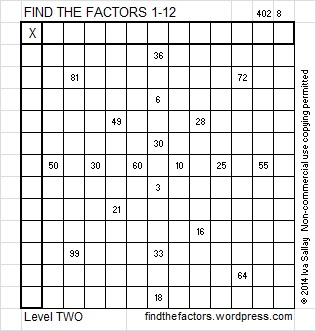
2014-01-13.2

How do you solve a level 5 FIND THE FACTORS 1 – 12 puzzle? As always the object is to write the numbers 1-12 in the top row and again in the first column so that those numbers are the factors of the given clues. Use logic, not guessing and checking, to find its unique solution. Here is how to solve a level 5 puzzle:

Begin by looking for perfect square clues, 1, 25, 49, 64, 81, 100, 121, or 144, because there is only one way to factor any of them so that both factors are numbers from 1 to 12. IF you find one of THOSE perfect square clues, write down its factors in the corresponding factor row and factor column.

Next locate a row or a column with at least 2 clues. Find ALL the common factors of that row or column that will allow you to write only numbers from 1 to 12 in both the factor row and the factor column. If that row or column has more than one common factor, leave it alone for now. In a level 5 puzzle there will be at least one row or column that has only one common factor. When you find such a row or column, write its factors in the corresponding factor cells.

Let’s use the level 5 puzzle from wk 1 – 2014 as an example. Starting at the top of the puzzle look at all each row to see if it has more than one clue. We notice that there are two rows with 2 clues, but in both cases, there is more than one possible common factor, so we will ignore those rows for now. Starting on the left, look at each column to see if it has more than one clue. There are 2 columns that have 2 clues, and one of those columns has 3 possible common factors. If you were to guess which of those factors were correct, you would have a 67% chance of guessing wrong. Guessing and checking leads to frustration. Use logic and start with the column that has only one possible common factor, in this case: 1.

2014-01 Level 5 1st step

Now you have at least 3 factors written down. Next look at ALL the remaining clues in the puzzle and find one that can only be factored using one of the factors you’ve written down already but haven’t used twice. (You notice that 54 = 9 x 6, so you can write 9 and 6 in the appropriate cells.)

Sometime during this process, you will discover that one or more of the remaining rows or columns that had more than one clue have had some of the possible factors eliminated. Logic, or the process of elimination, will help you know the only common factor that will work for those clues in this puzzle. (In last week’s puzzle, you may notice that 28 = 4 x 7. That means that 16 cannot be 4 x 4 because we can’t have any factor used more than one time in either the factor row or the factor column. That means in this particular puzzle 16 = 8 x 2. Since you already found one 8, it is easy to place this 8 and the 2.)

Continue to look at all the clues and use logic until all (or almost all) of the factors are found.

If a row or a column contains no clues, use logic is determine which number from 1 to 12 (or 1 to 10) should be written there.

While working on these puzzles, occasionally count from 1 to 12 (1 to 10) as you examine numbers in the factor row and factor column to make sure that a number is written only once in either place. Good luck!

This week’s puzzles are also available in an excel file here, if you have a spreadsheet program on your computer you can access it. If you enable editing in excel, you can type your answers directly onto the puzzle, and you can also easily print the puzzles. Here is the solution to the Week 1 – 2014, Level 5 puzzle:

2014-01 Level 5 Answer

26 and Level 4

26 is a composite number. 26 = 1 x 26 or 2 x 13. Factors of 26: 1, 2, 13, 26. Prime factorization: 26 = 2 x 13.

26 is never a clue in the FIND THE FACTORS 1-10 or 1-12 puzzles.

2014-01-13.4

Write the numbers 1-12 in the top row and again in the first column so that those numbers are the factors of the given clues. Use logic, not guessing and checking, to find its unique solution. Here is how to solve this level 4 “snow shovel” puzzle:

Begin by looking for perfect square clues, 1, 25, 49, 64, 81, 100, 121, or 144 because there is only one way to factor any of them so that both factors are numbers from 1 to 12. If you find one of those perfect square clues, write down its factors in the corresponding factor row and factor column.

Next locate a row or a column with at least 2 clues. Find the common factor of that row or column that will allow you to write only numbers from 1 to 12 in both the factor row and the factor column. If there is more than one row or column with at least 2 clues, repeat the previous step until only rows and columns with one clue remain.

Now you have at least 3 factors written down. Next look at ALL the remaining clues in the puzzle and find one that can only be factored using one of the factors you’ve written down already but haven’t used twice. Repeat the last step until all (or almost all) of the factors are found.

If a row or a column contains no clues, use logic is determine which number from 1 to 12 should be written there.

While working on these puzzles, occasionally count from 1 to 12 to make sure each of those numbers is written exactly once in both the factor row and the factor column. You will notice a rhythm for the answers as you work. Good luck!

This week’s puzzles are also available in an excel file here, if you have a spreadsheet program on your computer. If you enable editing in excel, you can type your answers directly onto the puzzle, and you can also easily print the puzzles.

Here is the solution to the week 1 level 4 puzzle:

2014-01 Level 4 Answer

25 and Level 3

25 is a composite number, and it is 5 squared. 25 = 1 x 25 or 5 x 5. Factors of 25: 1, 5, 25. Prime factorization: 25 = 5 x 5, which can also be written 25 = 5².

Since √25 = 5, a whole number, 25 is a perfect square. 

When 25 is a clue in the FIND THE FACTORS puzzles, write 5 in both the corresponding factor row and the factor column.

2014-02 Level 3

Write the numbers 1-12 in the top row and again in the first column so that those numbers are the factors of the given clues. Use logic, not guessing and checking, to find its unique solution. Level 3 puzzles are designed to be solved starting from a row at the top of the puzzle with 2 clues. First find the common factor of those two clues that will allow you to write only numbers from 1 to 12 in the factor row at the top of the puzzle. Then factor row by row to the bottom of the puzzle making sure each number from 1 to 12 is written only once in both the factor row and the factor column. You will notice a rhythm for the answers as you work. Good luck!

This week’s puzzles are also available in an excel file here if you have a spreadsheet program on your computer. If you enable editing in excel, you can type your answers directly onto the puzzle, and you can also easily print the puzzles.

Here is the solution to last week’s level 3 puzzle:

2014-01 Level 3 Answer

16 Silver Bells

16 is a composite number, and it is 4 squared. 16 = 1 x 16, 2 x 8, or 4 x 4. Factors of 16: 1, 2, 4, 8, 16. Prime factorization: 16 = 2 x 2 x 2 x 2, which can also be written 16 = 2⁴.

Since √16 = 4, a whole number, 16 is a perfect square.

When 16 is a clue in the FIND THE FACTORS puzzles, use either 2 x 8 or 4 x 4. Only one of those sets of factors will work for any particular puzzle.

“Silver bells, silver bells.
It’s Christmas time in the city.”

2013-12-16.42013-12-16.7

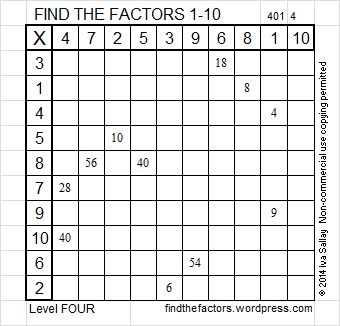
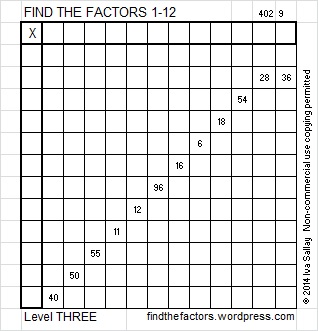
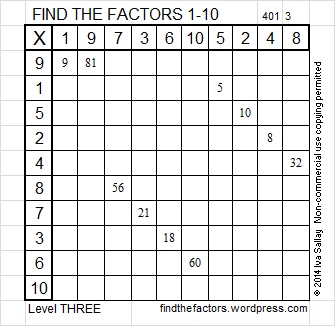
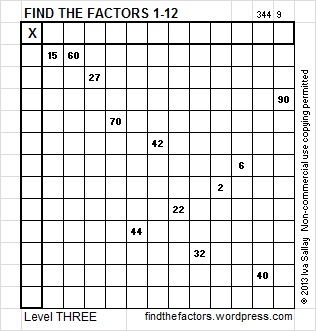
Find the Factors is a type of logic puzzle. To solve one of the above puzzles, place the numbers 1 – 10 in both the top row and in the first column so that those numbers are factors of the given clues. For each puzzle, there is only one solution. Click on 10 Factors 2013-12-16 to find these and a few more puzzles, as well as last Monday’s solutions.

Some of these Related articles have the lyrics or soundtrack to Silver Bells:

4 Rhyme and Rhythm

4  is the first composite number, and it is 2 squared. 4 = 1 x 4 or 2 x 2. Factors of 4: 1, 2, 4. Prime factorization: 4 = 2 x 2, which can also be written 4 = 2².

Since √4 = 2, a whole number, 4 is a perfect square.

When 4 is a clue in the FIND THE FACTORS puzzles, the factors might be 1 and 4 or they might be 2 and 2.

—————————————————————–

Seventeen years ago, when my daughter was learning the multiplication facts, I came across a rhyme that taught one fact:

5, 6, 7, 8……….56 is 7 times 8.

Coincidentally,

1, 2, 3, 4……….I know twelve is 3 times 4.

3 x 4 = 12 isn’t as difficult to remember as 7 x 8 = 56. Still I find it fun to notice the relationship between counting to eight and these two multiplication facts. I enjoyed the rhymes mentioned in my 10/31/2013 post, and I have found yet another site with rhymes for learning the multiplication facts. Two rhymes similar to these 12 and 56 counting rhymes were even included!  The site is : http://www.teacherweb.com/NY/Quogue/MrsLevy/MULTIPLICATION-RHYMES.pdf

Some children have no problem memorizing number facts, but for some children, a rhyme makes learning the facts more fun and much easier.  Even though I already know all of the basic multiplication facts, I am going to memorize these rhymes simply because I personally enjoy them.  I also know I will have at least one opportunity every week to share them with someone trying to memorize the facts: Already when a student asks me, “what’s 7 x 8?” I always answer in rhyme.

Besides the two rhymes listed above, my favorites are:

Times One: Mirror, mirror look and see, it’s the other number, not me.
Times Zero:  Zero is always the hero
Six times six / Magic tricks / Abracadabra / thirty-six
A tree on skates fell on the floor / Three times eight is twenty-four.
A 4 by 4 is a big machine, Iʼm going to get one when Iʼm 16.

This week I even wrote one myself:  Twelve times twelve / Is a dozen dozen / A gross one forty-four / Just ask my cousin.

When a very young child loves a rhyme, he or she will want to hear it over and over again. Mother Goose rhymes have been enriching lives for years. Being able to fully comprehend what the rhyme is about isn’t necessary at first so even preschoolers can be introduced to these rhymes.

Robin Liner writes a blog (crazygoodreaders.wordpress.com) that discusses reading and dyslexia.  On October 5, 2013 , she wrote Rhythm and Rhyme: A Phonological Power Tool.  She wrote, “Rhymes provide subconscious clues.” That means someone is more likely to get an answer right when that answer rhymes with the question. What a fun and powerful way to learn!

Much of what she wrote not only applies to learning to read but also to learning math, science, history, ……. anything.

Twice a week I put 6 new puzzles in an excel file that is attached to this blog. The puzzles can be solved using logic and knowledge of the multiplication table. Here is one of the puzzles I created this week.

2013-11-07

Click on this link, 12 Factors 2013-11-07,  for more puzzles and the previous week’s solutions. How do you solve the puzzles? Place the numbers 1 – 12 in both the top row and the first column so that those numbers are the factors of the given clues.

Update: I like the idea of using rhymes to learn multiplication facts so much that I compiled my own list:

Multiplication Rhymes