50 and Multiples

Multiples and factors are related.

For example, 50 is a multiple of all these numbers: 1, 2, 5, 10, 25, and 50.

And 1, 2, 5, 10, 25, and 50 are all factors of 50.

50 is a composite number. 50 = 1 x 50, 2 x 25, or 5 x 10. Factors of 50: 1, 2, 5, 10, 25, 50. Prime factorization: 50 = 2 x 5 x 5, which can also be written 2 x 5².

The first few multiples of 50 are 50, 100, 150, 200, 250, 300, and so on…

If the difference between factors and multiples is confusing, this poster should help. Thanks to Resourceaholic for mentioning this great resource in one of her posts.

Sometimes 50 is a clue in the FIND THE FACTORS puzzles. Even though it has other factors, we only use 50 = 5 x 10 to fill in the table.

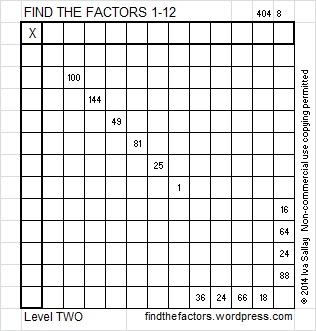
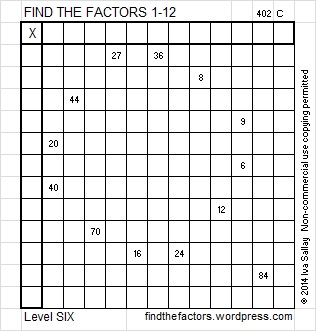
Each of the clues inside this puzzle are MULTIPLES of a number from 1 to 12. Can you write every number from 1 to 12 in the top row as well as in the first column so that the clues are multiples of the numbers that you write?

2014-04 Level 4

This week’s puzzles are available in an excel file here. If you have a spreadsheet program on your computer, you can access it. If you enable editing in excel, you can type your answers directly onto the puzzle, and you can also easily print the puzzles.

Here are the factors to last week’s level 4 puzzle:

2014-03 Level 4 Answer

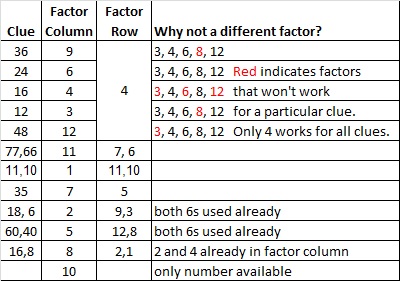
The chart below shows one possible way to arrive logically at the solution.

2014-03 L4 steps

49 and V is for Victory Puzzle

49 is a composite number, and it is 7 squared. 49 = 1 x 49 or 7 x 7. Factors of 49: 1, 7, 49. Prime factorization: 49 = 7 x 7 which can also be written 49 = 7².

Since √49 = 7, a whole number, 49 is a perfect square. 

Whenever 49 is a clue in the FIND THE FACTOR puzzles, write 7 in both the corresponding factor column and factor row.

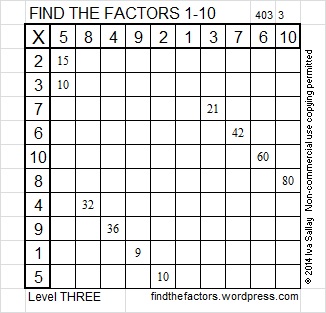
Level 3 is the first level of the higher level FIND THE FACTORS puzzles. For many people going from level 2 to level 4 would be too overwhelming. Level 3 is a bridge between those two levels and allows a person to move on from the lower levels and victoriously solve a little more difficult puzzle. V is for that victory.

Level 3 puzzles are designed to be solved starting from a row or column at the top of the puzzle with 2 clues. First find the common factor of those two clues that will allow you to write only numbers from 1 to 10 in the first column of the puzzle. Then factor row by row to the bottom of the puzzle making sure each number from 1 to 12 is written only once in both the factor row and the factor column. You will notice a rhythm for the answers as you work.

2014-04 Level 3


This week’s puzzles are available in an excel file here. If you have a spreadsheet program on your computer, you can access it. If you enable editing in excel, you can type your answers directly onto the puzzle, and you can also easily print the puzzles. May you be victorious in your efforts!

Here are the factors to last week’s level 3 puzzle:

2014-03 Level 3 Answer


This puzzle was solved starting with the column with 2 clues near the top of the puzzle and then factoring row by row until we reached the bottom of the puzzle.

46 and South East Arrow Puzzle

46 is a composite number. 46 = 1 x 46 or 2 x 23. Factors of 46: 1, 2, 23, 46. Prime factorization: 46 = 2 x 23.

46 is never a clue in the FIND THE FACTORS puzzles.

Wikipedia has a chart of 116 different directional arrow symbols. Each one of them has a name. Today’s puzzle represents the South East Arrow.

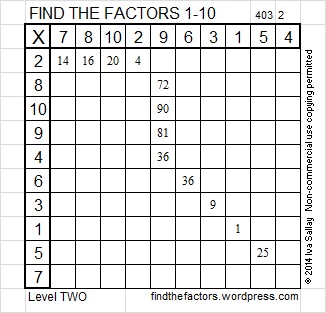
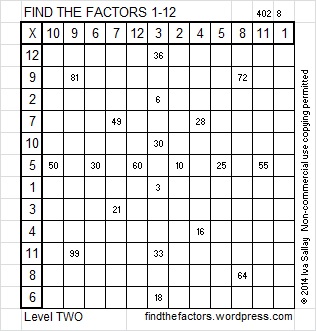
2014-04 Level 2

To solve the puzzle write the numbers 1 -12 in the top row and again in the first column so that the numbers you write and the clues in the puzzle work together to make a multiplication table.

This week’s puzzles are available in an excel file here. If you have a spreadsheet program on your computer, you can access it. If you enable editing in excel, you can type your answers directly onto the puzzle, and you can also easily print the puzzles.

Here are the factors of last week’s hook-shaped level 2 puzzle:

2014-03 Level 2 Answer

45 and A Change in Order

45 is a composite number. 45 = 1 x 45, 3 x 15, or 5 x 9. Factors of 45: 1, 3, 5, 9, 15, 45. Prime factorization: 45 = 3 x 3 x 5, which can also be written 45 = 3² x 5.

When 45 is a clue in the FIND THE FACTORS puzzles, always use 5 and 9 as the factors.

2014-04 Level 1

When I introduce the FIND THE FACTORS puzzles to elementary school students, I only print copies of level 1 and level 2 puzzles. After students have completed those puzzles, I will demonstrate how a level 3 puzzle is completed.

A few students have downloaded the puzzles at home. One very bright sixth grade student was able to complete a level 6 puzzle with the help of his dad.

Kids can be very determined. They may die several times fighting dragons, but they will eventually find the way to save the princess. They can be just as determined to find the way to write the numbers from 1 to 12 in the top row and the first column to make the puzzle work as a multiplication table, especially when I compare it to winning a computer or video game.

Many students tend to guess and check and will get frustrated unless they are shown how to solve the puzzles logically. Frustration can be the enemy of determination.

This week’s puzzles are available in an excel file here. If you have a spreadsheet program on your computer, you can access it. If you enable editing in excel, you can type your answers directly onto the puzzle, and you can also easily print the puzzles. If you click on the excel file you may notice that I have changed the order of the puzzles on the main page.

puzzle order

If the puzzles are printed on both sides of a sheet of paper, the paper can be cut down the middle. In this way I can print puzzles for an entire classroom using only half as much paper.

I instruct students to treat the sheet of puzzles like a computer game and see what level they can achieve. They know upfront that I will be extremely surprised if any of them find all the factors to all six puzzles. That statement motivates some students while it reduces stress in others. Not all students like solving the puzzles, but it is a joy to observe the ones who do.

front & back sides

Here is solution for last week’s level 1 puzzle:

2014-03 Level 1 Answer


39 and Seriously Hooked on Factoring

39 is a composite number. 39 = 1 x 39 or 3 x 13. Factors of 39: 1, 3, 13, 39. Prime factorization: 39 = 3 x 13.

39 is never a clue in the FIND THE FACTORS 1-10 or 1-12 puzzles.

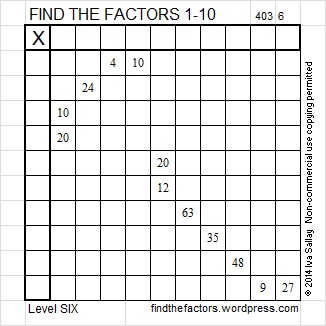
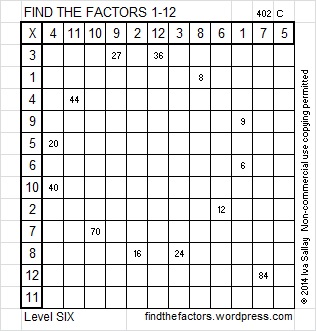
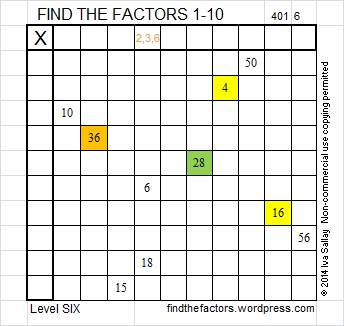
Last Tuesday I published a hook-shaped level 2 puzzle and invited readers to get hooked on factoring. Today I present a level 6 hook-shaped puzzle. Admittedly, one would have to be seriously hooked on factoring to attempt and eventually complete the more difficult level 6 puzzle. I assure you that it can be solved using logic with absolutely no guessing and checking.

2014-03 Level 6

This week’s puzzles are also available in an excel file here. If you have a spreadsheet program on your computer, you can access it. If you enable editing in excel, you can type your answers directly onto the puzzle, and you can also easily print the puzzles.

Here are the factors from last week’s level 6 snowball puzzle:

2014-02 Level 6 Answer

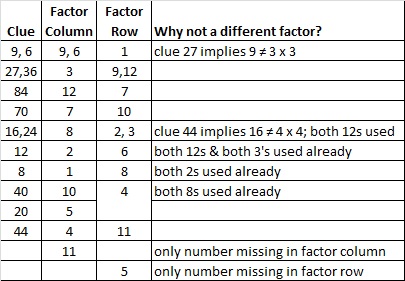
Below is a table showing one possible way to solve the snowball puzzle using logic alone.

2014-02 L6 steps

Seriously, study the clues for this week’s puzzle and see if you can figure out how to solve it using logic alone. Guessing and checking will most likely only frustrate you. Good luck!

36 and The Six Word Challenge

36 is a composite number, and it is 6 squared. 36 = 1 x 36, 2 x 18, 3 x 12, 4 x 9, or 6 x 6. Factors of 36: 1, 2, 3, 4, 6, 9, 12, 18, 36. Prime factorization: 36 = 2 x 2 x 3 x 3, which can also be written 36 = 2² x 3².

Since √36 = 6, a whole number, 36 is a perfect square.

When 36 is a clue in the FIND THE FACTORS  1 – 10 puzzles, use either 4 x 9 or 6 x 6. When 36 is a clue in the FIND THE FACTORS 1 – 12 puzzles, use either 3 x 12, 4 x 9 or 6 x 6. Only one of those combinations will work for any particular puzzle.

I enjoy this multiplication rhyme: Six times six, magic tricks, abracadabra, thirty-six!

A fellow blogger issued a challenge for her readers to write a puzzling story or tell a story about a puzzle using exactly six words. I’m choosing to give puzzle directions today using these six words:

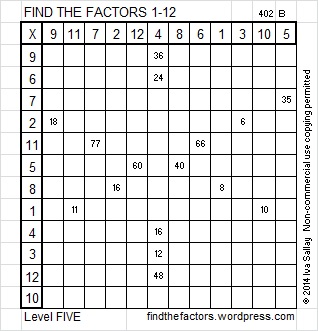
Without guessing, logically decide puzzle’s factors.

2014-03 Level 5

It was a fun challenge. Her blog has a 6-word story written by Ernest Hemingway as well as a few written by other bloggers.

This week’s puzzles are also available in an excel file here. If you have a spreadsheet program on your computer, you can access it. If you enable editing in excel, you can type your answers directly onto the puzzle, and you can also easily print the puzzles.

Here are the factors for last week’s level 5 snowflake puzzle:

2014-02 Level 5 Answer

There was more than one way to logically decide the snowflake puzzle’s factors. Some sets of clues needed to be avoided in the beginning: (18, 6) because both can be factored by 2, 3, and 6; (60, 40) because each can be factored by 5 and 10; and (16, 8) because both can be factored by 2, 4, and 8.

The column with 5 clues was a good place to start the puzzle after we narrowed down the common factor that would work for all the clues. The table below shows a way to find all the factors from 1 to 12 using logic without guessing and checking:

2014-02 L5 steps

Related article:

http://drieskewrites.wordpress.com/2014/01/22/six-word-story-challenge-puzzle/

35 and Pushing an Easy Button

35 is a composite number. 35 = 1 x 35 or 5 x 7. Factors of 35: 1, 5, 7, 35. Prime factorization: 35 = 5 x 7.

When 35 is a clue in the FIND THE FACTORS puzzles, always use 5 and 7 as the factors.

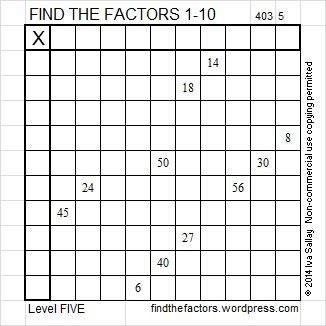
This week’s level 4 puzzle has a couple of easy clues (1 & 81) that will give you a good start solving the puzzle.

Some of the rest of the clues may still be a challenge, but sometimes, once you’ve started something, you’ve already done the hardest part.

Can you write all the numbers from 1 to 10 in the top row and again in the first column so that the numbers you write become the factors of the given clues? There is only one solution. It’s easier if you use logic. It’s difficult and frustrating if you guess and check.

2014-03 Level 4

This week’s puzzles are also available in an excel file here. If you have a spreadsheet program on your computer, you can access it. If you enable editing in excel, you can type your answers directly onto the puzzle, and you can also easily print the puzzles.

Here are the factors for last week’s level 4 snow shovel puzzle:

2014-02 Level 4 Answers

Below is a chart showing the steps I used to solve this puzzle using logic. The chart states what was written in the factor column and the factor row for each clue or set of clues.

2014-02 L4 step by step

The puzzle could have been solved using the clues in a little different order. Try it!

The more puzzles you work on, the easier they will become, with or without an easy button!

32 and Hooked on Factoring

32 is a composite number. 32 = 1 x 32, 2 x 16, or 4 x 8.  Factors of 32: 1, 2, 4, 8, 16, 32. Prime factorization: 32 = 2 x 2 x 2 x 2 x 2, which can also be written 32 = 2⁵.

When 32 is a clue in the FIND THE FACTORS puzzles, always use 4 and 8 as the factors.

2014-03 Level 2

Here is a hook-shaped FIND THE FACTORS 1-10 puzzle, and YOU can solve in by hook or by crook!

The puzzle has a few square numbers: 16, 4, 81, 36, 36, 9, 1, and 25. Several square numbers can only be factored one way in a FIND THE FACTORS puzzle, while others can be factored 2 or 3 ways.

Obviously, 6 x 6 = 36 will not let us off the hook both times that 36 appears. One of those times we must use 4 x 9 = 36. This puzzle reminds us that 36 is sometimes a square and sometimes a rectangle.

The 16 isn’t a square in this puzzle either. Sometimes 4 and 9 are rectangles, but not in this case.

81 and 25 are always square in the FIND THE FACTORS puzzles because even though 1 and 3 are allowed to be factors, 25, 27, and 81 are greater than 10 and not allowed as possible factors to solve the puzzle.

To solve this puzzle, write the numbers from 1 to 10 in the top row and again in the first column so that those numbers are the factors of the given clues. Don’t fall for those slightly tricky clues hook, line, and sinker!

This week’s puzzles are also available in an excel file here. If you have a spreadsheet program on your computer, you can access it. If you enable editing in excel, you can type your answers directly onto the puzzle, and you can also easily print the puzzles. I’m hooked on factoring. I hope you’ll get hooked, too!

Here are all the factors to last week’s level 2 FIND THE FACTORS 1-12 snowflake puzzle:

2014-02 Level 2 Answer

31 and Every Third Grader Should Know

  • 31 is a prime number.
  • Prime factorization: 31 is prime.
  • The exponent of prime number 31 is 1. Adding 1 to that exponent we get (1 + 1) = 2. Therefore 31 has exactly 2 factors.
  • Factors of 31: 1, 31
  • Factor pairs: 31 = 1 x 31
  • 31 has no square factors that allow its square root to be simplified. √31 ≈ 5.56776

How do we know that 31 is a prime number? If 31 were not a prime number, then it would be divisible by at least one prime number less than or equal to √31 ≈ 5.6. Since 31 cannot be divided evenly by 2, 3, or 5, we know that 31 is a prime number.

31 is never a clue in the FIND THE FACTORS puzzles.

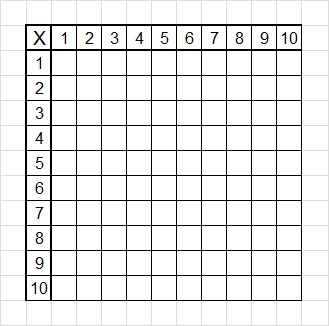
Every third grader should know how to fill in a multiplication table:

Basic multiplication table

By the middle of third grade, every third grade student has been taught the basic multiplication facts. Of course, that doesn’t mean that every third grader has LEARNED those facts. Corestandards.org/Math/Content/3/ lists EVERYTHING a student should learn in third grade math. Multiplication is very key in learning all of these concepts.

Many students, even beyond third grade, rely on skip counting to figure out what a multiplication product should be. Some students have learned rhymes to help them recall a fact. Given the opportunity some students even in middle school will use a calculator to find the answer to a basic multiplication fact.

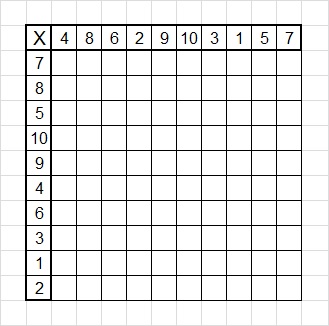
Practicing every day will help students recall the facts instantly instead of needing a calculator or other crutch to help them remember one of the basic multiplication facts. For variety, every third grader should also know how to fill out a multiplication table that looks like this:

mixed table

This kind of table doesn’t allow a student to simply count by twos, fives, nines or any other number to fill out a particular row or column. This type of table encourages a student to fully memorize all the multiplication facts so the table can be completed as quickly as possible.

About the middle of third grade, students are introduced to division. As soon as students learn that any number can be divided by 1, they are ready to tackle the easiest of the easiest FIND THE FACTORS puzzles. Here is the level 1 puzzle for the 3rd full week of 2014:

2014-03 Level 1

It is a level 1 puzzle because students only have to know 10 (or 12) division facts to solve the puzzle. Even though it is a simple puzzle, third grade students will need some instruction to complete it. Tell them that this puzzle is going to turn into a multiplication table as soon as they figure out what numbers go into the top row and the first column. Tell them the only numbers that will be written in those two places are numbers from 1 to 10 and that all of those numbers have to be written in both places.

Help the students know what numbers to write in each space on the top row. Some students will likely be confused when they get to the column with 8 clues and to the column with no clues. Help them use logic to figure out what numbers should go in those spaces. When all the factors have been found in both the factor row and the factor column, have them complete the multiplication table. It will be great practice for all of them.

Last week’s puzzle was fairly easy. Here is the puzzle with all of the factors found:

 2014-02 Level 1 Answer

This week’s puzzles are also available in an excel file here, if you have a spreadsheet program on your computer you can access it.

If you enable editing in excel, you can type your answers directly onto the puzzle, and you can also easily print the puzzles. Have fun!

29 and A Level 6 Snowball

  • 29 is a prime number.
  • Prime factorization: 29 is prime.
  • The exponent of prime number 29 is 1. Adding 1 to that exponent we get (1 + 1) = 2. Therefore 29 has exactly 2 factors.
  • Factors of 29: 1, 29
  • Factor pairs: 29 = 1 x 29
  • 29 has no square factors that allow its square root to be simplified. √29 ≈ 5.38516

How do we know that 29 is a prime number? If 29 were not a prime number, then it would be divisible by at least one prime number less than or equal to √29 ≈ 5.4. Since 29 cannot be divided evenly by 2, 3, or 5, we know that 29 is a prime number.

29 is never a clue in the FIND THE FACTORS puzzles.

Here is a FIND THE FACTORS 1-12 puzzle that is shaped like a snowball. Because it is a level 6 puzzle, you might feel as if you’re caught in a snowball fight:

2014-01-13.6

The object of the puzzle is to write the numbers 1 to 12 in the top row and again in the first column so that those numbers are the factors of the given clues. If you have attempted a level 6 puzzle, you may have screamed, “IS IT EVEN POSSIBLE to solve a level 6 puzzle without guessing and checking?” I promise you it is, BUT you will need to look at ALL the clues in the puzzle and think about them logically. I don’t want to spoil any of the fun of this week’s puzzle, so I will explain in detail how to solve last week’s puzzle instead.

Notice that for last week’s puzzle there is only one row or column with more than one clue, the column with the 6 and 18 in it. Notice there are three possible common factors, 2, 3, and 6 that will allow us to write only the numbers from 1 to 10 in the factor row and the factor column. You may be tempted to guess and check, but doing that often leads to frustration and/or screaming, so let’s ignore that column for now.

2014-01 Level 6 step 1

As we examine the other clues, we notice that there are four clues that are divisible by four: 4, 16, 28, and 36. Let’s look at the possible factors for each of those clues.

2014-01 Level 6 step 2

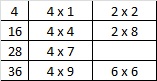
possible 4's Remember that each number from 1 to 10 can only appear once in the factor row and once in the factor column. That means that if 4 is 2 x 2, then 16 must be 4 x 4. Likewise if 16 is 2 x 8, then 4 must be 1 x 4.

If you think about it, you will realize that for this puzzle 4 MUST be a factor of either 4 OR 16. You should also notice that 4 must be a factor of 28. Therefore, in this puzzle, 4 will NOT be one the factors of 36.

We therefore, know that 6 x 6 = 36 works for this puzzle. Since that uses up both 6s, we know that we can’t use 6 as one of the factors of 18, and since 6 x 3 = 18, we also can’t use 3 as its factor. Logic tells us that 2 is the only common factor of 6 and 18 that will work for this puzzle. We now can fill in the corresponding factor cells from the information we have learned so far:

2014-01 Level 6 step 3

Since we found a 9 in the factor column, try to figure out where the 9 goes in the factor row. Since none of the clues that are left are divisible by 9, there is only one place a 9 can go in the factor row: over the column with no clues.

Now if we complete the puzzle using the clues in the order listed on the chart below, we can feel the rhythm as we fill in the rest of the factor cells. The first factor of each multiplication product should be written in the factor row (and the second factor should be written in the factor column):

2014-02.6 logic

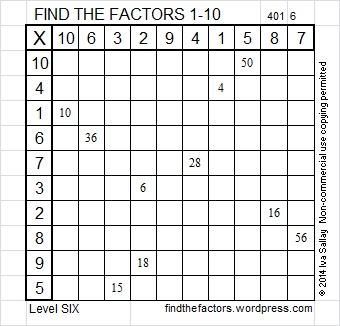
Now we have found all the factors using LOGIC only. We did not guess and check at all. Last week’s completed puzzle is shown below.

2014-01 Level 6 Answer

Try to discover the secret of the snowball puzzle on your own as well. This week’s puzzles are also available in an excel file here, if you have a spreadsheet program on your computer you can access it. If you enable editing in excel, you can type your answers directly onto the puzzle, and you can also easily print the puzzles. Good luck!