Because 5 is one of its factors, 670 is the hypotenuse of the Pythagorean triple 402-536-670. Which factor of 670 is the greatest common factor of those three numbers?
The exponents in the prime factorization are 1, 1, and 1. Adding one to each and multiplying we get (1 + 1)(1 + 1)(1 + 1) = 2 x 2 x 2 = 8. Therefore 670 has exactly 8 factors.
Factors of 670: 1, 2, 5, 10, 67, 134, 335, 670
Factor pairs: 670 = 1 x 670, 2 x 335, 5 x 134, or 10 x 67
670 has no square factors that allow its square root to be simplified. √670 ≈ 25.884358.
The exponents in the prime factorization are 1 and 1. Adding one to each and multiplying we get (1 + 1)(1 + 1) = 2 x 2 = 4. Therefore 669 has exactly 4 factors.
Factors of 669: 1, 3, 223, 669
Factor pairs: 669 = 1 x 669 or 3 x 223
669 has no square factors that allow its square root to be simplified. √669 ≈ 25.865034.
Here’s the puzzle without the possibly distracting color:
————————————
661 is a prime number. 659 and 661 are twin primes.
Prime factorization: 661 is prime.
The exponent of prime number 661 is 1. Adding 1 to that exponent we get (1 + 1) = 2. Therefore 661 has exactly 2 factors.
Factors of 661: 1, 661
Factor pairs: 661 = 1 x 661
661 has no square factors that allow its square root to be simplified. √661 ≈ 25.70992.
How do we know that 661 is a prime number? If 661 were not a prime number, then it would be divisible by at least one prime number less than or equal to √661 ≈ 25.7. Since 661 cannot be divided evenly by 2, 3, 5, 7, 11, 13, 17, 19, or 23, we know that 661 is a prime number.
Here’s another way we know that 661 is a prime number: Since 25² + 6² = 661, and 25 and 6 have no common prime factors, 661 will be prime unless it is divisible by a primitive Pythagorean hypotenuse less than or equal to √661 ≈ 25.7. Since 661 is not divisible by 5, 13, or 17, we know that 661 is a prime number.
—————————————————————————————————
A Logical Approach to solve a FIND THE FACTORS puzzle: Find the column or row with two clues and find their common factor. (None of the factors are greater than 10.) Write the corresponding factors in the factor column (1st column) and factor row (top row). Because this is a level three puzzle, you have now written a factor at the top of the factor column. Continue to work from the top of the factor column to the bottom, finding factors and filling in the factor column and the factor row one cell at a time as you go.
Prime factorization: 657 = 3 x 3 x 73, which can be written 657 = (3^2) x 73
The exponents in the prime factorization are 2 and 1. Adding one to each and multiplying we get (2 + 1)(1 + 1) = 3 x 2 = 6. Therefore 657 has exactly 6 factors.
Factors of 657: 1, 3, 9, 73, 219, 657
Factor pairs: 657 = 1 x 657, 3 x 219, or 9 x 73
Taking the factor pair with the largest square number factor, we get √657 = (√9)(√73) = 3√73 ≈ 25.632011.
The exponents in the prime factorization are 1 and 1. Adding one to each and multiplying we get (1 + 1)(1 + 1) = 2 x 2 = 4. Therefore 655 has exactly 4 factors.
Factors of 655: 1, 5, 131, 655
Factor pairs: 655 = 1 x 655 or 5 x 131
655 has no square factors that allow its square root to be simplified. √655 ≈ 25.592968.
The exponent of prime number 647 is 1. Adding 1 to that exponent we get (1 + 1) = 2. Therefore 647 has exactly 2 factors.
Factors of 647: 1, 647
Factor pairs: 647 = 1 x 647
647 has no square factors that allow its square root to be simplified. √647 ≈ 25.43619.
How do we know that 647 is a prime number? If 647 were not a prime number, then it would be divisible by at least one prime number less than or equal to √647 ≈ 25.4. Since 647 cannot be divided evenly by 2, 3, 5, 7, 11, 13, 17, 19, or 23, we know that 647 is a prime number.
The exponents in the prime factorization are 1, 1, and 1. Adding one to each and multiplying we get (1 + 1)(1 + 1)(1 + 1) = 2 x 2 x 2 = 8. Therefore 638 has exactly 8 factors.
Factors of 638: 1, 2, 11, 22, 29, 58, 319, 638
Factor pairs: 638 = 1 x 638, 2 x 319, 11 x 58, or 22 x 29
638 has no square factors that allow its square root to be simplified. √638 ≈ 25.25866.
—————————————————————————————————
A Logical Approach to solve a FIND THE FACTORS puzzle: Find the column or row with two clues and find their common factor. (None of the factors are greater than 12.) Write the corresponding factors in the factor column (1st column) and factor row (top row). Because this is a level three puzzle, you have now written a factor at the top of the factor column. Continue to work from the top of the factor column to the bottom, finding factors and filling in the factor column and the factor row one cell at a time as you go.
Prime factorization: 636 = 2 x 2 x 3 x 53, which can be written 636 = (2^2) x 3 x 53
The exponents in the prime factorization are 2, 1, and 1. Adding one to each and multiplying we get (2 + 1)(1 + 1)(1 + 1) = 3 x 2 x 2 = 12. Therefore 636 has exactly 12 factors.
The exponents in the prime factorization are 1 and 1. Adding one to each and multiplying we get (1 + 1)(1 + 1) = 2 x 2 = 4. Therefore 634 has exactly 4 factors.
Factors of 634: 1, 2, 317, 634
Factor pairs: 634 = 1 x 634 or 2 x 317
634 has no square factors that allow its square root to be simplified. √634 ≈ 25.1793566.
The circumference of a circle with a radius of one is approximately 6.28. That’s an important enough number that it has been given the symbol “τ ” which is pronounced “tau”. τ looks a little like half of the number π, but τ = 2π.
Some people think we should get rid of π and only use τ. Other people feel that π has been used for centuries, and there is no compelling reason to change now.
π is perfect for finding the area of a circle: Area = πr². Here’s the area of a circle using tau: Area = r²τ/2.
τ is very good for finding the circumference of a circle: Circumference = τr, but that looks strange compared to 2πr. In fact, it can be difficult to tell if τr is one character or two.
The Tau Manifesto shows angle measurements in degrees, π radians and τ radians. You might want to look at some videos, too. Some people think the τ radians are simpler because the radians correspond exactly to the fractional pieces of the circumference of a circle or, get this, to the fractional pieces of a pie. (τ does that, not π.) Other people think that π radians are just as good because we’re used to them, and they correspond exactly to the area of any wedge in a unit circle or the area of any slice of pie. (Which would you rather eat the circumference or the area of a pie?)
Until I wrote this post and read the link shared in the comments, I hadn’t heard anybody say that π is better for some situations while τ is better for others. (Actually, it appears that π is better except in formulas that use 2π.) Diameters and radii have co-existed peacefully for centuries. I don’t understand why π and τ can’t do the same. Here’s a great video that shows both sides of the argument.
—————————————————————————————————
22² + 12² = 628.
628 is the hypotenuse of the Pythagorean triple 340-528-628. The greatest common factor of those three numbers is the same as the greatest common factor of 22² and 12².
7² + 11² + 13² + 17² = 628. Thank you OEIS.org for that fun fact about the squares of those four consecutive prime numbers.
Prime factorization: 628 = 2 x 2 x 157, which can be written 628 = (2^2) x 157
The exponents in the prime factorization are 2 and 1. Adding one to each and multiplying we get (2 + 1)(1 + 1) = 3 x 2 = 6. Therefore 628 has exactly 6 factors.
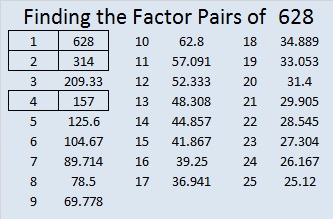
Factors of 628: 1, 2, 4, 157, 314, 628
Factor pairs: 628 = 1 x 628, 2 x 314, or 4 x 157
Taking the factor pair with the largest square number factor, we get √628 = (√4)(√157) = 2√157 ≈ 25.059928.