199 My List of Multiplication Rhymes

  • 199 is a prime number.
  • Prime factorization: 199 is prime.
  • The exponent of prime number 199 is 1. Adding 1 to that exponent we get (1 + 1) = 2. Therefore 199 has exactly 2 factors.
  • Factors of 199: 1, 199
  • Factor pairs: 199 = 1 x 199
  • 199 has no square factors that allow its square root to be simplified. √199 ≈ 14.1067

How do we know that 199 is a prime number? If 199 were not a prime number, then it would be divisible by at least one prime number less than or equal to √199 ≈ 14.1. Since 199 cannot be divided evenly by 2, 3, 5, 7, 11, or 13, we know that 199 is a prime number.

———————————

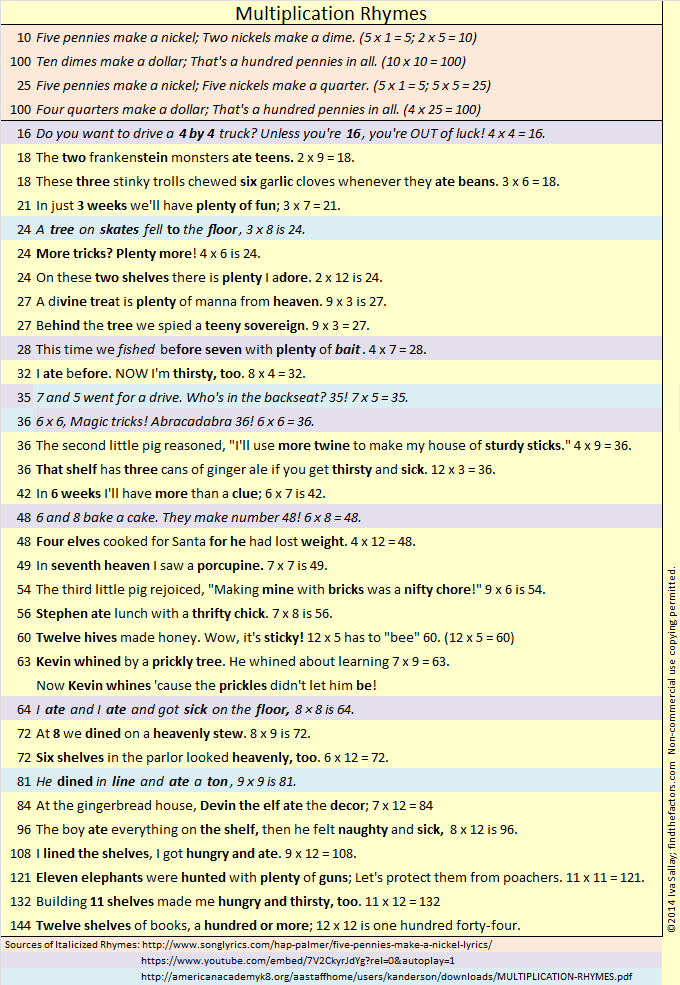
I recently wrote a post that asked “Are Multiplication Rhymes Able to Help Kids Learn the Multiplication Table?” Here is a list of rhymes that I’ve put together.

Multiplication Rhymes


Most of the rhymes have rhyming clues to help students remember both numbers being multiplied as well as their product. I wrote the rhymes that are highlighted in yellow. Those highlighted in peach, purple, or blue are from other sources, but I did alter the rhymes for 24, 28, and 81. A black and white pdf of the rhymes is also available here.

198 and Level 6

  • 198 is a composite number.
  • Prime factorization: 198 = 2 × 3 × 3 × 11, which can be written 198 = 2 × 3² × 11
  • The exponents in the prime factorization are 1, 2, and 1. Adding one to each and multiplying we get (1 + 1)(2 + 1)(1 + 1) = 2 × 3 × 2 = 12. Therefore 198 has exactly 12 factors.
  • Factors of 198: 1, 2, 3, 6, 9, 11, 18, 22, 33, 66, 99, 198
  • Factor pairs: 198 = 1 × 198, 2 × 99, 3 × 66, 6 × 33, 9 × 22, or 11 × 18
  • Taking the factor pair with the largest square number factor, we get √198 = (√9)(√22) = 3√22 ≈ 14.0712

Since 1 + 9 + 8 = 18, a multiple of 9, 198 is divisible by 9. Here is one of several possible factor trees for 198:

198 factor tree

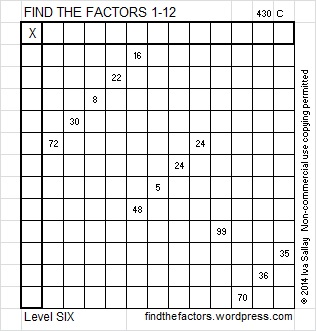
2014-31 Level 6

Excel file of puzzles and previous week’s factor solutions: 10 Factors 2014-08-04

The common factors of 20 and 40 are 4, 5, and 10. Since 14 and either 8, 10, or 6 will use both 2’s, 10 cannot be the CF. If we choose 4 as the common factor, then 5 and 10 would be placed in the top row followed by 3, the factor of 15. However, then we wouldn’t be able to use either 3 or 6 as the common factor of 24 and 18 because 3 would already be in the top row and 4 would already be in the 1st column.  Therefore, the common factor of 20 and 40 has to be 5.

2014-31 Level 6 Logic

197 and Level 5

  • 197 is a prime number.
  • Prime factorization: 197 is prime.
  • The exponent of prime number 197 is 1. Adding 1 to that exponent we get (1 + 1) = 2. Therefore 197 has exactly 2 factors.
  • Factors of 197: 1, 197
  • Factor pairs: 197 = 1 x 197
  • 197 has no square factors that allow its square root to be simplified. √197 ≈ 14.0356688

How do we know that 197 is a prime number? If 197 were not a prime number, then it would be divisible by at least one prime number less than or equal to √197 ≈ 14. Since 197 cannot be divided evenly by 2, 3, 5, 7, 11, or 13, we know that 197 is a prime number.

2014-31 Level 5

Excel file of puzzles and previous week’s factor solutions: 10 Factors 2014-08-04

2014-31 Level 5 Logic

196 and Level 4

  • 196 is a composite number.
  • Prime factorization: 196 = 2 × 2 × 7 × 7, which can be written 196 = 2² × 7²
  • The exponents in the prime factorization are 2 and 2. Adding one to each and multiplying we get (2 + 1)(2 + 1) = 3 × 3 = 9. Therefore 196 has exactly 9 factors.
  • Factors of 196: 1, 2, 4, 7, 14, 28, 49, 98, 196
  • Factor pairs: 196 =  1 × 196, 2 × 98, 4 × 49, 7 × 28, or 14 × 14
  • 196 is a perfect square. √196 = 14

13 and 14 squared

2014-08-07

Excel file of puzzles and previous week’s factor solutions: 10 Factors 2014-08-04

2014-31 Level 4 Logic

195 and Level 3

  • 195 is a composite number.
  • Prime factorization: 195 = 3 x 5 x 13
  • The exponents in the prime factorization are 1, 1, and 1. Adding one to each and multiplying we get (1 + 1)(1 + 1)(1 + 1) = 2 × 2 × 2 = 8. Therefore 195 has exactly 8 factors.
  • Factors of 195: 1, 3, 5, 13, 15, 39, 65, 195
  • Factor pairs: 195 = 1 x 195, 3 x 65, 5 x 39, or 13 x 15
  • 195 has no square factors that allow its square root to be simplified. √195 ≈ 13.96424

—————————————————————-

2014-31 Level 3

Excel file of puzzles and previous week’s factor solutions: 10 Factors 2014-08-04

A Logical Approach to FIND THE FACTORS: Find the column or row with two clues and find their common factor. Write the corresponding factors in the factor column (1st column) and factor row (top row).  Because this is a level three puzzle, you have now written a factor at the top of the factor column. Continue to work from the top of the factor column to the bottom, finding factors and filling in the factor column and the factor row one cell at a time as you go.

2014-31 Level 3 Factors

194 Are Multiplication Rhymes Able to Help Kids Learn the Multiplication Table?

194 is a composite number. Factor pairs: 194 = 1 x 194 or 2 x 97. Factors of 194: 1, 2, 97, 194. Prime factorization: 194 = 2 x 97.

Are multiplication rhymes able to help kids learn the multiplication table? The obvious answer is, of course, YES! Duh!

Little Pigs Multiplication Rhymes

However, sometimes this obvious answer may not be correct. I recently read a researched article on the effectiveness of certain teaching practices in helping first-grade children learn mathematics. The points made in the article would likely apply to third and fourth-grade students learning multiplication as well. The article states that alternative techniques (music, movement, m&m’s, other manipulatives, etc.) do reinforce concepts for students who already understand what is being taught, but students who struggle actually make no gains when unproven techniques are used. The researcher hypothesized that when students struggle to learn mathematical concepts “alternative techniques tend to demand more, cognitively, from [these] students.” Demanding more cognitively can backfire: Requiring a student to memorize a rhyme and the math fact could put that student’s brain on overload with even fewer facts learned.

I have now modified my opinion of multiplication rhymes. If rhyme-and-rhythm is helpful, use it, if not, don’t. What is good for some of the class, may not be good for all of the class. If a student doesn’t make progress using the rhymes, it may be better to stick with more direct instruction to learn the math facts. Additionally, each rhyme should be examined individually and its own pros and cons considered.

Here are two of my FAVORITE sources of multiplication rhymes: American Academy’s MULTIPLICATION-RHYMES.pdf now requires registration to view, but it has rhymes printed in pretty colors and contains a few of my favorite multiplication rhymes. Kids would probably like looking at this pdf multiple times.

Multiplication Rhymes 1 is an entertaining You-tube video made by Mrs. Rice that children would probably enjoy watching over and over again, and it also has a few very memorable rhymes.

Although these two sources are great, I think some of the rhymes are too similar:

  • From the pdf, we have “8 and 4 were sad and blue, 8 x 4 = 32” while the video recites “6 and 7 are sad and blue, they make number 42.” If students learned either of those rhymes, they may have difficulty remembering the product or which two numbers were sad and blue several weeks later.
  • The video also gave two other rhymes that were too similar to each other: “9 and 8 what do they do? They go play (tag) with 72.” and  “9 and 9 are having fun. They play tag with 81.” “Tag” is in parentheses because it wasn’t on the note card that was shown, but it was spoken on the video. Again weeks later, groups or individuals may not remember which numbers were playing tag or what the product was when they were multiplied together.

I compiled my own List of Multiplication Rhymes which focus on the multiplication facts highlighted in the multiplication table below. I included some rhymes from the above pdf and the video and added some from the song Five Pennies Make a Nickel. All of those rhymes are in italics. The rhymes that I wrote myself are in regular print. If I modified an existing rhyme, the modifications are in regular print while the rest of the rhyme is in italics. I also ordered the rhymes in a way that should make finding the rhyme for any particular fact much easier. I hope there will be many rhymes on this list that you enjoy as well, and that they get used to help many students learn the very important multiplication facts highlighted in the table below.

Multiplication Rhymes Table

 Multiplication Rhymes

193 and Level 2

  • 193 is a prime number.
  • Prime factorization: 193 is prime.
  • The exponent of prime number 193 is 1. Adding 1 to that exponent we get (1 + 1) = 2. Therefore 193 has exactly 2 factors.
  • Factors of 193: 1, 193
  • Factor pairs: 193 = 1 x 193
  • 193 has no square factors that allow its square root to be simplified. √193 ≈ 13.89244

How do we know that 193 is a prime number? If 193 were not a prime number, then it would be divisible by at least one prime number less than or equal to √193 ≈ 13.9. Since 193 cannot be divided evenly by 2, 3, 5, 7, 11, or 13, we know that 193 is a prime number.

2014-31 Level 2

Excel file of puzzles and previous week’s factor solutions: 10 Factors 2014-08-04

2014-31 Level 2 Factors

192 and Level 1

192 is a composite number.
Factor pairs: 192 = 1 x 192, 2 x 96, 3 x 64, 4 x 48, 6 x 32, 8 x 24, or 12 x 16
Factors of 192: 1, 2, 3, 4, 6, 8, 12, 16, 24, 32, 48, 64, 96, 192
Prime factorization: 192 = 2 x 2 x 2 x 2 x 2 x 2 x 3, which can also be written (2^6) x 3

———————————————————————————————————————

2014-31 Level 1

Excel file of puzzles and previous week’s factor solutions: 10 Factors 2014-08-04

2014-31 Level 1 Factors

191 and Level 6

  • 191 is a prime number.
  • Prime factorization: 191 is prime.
  • The exponent of prime number 191 is 1. Adding 1 to that exponent we get (1 + 1) = 2. Therefore 191 has exactly 2 factors.
  • Factors of 191: 1, 191
  • Factor pairs: 191 = 1 x 191
  • 191 has no square factors that allow its square root to be simplified. √191 ≈ 13.82027

How do we know that 191 is a prime number? If 191 were not a prime number, then it would be divisible by at least one prime number less than or equal to √191 ≈ 13.8. Since 191 cannot be divided evenly by 2, 3, 5, 7, 11, or 13, we know that 191 is a prime number.

There are 22 prime numbers between 100 and 200:

  • The first four of those prime numbers are 101, 103, 107, and 109.
  • The last four of those prime numbers are 191, 193, 197, and 199.


2014-30 Level 6

Excel file of puzzles and previous week’s factor solutions: 12 Factors 2014-07-28

2014-30 Level 6 Logic

2014-30 Level 6 Problems


190 and Level 5

190 is a composite number.
Factor pairs: 190 = 1 x 190, 2 x 95, 5 x 38, 10 x 19
Factors of 190: 1, 2, 5, 10, 19, 38, 95, 190
Prime factorization: 190 = 2 x 5 x 19

———————————————————————————————————————

2014-30 Level 5

Excel file of puzzles and previous week’s factor solutions: 12 Factors 2014-07-28

2014-30 Level 5 Logic