Square Roots up to √352 That Can Be Simplified

  • 352 is even and therefore a composite number.
  • Prime factorization: 352 = 2 x 2 x 2 x 2 x 2 x 11, which can be written 352 = (2^5) x 11
  • The exponents in the prime factorization are 5 and 1. Adding one to each and multiplying we get (5 + 1)(1 + 1) = 6 x 2 = 12. Therefore 352 has exactly 12 factors.
  • Factors of 352: 1, 2, 4, 8, 11, 16, 22, 32, 44, 88, 176, 352
  • Factor pairs: 352 = 1 x 352, 2 x 176, 4 x 88, 8 x 44, 11 x 32, or 16 x 22
  • Taking the factor pair with the largest square number factor, we get √352 = (√16)(√22) = 4√22 ≈ 18.762

Mathematics is full of interesting patterns. Let’s explore some patterns in reducible square roots.

Here are the first ten numbers that have reducible square roots. Notice that five of the numbers in this list, 1, 4, 9, 16, and 25 are perfect squares:

1-25 sqrt

40% of the numbers up to 5 have reducible square roots. The same thing is true for 40% of the numbers up to 10, 40% of the numbers up to 20, and 40% of the numbers up to 25.

Here are the second ten numbers with reducible square roots. The last number,50, is double the previous last number, 25. Again 40% of the numbers up to 50 have reducible square roots, and only two of these numbers are perfect squares. Notice that the last three numbers under the radical sign in this set are consecutive numbers.

27-50 sqrt

Would you like to make any predictions for the third set of ten numbers with reducible square roots?

If you predicted that this set of numbers would end with 75, you were almost right! 29/75 or 38.67% of the numbers up to 75 have reducible square roots, and 30/76 or 39.47% of the numbers up to 76 do. Both of these values are very close to 40%, but not quite there. Notice this time only one number is a perfect square.

52-76 sqrt

Would you like to make a prediction for what will happen with the fourth set of ten numbers with reducible square roots?

Surprise! We’re back to 40% of the numbers up to 100 have reducible square roots. Those consecutive numbers at the end of the set really helped raise the percentage right at the last minute. This set of numbers has two perfect squares.

80-100 sqrt

What do you think will happen if we look at all the reducible square roots up to 350? Multiples of any perfect square will always have reducible square roots. Since we have more perfect squares, do you think more will be reducible?

Because the square roots of 351 and 352 are also reducible, let’s include them in this chart. Each column has 20 reducible square roots in it, and they are grouped into fives for easier counting. I’ve highlighted sets of three or four consecutive numbers. In all, we now have charts showing the first 140 reducible square roots. This last set has eight perfect squares. Let’s look at the percentages at the end of some of those sets of consecutive numbers: 50/126 or 39.68% of the first 126 numbers have reducible square roots. 96/245 or 39.18% of the first 245 numbers have reducible square roots. Finally, 140/352 or 39.77% of the numbers up to 352 have reducible square roots. That one is so close to 40%!

104-352 sqrt

Sets of 41-60, 61-80, 81-100, 101-120, & 121-140 Reducible Square Roots

No matter how big a table we make, the percentage of reducible square roots will be very close to 40%. It will not get significantly higher because, believe it or not, most numbers are either prime numbers or the product of two or more DIFFERENT primes and thus have square roots that are NOT reducible.

Prime Number Tests for 347

  • 347 is a prime number.
  • Prime factorization: 347 is prime.
  • The exponent of prime number 347 is 1. Adding 1 to that exponent we get (1 + 1) = 2. Therefore 347 has exactly 2 factors.
  • Factors of 347: 1, 347
  • Factor pairs: 347 = 1 x 347
  • 347 has no square factors that allow its square root to be simplified. √347 ≈ 18.628

How do we know that 347 is a prime number? If 347 were not a prime number, then it would be divisible by at least one prime number less than or equal to √347 ≈ 18.628. Since 347 cannot be divided evenly by 2, 3, 5, 7, 11, 13, or 17, we know that 347 is a prime number.

Is there a quicker way to tell that 347 is a prime number? Not exactly…There is a quick test that will tell you if 347 is VERY LIKELY prime.

Quick Prime or Composite Number Test: You can use as few as TEN calculator keystrokes to test if 347 is VERY LIKELY prime: What is the remainder when 2³⁴⁷ is divided by 347? To find out type “(2)(xʸ)(3)(4)(7)(Mod)(3)(4)(7)” followed by the equal sign into your computer’s calculator. This is how the calculator should look before you hit the equal sign:

mod 347

2^347 mod (347) = 2, the same as the base we typed in. That means 347 is VERY LIKELY prime. This tests works for all prime numbers, but sometimes it gives a false positive for a relatively few (but infinite number) of composite numbers. (341 is the smallest of these numbers, and I wrote about it here.)

2 isn’t the only prime number that can be used as the base in this quick test. You can verify the following also on your computer’s calculator:

  • 3^347 mod (347) = 3
  • 5^347 mod (347) = 5
  • 7^347 mod (347) = 7
  • 11^347 mod (347) = 11. We can practically go on forever using prime number after prime number….until
  • 337^347 mod (347) = 337, the largest prime number less than 347.

As long as we use a prime less than 347 as the base and 347 as the exponent, we will always get that prime as the remainder. Still even though 347 passes ALL those prime number tests, we can only conclude that 347 is VERY LIKELY prime. Doing all those calculations is more work than simply dividing 347 by all the prime numbers less than or equal to its square root and getting a remainder every single time.

Tomcircle, a fellow blogger, shared a video of a new-prime-number-test that works for prime numbers and NEVER gives a false positive.

While this test works every time in theory, it can be quite a nightmare in practice. It involves putting the possible prime number into a particular expression, expanding the expression, calculating each coefficient, and verifying that all those coefficients are divisible by this possible prime number. In the case of the relatively small number 347, there would be 173 different coefficients. Each of those coefficients are the numbers in the 347th row of Pascal’s triangle, and too many of them are usually expressed in scientific notation. Dividing each of them by 347 to verify there is no remainder is far more work than most people would want to do. In fact, dividing 347 by all the integers less than 347 would actually be less work!

The Sieve of Eratosthenes was how the ancient Greeks found prime numbers. It takes a little longer than dividing the possible prime number by all of the primes less than or equal to its square root, but it finds many primes at the same time. Solvemymath shares some interesting facts about it.

Prime numbers are intriguing, and 347 is one of them!

341 is the smallest composite number that gives a false positive for this Quick Prime Number Test

  • 341 is a composite number.
  • Prime factorization: 341 = 11 x 31
  • The exponents in the prime factorization are 1 and 1. Adding one to each and multiplying we get (1 + 1)(1 + 1) = 2 x 2 = 4. Therefore 341 has exactly 4 factors.
  • Factors of 341: 1, 11, 31, 341
  • Factor pairs: 341 = 1 x 341 or 11 x 31
  • 341 has no square factors that allow its square root to be simplified. √341 ≈ 18.466

341 is a composite number that sometimes acts like a prime number. To understand why, we need to understand a little bit about modular arithmetic:

When one number is divided by another, sometimes there is a remainder. Modular arithmetic is all about the remainders. We don’t care how many times one number divides into another number; we only care about the remainder.

Something very curious happens when the equation in the chart below is applied to a prime number greater than 2: The remainder is always 2. It really is! For example, 2^5 = 32 and 32 divided by 5 is 6R2. We say that 32 (mod 5) = 2 or 2^5 (mod 5) = 2 because 2 is the remainder. The fact that the remainder for prime numbers applied to this equation is always 2 is amazing, and can be a QUICK TEST to see if an odd number might be a PRIME NUMBER! If the remainder isn’t 2, that odd number is definitely NOT prime!

Prime Number Test

QUICK PRIME NUMBER TEST (Please, excuse my using = instead of ≡, the “equal sign” that is usually used in modular arithmetic. I think = looks less intimidating.)

Passing the remainder test is a necessary but not a sufficient indicator that a number is prime: Even though 341 is not a prime number, the quantity 2^341 divided by 341 also has a remainder of 2. Since 341 = 11 x 31, but passes the remainder test, it is known as a pseudoprime number.  341 is the smallest composite number that passes this particular test, so 341 is an amazing number!

Also in the chart above, 2 is the most common remainder, followed by 8, then 32, then 128. All of those numbers are odd powers of 2. The even powers of 2 do not appear on the chart at all! That is a very curious phenomenon as well. (However, if x is an even number, it appears that y will usually be an even power of 2.)

Earlier mathematicians have written equivalent expressions and algorithms, but I prefer using “2^x (mod x)” because it takes very few keystrokes to enter into a calculator before hitting the equal sign:

mod 341 calculator

This is only a picture of a calculator.

Look at the image below.  It demonstrates that in prime-numbered rows, the numbers in that row can be divided evenly by that prime number (not counting the 1’s at the beginning and ending of each row).

  • For a composite number, such as 15, at least one of the numbers in the row will NOT be divisible by that composite number. In row 15, 1 is the 0th term, 15 is the 1st term, 105 is the 2nd term, 455 is the 3rd term, and 1365 is the 4th term and so forth.
  • Terms that are divisible by 15 are the 1st term (15), the 2nd term (105), the 4th term (1365), the 7th term (6435), the 8th term (6435), the 11th term (1365), and the 13th term (105). All of those term numbers, 1, 2, 4, 7, 8, 11, and 13, do NOT have factors in common with the number 15.
  • The terms that are NOT divisible by 15 are the 3rd term (455), the 5th term (3003), the 6th term (5005), the 9th term (5005), the 10th term (3003), and the 12th term (455). All of those term numbers, 3, 5, 6, 9, 10, and 12, have at least one factor in common with the number 15.

If we could see the VERY large numbers for the 341st row, and if they weren’t expressed in Scientific Notation, we could note that the following terms would NOT be divisible by 341: terms numbered 11th, 22nd, 33rd, 44th, and so forth and the terms numbered 31st, 62nd, 93rd and so forth. However, if you add those terms together, that very large sum would be divisible by 341. That is so amazing, even though 341 is not prime!

This second image from Pascal’s Triangle demonstrates that the sum of the numbers in any row of Pascal’s triangle equals two raised to the second number in that row.
(There is no second number in the top row, so we could say that second number is zero, and 2º = 1.)

These two images work together so that 2^p (mod p) will always be 2 for every prime number greater than 2 because every number in the prime-numbered rows can be evenly divided by that prime number. (Except the 1 at the beginning of the row and the 1 at the end of the row; Note 1 + 1 = 2)

Now that is why this amazing test for prime numbers works as well as it does while giving just a few false positives!

339 and Level 4

  • 339 is a composite number.
  • Prime factorization: 339 = 3 x 113
  • The exponents in the prime factorization are 1 and 1. Adding one to each and multiplying we get (1 + 1)(1 + 1) = 2 x 2 = 4. Therefore 339 has exactly 4 factors.
  • Factors of 339: 1, 3, 113, 339
  • Factor pairs: 339 = 1 x 339 or 3 x 113
  • 339 has no square factors that allow its square root to be simplified. √339 ≈ 18.412

Existential Spaghetti wrote a blog post a couple of years ago on New Year’s resolutions being yearly-chinese-finger-traps. People tend to choose resolutions that are “both time-consuming and often high-energy.” Ponder that as you solve this Level 4 Chinese Finger Trap Factoring Puzzle made especially for the New Year.

2014-52 Level 4

Print the puzzles or type the factors on this excel file: 12 Factors 2014-12-29

 Amazon.com sells these Chinese Finger Traps:

2014-52 Level 4 Logic

331 and Hockey Sticks

  • 331 is a prime number.
  • Prime factorization: 331 is prime.
  • The exponent of prime number 331 is 1. Adding 1 to that exponent we get (1 + 1) = 2. Therefore 331 has exactly 2 factors.
  • Factors of 331: 1, 331
  • Factor pairs: 331 = 1 x 331
  • 331 has no square factors that allow its square root to be simplified. √331 ≈ 18.193

How do we know that 331 is a prime number? If 331 were not a prime number, then it would be divisible by at least one prime number less than or equal to √331 ≈ 18.193. Since 331 cannot be divided evenly by 2, 3, 5, 7, 11, 13, or 17, we know that 331 is a prime number.

2014-51 Level 3

 Print the puzzles or type the factors on this excel file:  10 Factors 2014-12-22

Today’s puzzle looks like a hockey stick. Hockey sticks remind me not only of the obvious winter sport but also of the Twelve Days of Christmas and Pascal’s triangle.

Dimacs.rutgers.edu explains quite nicely how a hockey stick in Pascal’s triangle can give you the total number of gifts received after one day, two days, three days, and so on. Look at the green and red hockey stick with bold black numbers in this illustration of Pascal’s triangle:

If someone gave you one partridge every day for 12 days, two turtle doves every day for 11 days, three French hens every day for 10 days, etc, etc, and etc, then you would receive 364 gifts. (364 is so easy to remember because it is one less than the number of days in a year.)

A Logical Approach to FIND THE FACTORS: Find the column or row with two clues and find their common factor. Write the corresponding factors in the factor column (1st column) and factor row (top row).  Because this is a level three puzzle, you have now written a factor at the top of the factor column. Continue to work from the top of the factor column to the bottom, finding factors and filling in the factor column and the factor row one cell at a time as you go.
2014-51 Level 3 Factors

329 and A Last Minute Gift

  • 329 is a composite number.
  • Prime factorization: 329 = 7 x 47
  • The exponents in the prime factorization are 1 and 1. Adding one to each and multiplying we get (1 + 1)(1 + 1) = 2 x 2 = 4. Therefore 329 has exactly 4 factors.
  • Factors of 329: 1, 7, 47, 329
  • Factor pairs: 329 = 1 x 329 or 7 x 47
  • 329 has no square factors that allow its square root to be simplified. √329 ≈ 18.138

Here’s a puzzle that could be a last minute gift. If there is a child in you life who has recently become familiar with the multiplication table, put this puzzle in his or her stocking! It is as easy as the puzzles get.

2014-51 Level 1

Print or type on this week’s puzzles using this excel file: 10 Factors 2014-12-22

2014-51 Level 1 Factors

Last year on Christmas Eve I offered a free last minute gift, a puzzle booklet, but I discovered that most people take care of their last minute gift-giving a couple of days sooner than that. Still this last minute gift could be sent electronically and you can’t beat the price.

I also learned that margins in excel can move so the booklet didn’t always print up as nicely as I wanted. I’m still recovering from surgery so this year I simply revised that same booklet.

I saved the booklet as Factor Holiday pdf to eliminate those printing issues.  In pdf, the lines on the puzzles became quite dark so I don’t like the way they look as much, but I’ll live with it.

The booklet is also available in Factor Holiday excel if you prefer to type your answers directly on the computer. You can try printing it off of excel as well, but I can’t guarantee what the margins will do at any given time.

Here’s a copy of the puzzle booklet’s cover with my sincere holiday greetings for all of you:

2013 Puzzle Holiday

327 and Level 5

  • 327 is a composite number.
  • Prime factorization: 327 = 3 x 10⁹
  • The exponents in the prime factorization are 1 and 1. Adding one to each and multiplying we get (1 + 1)(1 + 1) = 2 x 2 = 4. Therefore 327 has exactly 4 factors.
  • Factors of 327: 1, 3, 109, 327
  • Factor pairs: 327 = 1 x 327 or 3 x 10⁹
  • 327 has no square factors that allow its square root to be simplified. √327 ≈ 18.083

Can these 14 clues help you complete this multiplication table puzzle?

2014-50 Level 5

Print the puzzles or type the factors on this excel file: 12 Factors 2014-12-15

2014-50 Level 5 Logic

314 and The Pi Day of Our Lives

  • 314 is a composite number.
  • Prime factorization: 314 = 2 x 157
  • The exponents in the prime factorization are 1 and 1. Adding one to each and multiplying we get (1 + 1)(1 + 1) = 2 x 2 = 4. Therefore 314 has exactly 4 factors.
  • Factors of 314: 1, 2, 157, 314
  • Factor pairs: 314 = 1 x 314 or 2 x 157
  • 314 has no square factors that allow its square root to be simplified. √314 ≈ 17.720

On 3-14-15 at 9:26:53 we will experience the most significant pi day of our lives.

Thepidayofourlives.homestead.com  is selling wristbands, t-shirts, and baseball caps commemorating this special upcoming event at very reasonable prices.

Each wristband costs only $3.14 (minimum purchase is 3 wristbands) while the t-shirts and the baseball caps are only $20 each. The website offers free shipping on everything they offer anywhere! You might just want to add one or more of these items to your Christmas wishlist!


313 and Memorizing One Seventh

  • 313 is a prime number.
  • Prime factorization: 313 is prime.
  • The exponent of prime number 313 is 1. Adding 1 to that exponent we get (1 + 1) = 2. Therefore 313 has exactly 2 factors.
  • Factors of 313: 1, 313
  • Factor pairs: 313 = 1 x 313
  • 313 has no square factors that allow its square root to be simplified. √313 ≈ 17.692

How do we know that 313 is a prime number? If 313 were not a prime number, then it would be divisible by at least one prime number less than or equal to √313 ≈ 17.692. Since 313 cannot be divided evenly by 2, 3, 5, 7, 11, 13, or 17, we know that 313 is a prime number.

Question: Liam set a goal to read all of the Harry Potter books. What percentage of the books had he read once he finished the first book? Answer: 1/7 ≈ 14.2857%, which looks like a much more complicated percentage than it really is. 1/7 is a repeating decimal that isn’t too difficult to remember. Here’s how I remember it:

one seventh

A famous approximation for pi is 22/7 = 3 1/7. If you have 1/7 memorized then you can also easily remember that pi is approximately equal to 3.142857. (It’s true that 355/113 ≈ 3.141592 is a better approximation since it’s accurate to six decimal places while 22/7 is accurate to only two. You can remember 355/113 by thinking 113355 and putting the first three digits in the denominator and the last three digits in the numerator.)

Here’s some other questions to consider: What percentage of the names of the seven dwarfs can you remember? What decimal amount of the seven wonders of the world can you name? What percentage of days last week did you exercise? How many of the seven deadly sins….

The decimals for 2/7, 3/7, 4/7, 5/7, and 6/7 are also easy and use the same very cool pattern, 142857, but each fraction starts with a different digit. Here’s how to remember each of those decimals, too:

remembering the sevenths

Go ahead and make somebody think you’re a human calculator today!


Integers (up to 300) with the Same Number of Factors

  • 300 is a composite number.
  • Prime factorization: 300 = 2 x 2 x 3 x 5 x 5, which can be written 300 = (2^2) x 3 x (5^2)
  • The exponents in the prime factorization are 2, 1 and 2. Adding one to each and multiplying we get (2 + 1)(1 + 1)(2 + 1) = 3 x 2 x 3 = 18. Therefore 300 has exactly 18 factors.
  • Factors of 300: 1, 2, 3, 4, 5, 6, 10, 12, 15, 20, 25, 30, 50, 60, 75, 100, 150, 300
  • Factor pairs: 300 = 1 x 300, 2 x 150, 3 x 100, 4 x 75, 5 x 60, 6 x 50, 10 x 30, 12 x 25 or 15 x 20
  • Taking the factor pair with the largest square number factor, we get √300 = (√3)(√100) = 10√3 ≈ 17.321

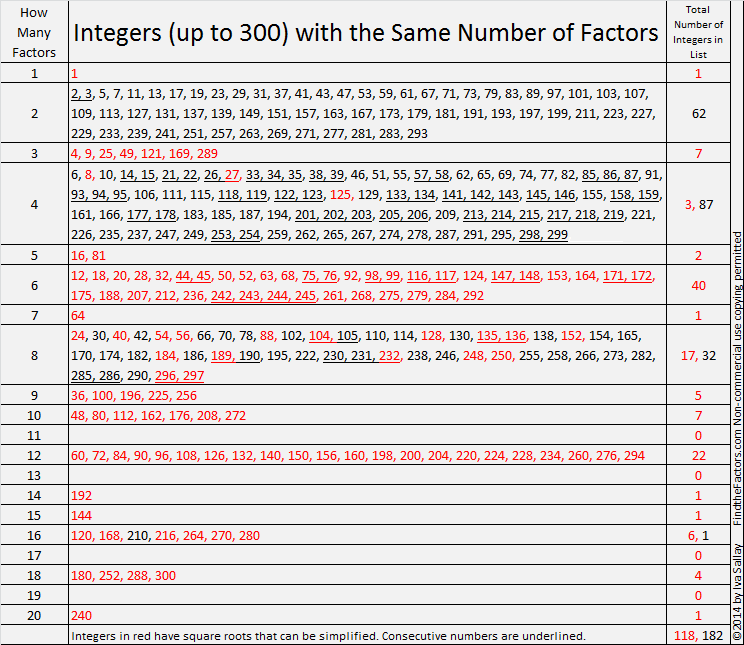
I made a couple of graphics a few weeks ago anticipating my 300th post.

Integers with the Same Number of Factors

Observations:

  • The only number with exactly one factor is one.
  • The number of factors of all the black integers on the chart are powers of 2. These integers have irreducible square roots.
  • Consecutive integers with the same number of factors can only occur if the number of factors is NOT a prime number.
  • 90/300 or 30% of the first 300 integers have 4 factors. (Largest group)
  • 62/300 or 20.6666% of the first 300 integers are prime numbers and therefore have 2 factors. (2nd largest group)
  • 49/300 or 16.3333% of the first 300 integers have 8 factors. (3rd largest group)
  • 40/300 or 13.3333% of the first 300 integers have 6 factors. (4th largest group) All integers with 6 factors have reducible square roots.
  • 22/300 or 7.3333% of the first 300 integers have 12 factors. (5th largest group)
  • All but 37/300 or 12.3333% of the first 300 integers are in one of those 5 groups.
  • 118/300 or 39.3333% of the first 300 integers have square roots that can be simplified.

Warning: the next chart and observations could make your brain hurt:

Smallest Numbers with 2 to 20 Factors

  • How many numbers have exactly 2 factors? Euclid proved that there is an infinite number of prime numbers which means there is an infinite number of integers with exactly 2 factors.
  • How many integers have exactly 19 factors? Even though the smallest integer with exactly 19 factors is 262,144, there is still an infinite number of integers with exactly that many factors. The integers in that list are each prime number raised to the 18th power. Since there is an infinite number of prime numbers, there is an infinite number of integers with exactly 19 factors.
  • {2⁹⁹⁶, 3⁹⁹⁶, 5⁹⁹⁶, . . . } is the infinite list of integers with exactly 997 factors. Likewise {2ᵖ⁻¹, 3ᵖ⁻¹, 5ᵖ⁻¹, . . . } where p is a prime number is the infinite list of integers with exactly p factors.
  • If the number of factors is c, a composite number, then it could be said that there is more than an infinite number of integers with that many factors because the infinite list of integers will include {2ᶜ⁻¹, 3ᶜ⁻¹, 5ᶜ⁻¹, . . . } as well as many other integers.