371 What Pythagorean Triple Comes Next?

Could 371 be a prime number? Let’s do a quick prime number test on it.  2^371 (mod 371) = 340, not 2. Therefore, 371 is definitely a composite number. Scroll down to see its factoring information.

What Pythagorean Triple Comes Next

If you can figure out the simple pattern that these odd Pythagorean triples make, you can predict the next one in the sequence FOREVER by squaring only one number, and without ever taking a single square root! Look at the blue and red squares in the graphic above.

  • 4 + 5 = 9 = 3², and 3, 4, 5 make a Pythagorean triple.
  • 12 + 13 = 25 = 5², and 5, 12, 13 is also a Pythagorean triple.
  • 24 + 25 = 49 = 7², and 7, 24, 25 is another Pythagorean triple, and
  • 40 + 41 = 81 = 9², and 9, 40, 41 is yet another Pythagorean triple!

What Pythagorean triple comes next? The answer is found by taking the next odd number, 11, squaring it to get 121 and dividing the 121 by 2. We round down to 60 for the 2nd number and round up to 61 for the 3rd number. Thus the next Pythagorean triple would be 11, 60, 61.

No matter how many times we repeat this pattern, we always get primitive Pythagorean triples. We can put all the triples in order to make a sequence that I call the Odd Primitive Pythagorean Triple Sequence:

The Odd Primitive Pythagorean Triple Sequence

Every odd number is the short leg of at least one primitive Pythagorean triple! Here’s how I came to realize this amazing fact:

Last week I was thinking about the difference of two squares applied to integers in general

Difference of Two Squares

as I looked at this multiplication table.

The Multiplication Table

Everyone knows that the numbers in the boxes outlined in red are perfect squares, but most people do not realize that the numbers inside EVERY other colored square on this multiplication table can be expressed as the difference of two squares. The larger of those two squares will be the perfect square that is the same color.

For example, look at 5 x 11 or 55. If we count as we follow the light blue diagonal stripe from 55 to 64, we count 3 squares. That means that 55 = 64 – 3².

As I looked at the multiplication table I realized that some even numbered squares are colored and some are not, but EVERY odd number square is in color! That means that EVERY odd number on the table can be expressed as the difference of two squares in at least one way.

The light blue 9 from 1 x 9 is four squares away from the 25 that is outlined in red. 9 = 25 – 4². Since all those numbers are perfect squares, we can write 3² = 5² – 4² or the equivalent in Pythagorean Theorem form   3² + 4² = 5².

When an odd number is squared, the resulting perfect square is ALWAYS an odd number. Since all odd numbers can be written as the difference of two squares, The square of all odd numbers can be written as the difference of two squares. In other words, every odd number is a leg in a Pythagorean triple!

Let’s look at the factoring information for 371 and use it to find some Pythagorean triples.

  • 371 is a composite number.
  • Prime factorization: 371 = 7 x 53
  • The exponents in the prime factorization are 1 and 1. Adding one to each and multiplying we get (1 + 1)(1 + 1) = 2 x 2 = 4. Therefore 371 has exactly 4 factors.
  • Factors of 371: 1, 7, 53, 371
  • Factor pairs: 371 = 1 x 371 or 7 x 53
  • 371 has no square factors that allow its square root to be simplified. √371 ≈ 19.261

371 is odd and has two odd prime factors. Here are some Pythagorean triples involving 371 as the short leg:

  • 371, 68820, 68821 (This triple is a primitive from the odd primitive sequence.)
  • 371, 1380, 1429 (A primitive, not from the odd primitive sequence. I’m also making a note that √(1380 + 1429) = 53 and √(1429 – 1380) = 7.)
  • 7, 24, 25 multiplied by 53 becomes 371, 1272, 1325
  • 53, 1404, 1405 multiplied by 7 becomes 371, 9828, 9835

371 is also the hypotenuse of a Pythagorean triple: 196, 315, 371 which is primitive 28, 45, 53 multiplied by 7.

370 and Level 3

370 is a composite number because it is a multiple of ten. Scroll down to see its factors.

370 Puzzle

Print the puzzles or type the factors on this excel file:12 Factors 2015-01-26

  • 370 is a composite number.
  • Prime factorization: 370 = 2 x 5 x 37
  • The exponents in the prime factorization are 1, 1, and 1. Adding one to each and multiplying we get (1 + 1)(1 + 1)(1 + 1) = 2 x 2 x 2 = 8. Therefore 370 has exactly 8 factors.
  • Factors of 370: 1, 2, 5, 10, 37, 74, 185, 370
  • Factor pairs: 370 = 1 x 370, 2 x 185, 5 x 74, or 10 x 37
  • 370 has no square factors that allow its square root to be simplified. √370 ≈ 19.235

A Logical Approach to FIND THE FACTORS: Find the column or row with two clues and find their common factor. Write the corresponding factors in the factor column (1st column) and factor row (top row).  Because this is a level three puzzle, you have now written a factor at the top of the factor column. Continue to work from the top of the factor column to the bottom, finding factors and filling in the factor column and the factor row one cell at a time as you go.

370 Factors

368 and a Few Sequences

368 is a composite number because it is even. Scroll down for its factoring information.

Sequences can be illustrated in pictures, but they are most often simply a list of numbers such as 23, 46, 69, 92, 115, . . . . .

Those numbers are the multiples of 23 listed in order. If we continued writing the numbers in that sequence, we would see that 368 is the 16th number listed.

We also know that 368 is an element of many other sequences even though it isn’t one of the typed numbers:

  • The sequence of all counting numbers: 1, 2, 3, 4, 5, . . . .
  • The sequence of all even counting numbers: 2, 4, 6, 8, 10, . . . .
  • The sequence of numbers that are multiples of four: 4, 8, 12, 16, 20, . . . . (This is the yellow sequence in the graphic below.)
  • The sequence of numbers that are one less than the multiples of three: 2, 5, 8, 11, 14, . . . .
  • The sequence of numbers that are one less than the multiples of nine: 8, 17, 26, 35, 44, . . . .

What's the next value

386 is NOT an element of any of the following sequences that involve even squared numbers:

  • 3, 15, 35, 63, 99, . . . . (The blue sequence in the graphic above)
  • 4, 16, 36, 64, 100, . . . .
  • 5, 17, 37, 65, 101, . . . . (The red sequence in the graphic above)

The yellow, blue, and red sequences above can be made into an array that contains only Primitive Pythagorean Triples!

Even Primitive Pythagorean Triple Sequence

Except for the 3, 4, 5 triangle that is listed first, every multiple of 4 is the short leg in a primitive Pythagorean triple! The other leg and the hypotenuse are based on a square with sides that are 1/2 the length of the shorter leg. Since the shorter leg is a multiple of four, that square length will always be an even number. Also note: 368 is divisible by 4 so 368, 33855, 33857 is a primitive that would be included in this sequence array.

The sequence contains only primitives, but it does NOT contain EVERY primitive whose short leg is a multiple of four. For example Pythagorean triple, 20, 21, 29, is not in that sequence array.

Let’s look at all the factoring information for 368:

  • 368 is a composite number.
  • Prime factorization: 368 = 2 x 2 x 2 x 2 x 23, which can be written 368 = (2^4) x 23
  • The exponents in the prime factorization are 4 and 1. Adding one to each and multiplying we get (4 + 1)(1 + 1) = 5 x 2 = 10. Therefore 368 has exactly 10 factors.
  • Factors of 368: 1, 2, 4, 8, 16, 23, 46, 92, 184, 368
  • Factor pairs: 368 = 1 x 368, 2 x 184, 4 x 92, 8 x 46, or 16 x 23
  • Taking the factor pair with the largest square number factor, we get √368 = (√16)(√23) = 4√23 ≈ 19.183

We can make a sequence array from the Pythagorean triple primitive 3, 4, 5 and its non-primitive multiples (which includes 276, 368, 460):

A Pythagorean Triple Sequence Array

We can find other Pythagorean triples that contain the number 368. Notice that 368 has several factors that are multiples of 4. They are 4, 8, 16, 92, and 184. Each one of them has its own primitive triple which can be multiplied by its factor pair partner to produce non-primitive triples that include 368 as well.

  • 3, 4, 5 multiplied by 92 is 276, 368, 460
  • 8, 15, 17 multiplied by 46 is 368, 690, 782
  • 16, 63, 65 multiplied by 23 is 368, 1449, 1495
  • 92, 2115, 2117 multiplied by 4 is 368, 8460, 8468
  • 184, 8463, 8465 multiplied by 2 is 368, 16926, 16930

In future posts I’ll write about how to find other Pythagorean triples like

  • 23, 264, 265, a primitive Pythagorean triple with an odd short leg. This primitive becomes 368, 4224, 4240 when multiplied by 16 (23’s factor pair partner).
  • 368, 465, 593, another primitive Pythagorean triple not included in the colored sequence array above and
  • 184, 513, 545, which when multiplied by 2 becomes 368, 1026, 1090.

Pythagorean triples aren’t just a bunch of “SQUARE” numbers. They are simply counting numbers that satisfy the equation a² + b² = c², and they are really COOL!


361 Do You See a Pattern?

When 2^361 is divided by 361, the remainder is 116, not 2. That means that 361 is definitely a composite number. Its factors are listed at the end of this post.

361 isn’t used as often, but it is just as special as some of the numbers in the table below:

Multiplication Pattern

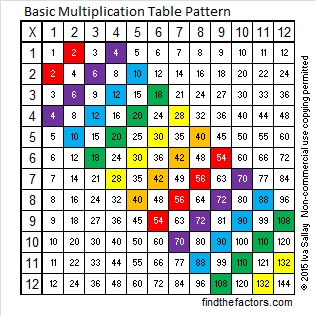
The pattern can also be seen along the diagonals in this ordinary multiplication table:

Multiplication Table Pattern

This pattern could be very helpful to students who are learning to multiply. I have seen plenty of students who knew 7 x 7 = 49, but couldn’t remember what 6 x 8 is.

Years after I learned the multiplication facts, I learned how to multiply binomials in an algebra class. I learned about the difference of two squares. In the example below one of the squares is n² and the other square is 1² which is equal to 1. I learned that the equation

(n-1)(n+1)

is true for ALL numbers, but nobody pointed out any practical examples to make it more meaningful. The table at the top of the page contains twelve practical examples. Let’s see how you do applying it to products of a few larger numbers.

Sometimes we find easy ways to remember certain products like
13 and 14 squared

We can use those products to help us remember other products easily by applying the difference of two squares. Try these: (Yes, you can easily do them without a calculator!)

  • 13 x 13 = 169. How much is 12 x 14?
  • 14 x 14 = 196. How much is 13 x 15?
  • 20 x 20 = 400. How much is 19 x 21?
  • If you know that the first ten powers of 2 are 2, 4, 8, 16, 32, 64, 128, 256, 512, 1024, then it’s easy to remember that 16 x 16 = 256. How much is 15 x 17?
  • What if we go in the opposite direction…It isn’t too hard to multiply 18 x 20 in your head to get 360. How much is 19 x 19?
  • 22 x 20 = 440 was also easy to find. How much is 21 x 21?
  • 30 x 30 = 900. How much is 29 x 31?
  • 100 x 100 = 10,000. How much is 99 x 101?

Multiplication Pattern 2

Did you figure out what 361 has to do with this pattern? It is a perfect square just like 1, 4, 9, 16, and 25. Here is its factoring information:

  • 361 is a composite number.
  • Prime factorization: 361 = 19^2
  • The exponent in the prime factorization is 2. Adding one we get (2 + 1) = 3. Therefore 361 has exactly 3 factors.
  • Factors of 361: 1, 19, 361
  • Factor pairs: 361 = 1 x 361 or 19 x 19
  • 361 is a perfect square. √361 = 19

360 What Can You Do With Fraction Circles?

360 has more factors than any previous number. 240 and 336 held the previous record of 20 factors for each of them. How many factors do you think 360 has? Scroll down to the end of the post to find out.

360 can be evenly divided by every number from one to ten except seven, so it was a good number for the ancients to choose when they divided the circle into 360 degrees.

I bought a few fraction circles. Each 51 piece set consists of 1 whole circle as well as circles divided into 2 halves, 3 thirds, 4 fourths, 5 fifths, 6 sixths, 8 eighths, 10 tenths, and 12 twelves. What can you do with fraction circles? You can do a lot with them no matter what your age.

Art and Mathematics

The fraction circle shapes can be used just as tangram shapes to create artwork, big or small. A couple of cool symmetric designs can be found at fraction-art and fraction-circle-art. Adding rectangular fraction pieces will increase the possibilities. Here are some simple artistic designs.

Fraction Relationships

You can use fraction circle shapes to explore the relationship between fractions such as ½, ¼, and  ⅟₈;  ⅟₃, ⅟₆  and ⅟₁₂; or ½, ⅟₅ and ⅟₁₀:

Areas of Parallelograms, Trapezoids, and Circles 

The picture above shows what happens when the circle is divided into four, six, eight, ten or twelve equal wedges, and the wedges are arranged into something that resembles a parallelogram. This idea can be so easily duplicated with these fraction circles without any cutting.

Here are some good questions to ask:

  1. What happens to the top and bottom of the shape when the number of wedges increases?
  2. Sometimes the resulting shape will look like a trapezoid, and sometimes it looks more like a parallelogram. Why does that happen?

We know that the circumference of any circle is 2πr with π defined as the circumference divided by the radius. π is the same value no matter how big or small the circle is.

We can calculate the area of any of the parallelogram-like shapes or trapezoid-like shapes above. Let’s call the length of the bottom of the shape b₁ and the length of the top b₂. The area of the resulting shape is calculated: A = ½ · (b₁ + b₂) · h. Since b₁ + b₂ = 2πr, and the height equals the radius, we can write our formula for the area of a circle as A = ½ · 2πr · r = πr².

This exercise demonstrates that the area of rectangles, parallelograms, trapezoids, and circles are all related!

Introduction to Pie Charts

Pie charts are a great way to display data when we want to look at percentages of a whole. If you use fraction circles, you are limited to using only to certain percentages, but they can still make a good introduction to the subject. To make the pie chart work either the total of all the degrees will have to equal 360 or the total of all the percents will have to equal 100:

Pie Chart Pieces

After a brief introduction using the fraction circles, try Kids Zone Create a Graph. It’s really easy to use!

Exploring Perimeter and Introducing Radians in Trigonometry

The perimeter of each fraction circle piece can be calculated. If the r = 1, the circumference of the circle is 2π, and we can see an important relationship between the degrees and the perimeter of each piece.

Perimeter of Fraction Circle Pieces

What experiences have YOU had with circle fractions? Did you find them frustrating or enlightening? Personally, I like them very much, but I wish they had also been cut into ninths.

Here are some facts about the number 360:

The interior angles of every convex or concave quadrilateral total 360 degrees.

The exterior angles of every convex or concave polygon also total 360 degrees.

Here is all the factoring information about 360:

  • 360 is a composite number.
  • Prime factorization: 360 = 2 x 2 x 2 x 3 x 3 x 5, which can be written 360 = 2³·3²·5
  • The exponents in the prime factorization are 3, 2 and 1. Adding one to each and multiplying we get (3 + 1)(2 + 1)(1 + 1) = 4 x 3 x 2 = 24. Therefore 360 has exactly 24 factors.
  • Factors of 360: 1, 2, 3, 4, 5, 6, 8, 9, 10, 12, 15, 18, 20, 24, 30, 36, 40, 45, 60, 72, 90, 120, 180, 360
  • Factor pairs: 360 = 1 x 360, 2 x 180, 3 x 120, 4 x 90, 5 x 72, 6 x 60, 8 x 45, 9 x 40, 10 x 36, 12 x 30, 15 x 24 or 18 x 20
  • Taking the factor pair with the largest square number factor, we get √360 = (√10)(√36) = 6√10 ≈ 18.974

Square Roots up to √352 That Can Be Simplified

  • 352 is even and therefore a composite number.
  • Prime factorization: 352 = 2 x 2 x 2 x 2 x 2 x 11, which can be written 352 = (2^5) x 11
  • The exponents in the prime factorization are 5 and 1. Adding one to each and multiplying we get (5 + 1)(1 + 1) = 6 x 2 = 12. Therefore 352 has exactly 12 factors.
  • Factors of 352: 1, 2, 4, 8, 11, 16, 22, 32, 44, 88, 176, 352
  • Factor pairs: 352 = 1 x 352, 2 x 176, 4 x 88, 8 x 44, 11 x 32, or 16 x 22
  • Taking the factor pair with the largest square number factor, we get √352 = (√16)(√22) = 4√22 ≈ 18.762

Mathematics is full of interesting patterns. Let’s explore some patterns in reducible square roots.

Here are the first ten numbers that have reducible square roots. Notice that five of the numbers in this list, 1, 4, 9, 16, and 25 are perfect squares:

1-25 sqrt

40% of the numbers up to 5 have reducible square roots. The same thing is true for 40% of the numbers up to 10, 40% of the numbers up to 20, and 40% of the numbers up to 25.

Here are the second ten numbers with reducible square roots. The last number,50, is double the previous last number, 25. Again 40% of the numbers up to 50 have reducible square roots, and only two of these numbers are perfect squares. Notice that the last three numbers under the radical sign in this set are consecutive numbers.

27-50 sqrt

Would you like to make any predictions for the third set of ten numbers with reducible square roots?

If you predicted that this set of numbers would end with 75, you were almost right! 29/75 or 38.67% of the numbers up to 75 have reducible square roots, and 30/76 or 39.47% of the numbers up to 76 do. Both of these values are very close to 40%, but not quite there. Notice this time only one number is a perfect square.

52-76 sqrt

Would you like to make a prediction for what will happen with the fourth set of ten numbers with reducible square roots?

Surprise! We’re back to 40% of the numbers up to 100 have reducible square roots. Those consecutive numbers at the end of the set really helped raise the percentage right at the last minute. This set of numbers has two perfect squares.

80-100 sqrt

What do you think will happen if we look at all the reducible square roots up to 350? Multiples of any perfect square will always have reducible square roots. Since we have more perfect squares, do you think more will be reducible?

Because the square roots of 351 and 352 are also reducible, let’s include them in this chart. Each column has 20 reducible square roots in it, and they are grouped into fives for easier counting. I’ve highlighted sets of three or four consecutive numbers. In all, we now have charts showing the first 140 reducible square roots. This last set has eight perfect squares. Let’s look at the percentages at the end of some of those sets of consecutive numbers: 50/126 or 39.68% of the first 126 numbers have reducible square roots. 96/245 or 39.18% of the first 245 numbers have reducible square roots. Finally, 140/352 or 39.77% of the numbers up to 352 have reducible square roots. That one is so close to 40%!

104-352 sqrt

Sets of 41-60, 61-80, 81-100, 101-120, & 121-140 Reducible Square Roots

No matter how big a table we make, the percentage of reducible square roots will be very close to 40%. It will not get significantly higher because, believe it or not, most numbers are either prime numbers or the product of two or more DIFFERENT primes and thus have square roots that are NOT reducible.

Prime Number Tests for 347

  • 347 is a prime number.
  • Prime factorization: 347 is prime.
  • The exponent of prime number 347 is 1. Adding 1 to that exponent we get (1 + 1) = 2. Therefore 347 has exactly 2 factors.
  • Factors of 347: 1, 347
  • Factor pairs: 347 = 1 x 347
  • 347 has no square factors that allow its square root to be simplified. √347 ≈ 18.628

How do we know that 347 is a prime number? If 347 were not a prime number, then it would be divisible by at least one prime number less than or equal to √347 ≈ 18.628. Since 347 cannot be divided evenly by 2, 3, 5, 7, 11, 13, or 17, we know that 347 is a prime number.

Is there a quicker way to tell that 347 is a prime number? Not exactly…There is a quick test that will tell you if 347 is VERY LIKELY prime.

Quick Prime or Composite Number Test: You can use as few as TEN calculator keystrokes to test if 347 is VERY LIKELY prime: What is the remainder when 2³⁴⁷ is divided by 347? To find out type “(2)(xʸ)(3)(4)(7)(Mod)(3)(4)(7)” followed by the equal sign into your computer’s calculator. This is how the calculator should look before you hit the equal sign:

mod 347

2^347 mod (347) = 2, the same as the base we typed in. That means 347 is VERY LIKELY prime. This tests works for all prime numbers, but sometimes it gives a false positive for a relatively few (but infinite number) of composite numbers. (341 is the smallest of these numbers, and I wrote about it here.)

2 isn’t the only prime number that can be used as the base in this quick test. You can verify the following also on your computer’s calculator:

  • 3^347 mod (347) = 3
  • 5^347 mod (347) = 5
  • 7^347 mod (347) = 7
  • 11^347 mod (347) = 11. We can practically go on forever using prime number after prime number….until
  • 337^347 mod (347) = 337, the largest prime number less than 347.

As long as we use a prime less than 347 as the base and 347 as the exponent, we will always get that prime as the remainder. Still even though 347 passes ALL those prime number tests, we can only conclude that 347 is VERY LIKELY prime. Doing all those calculations is more work than simply dividing 347 by all the prime numbers less than or equal to its square root and getting a remainder every single time.

Tomcircle, a fellow blogger, shared a video of a new-prime-number-test that works for prime numbers and NEVER gives a false positive.

While this test works every time in theory, it can be quite a nightmare in practice. It involves putting the possible prime number into a particular expression, expanding the expression, calculating each coefficient, and verifying that all those coefficients are divisible by this possible prime number. In the case of the relatively small number 347, there would be 173 different coefficients. Each of those coefficients are the numbers in the 347th row of Pascal’s triangle, and too many of them are usually expressed in scientific notation. Dividing each of them by 347 to verify there is no remainder is far more work than most people would want to do. In fact, dividing 347 by all the integers less than 347 would actually be less work!

The Sieve of Eratosthenes was how the ancient Greeks found prime numbers. It takes a little longer than dividing the possible prime number by all of the primes less than or equal to its square root, but it finds many primes at the same time. Solvemymath shares some interesting facts about it.

Prime numbers are intriguing, and 347 is one of them!

341 is the smallest composite number that gives a false positive for this Quick Prime Number Test

  • 341 is a composite number.
  • Prime factorization: 341 = 11 x 31
  • The exponents in the prime factorization are 1 and 1. Adding one to each and multiplying we get (1 + 1)(1 + 1) = 2 x 2 = 4. Therefore 341 has exactly 4 factors.
  • Factors of 341: 1, 11, 31, 341
  • Factor pairs: 341 = 1 x 341 or 11 x 31
  • 341 has no square factors that allow its square root to be simplified. √341 ≈ 18.466

341 is a composite number that sometimes acts like a prime number. To understand why, we need to understand a little bit about modular arithmetic:

When one number is divided by another, sometimes there is a remainder. Modular arithmetic is all about the remainders. We don’t care how many times one number divides into another number; we only care about the remainder.

Something very curious happens when the equation in the chart below is applied to a prime number greater than 2: The remainder is always 2. It really is! For example, 2^5 = 32 and 32 divided by 5 is 6R2. We say that 32 (mod 5) = 2 or 2^5 (mod 5) = 2 because 2 is the remainder. The fact that the remainder for prime numbers applied to this equation is always 2 is amazing, and can be a QUICK TEST to see if an odd number might be a PRIME NUMBER! If the remainder isn’t 2, that odd number is definitely NOT prime!

Prime Number Test

QUICK PRIME NUMBER TEST (Please, excuse my using = instead of ≡, the “equal sign” that is usually used in modular arithmetic. I think = looks less intimidating.)

Passing the remainder test is a necessary but not a sufficient indicator that a number is prime: Even though 341 is not a prime number, the quantity 2^341 divided by 341 also has a remainder of 2. Since 341 = 11 x 31, but passes the remainder test, it is known as a pseudoprime number.  341 is the smallest composite number that passes this particular test, so 341 is an amazing number!

Also in the chart above, 2 is the most common remainder, followed by 8, then 32, then 128. All of those numbers are odd powers of 2. The even powers of 2 do not appear on the chart at all! That is a very curious phenomenon as well. (However, if x is an even number, it appears that y will usually be an even power of 2.)

Earlier mathematicians have written equivalent expressions and algorithms, but I prefer using “2^x (mod x)” because it takes very few keystrokes to enter into a calculator before hitting the equal sign:

mod 341 calculator

This is only a picture of a calculator.

Look at the image below.  It demonstrates that in prime-numbered rows, the numbers in that row can be divided evenly by that prime number (not counting the 1’s at the beginning and ending of each row).

  • For a composite number, such as 15, at least one of the numbers in the row will NOT be divisible by that composite number. In row 15, 1 is the 0th term, 15 is the 1st term, 105 is the 2nd term, 455 is the 3rd term, and 1365 is the 4th term and so forth.
  • Terms that are divisible by 15 are the 1st term (15), the 2nd term (105), the 4th term (1365), the 7th term (6435), the 8th term (6435), the 11th term (1365), and the 13th term (105). All of those term numbers, 1, 2, 4, 7, 8, 11, and 13, do NOT have factors in common with the number 15.
  • The terms that are NOT divisible by 15 are the 3rd term (455), the 5th term (3003), the 6th term (5005), the 9th term (5005), the 10th term (3003), and the 12th term (455). All of those term numbers, 3, 5, 6, 9, 10, and 12, have at least one factor in common with the number 15.

If we could see the VERY large numbers for the 341st row, and if they weren’t expressed in Scientific Notation, we could note that the following terms would NOT be divisible by 341: terms numbered 11th, 22nd, 33rd, 44th, and so forth and the terms numbered 31st, 62nd, 93rd and so forth. However, if you add those terms together, that very large sum would be divisible by 341. That is so amazing, even though 341 is not prime!

This second image from Pascal’s Triangle demonstrates that the sum of the numbers in any row of Pascal’s triangle equals two raised to the second number in that row.
(There is no second number in the top row, so we could say that second number is zero, and 2º = 1.)

These two images work together so that 2^p (mod p) will always be 2 for every prime number greater than 2 because every number in the prime-numbered rows can be evenly divided by that prime number. (Except the 1 at the beginning of the row and the 1 at the end of the row; Note 1 + 1 = 2)

Now that is why this amazing test for prime numbers works as well as it does while giving just a few false positives!

339 and Level 4

  • 339 is a composite number.
  • Prime factorization: 339 = 3 x 113
  • The exponents in the prime factorization are 1 and 1. Adding one to each and multiplying we get (1 + 1)(1 + 1) = 2 x 2 = 4. Therefore 339 has exactly 4 factors.
  • Factors of 339: 1, 3, 113, 339
  • Factor pairs: 339 = 1 x 339 or 3 x 113
  • 339 has no square factors that allow its square root to be simplified. √339 ≈ 18.412

Existential Spaghetti wrote a blog post a couple of years ago on New Year’s resolutions being yearly-chinese-finger-traps. People tend to choose resolutions that are “both time-consuming and often high-energy.” Ponder that as you solve this Level 4 Chinese Finger Trap Factoring Puzzle made especially for the New Year.

2014-52 Level 4

Print the puzzles or type the factors on this excel file: 12 Factors 2014-12-29

 Amazon.com sells these Chinese Finger Traps:

2014-52 Level 4 Logic

331 and Hockey Sticks

  • 331 is a prime number.
  • Prime factorization: 331 is prime.
  • The exponent of prime number 331 is 1. Adding 1 to that exponent we get (1 + 1) = 2. Therefore 331 has exactly 2 factors.
  • Factors of 331: 1, 331
  • Factor pairs: 331 = 1 x 331
  • 331 has no square factors that allow its square root to be simplified. √331 ≈ 18.193

How do we know that 331 is a prime number? If 331 were not a prime number, then it would be divisible by at least one prime number less than or equal to √331 ≈ 18.193. Since 331 cannot be divided evenly by 2, 3, 5, 7, 11, 13, or 17, we know that 331 is a prime number.

2014-51 Level 3

 Print the puzzles or type the factors on this excel file:  10 Factors 2014-12-22

Today’s puzzle looks like a hockey stick. Hockey sticks remind me not only of the obvious winter sport but also of the Twelve Days of Christmas and Pascal’s triangle.

Dimacs.rutgers.edu explains quite nicely how a hockey stick in Pascal’s triangle can give you the total number of gifts received after one day, two days, three days, and so on. Look at the green and red hockey stick with bold black numbers in this illustration of Pascal’s triangle:

If someone gave you one partridge every day for 12 days, two turtle doves every day for 11 days, three French hens every day for 10 days, etc, etc, and etc, then you would receive 364 gifts. (364 is so easy to remember because it is one less than the number of days in a year.)

A Logical Approach to FIND THE FACTORS: Find the column or row with two clues and find their common factor. Write the corresponding factors in the factor column (1st column) and factor row (top row).  Because this is a level three puzzle, you have now written a factor at the top of the factor column. Continue to work from the top of the factor column to the bottom, finding factors and filling in the factor column and the factor row one cell at a time as you go.
2014-51 Level 3 Factors