308 and Level 6

  • 308 is a composite number.
  • Prime factorization: 308 = 2 × 2 × 7 × 11, which can be written 308 = 2² × 7 × 11
  • The exponents in the prime factorization are 2, 1, and 1. Adding one to each and multiplying we get (2 + 1)(1 + 1)(1 + 1) = 3 x 2 x 2 = 12. Therefore 308 has exactly 12 factors.
  • Factors of 308: 1, 2, 4, 7, 11, 14, 22, 28, 44, 77, 154, 308
  • Factor pairs: 308 = 1 x 308, 2 x 154, 4 x 77, 7 x 44, 11 x 28, or 14 x 22
  • Taking the factor pair with the largest square number factor, we get √308 = (√4)(√77) = 2√77 ≈ 17.5499

2014-47 Level 6

Print the puzzles or type the factors on this excel file: 10 Factors 2014-11-24

2014-47 Level 6 Logic

307 and Level 5

  • 307 is a prime number.
  • Prime factorization: 307 is prime.
  • The exponent of prime number 307 is 1. Adding 1 to that exponent we get (1 + 1) = 2. Therefore 307 has exactly 2 factors.
  • Factors of 307: 1, 307
  • Factor pairs: 307 = 1 x 307
  • 307 has no square factors that allow its square root to be simplified. √307 ≈ 17.521

How do we know that 307 is a prime number? If 307 were not a prime number, then it would be divisible by at least one prime number less than or equal to √307 ≈ 17.521. Since 307 cannot be divided evenly by 2, 3, 5, 7, 11, 13, or 17, we know that 307 is a prime number.

Eleven clues that might stump you:

2014-47 Level 5

Print the puzzles or type the factors on this excel file: 10 Factors 2014-11-24

2014-47 Level 5 Logic

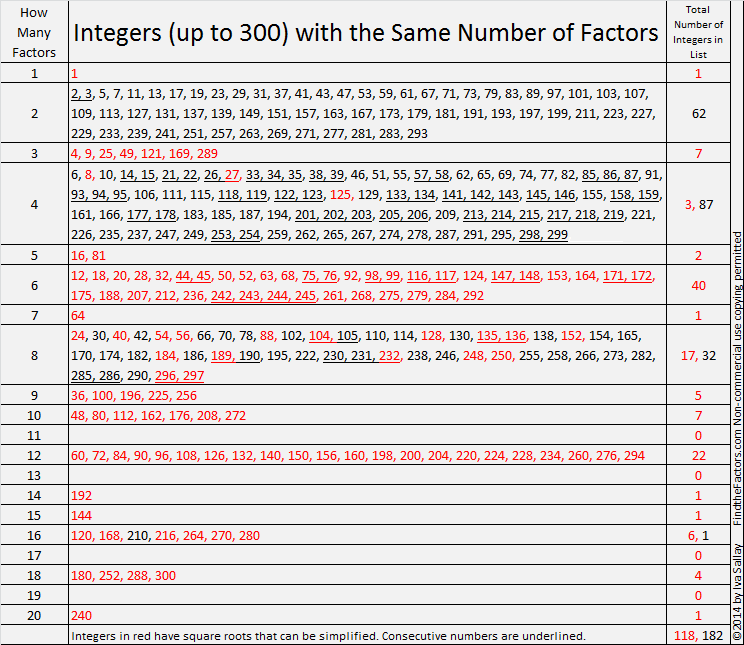
Integers (up to 300) with the Same Number of Factors

  • 300 is a composite number.
  • Prime factorization: 300 = 2 x 2 x 3 x 5 x 5, which can be written 300 = (2^2) x 3 x (5^2)
  • The exponents in the prime factorization are 2, 1 and 2. Adding one to each and multiplying we get (2 + 1)(1 + 1)(2 + 1) = 3 x 2 x 3 = 18. Therefore 300 has exactly 18 factors.
  • Factors of 300: 1, 2, 3, 4, 5, 6, 10, 12, 15, 20, 25, 30, 50, 60, 75, 100, 150, 300
  • Factor pairs: 300 = 1 x 300, 2 x 150, 3 x 100, 4 x 75, 5 x 60, 6 x 50, 10 x 30, 12 x 25 or 15 x 20
  • Taking the factor pair with the largest square number factor, we get √300 = (√3)(√100) = 10√3 ≈ 17.321

I made a couple of graphics a few weeks ago anticipating my 300th post.

Integers with the Same Number of Factors

Observations:

  • The only number with exactly one factor is one.
  • The number of factors of all the black integers on the chart are powers of 2. These integers have irreducible square roots.
  • Consecutive integers with the same number of factors can only occur if the number of factors is NOT a prime number.
  • 90/300 or 30% of the first 300 integers have 4 factors. (Largest group)
  • 62/300 or 20.6666% of the first 300 integers are prime numbers and therefore have 2 factors. (2nd largest group)
  • 49/300 or 16.3333% of the first 300 integers have 8 factors. (3rd largest group)
  • 40/300 or 13.3333% of the first 300 integers have 6 factors. (4th largest group) All integers with 6 factors have reducible square roots.
  • 22/300 or 7.3333% of the first 300 integers have 12 factors. (5th largest group)
  • All but 37/300 or 12.3333% of the first 300 integers are in one of those 5 groups.
  • 118/300 or 39.3333% of the first 300 integers have square roots that can be simplified.

Warning: the next chart and observations could make your brain hurt:

Smallest Numbers with 2 to 20 Factors

  • How many numbers have exactly 2 factors? Euclid proved that there is an infinite number of prime numbers which means there is an infinite number of integers with exactly 2 factors.
  • How many integers have exactly 19 factors? Even though the smallest integer with exactly 19 factors is 262,144, there is still an infinite number of integers with exactly that many factors. The integers in that list are each prime number raised to the 18th power. Since there is an infinite number of prime numbers, there is an infinite number of integers with exactly 19 factors.
  • {2⁹⁹⁶, 3⁹⁹⁶, 5⁹⁹⁶, . . . } is the infinite list of integers with exactly 997 factors. Likewise {2ᵖ⁻¹, 3ᵖ⁻¹, 5ᵖ⁻¹, . . . } where p is a prime number is the infinite list of integers with exactly p factors.
  • If the number of factors is c, a composite number, then it could be said that there is more than an infinite number of integers with that many factors because the infinite list of integers will include {2ᶜ⁻¹, 3ᶜ⁻¹, 5ᶜ⁻¹, . . . } as well as many other integers.

293 and Level 4

  • 293 is a prime number.
  • Prime factorization: 293 is prime.
  • The exponent of prime number 293 is 1. Adding 1 to that exponent we get (1 + 1) = 2. Therefore 293 has exactly 2 factors.
  • Factors of 293: 1, 293
  • Factor pairs: 293 = 1 x 293
  • 293 has no square factors that allow its square root to be simplified. √293 ≈ 17.117

How do we know that 293 is a prime number? If 293 were not a prime number, then it would be divisible by at least one prime number less than or equal to √293 ≈ 17.117. Since 293 cannot be divided evenly by 2, 3, 5, 7, 11, 13, or 17, we know that 293 is a prime number.

—————

I will be having major surgery tomorrow so I’ll publish the rest of this week’s puzzles early. I suspect that next week’s puzzles might be published late.

Today’s puzzle has another ten clues, but this puzzle is just a little more challenging that the last one.

2014-45 Level 4

Print the puzzles or type the factors on this excel file: 10 Factors 2014-11-10

Here are a few more number facts about the number 293:

17² + 2² = 293

Thus, 293 is the hypotenuse of a primitive Pythagorean triple:

  • 68-285-293 calculated from 2(17)(2), 17² – 2², 17² + 2².

293 is the short leg of this primitive Pythagorean triple:

  • 293-42924-42925

293 can also be written as the sum of three squares four different ways:

  • 16² + 6² + 1² = 293
  • 15² + 8² + 2² = 293
  • 14² + 9² + 4² = 293
  • 12² + 10² + 7² = 293

2014-45 Level 4 Logic

288 and Level 5

  • 288 is a composite number.
  • Prime factorization: 288 = 2 x 2 x 2 x 2 x 2 x 3 x 3, which can be written 288 = (2^5) x (3^2)
  • The exponents in the prime factorization are 5 and 2. Adding one to each and multiplying we get (5 + 1)(2 + 1) = 6 x 3  = 18. Therefore 288 has exactly 18 factors.
  • Factors of 288: 1, 2, 3, 4, 6, 8, 9, 12, 16, 18, 24, 32, 36, 48, 72, 96, 144, 288
  • Factor pairs: 288 = 1 x 288, 2 x 144, 3 x 96, 4 x 72, 6 x 48, 8 x 36, 9 x 32, 12 x 24, or 16 x 18
  • Taking the factor pair with the largest square number factor, we get √288 = (√2)(√144) = 12√2 ≈ 16.971

2014-44 Level 5

Print the puzzles or type the factors on this excel file: 12 Factors 2014-11-03

2014-44 Level 5 Logic

287 and Level 4

  • 287 is a composite number.
  • Prime factorization: 287 = 7 x 41
  • The exponents in the prime factorization are 1 and 1. Adding one to each and multiplying we get (1 + 1)(1 + 1) = 2 x 2 = 4. Therefore 287 has 4 factors.
  • Factors of 287: 1, 7, 41, 287
  • Factor pairs: 287 = 1 x 287 or 7 x 41
  • 287 has no square factors that allow its square root to be simplified. √287 ≈ 16.941.

Here’s today’s puzzle:

2014-44 Level 4


Print the puzzles or type the factors on this excel file: 12 Factors 2014-11-03

2014-44 Level 4 Logic

286 and Level 3

  • 286 is a composite number.
  • Prime factorization: 286 = 2 x 11 x 13
  • The exponents in the prime factorization are 1, 1, and 1. Adding one to each and multiplying we get (1 + 1)(1 + 1)(1 + 1) = 2 x 2 x 2 = 8. Therefore 286 has 8 factors.
  • Factors of 286: 1, 2, 11, 13, 22, 26, 143, 286
  • Factor pairs: 1 x 286, 2 x 143, 11 x  26, or 13 x 22
  • 286 has no square factors that allow its square root to be simplified. √286 ≈ 16.912

2014-44 Level 3

Print the puzzles or type the factors on this excel file: 12 Factors 2014-11-03

A Logical Approach to FIND THE FACTORS: Find the column or row with two clues and find their common factor. Write the corresponding factors in the factor column (1st column) and factor row (top row).  Because this is a level three puzzle, you have now written a factor at the top of the factor column. Continue to work from the top of the factor column to the bottom, finding factors and filling in the factor column and the factor row one cell at a time as you go.

2014-44 Level 3 Factors

285 and Level 2

  • 285 is a composite number.
  • Prime factorization: 285 = 3 x 5 x 19
  • The exponents in the prime factorization are 1, 1, and 1. Adding one to each and multiplying we get (1 + 1)(1 + 1)(1 + 1) = 2 x 2 x 2 = 8. Therefore 285 has 8 factors.
  • Factors of 285: 1, 3, 5, 15, 19, 57, 95, 285
  • Factor pairs: 1 x 185, 3 x 95, 5 x 57, or 15 x 19
  • 285 has no square factors that allow its square root to be simplified. √285 ≈ 16.882

2014-44 Level 2

Print the puzzles or type the factors on this excel file: 12 Factors 2014-11-03

2014-44 Level 2 Factors

284 and Level 1

  • 284 is a composite number.
  • Prime factorization: 284 = 2 x 2 x 71, which can be written 284 = 2² x 71
  • The exponents in the prime factorization are 2 and 1. Adding one to each and multiplying we get (2 + 1)(1 + 1) = 3 x 2  = 6. Therefore 284 has exactly 6 factors.
  • Factors of 284: 1, 2, 4, 71, 142, 284
  • Factor pairs: 284 = 1 x 284, 2 x 142, or 4 x 71
  • Taking the factor pair with the largest square number factor, we get √284 = (√4)(√71) = 2√71 ≈ 16.852

2014-44 Level 1

Print the puzzles or type the factors on this excel file: 12 Factors 2014-11-03

2014-44 Level 1 Factors

283 and Level 6

  • 283 is a prime number.
  • Prime factorization: 283 is prime.
  • The exponent of prime number 283 is 1. Adding 1 to that exponent we get (1 + 1) = 2. Therefore 283 has exactly 2 factors.
  • Factors of 283: 1, 283
  • Factor pairs: 283 = 1 x 283
  • 283 has no square factors that allow its square root to be simplified. √283 ≈ 16.823

How do we know that 283 is a prime number? If 283 were not a prime number, then it would be divisible by at least one prime number less than or equal to √283 ≈ 16.823. Since 283 cannot be divided evenly by 2, 3, 5, 7, 11, or 13, we know that 283 is a prime number.

2014-43 Level 6

Print the puzzles or type the factors on this excel file: 10 Factors 2014-10-27

2014-43 Level 6 Logic