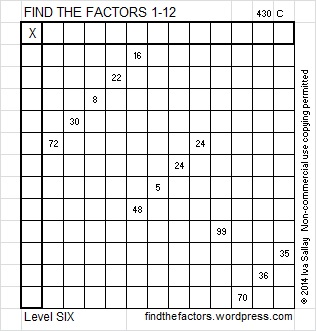
223 and Level 5

  • 223 is a prime number.
  • Prime factorization: 223 is prime.
  • The exponent of prime number 223 is 1. Adding 1 to that exponent we get (1 + 1) = 2. Therefore 223 has exactly 2 factors.
  • Factors of 223: 1, 223
  • Factor pairs: 223 = 1 x 223
  • 223 has no square factors so its square root cannot be simplified. √223 ≈ 14.933

How do we know that 223 is a prime number? If 223 were not a prime number, then it would be divisible by at least one prime number less than or equal to √223 ≈ 14.933. Since 223 cannot be divided evenly by 2, 3, 5, 7, 11, or 13, we know that 223 is a prime number.

2014-35 Level 5

Excel file of puzzles and previous week’s factor solutions: 10 Factors 2014-09-01

2014-35 Level 5 Logic

211 and Level 5

  • 211 is a prime number.
  • Prime factorization: 211 is prime.
  • The exponent of prime number 211 is 1. Adding 1 to that exponent we get (1 + 1) = 2. Therefore 211 has exactly 2 factors.
  • Factors of 211: 1, 211
  • Factor pairs: 211 = 1 x 211
  • 211 has no square factors so its square root cannot be simplified. √211 ≈ 14.526

How do we know that 211 is a prime number? If 211 were not a prime number, then it would be divisible by at least one prime number less than or equal to √211 ≈ 14.526. Since 211 cannot be divided evenly by 2, 3, 5, 7, 11, or 13, we know that 211 is a prime number.

 2014-33 Level 5

Excel file of puzzles and previous week’s factor solutions: 10 Factors 2014-08-18

2014-33 Level 5 Logic

199 My List of Multiplication Rhymes

  • 199 is a prime number.
  • Prime factorization: 199 is prime.
  • The exponent of prime number 199 is 1. Adding 1 to that exponent we get (1 + 1) = 2. Therefore 199 has exactly 2 factors.
  • Factors of 199: 1, 199
  • Factor pairs: 199 = 1 x 199
  • 199 has no square factors that allow its square root to be simplified. √199 ≈ 14.1067

How do we know that 199 is a prime number? If 199 were not a prime number, then it would be divisible by at least one prime number less than or equal to √199 ≈ 14.1. Since 199 cannot be divided evenly by 2, 3, 5, 7, 11, or 13, we know that 199 is a prime number.

———————————

I recently wrote a post that asked “Are Multiplication Rhymes Able to Help Kids Learn the Multiplication Table?” Here is a list of rhymes that I’ve put together.

Multiplication Rhymes


Most of the rhymes have rhyming clues to help students remember both numbers being multiplied as well as their product. I wrote the rhymes that are highlighted in yellow. Those highlighted in peach, purple, or blue are from other sources, but I did alter the rhymes for 24, 28, and 81. A black and white pdf of the rhymes is also available here.

197 and Level 5

  • 197 is a prime number.
  • Prime factorization: 197 is prime.
  • The exponent of prime number 197 is 1. Adding 1 to that exponent we get (1 + 1) = 2. Therefore 197 has exactly 2 factors.
  • Factors of 197: 1, 197
  • Factor pairs: 197 = 1 x 197
  • 197 has no square factors that allow its square root to be simplified. √197 ≈ 14.0356688

How do we know that 197 is a prime number? If 197 were not a prime number, then it would be divisible by at least one prime number less than or equal to √197 ≈ 14. Since 197 cannot be divided evenly by 2, 3, 5, 7, 11, or 13, we know that 197 is a prime number.

2014-31 Level 5

Excel file of puzzles and previous week’s factor solutions: 10 Factors 2014-08-04

2014-31 Level 5 Logic

193 and Level 2

  • 193 is a prime number.
  • Prime factorization: 193 is prime.
  • The exponent of prime number 193 is 1. Adding 1 to that exponent we get (1 + 1) = 2. Therefore 193 has exactly 2 factors.
  • Factors of 193: 1, 193
  • Factor pairs: 193 = 1 x 193
  • 193 has no square factors that allow its square root to be simplified. √193 ≈ 13.89244

How do we know that 193 is a prime number? If 193 were not a prime number, then it would be divisible by at least one prime number less than or equal to √193 ≈ 13.9. Since 193 cannot be divided evenly by 2, 3, 5, 7, 11, or 13, we know that 193 is a prime number.

2014-31 Level 2

Excel file of puzzles and previous week’s factor solutions: 10 Factors 2014-08-04

2014-31 Level 2 Factors

191 and Level 6

  • 191 is a prime number.
  • Prime factorization: 191 is prime.
  • The exponent of prime number 191 is 1. Adding 1 to that exponent we get (1 + 1) = 2. Therefore 191 has exactly 2 factors.
  • Factors of 191: 1, 191
  • Factor pairs: 191 = 1 x 191
  • 191 has no square factors that allow its square root to be simplified. √191 ≈ 13.82027

How do we know that 191 is a prime number? If 191 were not a prime number, then it would be divisible by at least one prime number less than or equal to √191 ≈ 13.8. Since 191 cannot be divided evenly by 2, 3, 5, 7, 11, or 13, we know that 191 is a prime number.

There are 22 prime numbers between 100 and 200:

  • The first four of those prime numbers are 101, 103, 107, and 109.
  • The last four of those prime numbers are 191, 193, 197, and 199.


2014-30 Level 6

Excel file of puzzles and previous week’s factor solutions: 12 Factors 2014-07-28

2014-30 Level 6 Logic

2014-30 Level 6 Problems


181 and Level 2

  • 181 is a prime number.
  • Prime factorization: 181 is prime.
  • The exponent of prime number 181 is 1. Adding 1 to that exponent we get (1 + 1) = 2. Therefore 181 has exactly 2 factors.
  • Factors of 181: 1, 181
  • Factor pairs: 181 = 1 x 181
  • 181 has no square factors that allow its square root to be simplified. √181 ≈ 13.45362

How do we know that 181 is a prime number? If 181 were not a prime number, then it would be divisible by at least one prime number less than or equal to √181 ≈ 13.5. Since 181 cannot be divided evenly by 2, 3, 5, 7, 11, or 13, we know that 181 is a prime number.

2014-29 Level 2

Excel file of puzzles and previous week’s factor solutions: 10 Factors 2014-07-21

2014-29 Level 2 Factors

179 and Level 6

  • 179 is a prime number.
  • Prime factorization: 179 is prime.
  • The exponent of prime number 179 is 1. Adding 1 to that exponent we get (1 + 1) = 2. Therefore 179 has exactly 2 factors.
  • Factors of 179: 1, 179
  • Factor pairs: 179 = 1 x 179
  • 179 has no square factors that allow its square root to be simplified. √179 ≈ 13.379088

How do we know that 179 is a prime number? If 179 were not a prime number, then it would be divisible by at least one prime number less than or equal to √179 ≈ 13.4. Since 179 cannot be divided evenly by 2, 3, 5, 7, 11, or 13, we know that 179 is a prime number.

2014-28 Level 6

Excel file of puzzles and previous week’s factor solutions: 12 Factors 2014-07-14

2014-28 Level 6 Logic

173 and Level 6

  • 173 is a prime number.
  • Prime factorization: 173 is prime.
  • The exponent of prime number 173 is 1. Adding 1 to that exponent we get (1 + 1) = 2. Therefore 173 has exactly 2 factors.
  • Factors of 173: 1, 173
  • Factor pairs: 173 = 1 x 173
  • 173 has no square factors that allow its square root to be simplified. √173 ≈ 13.1529

How do we know that 173 is a prime number? If 173 were not a prime number, then it would be divisible by at least one prime number less than or equal to √173 ≈ 13.2. Since 173 cannot be divided evenly by 2, 3, 5, 7, 11, or 13, we know that 173 is a prime number.

2014-27 Level 6

Excel file of puzzles and previous week’s factor solutions: 10 Factors 2014-07-07

2014-27 Level 6 Logic

167 and Level 1

  • 167 is a prime number.
  • Prime factorization: 167 is prime.
  • The exponent of prime number 167 is 1. Adding 1 to that exponent we get (1 + 1) = 2. Therefore 167 has exactly 2 factors.
  • Factors of 167: 1, 167
  • Factor pairs: 167 = 1 x 167
  • 167 has no square factors that allow its square root to be simplified. √167 ≈ 12.9228

How do we know that 167 is a prime number? If 167 were not a prime number, then it would be divisible by at least one prime number less than or equal to √167 ≈ 12.9. Since 167 cannot be divided evenly by 2, 3, 5, 7, or 11, we know that 167 is a prime number.

2014-27 Level 1

Excel file of puzzles and previous week’s factor solutions: 10 Factors 2014-07-07

2014-27 Level 1 Factors