876 and Level 1

876 consists of three consecutive numbers 6, 7, 8, so 876 has to be divisible by 3. We can also conclude the following:

  • Since it’s even and divisible by 3, we know that 876 is also divisible by 6.
  • Since it is divisible by 3 and it’s last two digits are divisible by 4, we know that 876 is also divisible by 12.

Print the puzzles or type the solution on this excel file: 10-factors-875-885

876 is a palindrome in four other bases:

  • 727 BASE 11, because 7(121) + 2(11) + 7(1) = 876
  • 525 BASE 13, because 5(13²) + 2(13¹) + 5(13º) = 876
  • 282 BASE 19, because 2(19²) + 8(19¹) + 2(19º) = 876
  • 1A1 BASE 25 (A is 10 base 10), because 1(25²) + 10(25¹) + 1(25º) = 876

876 is also the hypotenuse of Pythagorean triple, 576-660-876 which is 12 times (48-55-73).

  • 876 is a composite number.
  • Prime factorization: 876 = 2 × 2 × 3 × 73, which can be written 876 = 2² × 3 × 73
  • The exponents in the prime factorization are 2, 1, and 1. Adding one to each and multiplying we get (2 + 1)(1 + 1)(1 + 1) = 3 × 2 × 2 = 12. Therefore 876 has exactly 12 factors.
  • Factors of 876: 1, 2, 3, 4, 6, 12, 73, 146, 219, 292, 438, 876
  • Factor pairs: 876 = 1 × 876, 2 × 438, 3 × 292, 4 × 219, 6 × 146, or 12 × 73,
  • Taking the factor pair with the largest square number factor, we get √876 = (√4)(√219) = 2√219 ≈ 29.597297

874 and Level 6

874 is the sum of the first 23 prime numbers:

  • 2 + 3 + 5 + 7 + 11 + 13 + 17 + 19 + 23 + 29 + 31 + 37 + 41 + 43 + 47 + 53 + 59 + 61 + 67 + 71 + 73 + 79 + 83 = 874

ALL of 874’s prime factors were included in that list.

Print the puzzles or type the solution on this excel file: 12 factors 864-874

  • 874 is a composite number.
  • Prime factorization: 874 = 2 × 19 × 23
  • The exponents in the prime factorization are 1, 1, and 1. Adding one to each and multiplying we get (1 + 1)(1 + 1)(1 + 1) = 2 × 2 × 2 = 8. Therefore 874 has exactly 8 factors.
  • Factors of 874: 1, 2, 19, 23, 38, 46, 437, 874
  • Factor pairs: 874 = 1 × 874, 2 × 437, 19 × 46, or 23 × 38
  • 874 has no square factors that allow its square root to be simplified. √874 ≈ 29.56349.

873 and Level 5

8 + 7 + 3 = 18; 1 + 8 = 9, so 873 can be evenly divided by 9.

27² + 12² = 873 so 873 is the hypotenuse of a Pythagorean triple:

  • 585-648-873 which is 9 times (65-72-97), and can be calculated from 27² – 12², 2(27)(12), 27² + 12²

OEIS.org reminds us that 1! + 2! + 3! + 4! + 5! + 6! = 873.

Print the puzzles or type the solution on this excel file: 12 factors 864-874

  • 873 is a composite number.
  • Prime factorization: 873 = 3 × 3 × 97, which can be written 873 = 3² × 97
  • The exponents in the prime factorization are 2 and 1. Adding one to each and multiplying we get (2 + 1)(1 + 1) = 3 × 2  = 6. Therefore 873 has exactly 6 factors.
  • Factors of 873: 1, 3, 9, 97, 291, 873
  • Factor pairs: 873 = 1 × 873, 3 × 291, or 9 × 97
  • Taking the factor pair with the largest square number factor, we get √873 = (√9)(√97) = 3√97 ≈ 29.546573


872 and Level 4

26² + 14² = 872 so 872 is the hypotenuse of a Pythagorean triple:

480-728-872 which can be calculated from 26² – 14², 2(26)(14), 26² + 14².

872 is the sum of consecutive prime numbers 433 and 439.

872 is also the sum of the 21 prime numbers from 3 to 79.

872! + 1 is a number much too big for any calculator I own, but OEIS.org informs us that it is a prime number.

Print the puzzles or type the solution on this excel file: 12 factors 864-874


  • 872 is a composite number.
  • Prime factorization: 872 = 2 × 2 × 2 × 109, which can be written 872 = 2³ × 109
  • The exponents in the prime factorization are 3 and 1. Adding one to each and multiplying we get (3 + 1)(1 + 1) = 4 × 2 = 8. Therefore 872 has exactly 8 factors.
  • Factors of 872: 1, 2, 4, 8, 109, 218, 436, 872
  • Factor pairs: 872 = 1 × 872, 2 × 436, 4 × 218, or 8 × 10⁹
  • Taking the factor pair with the largest square number factor, we get √872 = (√4)(√218) = 2√218 ≈ 29.529646

870 If You Can Solve a 3×3 and a 4×4 Magic Square, Then You Can Solve a 12×12 Magic Square

It’s simple multiplication, folks!

3×4 = 12, so if you can solve a 3×3 Magic Square and a 4×4 Magic Square, then you can solve a 12×12 Magic Square, too.

Seriously. Really. It’s true! You really can solve a 12×12 Magic Square. I did it. Twice. You’ll see. You can do it, too.

That solution consists of sixteen 3×3 Magic Squares that use all the numbers from 1 to 144. The one in the corner is the most familiar one. The other ones are just that familiar Magic Square plus 9, 18, 27 and a few other multiples of 9. I used the 4×4 Magic Square below as a guide as I placed the sixteen 3×3 Magic Squares on the excel file I made, 12 factors 864-874.

4 x 4 Magic Square

make science GIFs like this at MakeaGif

There is 1 solution times 8 orientations (right-side-up, upside-down, etc.) for the 3×3 Magic Square, and there are 880 solutions times 8 orientations for the 4×4 Magic Square. That’s a lot of different possible solutions!

I also solved the 12×12 Magic Square by using nine 4×4 Magic Squares and placing them on the second grid in 12 factors 864-874. This arrangement also has many more possibilities than the one shown here.

You can easily solve your own 12×12 Magic Square by opening this excel file, 12 factors 864-874, going to the 12×12 Magic Square tab, and following the directions.

Here’s more about the awesome number 870:

29 × 30 = 870. That means 870 is 29 × (29+1), so 870 is the sum of the first 29 even numbers.

870 is the sum of the ten prime numbers from 67 to 107.

Because 5 and 29 are its factors, 870 is the hypotenuse of four Pythagorean triples: ( Note that 5 × 29 = 145)

  • 102-864-870, which is 6 times (17-144-145)
  • 144-858-870, which is 6 times (24-143-145)
  • 522-696-870, which is (3-4-5) times 174
  • 600-630-870, which is (20-21-29) times 30

870 has some interesting representations in other bases:

  • 606 in BASE 12, because 6(12²) + 0(12¹) + 6(12º) = 6(145) = 870
  • 303 in BASE 17, because 3(17²) + 0(17¹) + 3(17º) = 3(290) = 870
  • 110 in BASE 29, because 1(29²) + 1(29¹) + 0(29º) = 870
  • T0 in BASE 30 (T is 29 base 10), because 29(30¹) + 0(30º) = 29(30) = 870

8 + 0 + 7 + 8³ + 0³ + 7³ = 870. Thank you OEIS.org for that fun fact.

  • 870 is a composite number.
  • Prime factorization: 870 = 2 × 3 × 5 × 29
  • The exponents in the prime factorization are 1, 1, 1, and 1. Adding one to each and multiplying we get (1 + 1)(1 + 1)(1 + 1)(1 + 1) = 2 × 2 × 2 × 2 = 16. Therefore 870 has exactly 16 factors.
  • Factors of 870: 1, 2, 3, 5, 6, 10, 15, 29, 30, 58, 87, 145, 174, 290, 435, 870
  • Factor pairs: 870 = 1 × 870, 2 × 435, 3 × 290, 5 × 174, 6 × 145, 10 × 87, 15 × 58, or 29 × 30
  • 870 has no square factors that allow its square root to be simplified. √870 ≈ 29.495762

869 and Level 3

8 – 6 + 9 = 11 so 869 is divisible by 11.

869 is equal to the sum of the 21 prime numbers from 5 to 83.

Print the puzzles or type the solution on this excel file: 12 factors 864-874

  • 869 is a composite number.
  • Prime factorization: 869 = 11 × 79
  • The exponents in the prime factorization are 1 and 1. Adding one to each and multiplying we get (1 + 1)(1 + 1) = 2 × 2 = 4. Therefore 869 has exactly 4 factors.
  • Factors of 869: 1, 11, 79, 869
  • Factor pairs: 869 = 1 × 869 or 11 × 79
  • 869 has no square factors that allow its square root to be simplified. √869 ≈ 29.4788

Palindrome 868 Has a Fun Square Root

Obviously, 868 is a palindrome in base 10. It has some interesting representations in some other bases, too:

  • 868 is 4004 in BASE 6, because 4(6³) + 0(6²) + 0(6¹) + 4(6º) = 868
  • SS in BASE 30 (S is 28 base 10), because 28(30) + 28(1) = 28(31) = 868
  • S0 in BASE 31, because 28(31) = 868

From OEIS.org I learned that all the digits from 1 to 9 make up the first nine decimal places of √868, so I decided to make a gif showing that fun fact:

Square root of 868

make science GIFs like this at MakeaGif
  • 868 is a composite number.
  • Prime factorization: 868 = 2 × 2 × 7 × 31, which can be written 868 = 2² × 7 × 31
  • The exponents in the prime factorization are 2, 1, and 1. Adding one to each and multiplying we get (2 + 1)(1 + 1)(1 + 1) = 3 × 2 × 2 = 12. Therefore 868 has exactly 12 factors.
  • Factors of 868: 1, 2, 4, 7, 14, 28, 31, 62, 124, 217, 434, 868
  • Factor pairs: 868 = 1 × 868, 2 × 434, 4 × 217, 7 × 124, 14 × 62, or 28 × 31,
  • Taking the factor pair with the largest square number factor, we get √868 = (√4)(√217) = 2√217 ≈ 29.461839725

867 and Level 2

867 is composed of three consecutive numbers so 867 is divisible by 3. The middle number of those three numbers, 6, 7, 8 is 7 so 867 is NOT divisible by 9.

Print the puzzles or type the solution on this excel file: 12 factors 864-874

867 is the hypotenuse of two Pythagorean triples:

  • 483-720-867, which is 3 times (161-240-289)
  • 408-765-867 which is (8-15-17) times 51

867 is 300 in BASE 17 because 3(17²) = 867.

  • 867 is a composite number.
  • Prime factorization: 867 = 3 × 17 × 17, which can be written 867 = 3 × 17²
  • The exponents in the prime factorization are 1 and 2. Adding one to each and multiplying we get (1 + 1)(2 + 1) = 2 × 3  = 6. Therefore 867 has exactly 6 factors.
  • Factors of 867: 1, 3, 17, 51, 289, 867
  • Factor pairs: 867 = 1 × 867, 3 × 289, or 17 × 51
  • Taking the factor pair with the largest square number factor, we get √867 = (√289)(√3) = 17√3 ≈ 29.44486

865 and Level 1

Print the puzzles or type the solution on this excel file: 12 factors 864-874

865 is the sum of two squares two different ways:

  • 28² + 9² = 865
  • 24² + 17² = 865

865 is the hypotenuse of four Pythagorean triples, two of which are primitives:

  • 260-825-865, which is 5 times (52-165-173)
  • 287-816-865, which is 24² – 17², 2(24)(17), 24² + 17²
  • 504-703-865 which is 2(28)(9), 28² – 9², 28² – 9²
  • 519-692-865, which is (3-4-5) times 173

You could see 865’s factors in two of those Pythagorean triples, and here they are again:

  • 865 is a composite number.
  • Prime factorization: 865 = 5 × 173
  • The exponents in the prime factorization are 1 and 1. Adding one to each and multiplying we get (1 + 1)(1 + 1) = 2 × 2 = 4. Therefore 865 has exactly 4 factors.
  • Factors of 865: 1, 5, 173, 865
  • Factor pairs: 865 = 1 × 865 or 5 × 173
  • 865 has no square factors that allow its square root to be simplified. √865 ≈ 29.41088

864 Factor Trees

Factor Trees for 864:

The prime factorization of 864 is 2⁵ × 3³. The sum of the exponents is 5 + 3 = 8. Since 8 is a power of 2,  a couple of 864’s factor trees are full and well-balanced:

All of those prime factors lined up in numerical order. That didn’t happen for the next one, but it still makes a good looking tree, and all the prime factors are easy to find.

Is it possible to make a factor tree for 864 that hardly looks like a tree and isn’t as easy to find all the prime factors? Yes, it is. Here’s an example:

Factors of 864:

  • 864 is a composite number.
  • Prime factorization: 864 = 2 × 2 × 2 × 2 × 2 × 3 × 3 × 3, which can be written 864 = 2⁵ × 3³
  • The exponents in the prime factorization are 5 and 3. Adding one to each and multiplying we get (5 + 1)(3 + 1) = 6 × 4 = 24. Therefore 864 has exactly 24 factors.
  • Factors of 864: 1, 2, 3, 4, 6, 8, 9, 12, 16, 18, 24, 27, 32, 36, 48, 54, 72, 96, 108, 144, 216, 288, 432, 864
  • Factor pairs: 864 = 1 × 864, 2 × 432, 3 × 288, 4 × 216, 6 × 144, 8 × 10⁸, 9 × 96, 12 × 72, 16 × 54, 18 × 48, 24 × 36, or 27 × 32
  • Taking the factor pair with the largest square number factor, we get √864 = (√144)(√6) = 12√6 ≈ 29.3938769

Sum-Difference Puzzles:

6 has two factor pairs. One of those pairs adds up to 5, and the other one subtracts to 5. Put the factors in the appropriate boxes in the first puzzle.

864 has twelve factor pairs. One of the factor pairs adds up to ­60, and a different one subtracts to 60. If you can identify those factor pairs, then you can solve the second puzzle!

More Facts about the Number 864:

864 looked interesting to me in a few other bases:

  • 4000 BASE 6 because 4(6³) = 864
  • 600 BASE 12 because 6(12²) = 864
  • RR BASE 31 (R is 27 base 10) because 27(31) + 27(1) = 27(32) = 864
  • OO BASE 35 (O is 24 base 10) because 24(35) + 24(1) = 24(36) = 864
  • O0 BASE 36 (Oh zero) because 24(36) + 0(1) = 864

864 is the sum of the 20 prime numbers from 7 to 83.

131 + 137 + 139 + 149 + 151 + 157 = 864; that’s six consecutive primes.

431 + 433 = 864; that’s the sum of twin primes.

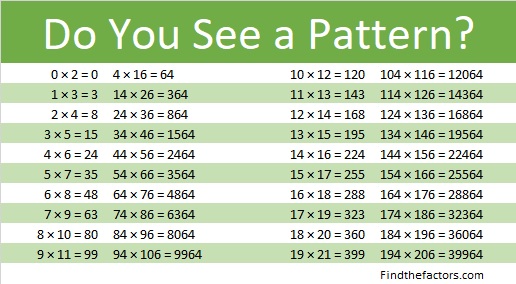
864 is in this cool pattern: