368 and a Few Sequences

368 is a composite number because it is even. Scroll down for its factoring information.

Sequences can be illustrated in pictures, but they are most often simply a list of numbers such as 23, 46, 69, 92, 115, . . . . .

Those numbers are the multiples of 23 listed in order. If we continued writing the numbers in that sequence, we would see that 368 is the 16th number listed.

We also know that 368 is an element of many other sequences even though it isn’t one of the typed numbers:

  • The sequence of all counting numbers: 1, 2, 3, 4, 5, . . . .
  • The sequence of all even counting numbers: 2, 4, 6, 8, 10, . . . .
  • The sequence of numbers that are multiples of four: 4, 8, 12, 16, 20, . . . . (This is the yellow sequence in the graphic below.)
  • The sequence of numbers that are one less than the multiples of three: 2, 5, 8, 11, 14, . . . .
  • The sequence of numbers that are one less than the multiples of nine: 8, 17, 26, 35, 44, . . . .

What's the next value

386 is NOT an element of any of the following sequences that involve even squared numbers:

  • 3, 15, 35, 63, 99, . . . . (The blue sequence in the graphic above)
  • 4, 16, 36, 64, 100, . . . .
  • 5, 17, 37, 65, 101, . . . . (The red sequence in the graphic above)

The yellow, blue, and red sequences above can be made into an array that contains only Primitive Pythagorean Triples!

Even Primitive Pythagorean Triple Sequence

Except for the 3, 4, 5 triangle that is listed first, every multiple of 4 is the short leg in a primitive Pythagorean triple! The other leg and the hypotenuse are based on a square with sides that are 1/2 the length of the shorter leg. Since the shorter leg is a multiple of four, that square length will always be an even number. Also note: 368 is divisible by 4 so 368, 33855, 33857 is a primitive that would be included in this sequence array.

The sequence contains only primitives, but it does NOT contain EVERY primitive whose short leg is a multiple of four. For example Pythagorean triple, 20, 21, 29, is not in that sequence array.

Let’s look at all the factoring information for 368:

  • 368 is a composite number.
  • Prime factorization: 368 = 2 x 2 x 2 x 2 x 23, which can be written 368 = (2^4) x 23
  • The exponents in the prime factorization are 4 and 1. Adding one to each and multiplying we get (4 + 1)(1 + 1) = 5 x 2 = 10. Therefore 368 has exactly 10 factors.
  • Factors of 368: 1, 2, 4, 8, 16, 23, 46, 92, 184, 368
  • Factor pairs: 368 = 1 x 368, 2 x 184, 4 x 92, 8 x 46, or 16 x 23
  • Taking the factor pair with the largest square number factor, we get √368 = (√16)(√23) = 4√23 ≈ 19.183

We can make a sequence array from the Pythagorean triple primitive 3, 4, 5 and its non-primitive multiples (which includes 276, 368, 460):

A Pythagorean Triple Sequence Array

We can find other Pythagorean triples that contain the number 368. Notice that 368 has several factors that are multiples of 4. They are 4, 8, 16, 92, and 184. Each one of them has its own primitive triple which can be multiplied by its factor pair partner to produce non-primitive triples that include 368 as well.

  • 3, 4, 5 multiplied by 92 is 276, 368, 460
  • 8, 15, 17 multiplied by 46 is 368, 690, 782
  • 16, 63, 65 multiplied by 23 is 368, 1449, 1495
  • 92, 2115, 2117 multiplied by 4 is 368, 8460, 8468
  • 184, 8463, 8465 multiplied by 2 is 368, 16926, 16930

In future posts I’ll write about how to find other Pythagorean triples like

  • 23, 264, 265, a primitive Pythagorean triple with an odd short leg. This primitive becomes 368, 4224, 4240 when multiplied by 16 (23’s factor pair partner).
  • 368, 465, 593, another primitive Pythagorean triple not included in the colored sequence array above and
  • 184, 513, 545, which when multiplied by 2 becomes 368, 1026, 1090.

Pythagorean triples aren’t just a bunch of “SQUARE” numbers. They are simply counting numbers that satisfy the equation a² + b² = c², and they are really COOL!


367 and Level 1

2^367 (mod 367) = 2, so 367 is VERY LIKELY a prime number. Scroll down below the puzzle to know for sure.

367 Puzzle

Print the puzzles or type the factors on this excel file:12 Factors 2015-01-26

  • 367 is a prime number.
  • Prime factorization: 367 is prime.
  • The exponent of prime number 367 is 1. Adding 1 to that exponent we get (1 + 1) = 2. Therefore 367 has exactly 2 factors.
  • Factors of 367: 1, 367
  • Factor pairs: 367 = 1 x 367
  • 367 has no square factors that allow its square root to be simplified. √367 ≈ 19.157

How do we know that 367 is a prime number? If 367 were not a prime number, then it would be divisible by at least one prime number less than or equal to √367 ≈ 19.157. Since 367 cannot be divided evenly by 2, 3, 5, 7, 11, 13, 17, or 19, we know that 367 is a prime number.

367 Factors

366 and a Quote from Euclid

The laws of nature are but the mathematical thoughts of God.  ~Euclid

//platform.twitter.com/widgets.js

Euclid was a Greek mathematician who was born about 300 BC. I realize when he wrote these words (in ancient Greek), they didn’t mean the exact same thing to him that they mean to me. Nevertheless, I like the quote very much, and find infinite beauty in its message. The laws of nature are but the mathematical thoughts of God.  ~Euclid

Since writing this post, I have found some other lovely representations of this quote on twitter:

//platform.twitter.com/widgets.js

It is well worth pushing the button to see this next gif in action:

//platform.twitter.com/widgets.js

Here are some mathematical thoughts about the number 366:

  • 366 is a composite number.
  • Prime factorization: 366 = 2 x 3 x 61
  • The exponents in the prime factorization are 1, 1, and 1. Adding one to each and multiplying we get (1 + 1)(1 + 1)(1 + 1) = 2 x 2 x 2 = 8. Therefore 366 has exactly 8 factors.
  • Factors of 366: 1, 2, 3, 6, 61, 122, 183, 366
  • Factor pairs: 366 = 1 x 366, 2 x 183, 3 x 122, or 6 x 61
  • 366 has no square factors that allow its square root to be simplified. √366 ≈ 19.131

66² + 360² = 366² How do I know? Because 11² + 60² = 61² so (6·11)² + (6·60)² = (6·61)².

366 is a palindrome in a couple of bases:

  • 303 in BASE 11 because 3(11²) + 0(11¹) + 3(11º) = 366
  • 222 in BASE 13 because 2(13²) + 2(13¹) + 2(13º) = 366

These are just a few of the things known by the Greatest Mathematician of All! He completely understands EVERYTHING from infinitesimal to infinity. By His grace I understand a tiny bit of what He knows.


365 and Level 6

If the earth revolved around the sun just a little bit faster there would be 364 days in a year, and those 364 days could easily be divided into 52-seven day weeks, thirteen 28-day months, and four 91-day seasons. If you were born on a Saturday, your birthday would occur on a Saturday every single year, too. Would there be more superstitions about the number 13 or less?

But that isn’t the way things are. It takes the earth nearly 365 1/4 days to revolve around the sun. We have settled on 365 days in a year with a 366-day leap year almost every four years.

365 has only two prime factors: 5 and 73. Seventy-three is a much bigger prime number than people use regularly, but it is only one more than 72 which has lots of great factors including twelve, a number that can easily be divided in half or into four seasons.

Besides if we could make the earth revolve around the sun faster, why not choose 360 days instead? Then we could have twelve 30-day months, four 90-day seasons, and our choice of 60 six-day weeks or 45 eight-day weeks. Perhaps we could listen to the Beatles sing Eight Days a Week.

On the other hand, I suppose we would all grow a little older a little faster…oops! Just forget I brought up the subject, please! And do something to keep your brain young, like this puzzle:

365 Puzzle

Print the puzzles or type the factors on this excel file: 10 Factors 2015-01-19

  • 365 is a composite number.
  • Prime factorization: 365 = 5 x 73
  • The exponents in the prime factorization are 1 and 1. Adding one to each and multiplying we get (1 + 1)(1 + 1) = 2 x 2 = 4. Therefore 365 has exactly 4 factors.
  • Factors of 365: 1, 5, 73, 365
  • Factor pairs: 365 = 1 x 365 or 5 x 73
  • 365 has no square factors that allow its square root to be simplified. √365 ≈ 19.105

365 Logic

364 and Level 5

364 =

This is why 364 is a TETRAHEDRAL number.


364 is an easy tetrahedral number to remember because it is one less than the number of days in a year. It is the ridiculous sum total number of all the birds, rings, maids, dancers, and musicians given over the twelve days of Christmas.

One of 364’s factor pairs is also easy to remember: 7 × 52 = 364. There are 7 days in a week and 52 weeks in a year . . . or rather in a year minus one day.

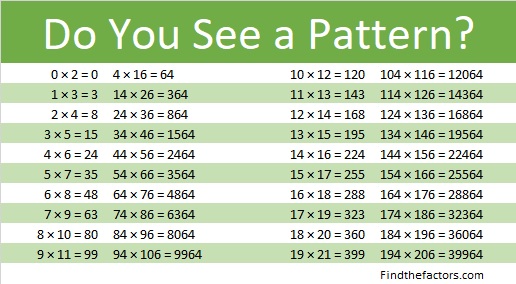
364 is in this cool pattern:

The factoring information for 364 is below the puzzle.

364 Puzzle

Print the puzzles or type the factors on this excel file: 10 Factors 2015-01-19

  • 364 is a composite number.
  • Prime factorization: 364 = 2 x 2 x 7 x 13, which can be written 364 = (2^2) x 7 x 13
  • The exponents in the prime factorization are 2, 1, and 1. Adding one to each and multiplying we get (2 + 1)(1 + 1)(1 + 1) = 3 x 2 x 2 = 12. Therefore 364 has exactly 12 factors.
  • Factors of 364: 1, 2, 4, 7, 13, 14, 26, 28, 52, 91, 182, 364
  • Factor pairs: 364 = 1 x 364, 2 x 182, 4 x 91, 7 x 52, 13 x 28, or 14 x 26
  • Taking the factor pair with the largest square number factor, we get √364 = (√4)(√91) = 2√91 ≈ 19.079

364 Logic

363 and Level 4

Every digit of 363 is divisible by 3, so 363 is divisible by 3 and is a composite number. Its factor information is given below the puzzle.

363 Puzzle

Print the puzzles or type the factors on this excel file: 10 Factors 2015-01-19

  • 363 is a composite number.
  • Prime factorization: 363 = 3 x 11 x 11, which can be written 363 = 3 x (11^2)
  • The exponents in the prime factorization are 1 and 2. Adding one to each and multiplying we get (1 + 1)(2 + 1) = 2 x 3  = 6. Therefore 363 has exactly 6 factors.
  • Factors of 363: 1, 3, 11, 33, 121, 363
  • Factor pairs: 363 = 1 x 363, 3 x 121, or 11 x 33
  • Taking the factor pair with the largest square number factor, we get √363 = (√3)(√121) = 11√3 ≈ 19.053

363 Logic

362 and Level 3

362 is even so it is a composite number. Its factors are listed below the puzzle.

362 Puzzle

Print the puzzles or type the factors on this excel file: 10 Factors 2015-01-19

  • 362 is a composite number.
  • Prime factorization: 362 = 2 x 181
  • The exponents in the prime factorization are 1 and 1. Adding one to each and multiplying we get (1 + 1)(1 + 1) = 2 x 2 = 4. Therefore 362 has exactly 4 factors.
  • Factors of 362: 1, 2, 181, 362
  • Factor pairs: 362 = 1 x 362 or 2 x 181
  • 362 has no square factors that allow its square root to be simplified. √362 ≈ 19.026

A Logical Approach to FIND THE FACTORS: Find the column or row with two clues and find their common factor. Write the corresponding factors in the factor column (1st column) and factor row (top row).  Because this is a level three puzzle, you have now written a factor at the top of the factor column. Continue to work from the top of the factor column to the bottom, finding factors and filling in the factor column and the factor row one cell at a time as you go.

362 Factors

359 and Level 2

When 2^359 is divided by 359, the remainder is 2, so 359 is VERY LIKELY a prime number. Scroll down past the puzzle to know for sure.

359 Puzzle

Print the puzzles or type the factors on this excel file: 10 Factors 2015-01-19

  • 359 is a prime number.
  • Prime factorization: 359 is prime.
  • The exponent of prime number 359 is 1. Adding 1 to that exponent we get (1 + 1) = 2. Therefore 359 has exactly 2 factors.
  • Factors of 359: 1, 359
  • Factor pairs: 359 = 1 x 359
  • 359 has no square factors that allow its square root to be simplified. √359 ≈ 18.947

How do we know that 359 is a prime number? If 359 were not a prime number, then it would be divisible by at least one prime number less than or equal to √359 ≈ 18.947. Since 359 cannot be divided evenly by 2, 3, 5, 7, 11, 13, or 17, we know that 359 is a prime number.

359 Factors

358 and Level 1

358 is even and therefore a composite number. Scroll down below the puzzle to see its factors.

358 Puzzle

Print the puzzles or type the factors on this excel file: 10 Factors 2015-01-19

  • 358 is a composite number.
  • Prime factorization: 358 = 2 x 179
  • The exponents in the prime factorization are 1 and 1. Adding one to each and multiplying we get (1 + 1)(1 + 1) = 2 x 2 = 4. Therefore 358 has exactly 4 factors.
  • Factors of 358: 1, 2, 179, 358
  • Factor pairs: 358 = 1 x 358 or 2 x 179
  • 358 has no square factors that allow its square root to be simplified. √358 ≈ 18.921

358 Factors

357 Equality, Mathematics, and Dr. Martin Luther King, Jr.

I read several quotes from Dr. Martin Luther Kings, Jr. today, including this one on equality and integration. The last sentence mentions mathematics, but I’m not exactly sure what that last sentence has to do with the rest of the quotation. Can anyone enlighten me? (Check the comments for one interpretation.)

Martin Luther King, Jr. quote

Here is a little about the number 357:

3, 5, and 7 are three consecutive odd numbers so, so 357 is divisible by 3 and is a composite number.

  • 357 is a composite number.
  • Prime factorization: 357 = 3 x 7 x 17
  • The exponents in the prime factorization are 1, 1, and 1. Adding one to each and multiplying we get (1 + 1)(1 + 1)(1 + 1) = 2 x 2 x 2 = 8. Therefore 357 has exactly 8 factors.
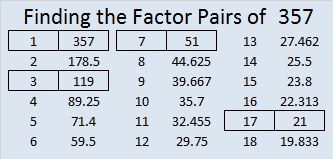
  • Factors of 357: 1, 3, 7, 17, 21, 51, 119, 357
  • Factor pairs: 357 = 1 x 357, 3 x 119, 7 x 51, or 17 x 21
  • 357 has no square factors that allow its square root to be simplified. √357 ≈ 18.894