130 and Level 3

130 is a composite number. 130 = 1 x 130, 2 x 65, 5 x 26, or 10 x 13. Factors of 130: 1, 2, 5, 10, 13, 26, 65, 130. Prime factorization: 130 = 2 x 5 x 13.

130 is never a clue in the  FIND THE FACTORS 1 – 10 or 1 – 12 puzzles.

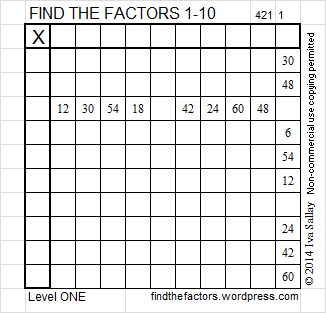
2014-21 Level 3

Excel file of puzzles and previous week’s solutions: 10 Factors 2014-05-26

A Logical Approach to FIND THE FACTORS: Find the column or row with two clues and find their common factor. Write the corresponding factors in the factor column (1st column) and factor row (top row).  Because this is a level three puzzle, you have now written a factor at the top of the factor column. Continue to work from the top of the factor column to the bottom, finding factors and filling in the factor column and the factor row one cell at a time as you go:

2014-21 Level 3 Factors

129 and Level 2

129  is a composite number. 129 = 1 x 129 or 3 x 43. Factors of 129: 1, 3, 43, 129. Prime factorization: 129 = 3 x 43.

2 + 3 + 5 + 7 + 11 + 13 + 17 + 19 + 23 + 29 = 129, thus 129 is the sum of the first 10 prime numbers.

129 is never a clue in the FIND THE FACTORS puzzles.

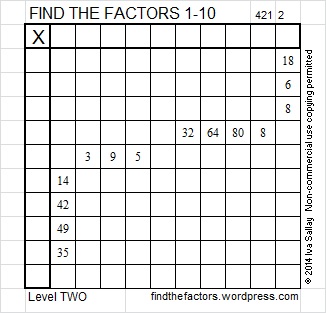
2014-21 Level 2

Excel file of puzzles and previous week’s solutions: 10 Factors 2014-05-26

2014-21 Level 2 Factors

128 and Level 1

128  is a composite number. 128 = 1 x 128, 2 x 64, 4 x 32, or 8 x 16. Factors of 128: 1, 2, 4, 8, 16, 32, 64, 128. Prime factorization: 128 = 2×2×2×2×2×2×2 which can be written 128 = 2⁷

128 is never a clue in the FIND THE FACTORS  puzzles.

2014-21 Level 1

Excel file of puzzles and last week’s solutions: 10 Factors 2014-05-26

2014-21 Level 1 Factors

126 and Level 5

126 is a composite number. 126 = 1 x 126, 2 x 63, 3 x 42, 6 x 21, 7 x 18, or 9 x 14. Factors of 126: 1, 2, 3, 6, 7, 9, 14, 18, 21, 42, 63, 126. Prime factorization: 126 = 2 x 3 x 3 x 7, which can also be written 2 x 3² x 7.

Thinking process using divisibility tricks to find the factor pairs of 126 quickly:

√126 is irrational and approximately equal to 11.22. Every factor pair of 126 will have one factor less than 11.22 and one factor greater than 11.22, and we will find both factors in each pair at the same time. The following integers are less than 11.22. Are they factors of 126?

  1. Yes, all whole numbers are divisible by 1, so 1 x 126 = 126.
  2. Yes, 126 is an even number. 126 ÷ 2 = 63, so 2 x 63 = 126. (Since 63 is odd, 4 will not be a factor of 126.)
  3. Yes, 1 + 2 + 6 = 9 which is divisible by both 3 and 9, so 126 is divisible by both 3 and 9, and 3 x 42 = 126.
  4. No, the number formed from its last two digits, 26, isn’t divisible by 4, so 126 is not divisible by 4.
  5. No, the last digit is not 0 or 5, so 126 is not divisible by 5.
  6. Yes, 126 is divisible by both 2 and 3, so it is divisible by 6, and 6 x 21 = 126.
  7. Yes, 63, 42, and 21 found above give this fact away. But also try the divisibility trick for 7 which requires us to split 126 into 12 and 6. We double 6 and subtract the double from 12. We get 12 – (2 x 6) = 12 – 12 = 0. Since 0 is divisible by 7, 126 is also divisible by 7, and 7 x 18 = 126.
  8. No, since 126 isn’t divisible by 4, it is not divisible by any multiple of 4.
  9. Yes, see 3 above. 126 is divisible by 9, and 9 x 14 = 126.
  10. No, 126 doesn’t ends with a zero, so 10 is not a factor of 126.
  11. No. I’ve typed the digits that are in an odd position in regular type and the digit in an even position in bold type: 126. To perform the divisibility trick for 11, we find the sum of the numbers typed in regular type (1 + 6  = 7) and the sum of the numbers typed in bold type (2) and subtract the smaller sum from the larger sum (7 – 2 = 5). If the difference were a multiple of 11, than the original number would also be a  multiple of 11 (and divisible by 11). Since 5 is not a multiple of 11, we know 126 is not divisible by 11.

From this thinking process we conclude that the factor pairs of 126 are 1 x 126, 2 x 63, 3 x 42, 6 x 21, 7 x 18, and 9 x 14.

126 is never a clue in the FIND THE FACTORS puzzles.

Today’s puzzle might be the most difficult level 5 puzzle I have ever published, so if you have never solved a level 5 or level 6 puzzle before, you probably don’t want to start with this one.

2014-20 Level 5

Excel file of this week’s puzzles and last week’s factors: 12 Factors 2014-05-19

2014-20 Level 5 Logic

125 and Level 4

125 is a composite number. 125 = 1 x 125 or 5 x 25. Factors of 125: 1, 5, 25, 125. Prime factorization: 125 = 5 x 5 x 5, which can also be written 125 = 5³.

125 is never a clue in the FIND THE FACTORS  puzzles.

Placing the last few factors on this Level 4 puzzle may be a bit trickier than usual. As always, use logic, not guessing and checking, to find its one and only solution. Good luck!

2014-20 Level 4

Excel file of this week’s puzzles and last week’s factors: 12 Factors 2014-05-19

2014-20 Level 4 Logic

124 and Level 3

124 is a composite number. 124 = 1 x 124, 2 x 62, or 4 x 31. Factors of 124: 1, 2, 4, 31, 62, 124. Prime factorization:124 = 2 x 2 x 31, which can also be written 124 = 2² x 31.

124 is never a clue in the FIND THE FACTORS puzzles.

2014-20 Level 3

Excel file of this week’s puzzles and last week’s factors: 12 Factors 2014-05-19

A Logical Approach to FIND THE FACTORS: Find the column or row with two clues and find their common factor. Write the corresponding factors in the factor column (1st column) and factor row (top row).  Because this is a level three puzzle, you have now written a factor at the top of the factor column. Continue to work from the top of the factor column to the bottom, finding factors and filling in the factor column and the factor row one cell at a time as you go:

2014-20 Level 3 Factors

123 and Level 2

123 is a composite number. 123 = 1 x 123 or 3 x 41. Factors of 123: 1, 3, 41, 123. Prime factorization: 123 = 3 x 41.

123 is never a clue in the FIND THE FACTORS puzzles.

2014-20 Level 2

Excel file of this week’s puzzles and last week’s factors: 12 Factors 2014-05-19

2014-20 Level 2 Factors

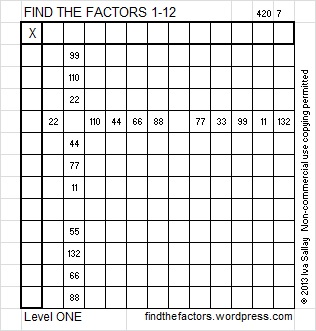
122 and Level 1

122 is a composite number. 122 = 1 x 122 or 2 x 61. Factors of 122: 1, 2, 61, 122. Prime factorization: 122 = 2 x 61.

122 is never a factor in the FIND THE FACTORS puzzles.

122 is the sum of two squares:
11² + 1² = 122

122 is the hypotenuse of a Pythagorean triple:
22-120-122 calculated from 2(11)(1), 11² – 1², 11² + 1²

2014-20 Level 1

Excel file of this week’s puzzles and last week’s factors: 12 Factors 2014-05-19

2014-20 Level 1 Factors

121 and Level 6

121 is not a clue in today’s puzzle. However, when 121 is a clue in a FIND THE FACTORS 1 – 12 puzzle, place 11 in the corresponding cells in both the factor row and the factor column.

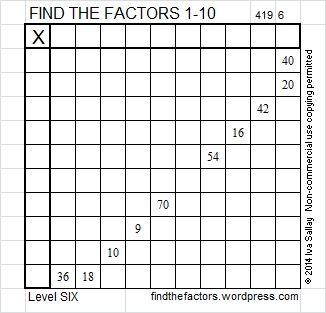
2014-19 Level 6

This week’s puzzles and last week’s factors: 10 Factors 2014-05-12

Here’s more about the number 121:

  • 121 is a composite number.
  • Prime factorization: 121 = 11 × 11 which can be written 121 = 11²
  • The exponent in the prime factorization is 2. Adding one we get (2 + 1) = 3. Therefore 121 has exactly 3 factors.
  • Factors of 121: 1, 11, 121
  • Factor pairs: 121 = 1 × 121 or 11 × 11
  • 121 is a perfect square. √121 = 11

121 = 11². Those digits 1, 1, 2 make 121 the second Friedman number because they can be arranged as a mathematical expression that equals a number that uses those same digits.

121 is not only a perfect square but it is also a star! In fact, games of Chinese checkers will be based on that perfect star.

Since 121 is the square of 11, the fifth prime number, it is only the fifth number to have exactly 3 factors.

121 is the sum of the three prime numbers from 37 to 43.

121 looks interesting when it is written in some other bases:
It’s repdigit 11111 in BASE 3 because 3⁴ + 3³ + 3² + 3¹ + 3⁰ = 121
and it’s 321 in BASE 6.

Not only is it a palindrome in base 10, but
it’s 232 in BASE 7, and
it’s 171 in BASE 8

It can also look pretty square depending on the base used:
It’s 441 in BASE 5,
144 in BASE 9,
121 in BASE 10 (of course),
100 in BASE 11,
81 in BASE 15, and
49 in BASE 28

121 is a pretty remarkable number!

If you got stuck solving the puzzle above, here’s one logical way to find the solution:

2014-19 Level 6 Logic

120 and Level 5

Today’s Puzzle:

Write the numbers from 1 to 10 in both the top row and the first column so that this puzzle functions like a multiplication table.

2014-19 Level 5

Excel file of this week’s puzzles and last week’s factors: 10 Factors 2014-05-12

Thinking process using divisibility rules to find the factor pairs of 120:

√120 is irrational and approximately equal to 10.95. Every factor pair of 120 will have one factor less than 10.95 and one factor greater than 10.95, and we will find both factors in each pair at the same time. The following numbers are less than 10.95. Are they factors of 120?

  1. Yes, all whole numbers are divisible by 1, so 1 x 120 = 120.
  2. Yes, 120 is an even number. 120 ÷ 2 = 60, so 2 x 60 = 120. (Since 60 is even, 4 will also be a factor of 120.)
  3. Yes, 1 + 2 + 0 = 3 which is divisible by 3 (but not by 9), so 120 is divisible by 3. 120 ÷ 3 = 40, so 3 x 40 = 120. Note 120 will not be divisible by 9.
  4. Yes, the number formed from its last two digits, 20, is divisible by 4, so 120 is divisible by 4, and 4 x 30 = 120. (Note since 30 is even, 8 will also be a factor of 120.)
  5. Yes, the last digit is 0 or 5, so 120 is divisible by 5, and 5 x 24 = 120.
  6. Yes, 120 is divisible by both 2 and 3, so it is divisible by 6, and 6 x 20 = 120.
  7. No. The divisibility trick for 7 requires us to split 120 into 12 and 0. We double 0 and subtract the double from 12. 12 – (2 x 0) = 12 – 0 = 12. Since 12 is not divisible by 7, 120 also is not divisible by 7.
  8. Yes, see 4 above. 120 = 8 x 15. (This will mean that ANY number whose last 3 digits are 120 will also be divisible by 8.)
  9. No, see 3 above. 120 is not divisible by 9.
  10. Yes, 120 ends with a zero, so 10 is a factor of 120, and 10 x 12 = 120.

From this thinking process we conclude that the factor pairs of 120 are 1 x 120, 2 x 60, 3 x 40, 4 x 30, 5 x 24, 6 x 20, 8 x 15, and 10 x 12.

Factors of 120:

120  is a composite number. 120 = 1 x 120, 2 x 60, 3 x 40, 4 x 30, 5 x 24, 6 x 20, 8 x 15, or 10 x 12. Factors of 120: 1, 2, 3, 4, 5, 6, 8, 10, 12, 15, 20, 24, 30, 40, 60, 120. Prime factorization: 120 = 2 x 2 x 2 x 3 x 5, which can also be written 120 = 2³ x 3 x 5.

When 120 is a clue in the FIND THE FACTORS 1 – 12 puzzles, use 10 and 12 as the factors.

Sum-Difference Puzzle:

30 has four factor pairs. One of those factor pairs adds up to 13, and another one subtracts to 13. Can you write those factors in their proper places in the first puzzle below?

120 has eight factor pairs. One of those factor pairs adds up to 26, and another one subtracts to 26. If you can identify those factor pairs, then you can solve the second puzzle!

The second puzzle is really just the first puzzle in disguise. Why would I say that?

More about the Number 120:

120 = 5! because 1·2·3·4·5 = 120

120 is also the smallest positive multiple of 6 that is neither preceded nor followed by a prime number! (119 = 7 ×1 7, and 121 = 11 × 11, so neither one is prime.)

What kind of shape is 120 in?

  • 120 is the 15th triangular number because 15(16)/2 = 120,
    it’s the 8th tetrahedral number because (8)(9)(10)/6 = 120 (That means
  • 120 is the sum of the first eight triangular numbers), and
  • it is the 8th hexagonal number because (8)(2·8-1) = 120.

120 is the hypotenuse of a Pythagorean triple:
72-96-120, which is 24 times (3-4-5).

A Logical Way to Find the Solution to Today’s Puzzle:

2014-19 Level 5 Logic