19 Last-Minute Gift

Today’s Puzzle and a Last-minute Gift Idea:

It’s Christmas Eve or even Christmas day, and maybe all of your shopping didn’t get done. Maybe you didn’t want to drive anyplace because of bad weather, or your favorite stores were closed early for the holiday. Well, if someone on your list likes number-placing puzzles (like Sudoku or Kakuro), then I have a last-minute gift idea for you, and it’s free. I design a number-placing logic puzzle based on the multiplication table called FIND THE FACTORS. If you have a computer, the internet, and a printer, you can print a little holiday booklet filled with these puzzles and give it as a gift. If the person on your gift list is many miles away, you can even send the booklet electronically. This last-minute gift is good for the brain and can be good for the memory. The level 1 and level 2 puzzles can be solved by children 3rd grade and up, but most of the higher level puzzles will be challenging for everyone regardless of age. 

Here is a  puzzle created to look a little like an angel just for the holidays:
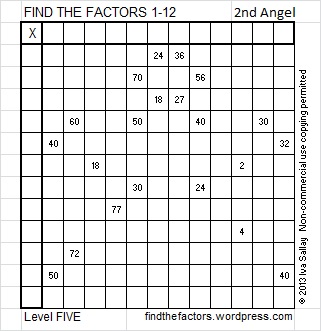
2nd angel

To solve the puzzle above simply write the numbers 1 – 12 in the top row and also in the first column so that those numbers are the factors of the given clues. Okay, maybe it isn’t quite that simple. You have to know basic multiplication facts and use logic to figure out where the numbers go, and yes, I may try to trick you. But you and the people on your gift list have enough skills and persistence to find the one and only correct solution.

Now glancing at the puzzle above you may think you know all the answers, but…

This is what the solved puzzle looks like. Some of those factors may surprise you. That is why using logic is so important when solving the puzzles. (Once the factors are found, filling out the rest of the table is optional.)
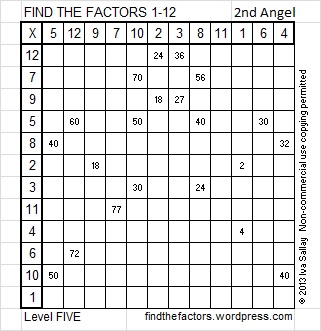
angel factors found

Click 2013 Factor Holiday to download a copy of the puzzle booklet. Some of the puzzles in the booklet are a little easier than the one above because they are a lower level or they only use factors up to 10. Have a very Merry Christmas and a Happy New Year!

Factors of the Number 19:

  • 19 is a prime number.
  • Prime factorization: 19 is prime.
  • The exponent of prime number 19 is 1. Adding 1 to that exponent we get (1 + 1) = 2. Therefore 19 has exactly 2 factors.
  • Factors of 19: 1, 19
  • Factor pairs: 19 = 1 x 19
  • 19 has no square factors that allow its square root to be simplified. √19 ≈ 4.3588989

How do we know that 19 is a prime number? If 19 were not a prime number, then it would be divisible by at least one prime number less than or equal to √19 ≈ 4.4. Since 19 cannot be divided evenly by 2 or 3, we know that 19 is a prime number.

19 is never a clue in the FIND THE FACTORS puzzles.

More About the Number 19:

19 is the fourth centered triangular number. There are 19 squares in the graphic below:

Why? Because 1 + 3(1) + 3(2) + 3(3) = 19.

19 is also the third centered hexagonal number.
Why? Because 1 + 6(1) + 6(2) = 19.
Imagine lines forming concentric hexagons in the drawing from the tweet below:


Related articles with other ideas for last-minute gifts:

3 Puzzles for a November Day

3 is the smallest odd prime number.

3 is the only number that equals the sum of ALL the counting numbers less than itself.

  • 3 is a prime number.
  • Prime factorization: 3 is prime.
  • The exponent of prime number 3 is 1. Adding 1 to that exponent we get (1 + 1) = 2. Therefore 3 has exactly 2 factors.
  • Factors of 3: 1, 3
  • Factor pairs: 3 = 1 x 3
  • 3 has no square factors that allow its square root to be simplified. √3 ≈ 1.732.

How do we know that 3 is a prime number? If 3 were not a prime number, then it would be divisible by at least one prime number less than or equal to √3 ≈ 1.7. Since there are no prime numbers less than or equal to 1.7, we know 3 is a prime number.

When 3 is a clue in the FIND THE FACTOR puzzles, the factors are always 1 and 3.

—————————————————————————————

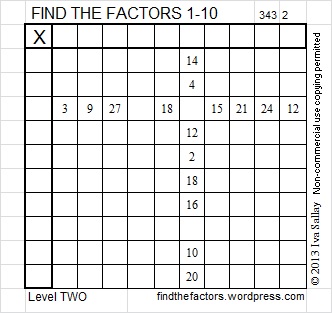
Click on this link, 10 factors 2013-11-04, to get printable copies of the puzzles below and last Monday’s answers. To solve the puzzles, place the numbers 1 – 10 in both the top row and the first column so that those numbers are the factors of the given clues. Obviously level 6 is more difficult to solve than level 1.

2013-11-04.12013-11-04.2 2013-11-04.32013-11-04.42013-11-04.52013-11-04.6

2 Gross Multiplication Facts


Factors 1-2 Blog 10-30-13

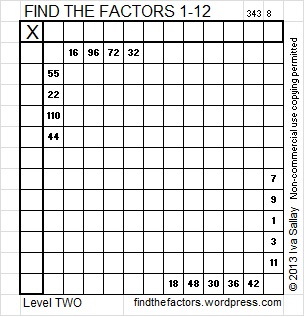
This level TWO multiplication table is only a little more difficult than the table in my previous post.  This puzzle uses 12 factors while the previous one used just 10. To find all these factors you have to be familiar with 144 multiplication facts, a requirement that sounds much more intimidating than it really is. (For example, 3 x 5 and 5 x 3 are counted as 2 different facts.) 144 is a fascinating number.  It is a dozen dozen, otherwise known as a gross. Therefore, completing this puzzle will help you review the gross multiplication facts!   If you haven’t memorized all of the facts, there is a gross way to learn some of the gross multiplication facts.

Edwin A. Anderson Elementary School uses manipulatives and rhymes to teach the multiplication facts.  Their students learn two rhymes a week for sixteen week and are masters of the gross multiplication facts when they are done. Five of the rhymes are actually a little gross:

  • 3×3, nine cuts on my knee
  • 3×8, 24 horseflies on my plate
  • 4×7, 28 spiders are webbin’
  • 6×8, fishing bait, count slimy worms all 48
  • 7×7, roaches on a vine, yucky and scary all 49

It was a very gross multiplication rhyme about the number 64 that inspired me to collect some favorite rhymes and even write a few rhymes myself. I collected them in one list I titled Multiplication Rhymes:

Multiplication Rhymes

That gross, but inspiring, rhyme about the number 64 and some other gross multiplication rhymes are listed below:

  • 18 The two Frankenstein monsters ate teens. 2×9=18
  • 18 These three stinky trolls chewed six garlic cloves whenever they ate beans. 3×6=18
  • 36 That shelf has three cans of ginger ale if you get thirsty and sick. 12×3=36
  • 63 Kevin whined by a prickly tree. He whined about learning 7×9=63. Now Kevin whines ’cause the prickles didn’t let him be!
  • 64 I ate and I ate and got sick on the floor, 8×8 is 64.
  • 96 The boy ate everything on the shelf. Then he felt naughty and sick. 8×12 is 96.


Knowing all 144 (gross) multiplication facts will help you complete my puzzles.

As you Find the Factors and fill in those gross multiplication facts, there are two things I’d like you to remember:

1. Don’t write anything on the inside of the puzzle until you write down all the factors on the outside of the puzzle.

2. The only numbers allowed in the factor row (top row) and the factor column (1st column) are the numbers from 1 to 12, and all 12 numbers must appear in both places.

Now you can click on 12 Factors 2013-10-31, to find the 6 puzzles appearing in this post.

2013-10-31.12013-10-31.32013-10-31.42013-10-31.52013-10-31.6

Now let’s think about the number 2:

2 is the smallest prime number and the only prime that is an even number.

2 is also the largest number that is equal to its number of factors.

In particular situations, there are several prefixes and words that mean two:

  • 2 is the second counting number.
  • A bicycle is a two-wheeler. A binomial is a polynomial with two terms.
  • Two musicians form a duet. Take a look at duet’s synonyms and translations in other languages.
  • The playing card with a 2 on it is called the deuce.
  • A pair can be two shoes, two eyes, or lots of other possibilities.
  • Two people in a relationship are called a couple.

Can you think of any more?

Base 2 uses only the digits 1 and 0 to represent each counting number. Computers use base 2, or binary, as it is also called.

Wikipedia informs us of a Calculus topic about the number 2:

  • If you take the sum from 0 to ∞ of b⁻ᵏ, it will converge to b, ONLY when the base number, b, is 2. Thus,
  •  ⅟₁ + ⅟₂ + ⅟₄ + ⅟₈ + ⅟₁₆ + ⅟₃₂ + ⅟₆₄ + ⅟₁₂₈ + … = 2

Here is 2’s factoring information:

  • 2 is a prime number.
  • Prime factorization: 2 is prime.
  • The exponent of prime number 2 is 1. Adding 1 to that exponent we get (1 + 1) = 2. Therefore 2 has exactly 2 factors.
  • Factors of 2: 1, 2
  • Factor pairs: 2 = 1 x 2
  • 2 has no square factors that allow its square root to be simplified. √2 ≈ 1.414.

How do we know that 2 is a prime number? If 2 were not a prime number, then it would be divisible by at least one prime number less than or equal to √2 ≈ 1.4. Since there are no prime numbers less than or equal to 1.4, we know 2 is a prime number.

When 2 is a clue in the FIND THE FACTOR puzzles, the factors are always 1 and 2.

1 Perfect Square

1 has 1 factor. 2 has 2 factors…that is the end of that pattern because no number greater than 2 equals its number of factors.

  • 1 is not a prime number, and 1 is not a composite number. 1 is in a category all by itself. It is classified as a unit.
  • 1 has no Prime factorization.
  • p⁰ = 1, where p is any prime number, so 1 is a factor of every prime number and every composite number.
  • 1 is also the only number to have exactly 1 factor.
  • Factors of 1: 1
  • Factor pairs: 1 = 1 x 1
  • √1 = 1. Since its square root is a whole number, 1 is a perfect square.

1(n) = n and n ÷ 1 = n for every number n.

Also 1⁰ = 1, 1¹ = 1, 1² = 1, 1³ = 1, 1⁴ = 1, 1⁵ = 1, 1⁶ = 1, 1⁷ = 1, 1⁸ = 1, 1⁹ = 1. In fact, 1 raised to any power equals 1. Even 1⁻⁹⁸⁷⁶⁵⁴³²¹⁰ = 1.

Not only that, but any number (EXCEPT 0) raised to the zeroth power is equal to 1.

One of my college professors wrote something like the following on the board to show why 0º is NOT defined:

When 1 is a clue in the FIND THE FACTORS puzzle, write 1 in both the corresponding factor row and the corresponding factor column.

————————————————————————

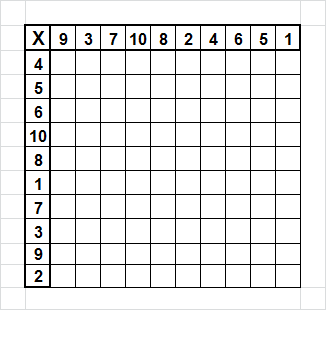
Like most people, you probably know how to fill in a multiplication table even if it looks like this:

standard random table

The numbers that are given on a table can be called clues. The table above has 20 clues. What is the least number of clues that a table could have and still only have one way to fill it out?

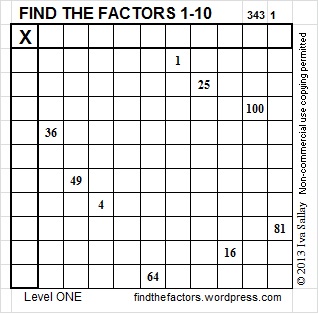
343-1

Although the table above has just nine clues, there is still only one way to complete it. Nine is the fewest number of clues that will still yield a unique solution.  All of those clues would have to be perfect squares: 1, 4, 9, 16, 25, 36, 49, 64, 81, and 100. One of the clues will be missing, but it isn’t difficult to figure out where the missing clue should go.  Always find the factors on the outside of the puzzle BEFORE writing down the products on the inside of the puzzle.

The puzzle above is rated difficulty level ONE because you only need to know 10 multiplication facts to find all the factors. If this puzzle is too easy for you, you can try a more difficult puzzle. Levels FOUR, FIVE, or SIX will be much more challenging, even for adults.

This link, 10 Factors 2013-10-28, will bring up an excel file with the puzzles that are on this post.  After you enable editing, you can print the puzzles or type the factor answers directly onto the excel file.

An answer key will be posted one week after a puzzle is published.

If you don’t want to open the excel file, the rest of the puzzles will be printed below. If you cut and paste them on a document, you can make them any size you want.

2013-10-28.2

2013-10-28.32013-10-28.4

2013-10-28.52013-10-28.6

If you want to check your work, the answers are given in a tab of the excel file that was published a week later: 10 factors 2013-11-04.