31 and Every Third Grader Should Know

  • 31 is a prime number.
  • Prime factorization: 31 is prime.
  • The exponent of prime number 31 is 1. Adding 1 to that exponent we get (1 + 1) = 2. Therefore 31 has exactly 2 factors.
  • Factors of 31: 1, 31
  • Factor pairs: 31 = 1 x 31
  • 31 has no square factors that allow its square root to be simplified. √31 ≈ 5.56776

How do we know that 31 is a prime number? If 31 were not a prime number, then it would be divisible by at least one prime number less than or equal to √31 ≈ 5.6. Since 31 cannot be divided evenly by 2, 3, or 5, we know that 31 is a prime number.

31 is never a clue in the FIND THE FACTORS puzzles.

Every third grader should know how to fill in a multiplication table:
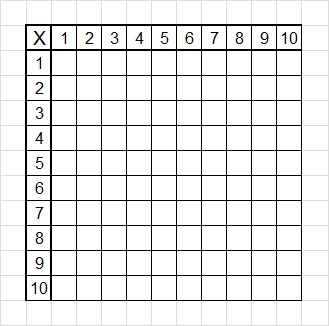
Basic multiplication table

By the middle of third grade, every third grade student has been taught the basic multiplication facts. Of course, that doesn’t mean that every third grader has LEARNED those facts. Corestandards.org/Math/Content/3/ lists EVERYTHING a student should learn in third grade math. Multiplication is very key in learning all of these concepts.

Many students, even beyond third grade, rely on skip counting to figure out what a multiplication product should be. Some students have learned rhymes to help them recall a fact. Given the opportunity some students even in middle school will use a calculator to find the answer to a basic multiplication fact.

Practicing every day will help students recall the facts instantly instead of needing a calculator or other crutch to help them remember one of the basic multiplication facts. For variety, every third grader should also know how to fill out a multiplication table that looks like this:
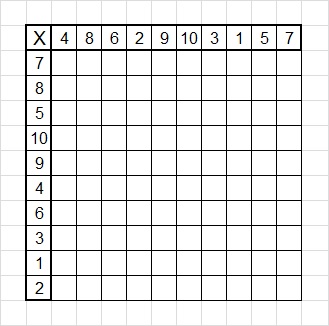
mixed table

This kind of table doesn’t allow a student to simply count by twos, fives, nines or any other number to fill out a particular row or column. This type of table encourages a student to fully memorize all the multiplication facts so the table can be completed as quickly as possible.

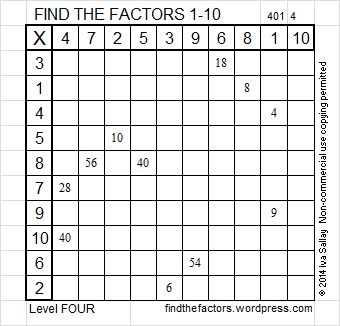
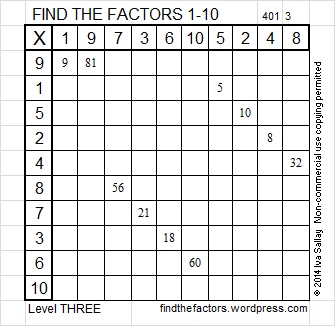
About the middle of third grade, students are introduced to division. As soon as students learn that any number can be divided by 1, they are ready to tackle the easiest of the easiest FIND THE FACTORS puzzles. Here is the level 1 puzzle for the 3rd full week of 2014:

2014-03 Level 1

It is a level 1 puzzle because students only have to know 10 (or 12) division facts to solve the puzzle. Even though it is a simple puzzle, third grade students will need some instruction to complete it. Tell them that this puzzle is going to turn into a multiplication table as soon as they figure out what numbers go into the top row and the first column. Tell them the only numbers that will be written in those two places are numbers from 1 to 10 and that all of those numbers have to be written in both places.

Help the students know what numbers to write in each space on the top row. Some students will likely be confused when they get to the column with 8 clues and to the column with no clues. Help them use logic to figure out what numbers should go in those spaces. When all the factors have been found in both the factor row and the factor column, have them complete the multiplication table. It will be great practice for all of them.

Last week’s puzzle was fairly easy. Here is the puzzle with all of the factors found:

 2014-02 Level 1 Answer

This week’s puzzles are also available in an excel file here, if you have a spreadsheet program on your computer you can access it.

If you enable editing in excel, you can type your answers directly onto the puzzle, and you can also easily print the puzzles. Have fun!

29 and A Level 6 Snowball

  • 29 is a prime number.
  • Prime factorization: 29 is prime.
  • The exponent of prime number 29 is 1. Adding 1 to that exponent we get (1 + 1) = 2. Therefore 29 has exactly 2 factors.
  • Factors of 29: 1, 29
  • Factor pairs: 29 = 1 x 29
  • 29 has no square factors that allow its square root to be simplified. √29 ≈ 5.38516

How do we know that 29 is a prime number? If 29 were not a prime number, then it would be divisible by at least one prime number less than or equal to √29 ≈ 5.4. Since 29 cannot be divided evenly by 2, 3, or 5, we know that 29 is a prime number.

29 is never a clue in the FIND THE FACTORS puzzles.

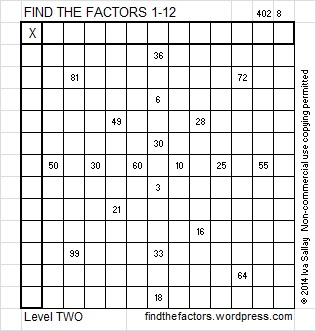
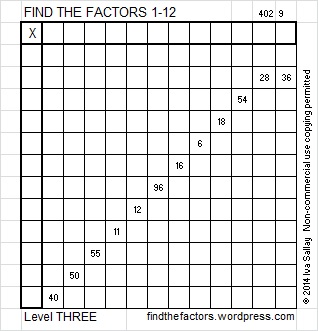
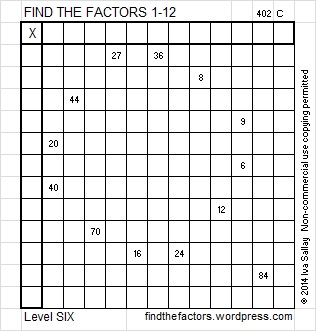
Here is a FIND THE FACTORS 1-12 puzzle that is shaped like a snowball. Because it is a level 6 puzzle, you might feel as if you’re caught in a snowball fight:

2014-01-13.6

The object of the puzzle is to write the numbers 1 to 12 in the top row and again in the first column so that those numbers are the factors of the given clues. If you have attempted a level 6 puzzle, you may have screamed, “IS IT EVEN POSSIBLE to solve a level 6 puzzle without guessing and checking?” I promise you it is, BUT you will need to look at ALL the clues in the puzzle and think about them logically. I don’t want to spoil any of the fun of this week’s puzzle, so I will explain in detail how to solve last week’s puzzle instead.

Notice that for last week’s puzzle there is only one row or column with more than one clue, the column with the 6 and 18 in it. Notice there are three possible common factors, 2, 3, and 6 that will allow us to write only the numbers from 1 to 10 in the factor row and the factor column. You may be tempted to guess and check, but doing that often leads to frustration and/or screaming, so let’s ignore that column for now.

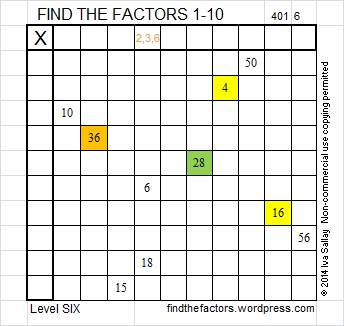
2014-01 Level 6 step 1

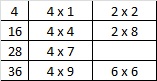
As we examine the other clues, we notice that there are four clues that are divisible by four: 4, 16, 28, and 36. Let’s look at the possible factors for each of those clues.

2014-01 Level 6 step 2

possible 4's Remember that each number from 1 to 10 can only appear once in the factor row and once in the factor column. That means that if 4 is 2 x 2, then 16 must be 4 x 4. Likewise if 16 is 2 x 8, then 4 must be 1 x 4.

If you think about it, you will realize that for this puzzle 4 MUST be a factor of either 4 OR 16. You should also notice that 4 must be a factor of 28. Therefore, in this puzzle, 4 will NOT be one the factors of 36.

We therefore, know that 6 x 6 = 36 works for this puzzle. Since that uses up both 6s, we know that we can’t use 6 as one of the factors of 18, and since 6 x 3 = 18, we also can’t use 3 as its factor. Logic tells us that 2 is the only common factor of 6 and 18 that will work for this puzzle. We now can fill in the corresponding factor cells from the information we have learned so far:

2014-01 Level 6 step 3

Since we found a 9 in the factor column, try to figure out where the 9 goes in the factor row. Since none of the clues that are left are divisible by 9, there is only one place a 9 can go in the factor row: over the column with no clues.

Now if we complete the puzzle using the clues in the order listed on the chart below, we can feel the rhythm as we fill in the rest of the factor cells. The first factor of each multiplication product should be written in the factor row (and the second factor should be written in the factor column):

2014-02.6 logic

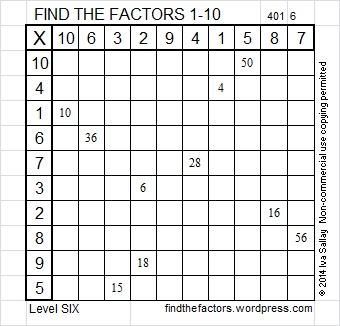
Now we have found all the factors using LOGIC only. We did not guess and check at all. Last week’s completed puzzle is shown below.

2014-01 Level 6 Answer

Try to discover the secret of the snowball puzzle on your own as well. This week’s puzzles are also available in an excel file here, if you have a spreadsheet program on your computer you can access it. If you enable editing in excel, you can type your answers directly onto the puzzle, and you can also easily print the puzzles. Good luck!

28 and Level 5 Snowflake

28 is a composite number. 28 = 1 x 28, 2 x 14, or 4 x 7. Factors of 28: 1, 2, 4, 7, 14, 28. Prime factorization: 28 = 2 x 2 x 7, which can also be written 28 = 2² x 7.

When 28 is a clue in the FIND THE FACTORS puzzles, the factors will be 4 and 7.

2014-01-13.5

This snowflake is actually a logic puzzle based on the multiplication table. Because it is a level 5 puzzle, it can be a little tricky to solve, and isn’t for beginners. If you haven’t solved a Find the Factors puzzle before, this level 2 snowflake puzzle might be a better choice:

2014-01-13.2

How do you solve a level 5 FIND THE FACTORS 1 – 12 puzzle? As always the object is to write the numbers 1-12 in the top row and again in the first column so that those numbers are the factors of the given clues. Use logic, not guessing and checking, to find its unique solution. Here is how to solve a level 5 puzzle:

Begin by looking for perfect square clues, 1, 25, 49, 64, 81, 100, 121, or 144, because there is only one way to factor any of them so that both factors are numbers from 1 to 12. IF you find one of THOSE perfect square clues, write down its factors in the corresponding factor row and factor column.

Next locate a row or a column with at least 2 clues. Find ALL the common factors of that row or column that will allow you to write only numbers from 1 to 12 in both the factor row and the factor column. If that row or column has more than one common factor, leave it alone for now. In a level 5 puzzle there will be at least one row or column that has only one common factor. When you find such a row or column, write its factors in the corresponding factor cells.

Let’s use the level 5 puzzle from wk 1 – 2014 as an example. Starting at the top of the puzzle look at all each row to see if it has more than one clue. We notice that there are two rows with 2 clues, but in both cases, there is more than one possible common factor, so we will ignore those rows for now. Starting on the left, look at each column to see if it has more than one clue. There are 2 columns that have 2 clues, and one of those columns has 3 possible common factors. If you were to guess which of those factors were correct, you would have a 67% chance of guessing wrong. Guessing and checking leads to frustration. Use logic and start with the column that has only one possible common factor, in this case: 1.

2014-01 Level 5 1st step

Now you have at least 3 factors written down. Next look at ALL the remaining clues in the puzzle and find one that can only be factored using one of the factors you’ve written down already but haven’t used twice. (You notice that 54 = 9 x 6, so you can write 9 and 6 in the appropriate cells.)

Sometime during this process, you will discover that one or more of the remaining rows or columns that had more than one clue have had some of the possible factors eliminated. Logic, or the process of elimination, will help you know the only common factor that will work for those clues in this puzzle. (In last week’s puzzle, you may notice that 28 = 4 x 7. That means that 16 cannot be 4 x 4 because we can’t have any factor used more than one time in either the factor row or the factor column. That means in this particular puzzle 16 = 8 x 2. Since you already found one 8, it is easy to place this 8 and the 2.)

Continue to look at all the clues and use logic until all (or almost all) of the factors are found.

If a row or a column contains no clues, use logic is determine which number from 1 to 12 (or 1 to 10) should be written there.

While working on these puzzles, occasionally count from 1 to 12 (1 to 10) as you examine numbers in the factor row and factor column to make sure that a number is written only once in either place. Good luck!

This week’s puzzles are also available in an excel file here, if you have a spreadsheet program on your computer you can access it. If you enable editing in excel, you can type your answers directly onto the puzzle, and you can also easily print the puzzles. Here is the solution to the Week 1 – 2014, Level 5 puzzle:

2014-01 Level 5 Answer

26 and Level 4

26 is a composite number. 26 = 1 x 26 or 2 x 13. Factors of 26: 1, 2, 13, 26. Prime factorization: 26 = 2 x 13.

26 is never a clue in the FIND THE FACTORS 1-10 or 1-12 puzzles.

2014-01-13.4

Write the numbers 1-12 in the top row and again in the first column so that those numbers are the factors of the given clues. Use logic, not guessing and checking, to find its unique solution. Here is how to solve this level 4 “snow shovel” puzzle:

Begin by looking for perfect square clues, 1, 25, 49, 64, 81, 100, 121, or 144 because there is only one way to factor any of them so that both factors are numbers from 1 to 12. If you find one of those perfect square clues, write down its factors in the corresponding factor row and factor column.

Next locate a row or a column with at least 2 clues. Find the common factor of that row or column that will allow you to write only numbers from 1 to 12 in both the factor row and the factor column. If there is more than one row or column with at least 2 clues, repeat the previous step until only rows and columns with one clue remain.

Now you have at least 3 factors written down. Next look at ALL the remaining clues in the puzzle and find one that can only be factored using one of the factors you’ve written down already but haven’t used twice. Repeat the last step until all (or almost all) of the factors are found.

If a row or a column contains no clues, use logic is determine which number from 1 to 12 should be written there.

While working on these puzzles, occasionally count from 1 to 12 to make sure each of those numbers is written exactly once in both the factor row and the factor column. You will notice a rhythm for the answers as you work. Good luck!

This week’s puzzles are also available in an excel file here, if you have a spreadsheet program on your computer. If you enable editing in excel, you can type your answers directly onto the puzzle, and you can also easily print the puzzles.

Here is the solution to the week 1 level 4 puzzle:

2014-01 Level 4 Answer

25 and Level 3

25 is a composite number, and it is 5 squared. 25 = 1 x 25 or 5 x 5. Factors of 25: 1, 5, 25. Prime factorization: 25 = 5 x 5, which can also be written 25 = 5².

Since √25 = 5, a whole number, 25 is a perfect square. 

When 25 is a clue in the FIND THE FACTORS puzzles, write 5 in both the corresponding factor row and the factor column.

2014-02 Level 3

Write the numbers 1-12 in the top row and again in the first column so that those numbers are the factors of the given clues. Use logic, not guessing and checking, to find its unique solution. Level 3 puzzles are designed to be solved starting from a row at the top of the puzzle with 2 clues. First find the common factor of those two clues that will allow you to write only numbers from 1 to 12 in the factor row at the top of the puzzle. Then factor row by row to the bottom of the puzzle making sure each number from 1 to 12 is written only once in both the factor row and the factor column. You will notice a rhythm for the answers as you work. Good luck!

This week’s puzzles are also available in an excel file here if you have a spreadsheet program on your computer. If you enable editing in excel, you can type your answers directly onto the puzzle, and you can also easily print the puzzles.

Here is the solution to last week’s level 3 puzzle:

2014-01 Level 3 Answer

22 Factor Trees

22 is a composite number. 22 = 1 x 22 or 2 x 11. Factors of 22: 1, 2, 11, 22. Prime factorization: 22 = 2 x 11.

When 22 is a clue in the FIND THE FACTORS 1 – 12 puzzles, use 2 and 11 as the factors.

‘Tis the season to use factor trees to find all the factors of a number. Here is a factor tree that shows all the prime factors of 560. Next to it is a factor tree for 324. Do you see all of their prime factors clearly?

560 green                           324 green

Because sometimes one can’t “see the factors for the trees,” I recommend circling the prime factors or doing something else to make them more distinct.  Here are the trees again with every prime factor clearly visible:

560 red                                    324 red

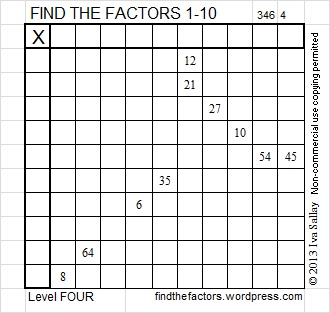
I make logic puzzles based on the multiplication table. The puzzles for today’s post could also be called factor trees because you have to factor the clues to find the solution, and the puzzles are shaped like evergreen trees in whole or in part. I’ve even included a tree hanging from the ceiling, of all places! It may seem like a modern novelty, but people have been hanging Christmas trees upside down in Eastern Europe for centuries. To solve the puzzles either cut and paste the puzzles into a document to print or click 12 Factors 2013-12-12.

2013-12-12.12013-12-12.2

2013-12-12.32013-12-12.4

2013-12-12.5 2013-12-12.6

7 Spaghetti and Meatballs for All!

A Wonderful Math-Related Picture Book

Spaghetti and Meatballs for All! by Marilyn Burns is a delightful story, the kind that children enjoy hearing over and over again.

I work at a Leader in Me school, where we promote the Seven Habits. I used this book when I taught about habit 4, think win-win. When we think win-win, we do not allow someone to “step on us’ to give them a win. Mrs. Comfort’s relatives stepped on her over and over again, and they didn’t even realize it. Finally, she cried, “I give up!” and planted herself on a chair. She definitely felt like she was losing. The class listened to the story intently trying to identify places where the Seven Habits were used or could have been used. We had a great discussion afterward. Also since the book did not use the words, “area” or “perimeter” at all, the class hardly realized that the story was also about those concepts. When we followed the suggestions at the back of the book, the class was able to learn about perimeter and area as we had a great discussion about those topics as well. 

Today’s Puzzle:

2013-11-18

Factors of 7:

  • 7 is a prime number.
  • Prime factorization: 7 is prime.
  • The exponent of prime number 7 is 1. Adding 1 to that exponent we get (1 + 1) = 2. Therefore 7 has exactly 2 factors.
  • Factors of 7: 1, 7
  • Factor pairs: 7 = 1 x 7
  • 7 has no square factors that allow its square root to be simplified. √7 ≈ 2.64575.

How do we know that 7 is a prime number? If 7 were not a prime number, then it would be divisible by at least one prime number less than or equal to √7 ≈ 2.6. Since 7 cannot be divided evenly by 2, we know that 7 is a prime number.

More about the Number 7:

When 7 is a clue in the FIND THE FACTORS puzzles, one factor will be 7 and the other will be 1.

6 A Piece of Cake

Birthday Puzzles for My Daughter:

Happy birthday, Kathy! I hope your day is wonderful. You have grown into a beautiful, talented, prayerful, intelligent, hard-working, and loving young woman.  I am grateful you are my daughter.  So for your birthday today and for this blog, I’ve created three special puzzles: the first is a birthday cake to celebrate your happy day. To highlight your love of music, the second puzzle is a quarter note. The third puzzle is either a violin, a guitar, or a ukulele, you decide. I love listening as you sing or as you play any of those instruments or the piano. Today for your birthday I will also cut down a tree and make yet another cake with two birthday candles on top in this blog post.  So have a fun birthday, today.  I love you.

Birthday cake

Click 12 Factors 2013-11-14 for more puzzles.

quarter note

Factor Trees vs. Factor Cakes:

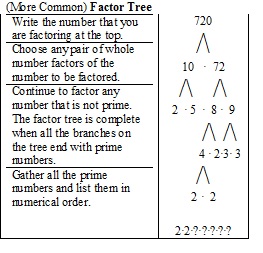
What did I mean by cutting down a tree and making yet another cake? Today I will discuss two methods for finding the prime factors of a whole number. One method is making a factor tree and the other is the cake method. To factor a number means to write it as the product of two or more factors. When those two or more factors are all prime factors, it is called a prime factorization of the number. A composite number always has more than two factors. A prime number always has exactly 2 factors, 1 and itself. (ZERO and ONE are neither prime or composite numbers.) Usually, to find the prime factors of a number, a person will usually make a factor tree. The following example shows how this is done:

factor tree

From this example, you can certainly understand why this algorithm is called a factor tree.  It looks exactly like a perfectly-shaped evergreen tree.  The problem is that a factor tree doesn’t always look so neat and trim.  Here is a factor tree that even Charlie Brown wouldn’t choose:

more common factor tree

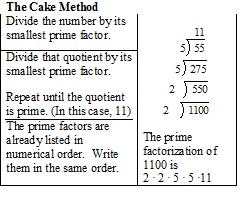
720 isn’t even that big of a number, but gathering all of the prime numbers from the factor tree and putting them in numerical order would be like picking up a bunch of scattered leaves. It would be like doing . . . yard work.  Imagine if you had a number that had many more factors. If one or two of the factors gets lost in the mess, your answer wouldn’t be correct. Notice that some of the prime factors of 720 (2,2,2,2,3,3,5) are not as easy to see as others on the factor tree.  That is why I want to chop down that tree. Even if you like to do yard work, do you really want to deal with that big of a mess, . . . especially when you can have cake instead?  Look, the cake method is so much more pleasing to the eye, and it is simply an extension of the very familiar division algorithm:

Cake method

With the cake method, the more factors you have, the bigger the cake will be, but it will always be neatly organized with all the factors on the outside of the cake.  And if the largest prime factor of your given number is eleven, you will also have two candles on top of your cake!  I find using the cake method to be much less confusing than using a factor tree.  Yes, finding prime factors can actually be a piece of cake. The only disadvantage to the cake method is that since you work from the bottom up you have to leave enough space for the cake to rise.

Still, in spite of my opinion, it is best to use whichever method you are more comfortable with.

Now if your appetite for cake has not been satisfied, click on one of the links below for a nice variety of cakes shared by other bloggers.

Factors of the Number 6:

6 is a composite number. 6 = 1 x 6 or 2 x 3. Factors of 6: 1, 2, 3, 6. Prime factorization: 2 x 3.

When 6 is a clue in the FIND THE FACTORS  puzzle, the pair that will work for that particular puzzle might be 1 x 6, or it might be 2 x 3.

A Sum-Difference Puzzle Featuring the Number 6 and its Factors:

Look at the factor pair puzzle above. Perhaps you will notice that
2 + 3 = 5 and 6 – 1 = 5.
Those are the facts you need to complete the Sum-Difference puzzle below.

5 Easy as 1-2-3

  • 5 is a prime number.
  • Prime factorization: 5 is prime.
  • The exponent of prime number 5 is 1. Adding 1 to that exponent we get (1 + 1) = 2. Therefore 5 has exactly 2 factors.
  • Factors of 5: 1, 5
  • Factor pairs: 5 = 1 x 5
  • 5 has no square factors that allow its square root to be simplified. √5 ≈ 2.236.

How do we know that 5 is a prime number? If 5 were not a prime number, then it would be divisible by at least one prime number less than or equal to √5 ≈ 2.2. Since 5 cannot be divided evenly by 2, we know that 5 is a prime number.

5 is the only number that is the sum of ALL the prime numbers less than itself.

2² + 1² = 5 and 3² + 4² = 5² so 5 is the smallest Pythagorean triple hypotenuse.

When 5 is a clue in a FIND THE FACTORS puzzle, use 1 for one of the factors and 5 for the other.

Being able to identify factors of a whole number is a very important skill in mathematics.  It is a skill that is commonly used in many areas of mathematics ranging from reducing fractions to solving differential equations.  The Find the Factors puzzles can help make that skill second nature.

2013-11-11

Click 10 Factors 2013-11-11 for more puzzles.

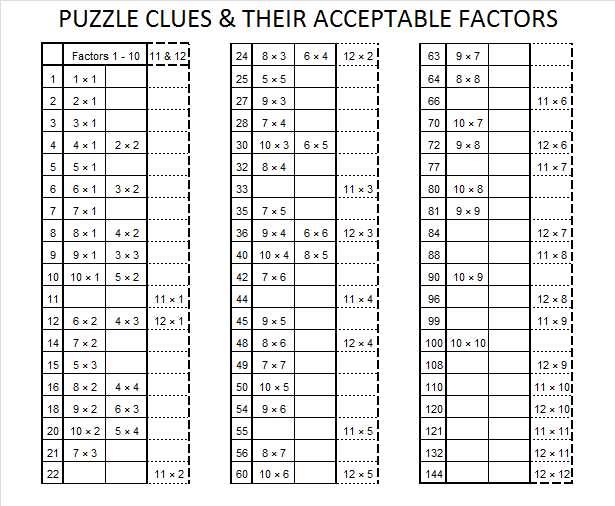
To solve the puzzles, we are only interested in the limited set of factors that are represented in the following table:

Puzzle Clues Chart

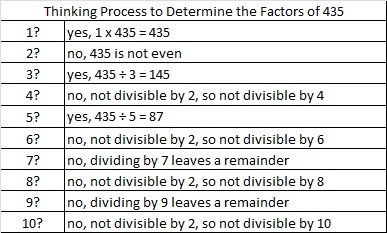
What about all the other factors of these numbers?  And what about all the other whole numbers not on the chart?  How do you find ALL of the factors of a given whole number?  For example, suppose you were asked to find all of the factors of 435.  Some people might notice right away that it is divisible by 5 because its last digit is 5.  While that is true, beginning with 5 is not the best place to start because there is an advantage in considering all possible factors in an organized way.  When you are asked to find ALL of the factors of any number, starting at 1 will make finding all of the factors as easy as 1-2-3. So what are the factors of 435?  Using a calculator, I notice that the square root of 435 is about 20.85.  That means I can find absolutely all of the factors of 435 by considering as  divisors just the whole numbers from 1 to 20!  Each factor will have a partner that is greater than 20 but will be found at the same time with these few short calculations. To demonstrate my thinking process, I will put each possible factor from 1 to 20 in a chart and write my thoughts as I consider each one.

Thinking part 1

Thinking part 2

As you may notice, once a possible factor is eliminated, it is not necessary to do any actual division by ANY of the multiples of that number. (4, 6, 8, 10, 12, 14, 16, 18, and 20 are all multiples of 2, which was not a factor, so I didn’t actually divide 435 by any of those multiples.)

As I carefully consider each possible factor, I only WRITE DOWN a number if it is an actual factor.  Therefore, with only a little bit of effort I would list ALL of the factors of 435 in one tidy list: 1 x 435, 3 x 145, 5 x 87, 15 x 29.

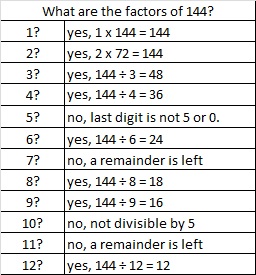
See, it was as easy as 1-2-3!  Now let’s find all of the factors of 144.

factors of 144

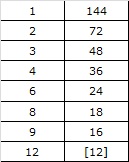
Even though 144 is less than 435, it has more factors. One of its factors is paired with itself because the square root of 144  is 12.  That fact is also the signal that we can stop looking for more factors, and we can list all the factors of 144 on the following chart:

144 table

There are 8 multiplication facts that produce 144, but 12 x 12 = 144 is the only fact we consider when solving a Find the Factors 1-12 puzzle with 144 as one of the clues. In every other case one of the pair of numbers in the multiplication fact will be greater than 12 and not eligible to be written in the factor row or factor column. However in solving mathematical problems, any of the factors of a whole number could be the star of the show. Knowing how to find those factors is indeed an important skill and is as easy as 1-2-3.