324 Christmas Factor Trees

  • 324 is a composite number.
  • Prime factorization: 324 = 2 x 2 x 3 x 3 x 3 x 3, which can be written 324 = (2^2) x (3^4)
  • The exponents in the prime factorization are 2 and 4. Adding one to each and multiplying we get (2 + 1)(4 + 1) = 3 x 5 = 15. Therefore 324 has exactly 15 factors.
  • Factors of 324: 1, 2, 3, 4, 6, 9, 12, 18, 27, 36, 54, 81, 108, 162, 324
  • Factor pairs: 324 = 1 x 324, 2 x 162, 3 x 10⁸, 4 x 81, 6 x 54, 9 x 36, 12 x 27, or 18 x 18
  • 324 is a perfect square. √324 = 18

Included in these 324 factor trees are smaller factor trees for the numbers in brown: 4, 6, 9, 12, 18, 27, 36, 54, 81, 108, and 162. Prime factors of 324 are in red.

324 Factor Trees

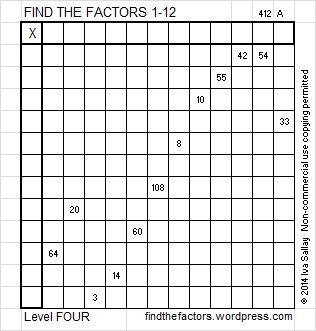
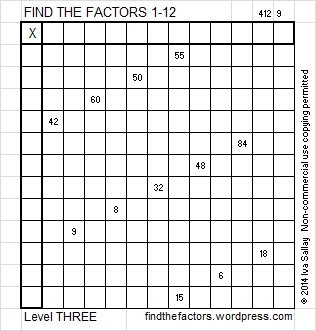
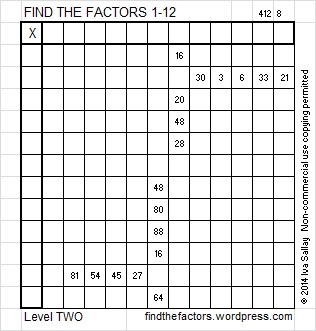
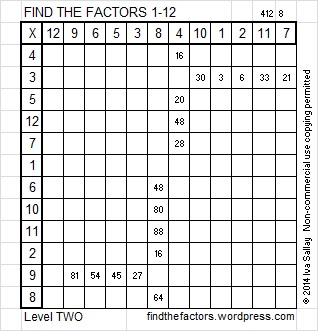
This Level 2 puzzle looks like part of a Christmas tree branch. It’s not too difficult to solve. Give it a try!

2014-50 Level 2

Print the puzzles or type the factors on this excel file: 12 Factors 2014-12-15

2014-50 Level 2 Factors


323 and Level 1

  • 323 is a composite number.
  • Prime factorization: 323 = 17 x 19
  • The exponents in the prime factorization are 1 and 1. Adding one to each and multiplying we get (1 + 1)(1 + 1) = 2 x 2 = 4. Therefore 323 has exactly 4 factors.
  • Factors of 323: 1, 17, 19, 323
  • Factor pairs: 323 = 1 x 323 or 17 x 19
  • 323 has no square factors that allow its square root to be simplified. √323 ≈ 17.972

Since 17 × 19 = 323, we know that 323 + 1 = 324 = 18². That follows from the fact that (n – 1)(n + 1) = n² – 1 is ALWAYS true.

Because 17 is one of its factors, 323 is the hypotenuse of a Pythagorean triple:

  • 152-285-323 which is 19 times 8-15-17

Here are 20 very easy clues to help you solve this puzzle:

2014-50 Level 1

Print the puzzles or type the factors on this excel file: 12 Factors 2014-12-15

2014-50 Level 1 Factors

140 and Gr-8 Divisibility Tricks

140 is a composite number. Factor pairs: 140 = 1 x 140, 2 x 70, 4 x 35, 5 x 28, 7 x 20, 10 x 14. Factors of 140: 1, 2, 4, 5, 7, 10, 14, 20, 28, 35, 70, 140. Prime factorization: 140 = 2 x 2 x 5 x 7, which can also be written 140 = 2² x 5 x 7.

140 is never a clue in the FIND THE FACTORS puzzles.

——————————————————————-

In a previous post I discussed how to tell if a whole number can be evenly divided by 4, 25, or both just by looking at the last 2 digits of the number.

Mathematics is full of patterns so you might be wondering if there are divisibility tricks involving the last 3 digits of a number. Yes! There is!

divide by 125

Again, because we use base 10, and 2 x 5 = 10, the following divisibility tricks work:

  • 1000 (10 cubed) divides evenly into any number ending in 000.
  • 125 (5 x 5 x 5) divides evenly into any whole number that ends with 000, 125, 250, 375, 500, 625, 750, 875. [I remember all 8 endings by thinking about U.S. coins. (000) no quarters equals 00 cents, (125) 1 quarter equals 25 cents, (250) 2 quarters equals 50 cents, (375) 3 quarters equals 75 cents. Adding 500 to each of those endings will give us the rest.]
  • 8 (2 x 2 x 2) will divide evenly into whole numbers whose last 3 digits are divisible by 8.

Let’s explore that divisibility rule for eights a little more:

  • There are 125 different three digit endings that are divisible by 8. I will not list them here, but here is a trick to the trick.

A whole number whose 3rd to the last digit is EVEN is divisible by 8 if the last 2 digits are (00, 08, 16, 24, 32, 40, 48, 56, 64, 72, 80, 88, 96)

  • If you know the times tables up to 8 x 12, then you recognize ALL of those 2 digit numbers.
  • If the 3rd to the last digit is odd and the last 2 digits are divisible by 4 but not by 8 (04, 12, 20, 28, 36, 44, 52, 60, 68, 76, 84, 92), then the whole number is divisible by 8. This last rule can be expressed more concisely using those same 8’s multiplication facts listed above:

A whole number whose 3rd to the last digit is ODD is divisible by 8 if its last two digits ± 4 = (00, 08, 16, 24, 32, 40, 48, 56, 64, 72, 80, 88, 96)

I like playing with these tricks, and they save me time especially when it comes to factoring larger whole numbers. I hope you will enjoy playing with them as well!

138 and Divisibility Tricks 4 You

138 is a composite number. Factor pairs: 138 = 1 x 138, 2 x 69, 3 x 46, or 6 x 23. Factors of 138: 1, 2, 3, 6, 23, 46, 69, 138. Prime factorization: 138 = 2 x 3 x 23.

138 is never a clue in the FIND THE FACTORS puzzles.

———————————————————————————

After you learned some basic division facts, you probably realized:

  • 2 will divide evenly into any EVEN whole number.
  • 5 will divide evenly into whole numbers ending in 0 or 5.
  • 10 will divide evenly into whole numbers ending in 0.

These three rules are related to each other. All of them are true because we use base ten in our numbering system, and the prime factorization of 10 is 2 x 5.

If you needed to find the factors of a 33-digit whole number, you would be able to tell if 2, 5, or 10 divide evenly into it  just by looking at the last digit. 33-digits is more than a standard calculator can handle, but no matter how many digits a whole number has, as long as you can see the very last one, you can apply those three simple divisibility rules to know if 2, 5, or 10 are factors. Thus you will be able to do something a calculator can’t.

But wait, there are even more divisibility tricks if you can see the last TWO digits of the whole number!

divide by 4

  • 10 squared, better known as 100, divides evenly into any whole number ending in 00.
  • 5 x 5 = 25 which divides evenly into any whole number ending in 00, 25, 50, or 75.
  • 2^2 (AKA 4) divides evenly into a whole number if the final two digits can be divided evenly by 4.

How can one tell if the last two digits of a whole number are divisible by 4 (without actually dividing by 4)? I’ll show you how: I’ve put the 25 possible 2-digit multiples of 4 into one of two lists:

  • 00, 04, 08, 20, 24, 28, 40, 44, 48, 60, 64, 68, 80, 84, 88
  • 12, 16, 32, 36, 52, 56, 72, 76, 92, 96

Notice in the first list ALL the digits are even and the last digit (0, 4, or 8) can be divided evenly by 4.

Then look at the second list. The first digit is always odd and the last digit is either 2 or 6 (the only two even digits that are not divisible by 4).

Hmm. I think we can rewrite the divisibility rule for 4:

  • 4 (AKA 2^2) divides evenly into a whole number if the last two digits are even and the final digit is divisible by 4 (the last digit is 0, 4, or 8).
  • 4 divides evenly into any whole number whose next to the last digit is odd if the final digit is even but not divisible by 4 (the last digit is 2 or 6).

The rewritten divisibility rule is longer to read but takes a little less time to implement so you will have to decide which version of the rule works best for you. Either trick takes much less time than dividing some really long whole number by 4 or dividing by 2 twice.

Now I’m on to thinking about what the last THREE digits tell us.

75 and Level 6

2014-12 Level 6

This week’s puzzles for you to solve

75 is a composite number. 75 = 1 x 75, 3 x 25, or 5 x 15. Factors of 75: 1, 3, 5, 15, 25, 75. Prime factorization: 75 = 3 x 5 x 5, which can also be written 75 = 3 x 5².

75 is never a clue in the FIND THE FACTORS puzzles.

75 is in this wonderful pattern. Can you tell what the pattern is?

2014-12 Level 6 Logic

74 and Level 5

2014-12 Level 5

This week’s puzzles for you to solve

74 is a composite number. 74 = 1 x 74 or 2 x 37. Factors of 74: 1, 2, 37, 74. Prime factorization: 74 = 2 x 37.

74 is never a clue in the FIND THE FACTORS puzzles.

2014-12 Level 5 Logic

72 and Level 4

2014-12 Level 4

This week’s puzzles for you to solve

Here are some facts about the number 72:

72 is a composite number. 72 = 1 x 72, 2 x 36, 3 x 24, 4 x 18, 6 x 12, or 8 x 9. Factors of 72: 1, 2, 3, 4, 6, 8, 9, 12, 18, 24, 36, 72. Prime factorization: 72 = 2 x 2 x 2 x 3 x 3, which can also be written 2³ x 3²

Sometimes 72 is a clue in the Find the Factors puzzles. Even though it has many other factors, we use only 8 x 9 for the FIND THE FACTORS 1-10 puzzles and 8 x 9 or 6 x 12 for the FIND THE FACTORS 1-12 puzzles.

2014-12 Level 4 Logic

71 and Level 3


2014-12 Level 3

This week’s puzzles for you to solve

Here’s a little about the number 71:

  • 71 is a prime number.
  • Prime factorization: 71 is prime.
  • The exponent of prime number 71 is 1. Adding 1 to that exponent we get (1 + 1) = 2. Therefore 71 has exactly 2 factors.
  • Factors of 71: 1, 71
  • Factor pairs: 71 = 1 x 71
  • 71 has no square factors that allow its square root to be simplified. √71 ≈ 8.4261

How do we know that 71 is a prime number? If 71 were not a prime number, then it would be divisible by at least one prime number less than or equal to √71 ≈ 8.4. Since 71 cannot be divided evenly by 2, 3, 5, or 7, we know that 71 is a prime number.

71 is never a clue in the FIND THE FACTORS puzzles.

A Logical Approach to the Solution of the puzzle: Find the column or row with two clues and find their common factor. Write the corresponding factors in the factor column and factor row.  Because this is a level three puzzle, you have now written a factor at the top of the factor column. Continue to work from the top of the factor column to the bottom, finding factors and filling in the table as you go:

2014-12 Level 3 Factors

70 and Level 2

2014-12 Level 2

This week’s puzzles for you to solve

70 is a composite number. 70 = 1 x 70, 2 x 35, 5 x 14, and 7 x 10. Factors of 70: 1, 2, 5, 7, 10, 14, 35, 70. Prime factorization: 70 = 2 x 5 x 7.

Sometimes 70 is a clue in the FIND THE FACTORS 1 – 12 puzzles. Even though it has other factors, we only use 70 = 7 x 10 in the puzzles.

Here are the factors for today’s puzzle:

2014-12 Level 2 Factors

69 and Six!

The number 6 appears twice as a clue in today’s puzzle. It shouldn’t be difficult to figure out why I put “Six!” in this post’s title.

2014-12 Level 1

This week’s puzzles for you to solve

69 is a composite number. 69 = 1 x 69 or 3 x 23. Factors of 69: 1, 3, 23, 69. Prime factorization: 69 = 3 x 23.

69 is never a clue in the FIND THE FACTORS puzzles.

Here are the factors for today’s puzzle:

2014-12 Level 1 Factors