869 and Level 3

8 – 6 + 9 = 11 so 869 is divisible by 11.

869 is equal to the sum of the 21 prime numbers from 5 to 83.

Print the puzzles or type the solution on this excel file: 12 factors 864-874

  • 869 is a composite number.
  • Prime factorization: 869 = 11 × 79
  • The exponents in the prime factorization are 1 and 1. Adding one to each and multiplying we get (1 + 1)(1 + 1) = 2 × 2 = 4. Therefore 869 has exactly 4 factors.
  • Factors of 869: 1, 11, 79, 869
  • Factor pairs: 869 = 1 × 869 or 11 × 79
  • 869 has no square factors that allow its square root to be simplified. √869 ≈ 29.4788

Palindrome 868 Has a Fun Square Root

Obviously, 868 is a palindrome in base 10. It has some interesting representations in some other bases, too:

  • 868 is 4004 in BASE 6, because 4(6³) + 0(6²) + 0(6¹) + 4(6º) = 868
  • SS in BASE 30 (S is 28 base 10), because 28(30) + 28(1) = 28(31) = 868
  • S0 in BASE 31, because 28(31) = 868

From OEIS.org I learned that all the digits from 1 to 9 make up the first nine decimal places of √868, so I decided to make a gif showing that fun fact:

Square root of 868

make science GIFs like this at MakeaGif
  • 868 is a composite number.
  • Prime factorization: 868 = 2 × 2 × 7 × 31, which can be written 868 = 2² × 7 × 31
  • The exponents in the prime factorization are 2, 1, and 1. Adding one to each and multiplying we get (2 + 1)(1 + 1)(1 + 1) = 3 × 2 × 2 = 12. Therefore 868 has exactly 12 factors.
  • Factors of 868: 1, 2, 4, 7, 14, 28, 31, 62, 124, 217, 434, 868
  • Factor pairs: 868 = 1 × 868, 2 × 434, 4 × 217, 7 × 124, 14 × 62, or 28 × 31,
  • Taking the factor pair with the largest square number factor, we get √868 = (√4)(√217) = 2√217 ≈ 29.461839725

867 and Level 2

867 is composed of three consecutive numbers so 867 is divisible by 3. The middle number of those three numbers, 6, 7, 8 is 7 so 867 is NOT divisible by 9.

Print the puzzles or type the solution on this excel file: 12 factors 864-874

867 is the hypotenuse of two Pythagorean triples:

  • 483-720-867, which is 3 times (161-240-289)
  • 408-765-867 which is (8-15-17) times 51

867 is 300 in BASE 17 because 3(17²) = 867.

  • 867 is a composite number.
  • Prime factorization: 867 = 3 × 17 × 17, which can be written 867 = 3 × 17²
  • The exponents in the prime factorization are 1 and 2. Adding one to each and multiplying we get (1 + 1)(2 + 1) = 2 × 3  = 6. Therefore 867 has exactly 6 factors.
  • Factors of 867: 1, 3, 17, 51, 289, 867
  • Factor pairs: 867 = 1 × 867, 3 × 289, or 17 × 51
  • Taking the factor pair with the largest square number factor, we get √867 = (√289)(√3) = 17√3 ≈ 29.44486

865 and Level 1

Print the puzzles or type the solution on this excel file: 12 factors 864-874

865 is the sum of two squares two different ways:

  • 28² + 9² = 865
  • 24² + 17² = 865

865 is the hypotenuse of four Pythagorean triples, two of which are primitives:

  • 260-825-865, which is 5 times (52-165-173)
  • 287-816-865, which is 24² – 17², 2(24)(17), 24² + 17²
  • 504-703-865 which is 2(28)(9), 28² – 9², 28² – 9²
  • 519-692-865, which is (3-4-5) times 173

You could see 865’s factors in two of those Pythagorean triples, and here they are again:

  • 865 is a composite number.
  • Prime factorization: 865 = 5 × 173
  • The exponents in the prime factorization are 1 and 1. Adding one to each and multiplying we get (1 + 1)(1 + 1) = 2 × 2 = 4. Therefore 865 has exactly 4 factors.
  • Factors of 865: 1, 5, 173, 865
  • Factor pairs: 865 = 1 × 865 or 5 × 173
  • 865 has no square factors that allow its square root to be simplified. √865 ≈ 29.41088

864 Factor Trees

Factor Trees for 864:

The prime factorization of 864 is 2⁵ × 3³. The sum of the exponents is 5 + 3 = 8. Since 8 is a power of 2,  a couple of 864’s factor trees are full and well-balanced:

All of those prime factors lined up in numerical order. That didn’t happen for the next one, but it still makes a good looking tree, and all the prime factors are easy to find.

Is it possible to make a factor tree for 864 that hardly looks like a tree and isn’t as easy to find all the prime factors? Yes, it is. Here’s an example:

Factors of 864:

  • 864 is a composite number.
  • Prime factorization: 864 = 2 × 2 × 2 × 2 × 2 × 3 × 3 × 3, which can be written 864 = 2⁵ × 3³
  • The exponents in the prime factorization are 5 and 3. Adding one to each and multiplying we get (5 + 1)(3 + 1) = 6 × 4 = 24. Therefore 864 has exactly 24 factors.
  • Factors of 864: 1, 2, 3, 4, 6, 8, 9, 12, 16, 18, 24, 27, 32, 36, 48, 54, 72, 96, 108, 144, 216, 288, 432, 864
  • Factor pairs: 864 = 1 × 864, 2 × 432, 3 × 288, 4 × 216, 6 × 144, 8 × 10⁸, 9 × 96, 12 × 72, 16 × 54, 18 × 48, 24 × 36, or 27 × 32
  • Taking the factor pair with the largest square number factor, we get √864 = (√144)(√6) = 12√6 ≈ 29.3938769

Sum-Difference Puzzles:

6 has two factor pairs. One of those pairs adds up to 5, and the other one subtracts to 5. Put the factors in the appropriate boxes in the first puzzle.

864 has twelve factor pairs. One of the factor pairs adds up to ­60, and a different one subtracts to 60. If you can identify those factor pairs, then you can solve the second puzzle!

More Facts about the Number 864:

864 looked interesting to me in a few other bases:

  • 4000 BASE 6 because 4(6³) = 864
  • 600 BASE 12 because 6(12²) = 864
  • RR BASE 31 (R is 27 base 10) because 27(31) + 27(1) = 27(32) = 864
  • OO BASE 35 (O is 24 base 10) because 24(35) + 24(1) = 24(36) = 864
  • O0 BASE 36 (Oh zero) because 24(36) + 0(1) = 864

864 is the sum of the 20 prime numbers from 7 to 83.

131 + 137 + 139 + 149 + 151 + 157 = 864; that’s six consecutive primes.

431 + 433 = 864; that’s the sum of twin primes.

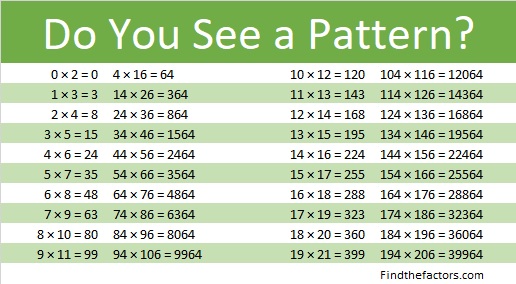
864 is in this cool pattern:


862 Look What a Little Bit of Spit Can Tell You!

All four of my husband’s grandparents were born in Hungary.

Recently my husband ordered a DNA kit from ancestry.com. When the kit arrived, he spit into the kit’s tube until his spit reached the indicated line and mailed it back to Ancestry. This week he received his results, and I was thrilled!

I made the map below based on Ancestry’s map of his genetic communities as well as other maps showing what Hungary looked like in the 1800’s. Near the center of the map, we see a rough outline of what Hungary looks like today. When his grandparents were born, Hungary was three times bigger than it is today so I’ve made an outline to show the size of the country that they knew and loved.

Places, where there is DNA similar to that of my husband, are shown in pink. The three red dots indicate the known locations of my husband’s grandparents’ births. The town names are in big bold red letters even though they were all little villages or small towns. Gyoma used to be in the center of Hungary. Now it is very close to the Romanian border. Zádorfalva is barely in the country while Szürte is barely outside. I didn’t indicate it on the map but my husband’s father was born in a little village southeast of Gyoma. It was part of Hungary when he was born but part of Romania now.

This map is not necessarily about where my husband’s grandparents were born, however. This map also shows where some of THEIR ancestors lived hundreds of years ago. Even though TWO of his grandparents were born in Gyoma, the map seems to indicate that their ancestors moved to Gyoma from someplace else. Also, if my husband’s brother took a DNA test, his map would look a little different because a child receives only half of each parent’s DNA, and the half received can vary from child to child.

My husband’s paternal grandfather, István Sallai, was born in Gyoma, as were his parents and grandparents for several generations. Our research goes back to the 1770’s where all of his ancestors were either born in Gyoma or else they moved to Gyoma from Túrkeve, a town 34.8 km to the north. Sallai means “from Salla”, but we are not certain where Salla might have been. Maps give many possibilities. Also, Frank Kery is one of my husband’s second cousins through this line, and he made the list of potential 2nd and 3rd cousins that the DNA test gave. That helps confirm our faith in the accuracy of the test.

István’s wife, Mária Finta, was also born in Gyoma, as were many generations of her family on her father’s side. Her 2nd great-grandfather, Mihály Finta moved to Gyoma from Túrkéve where MANY people with the surname Finta have lived over the years. On the other hand, Mária’s mother was of Slovak ancestry and was born in Szarvas which is 24.4 km to the west of Gyoma. The Lutheran Church in Szarvas kept wonderful records so I was able to find most of her ancestors back to the mid 1700’s. Sometime around or soon after 1720, her Slovak ancestors moved to Szarvas from whatever Slovak town in which they used to reside.

My husband’s maternal grandfather was born in Szürte, Ung county, Hungary which is now part of Ukraine. We do not have access to any records in the area so other than the names of his parents and possibly some siblings, we know very little about his family. This map and ancestry.com’s DNA database will likely match and introduce us to cousins my husband never knew he had.

Zádorfalva is located where most of the pink is concentrated on the map. My husband’s maternal grandmother, Erzsébet Lenkey was born in Zádorfalva. Both of her parents were born to noble families so we have the names of many of her ancestors back as far as the 1200’s for some lines who also lived there. Zádorfalva is still in Hungary near the Slovakian border. The other towns of her ancestry are close-by in what used to be Gömör county, Hungary. Now those towns are on one side or the other of the Hungary-Slovakian border. The Hungarian names for these towns include Alsószuha, Mihályfalva, Horka, and Kövecses. The noble families of these small towns tended to stay in town generation after generation, leaving only if they married into another noble family and relocated to that family’s town. It makes perfect sense to us that this part of the map has the greatest concentration of pink.

I am certain that if you took a DNA test, you would delight in the information given, too! You might also enjoy reading Ancestry.com’s research about DNA and western migration in North America.

Since this is my 862nd post, I’ll now write a little bit about the number 862:

I learned from OEIS.org that the sum of the factors of 862 is not only a perfect square but also a perfect fourth power:

1 + 2 + 431 + 862 = 1296 = 36² = 6⁴.

  • 862 is a composite number.
  • Prime factorization: 862 = 2 × 431
  • The exponents in the prime factorization are 1 and 1. Adding one to each and multiplying we get (1 + 1)(1 + 1) = 2 × 2 = 4. Therefore 862 has exactly 4 factors.
  • Factors of 862: 1, 2, 431, 862
  • Factor pairs: 862 = 1 × 862 or 2 × 431
  • 862 has no square factors that allow its square root to be simplified. √862 ≈ 29.3598

861 Interpolating Genealogical Data

Not that long ago, calculators were expensive and bulky. Algebra students did calculations using lots of different tables: trig tables, square root tables, logarithm tables. Students could quickly multiply or divide two decimals by adding or subtracting their logarithms and then taking the antilogarithm of the sum or difference. Each table was only a few pages and was found in the back of the Algebra or Trig textbook. These small tables contained information for thousands of numbers. Interpolating information in the tables was a skill that was taught and learned. What is interpolation? Interpolation is an estimate of a value that falls between two other values. You could say that interpolating means the same thing as reading in between the lines.

People who research their genealogy interpolate; they read between the lines. Doing so helps answer questions like this:

Some people live on this earth only for a few minutes, others for 70 years or more. If a septuagenarian kept a diary of his life, it could consist of hundreds of pages and be a rich resource of how that person lived. Most people don’t journal their lives, however. All that may still exist from a person’s life is a few dates scattered in various record books. Nevertheless, finding those dates and piecing together an ancestor’s life can feel so rewarding. Interpolating some of the data found often helps make that person come alive to the researcher.

As I’ve researched my husband’s family, I’ve a particular couple’s name over and over again. The wife’s maiden name was Bíró, the same as her husband’s surname, and that was the same surname as one of my husband’s great-great grandmothers. I wondered if either one of them was related to her. Over time I found the answer to that question and in the process learned a bit about the two of them, and I’d like to share some of that here.

How Eszter became Bálint Bíró’s second wife:  Bálint’s father, Mihály, died when he was only 9 years old.  From the time that he was 12 years old when his older brother married, Bálint was the oldest son living at home.  Five days before his 31st birthday, Bálint married Erzsébet Szilágyi. A year and a half later, she gave birth to László Bíró on 28 Feb 1859.  He was christened five days later.

At this time, Bálint’s mother, Susánna Nagy Bíró, was 67 years old and suffered from feebleness and weakness.  She died on 9 May 1859 when her brand new grandson was just 2 months old.

The next day Bálint’s wife died from a stroke.  She was only 21 years old! The responsibility of caring for her baby boy AND her feeble mother-in-law must have been all hers. What stress she must have felt! It literally killed her. Bálint went to his mother’s funeral on the 10th and to his wife’s funeral on the 11th of May. I can’t imagine his grief.

It was not at all unusual for a young father in Hungary to remarry soon if his wife died. So after two weeks of mourning and courtship, Bálint found a mother for his infant son.  He and Eszter announced their engagement on 26 June that same year.  When they married on 10 July 1859 in the Reformed Church in Gyoma, Békés, Hungary, he told her and the preacher that he was 10 years older than she was.  He was actually 16 years older.  Here is a list of their children. Several of them lived very short lives.

As you read the dates in that table, do you find yourself interpolating the feelings they might have had? Can you not help but to read in between the lines? How did it feel to take care of small children suffering with scarlet fever and then seeing them succumb to the disease?

There is almost an eleven year gap between the births of their children, Bálint and Benedek. Coincidentally, there was another couple in town having children during this time who had similar names, Benedek Bíró and Eszter Bíró. It was important not to get them confused with our Bálint Bíró and Eszter Bíró. They lived in a completely different houses and were not the same people!

Bálint and Eszter Bíró were well liked in their community, and they took their religious duties very seriously.  On several occasions when a couple in the town were married, Bálint was recorded as one of the two witnesses.  Many parents asked the two of them to be their children’s godparents. In fact, Dániel Finta, who was my husband’s great-grandfather and Bálint’s nephew, requested that Bálint and Eszter be the godparents to his firstborn son, Dániel.

What do their names mean?

Bálint is the Hungarian form of Valentinus which means “healthy or strong”. Bálint would have celebrated his name day each February 14th.

Eszter comes from the Hebrew word for “star”.  Queen Esther is a courageous woman in the Bible who saved thousands of her people. Eszter would have celebrated her name day each May 24th, which was the day after her birthday.

Bíró is the Hungarian word for “judge”.

What I know about Eszter Bíró’s early life:  Eszter was born 23 May 1842 to Benedek Bíró and Mária Ladányi.  Here is a table that contains Eszter and her siblings:

Almost half of Eszter’s ten siblings died before she was born. After losing so many of their precious children, her parents must have cherished her. She was their oldest surviving daughter.

Eszter’s paternal grandmother was Sára Kurutsó. Kurutsó was one of the three noble surnames in Gyoma, Békés, Hungary. Over the next century that surname changed into Krutsó, Krucsó, or Kruchió.  Noble families weren’t necessarily richer than their neighbors, but they had a title! Eszter was probably aware of her grandmother’s status.

Eszter completed her religious confirmation classes on 16 March 1856, a few weeks before her 14th birthday. In Hungary, birthdays were not necessarily celebrated as much as name days were, however.

What I know about Bálint Bíró’s early life: Bálint was born 18 Nov 1826 to Mihály Bíró and Susánna Nagy. Here is a table listing Bálint and his siblings. His sister, Sára Bíró, who was 3½ years his senior, is my husband’s great-great grandmother.

As you can see there are some blank spots in the table because I haven’t found all the information about this family yet.

I have found a little information about the number 861, and since this is my 861st post, I’ll share that here:

From OEIS.org I learned that 7 + 77 + 777 = 861. Since that is six 7’s, 861 has to be divisible by 3, but not by 9. (It would have to have nine 7’s to be divisible by nine.)

861 is the hypotenuse of a Pythagorean triple: 189-840-861, which is 21 times (9-40-41).

861 is the 41st triangular number because (41 × 42)/2 = 861. That means that 1 + 2 + 3 + . . . + 39 + 40 + 41 = 861.

861 is also the 21st hexagonal number because 2(21²) – 21 = 861. (All hexagonal numbers are also triangular numbers.) That means that 1 + 5  + 9 + 13 + 17 + 21 + 25 + . . . + 73 + 77 + 81 = 861.

  • 861 is a composite number.
  • Prime factorization: 861 = 3 × 7 × 41
  • The exponents in the prime factorization are 1, 1, and 1. Adding one to each and multiplying we get (1 + 1)(1 + 1)(1 + 1) = 2 × 2 × 2 = 8. Therefore 861 has exactly 8 factors.
  • Factors of 861: 1, 3, 7, 21, 41, 123, 287, 861
  • Factor pairs: 861 = 1 × 861, 3 × 287, 7 × 123, or 21 × 41
  • 861 has no square factors that allow its square root to be simplified. √861 ≈ 29.3428.

860 and Level 6

Print the puzzles or type the solution on this excel file: 10-factors-853-863

860 is the hypotenuse of a Pythagorean triple: 516-688-860, which is (3-4-5) times 172.

860 can be written as the sum of four consecutive prime numbers: 199 + 211 + 223 + 227 = 860

  • 860 is a composite number.
  • Prime factorization: 860 = 2 × 2 × 5 × 43, which can be written 860 = 2² × 5 × 43
  • The exponents in the prime factorization are 2, 1, and 1. Adding one to each and multiplying we get (2 + 1)(1 + 1)(1 + 1) = 3 × 2 × 2 = 12. Therefore 860 has exactly 12 factors.
  • Factors of 860: 1, 2, 4, 5, 10, 20, 43, 86, 172, 215, 430, 860
  • Factor pairs: 860 = 1 × 860, 2 × 430, 4 × 215, 5 × 172, 10 × 86, or 20 × 43,
  • Taking the factor pair with the largest square number factor, we get √860 = (√4)(√215) = 2√215 ≈ 29.3257566

858 and Level 4

There are sixteen numbers less than 1000 that have four different prime factors. 858 is one of them, and it is the ONLY one that is also a palindrome. Thank you, OEIS.org for alerting us to that fact. No smaller palindrome has four different prime factors!

The sixteen products on that chart each have exactly sixteen factors!

Here’s a Find the Factors 1-10 puzzle for you to solve:

Print the puzzles or type the solution on this excel file: 10-factors-853-863

Here’s a little more about the number 858:

858 is the hypotenuse of a Pythagorean triple: 330-792-858

  • 858 is a composite number.
  • Prime factorization: 858 = 2 × 3 × 11 × 13
  • The exponents in the prime factorization are 1, 1, 1, and 1. Adding one to each and multiplying we get (1 + 1)(1 + 1)(1 + 1)(1 + 1) = 2 × 2 × 2 × 2 = 16. Therefore 858 has exactly 16 factors.
  • Factors of 858: 1, 2, 3, 6, 11, 13, 22, 26, 33, 39, 66, 78, 143, 286, 429, 858
  • Factor pairs: 858 = 1 × 858, 2 × 429, 3 × 286, 6 × 143, 11 × 78, 13 × 66, 22 × 39, or 26 × 33
  • 858 has no square factors that allow its square root to be simplified. √858 ≈ 29.291637


856 Rays of Light

When we learn something new, it is as if rays of light touch our minds. If you know how to multiply and divide, let this puzzle enlighten your mind. Just start at the top of the first column and work down cell by cell until the numbers 1 to 10 have been written in the first column and the top row and those corresponding numbers multiply together to give the clues in the puzzle.

Print the puzzles or type the solution on this excel file: 10-factors-853-863


  • 856 is a composite number.
  • Prime factorization: 856 = 2 × 2 × 2 × 107, which can be written 856 = 2³ × 107
  • The exponents in the prime factorization are 3 and 1. Adding one to each and multiplying we get (3 + 1)(1 + 1) = 4 × 2 = 8. Therefore 856 has exactly 8 factors.
  • Factors of 856: 1, 2, 4, 8, 107, 214, 428, 856
  • Factor pairs: 856 = 1 × 856, 2 × 428, 4 × 214, or 8 × 10⁷
  • Taking the factor pair with the largest square number factor, we get √856 = (√4)(√214) = 2√214 ≈ 29.2574777

Here are a few more advanced facts about the number 856:

856 is the 16th nonagonal number because 16(7⋅16-5)/2.

856 is the 19th centered pentagonal number because (5⋅19² + 5⋅19 + 2)/2 = 856.

OEIS.org informs us that if the Fibonacci sequence didn’t start with 1, 1, but instead started with 1, 9, we would get 1, 9, 10, 19, 29, 48, 77, 125, 202, 327, 529, 856, …