A little surprise is waiting when you square 893.

What is special about the number 893? It makes a pretty cool square with two 4’s, 7’s, and 9’s in it. Thank you OEIS.org for that fun fact.

  • 893 is a composite number.
  • Prime factorization: 893 = 19 × 47
  • The exponents in the prime factorization are 1 and 1. Adding one to each and multiplying we get (1 + 1)(1 + 1) = 2 × 2 = 4. Therefore 893 has exactly 4 factors.
  • Factors of 893: 1, 19, 47, 893
  • Factor pairs: 893 = 1 × 893 or 19 × 47
  • 893 has no square factors that allow its square root to be simplified. √893 ≈ 29.8831

892 Tribute to The Mysteries of Harris Burdick

When I finished making today’s puzzle, I remembered a particular picture from The Mysteries of Harris Burdick. Can you guess which picture that would be?

Print the puzzles or type the solution on this excel file: 12 factors 886-896

This popular children’s book contains only pictures with short captions. Children use their imaginations to write short stories for the curious pictures and captions. The book is available in municipal libraries everywhere and on amazon.com.

892 looks interesting in a couple of different bases:

  • It is 4044 in BASE 6, because 4(6³) + 4(6) + 4(1) = 4(216 + 6 + 1) = 4(223) = 892
  • It is 161 in BASE 27, because 1(27²) + 6(27) + 1(1) = 892

892 is also the sum of consecutive prime numbers: 443 + 449 = 892

  • 892 is a composite number.
  • Prime factorization: 892 = 2 × 2 × 223, which can be written 892 = 2² × 223
  • The exponents in the prime factorization are 2 and 1. Adding one to each and multiplying we get (2 + 1)(1 + 1) = 3 × 2  = 6. Therefore 892 has exactly 6 factors.
  • Factors of 892: 1, 2, 4, 223, 446, 892
  • Factor pairs: 892 = 1 × 892, 2 × 446, or 4 × 223
  • Taking the factor pair with the largest square number factor, we get √892 = (√4)(√223) = 2√223 ≈ 29.866369

891 Mystery Level Puzzle

Sometimes revealing the puzzle level reveals more than is needed. I think I will periodically publish a Mystery Level puzzle. Can you solve this one?

Print the puzzles or type the solution on this excel file: 12 factors 886-896

8 + 9 + 1 = 18, so 891 is divisible by 3 and by 9.

8 – 9 + 1 = 0, so 891 is divisible by 11.

891 looks interesting in a few different bases:

  • 1(2⁹) + 1(2⁸) + 0(2⁷) + 1(2⁶) + 1(2⁵) + 1(2⁴) + 1(2³) + 0(2²) + 1(2¹) + 1(2⁰) =891, so it’s palindrome 1101111011 in BASE 2.
  • RR in BASE 32 (R is 27 in base 10), because 27(32) + 27(1) = 27(33) = 891
  • R0 in BASE 33, because 27(33) = 891

891 is also the sum of five consecutive prime numbers: 167 + 173 + 179 + 181 + 191 = 891

  • 891 is a composite number.
  • Prime factorization: 891 = 3 × 3 × 3 × 3 × 11, which can be written 891 = 3⁴ × 11
  • The exponents in the prime factorization are 4 and 1. Adding one to each and multiplying we get (4 + 1)(1 + 1) = 5 × 2 = 10. Therefore 891 has exactly 10 factors.
  • Factors of 891: 1, 3, 9, 11, 27, 33, 81, 99, 297, 891
  • Factor pairs: 891 = 1 × 891, 3 × 297, 9 × 99, 11 × 81, or 27 × 33
  • Taking the factor pair with the largest square number factor, we get √891 = (√81)(√11) = 9√11 ≈ 29.849623

891 is in this cool pattern:


890 and Level 4

890 is the sum of four consecutive prime numbers:

  • 211 + 223 + 227 + 229 = 890

890 is also the hypotenuse of four Pythagorean triples:

  • 168-874-890, which is 2 times (84-437-445)
  • 390-800-890, which is 10 times (39-80-89)
  • 406-792-890, which is 2 times (203-396-445)
  • 534-712-890, which is (3-4-5) times 178

Print the puzzles or type the solution on this excel file: 12 factors 886-896

  • 890 is a composite number.
  • Prime factorization: 890 = 2 × 5 × 89
  • The exponents in the prime factorization are 1, 1, and 1. Adding one to each and multiplying we get (1 + 1)(1 + 1)(1 + 1) = 2 × 2 × 2 = 8. Therefore 890 has exactly 8 factors.
  • Factors of 890: 1, 2, 5, 10, 89, 178, 445, 890
  • Factor pairs: 890 = 1 × 890, 2 × 445, 5 × 178, or 10 × 89
  • 890 has no square factors that allow its square root to be simplified. √890 ≈ 29.83286778.

889 and Level 3

889 is a palindrome in bases 13 and 24:

It is 535 in BASE 13 because 5(13²) + 3(13) + 5(1) = 889.

It is 1D1 in BASE 24 (D is 13 base 10) because 1(24²) + 13(24) + 1(1) = 889.

Print the puzzles or type the solution on this excel file: 12 factors 886-896

  • 889 is a composite number.
  • Prime factorization: 889 = 7 × 127
  • The exponents in the prime factorization are 1 and 1. Adding one to each and multiplying we get (1 + 1)(1 + 1) = 2 × 2 = 4. Therefore 889 has exactly 4 factors.
  • Factors of 889: 1, 7, 127, 889
  • Factor pairs: 889 = 1 × 889 or 7 × 127
  • 889 has no square factors that allow its square root to be simplified. √889 ≈ 29.816103

888 and Level 2

888 consists of three 8’s, so it is divisible by 3.

Print the puzzles or type the solution on this excel file: 12 factors 886-896

888 is the hypotenuse of a Pythagorean triple:

  • 288-840-888 which is 24 times (12-35-37)

888 is the sum of eight consecutive prime numbers:

  • 97 + 101 + 103 + 107 + 109 + 113 + 127 + 131 = 888

888 is a palindrome in BASE 15 and a repdigit in BASE 36:

  • 3E3 BASE 15 (E is 14 in base 10), because 3(15²) + 14(15) + 3(1) = 888
  • OO BASE 36 (O is 24 in base 10), because 24(26) + 24(1) = 24(27) = 888

How many factors does 888 have?

  • 888 is a composite number.
  • Prime factorization: 888 = 2 × 2 × 2 × 3 × 37, which can be written 888 = 2³ × 3 × 37
  • The exponents in the prime factorization are 3, 1, and 1. Adding one to each and multiplying we get (3 + 1)(1 + 1)(1 + 1) = 4 × 2 × 2 = 16. Therefore 888 has exactly 16 factors.
  • Factors of 888: 1, 2, 3, 4, 6, 8, 12, 24, 37, 74, 111, 148, 222, 296, 444, 888
  • Factor pairs: 888 = 1 × 888, 2 × 444, 3 × 296, 4 × 222, 6 × 148, 8 × 111, 12 × 74, or 24 × 37
  • Taking the factor pair with the largest square number factor, we get √888 = (√4)(√222) = 2√222 ≈ 29.7993.

886 and Level 1

886 is the sum of the sixteen prime numbers from 23 to 89.

886 is a palindrome in a couple of other bases:

  • 12021 in BASE 5, because 1(5⁴) + 2(5³) + 0(5²) + 2(5) + 1(1) = 886
  • 474 in BASE 14, because 4(14²) + 7(14) + 4(1) = 886

Print the puzzles or type the solution on this excel file: 12 factors 886-896

  • 886 is a composite number.
  • Prime factorization: 886 = 2 × 443
  • The exponents in the prime factorization are 1 and 1. Adding one to each and multiplying we get (1 + 1)(1 + 1) = 2 × 2 = 4. Therefore 886 has exactly 4 factors.
  • Factors of 886: 1, 2, 443, 886
  • Factor pairs: 886 = 1 × 886 or 2 × 443
  • 886 has no square factors that allow its square root to be simplified. √886 ≈ 29.76575


885 and Level 6

885 obviously is divisible by 5. Since it is exactly 3 numbers away from 888, it also can be evenly divided by 3 so adding up all its digits was not necessary to test for divisibility.

885 is the hypotenuse of a Pythagorean triple:

  • 531-708-885 which is (3-4-5) times 177

885 is palindrome 181 in BASE 26 because 1(26²) + 8(26) + 1(1) = 885

Print the puzzles or type the solution on this excel file: 10-factors-875-885

  • 885 is a composite number.
  • Prime factorization: 885 = 3 × 5 × 59
  • The exponents in the prime factorization are 1, 1, and 1. Adding one to each and multiplying we get (1 + 1)(1 + 1)(1 + 1) = 2 × 2 × 2 = 8. Therefore 885 has exactly 8 factors.
  • Factors of 885: 1, 3, 5, 15, 59, 177, 295, 885
  • Factor pairs: 885 = 1 × 885, 3 × 295, 5 × 177, or 15 × 59
  • 885 has no square factors that allow its square root to be simplified. √885 ≈ 29.74894956

884 Put First Things First

Tangrams have two large pieces, three medium size pieces, and two small pieces.

Most Tangram puzzles are easier to solve if you figure out where to put the two big triangles first. Making a daily plan is easier if you figure out where to schedule the important items like homework and chores first. One of the Seven Habits of Highly Effective People is Put First Things First.

I wrote a 30-40 minute lesson plan to teach habit number 3 of the seven habits with the seven Tangram shapes. The lesson has now been taught to a third of a local elementary school. It was taught to students from first grade to sixth, and all of them really liked the lesson. The teachers who taught it enjoyed it very much as well. The rest of the school will be taught the same lesson later.

I made a pdf copy of the lesson plan here: Put First Things First. You can use it if you would like to teach that principle to your children or your students.  Part of the lesson is reading the adorable book, A Small Brown Dog with a Wet Pink Nose, by Stephanie Stuve-Bodeen. Our county library system had more than enough copies for us to use. It is also available on Amazon.com.


Image result for a small brown dog with a wet pink nose

The Tangram square above was copied on light brown paper so each student in the class could make their own small brown dog.
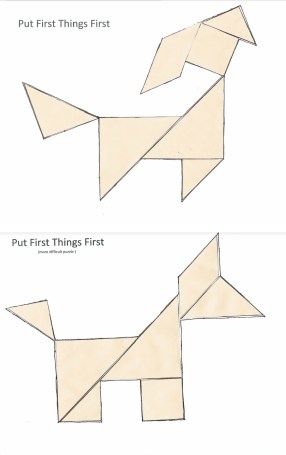
Students could make both dogs or just one of them. Ability levels vary in surprising ways. There were a few first graders who could put the Tangram puzzle together without any help while a few of the older kids struggled. It was okay if a student had difficulty putting the puzzle together. In fact, I made that potential difficulty an important part of the lesson plan. After playing with the puzzle pieces, some students chose to glue the pieces onto the puzzle. Some of them used crayons to add details to their dogs.

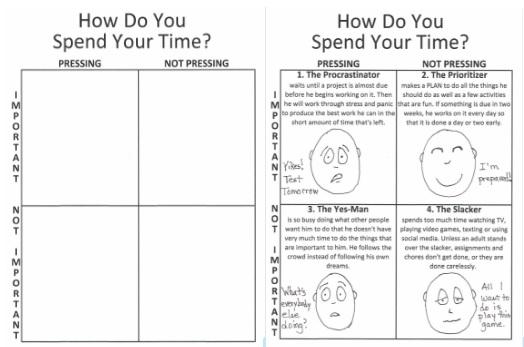
The book and the puzzle were the funnest parts of the lesson, but the lesson began with a serious discussion. We used a document camera to show the four time quadrants to the classes.

(I used the term “Pressing” instead of the more common term “Urgent.” Elementary students probably don’t know what either of those words mean, but they do know what “Pressure” means. They will feel a lot of pressure if they wait until the last minute to do something important. They might feel peer pressure to follow the crowd. Pressing and pressure have the same root word.)

So go ahead, click on the pdf file, Put First Things First, and teach planning and responsibility using the seven Tangram shapes.

Now I’ll write a little bit about the number 884:

884 is the hypotenuse of four Pythagorean triples.

  • 84-880-884 which is 4 times (21-220-221)
  • 340-816-884 which is (5-12-13) times 68
  • 416-780-884 which is (8-15-17) times 52
  • 560-684-884 which is 4 times (140-171-221)

If we had more than ten fingers, 884 might be written in some of these interesting ways:

  • 2D2 in BASE 18 (D is 13 base 10), because 2(18²) + 13(18) + 2(1) = 884
  • 202 in BASE 21, because 2(21²) + 2(1) = 2(441 + 1) = 2(442) = 884
  • QQ in BASE 33 (Q is 26 base 10), because 26(33) + 26(1) = 26(34) = 884
  • Q0 in BASE 34 because 26(34) = 884

What are the factors of 884?

  • 884 is a composite number.
  • Prime factorization: 884 = 2 × 2 × 3 × 73, which can be written 884 = 2² × 13 × 17
  • The exponents in the prime factorization are 2, 1, and 1. Adding one to each and multiplying we get (2 + 1)(1 + 1)(1 + 1) = 3 × 2 × 2 = 12. Therefore 884 has exactly 12 factors.
  • Factors of 884: 1, 2, 4, 13, 17, 26, 34, 52, 68, 221, 442, 884
  • Factor pairs: 884 = 1 × 884, 2 × 442, 4 × 221, 13 × 68, 17 × 52, or 26 × 34,
  • Taking the factor pair with the largest square number factor, we get √884 = (√4)(√221) = 2√221 ≈ 29.732137

884 is in this cool pattern:

882 Factor Trees for the First Day of Autumn

September 22 was the first day of autumn. Leaves are already beginning to fall from the trees.

To rake up the leaves for 882, you might first notice that it’s even. The logical thing to do would be to first divide 882 by two. . . But perhaps you might notice that 8 + 8 + 2 = 18, a number divisible by nine, so you might just as logically begin by dividing 882 by 9. The first step you take determines how the factor tree looks.

882 has many possible factor trees but these two are probably the most common.

You can rake the leaves up this way or you can rake them up that way, but when you rake up the leaves from 882’s factor trees, you always get the same prime factors: 2, 3, 3, 7, and 7.

Here’s a little more about the number 882:

882 has eighteen factors. The greatest number less than 882 with eighteen factors is 828. Now get this: 288 also has eighteen factors. That means that every possible combination of 8-8-2 has exactly eighteen factors!

882 has some interesting representations in some other bases:

  • 616 BASE 12, because 6(12²) + 1(12)¹ + 6(12º) = 882
  • 242 BASE 20, because 2(20²) + 4(20)¹ + 2(20º) = 882
  • 200 BASE 21, because 2(21²) = 882

882 is also the sum of consecutive primes: 439 + 443 = 882

  • 882 is a composite number.
  • Prime factorization: 882 = 2 × 3 × 3 × 7 × 7, which can be written 882 = 2 × 3² × 7²
  • The exponents in the prime factorization are 1, 2 and 2. Adding one to each and multiplying we get (1 + 1)(2 + 1)(2 + 1) = 2 × 3 × 3 = 18. Therefore 882 has exactly 18 factors.
  • Factors of 882: 1, 2, 3, 6, 7, 9, 14, 18, 21, 42, 49, 63, 98, 126, 147, 294, 441, 882
  • Factor pairs: 882 = 1 × 882, 2 × 441, 3 × 294, 6 × 147, 7 × 126, 9 × 98, 14 × 63, 18 × 49 or 21 × 42
  • Taking the factor pair with the largest square number factor, we get √882 = (√441)(√2) = 21√2 ≈ 29.6984848.