Today’s Puzzle:
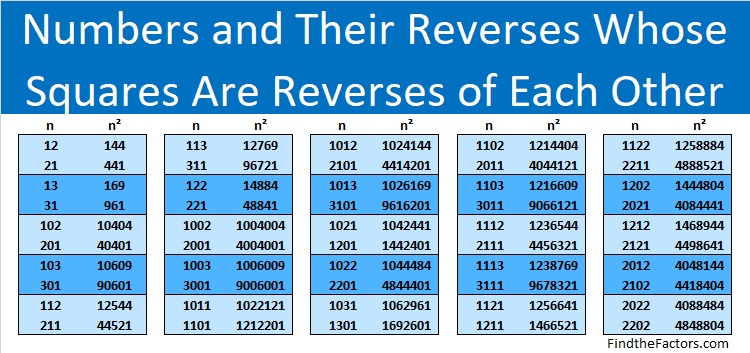
Solve these two multiplication problems and see how mirror-like they are!

Only 50 numbers less than 10000 can make a similar claim to fame:
Countdown to 2022:
Early in 2021, I found a countdown equation for 2022 that also involves its factors. A couple of weeks ago, I found another one. I can’t decide which one I like the best. Even though you can only focus on one equation at a time, the countdown will show both of them concurrently:


Factors of 2022:
It’s an even number, so it’s divisible by 2.
It’s also easy to remember that it is divisible by 3 because 2 + 2 + 2 = 6, a multiple of 3.
This graphic may help you remember that it is divisible by 337:

- 2022 is a composite number.
- Prime factorization: 2022 = 2 × 3 × 337.
- 2022 has no exponents greater than 1 in its prime factorization, so √2022 cannot be simplified.
- The exponents in the prime factorization are 1, 1, and 1. Adding one to each exponent and multiplying we get (1 + 1)(1 + 1)(1 + 1) = 2 × 2 × 2 = 8. Therefore 2022 has exactly 8 factors.
- The factors of 2022 are outlined with their factor pair partners in the graphic below.

More About the Number 2022:
2022 is in the hypotenuse of a Pythagorean triple:
1050-1728-2022, which is 6 times (175-288-337).
It is also the short leg in three other Pythagorean triples:
2022-2696-3370, which is (3-4-5) times 674,
2022-340704-340710, which is 6 times (337-56784-56785), and
2022-1022120-1022122, which is 2 times (1011-511060-511061)
2022 uses only 2’s and 0’s in base 10 and in base 3:
2022₁₀ = 2202220₃.
2022 is the sum of positive consecutive numbers in three different ways:

2022 Magic Squares:


All of the above are the facts that I came up with. Lots of people on Twitter have found other facts about 2022. Be sure to check them out!
Tweets Celebrating 2022’s Mathematical Properties:
Here are some tweets about 2022 that I’ve seen on Twitter. I’ll add more as I see them. They are not listed in order of difficulty, but more or less, in the order that I saw them.
Since #NewYear2022 is coming up, here’s a #Mathematics countdown you can use to spruce up your celebration!
Enjoy! Feel free to verify that it really does give 2022 on your own! 🥳🎉🎆 pic.twitter.com/nOPZBMm0KH— Math Nerd 1729 (@1729Nerd) December 26, 2021
Here’s number four in my countdown of reasons why 2022 promises to be a belter of a year, Mathematically (expect one of these each day as we approach the new year!): #HNY2022 pic.twitter.com/WJ9lFOKVe4
— Chris Smith (@aap03102) December 28, 2021
Here’s number three in my countdown of reasons why 2022 is shaping to be a smasher, Mathswise…(admittedly the appeal of this one’s a wee bit biased, Mr Smith) #HNY2022 pic.twitter.com/jfZllOW2t1
— Chris Smith (@aap03102) December 29, 2021
It’s time for number two in my countdown of reasons why 2022 is numerically worth celebrating (this time it’s a nifty double act connecting 2022 and 2021 with a weird sǫᴜᴀʀᴇ-ʀᴇᴠᴇʀsᴇ-sǫᴜᴀʀᴇ ʀᴏᴏᴛ-ʀᴇᴠᴇʀsᴇ algorithm):#HNY2022 pic.twitter.com/jxdPNrUvrt
— Chris Smith (@aap03102) December 30, 2021
For those who understand some A level math, Happy new year 2022 pic.twitter.com/FEChXkAsvK
— Omugaga Ham (@OmugagaH) December 27, 2021
Math up your countdown to 2022: the midpoint of 2 successive primes (2017 and 2027) that is also the sum of 2 successive primes (1009+1013), the product of 3 distinct primes (2×3×337), and results in a prime when divided by the sum of its digits (2022÷(2+0+2+2)=337) #HappyNewYear pic.twitter.com/Nserh6NpEf
— Maths Ed (@MathsEdIdeas) December 28, 2021
Y’all need to realise that 2020 is gone and it’s 2022 which is exactly “2020 too “
— ケイシン|Kei’s Christmas and maths arc (@cxtriia) December 22, 2021
2022 y las ternas pitagóricas https://t.co/gjDQuqMs0M vía @matescercanas
y gracias a @Connumeros pic.twitter.com/Jb1q2UjpT8— Amadeo Artacho (MatematicasCercanas) (@matescercanas) December 29, 2021
2022 y sus divisoreshttps://t.co/GX6z1WRWMK
a través de @matescercanas y gracias a @Connumeros pic.twitter.com/3oGShbCdRV— Amadeo Artacho (MatematicasCercanas) (@matescercanas) December 28, 2021
2022 = 7^2 + 20^2 + 22^2 + 33^2. Which contains 20 and 22.
— Alexander Farrugia (@farrugiamaths) December 29, 2021
New TikTok video: 2021 and 2022: Are they deficient, abundant, or perfect? pic.twitter.com/7DT7lspk12
— Howie Hua (@howie_hua) December 30, 2021
Well, any multiple of 20 is abundant since 20 itself is abundant. So, since 2020 wasn’t that abundant with good things, I’d think a more accurate test would be to check whether it’s a PRIMITIVE abundant number. Luckily, 2022 is one of those! Happy New Year! 🙂 https://t.co/d6dUg1TiXq pic.twitter.com/IhVaH38yqh
— Math Nerd 1729 (@1729Nerd) December 30, 2021
2022 as a palindromic, ambigrammatic, strobogrammatic, vertically and horizontally symmetric, ʇuoɹɟ oʇ ʞɔɐq puɐ spɹɐʍʞɔɐq uʍop ǝpᴉsd∩ expression #HappyNewYear #HappyNewYear2022 pic.twitter.com/9QEPEAZoBc
— Maths Ed (@MathsEdIdeas) December 30, 2021
┏━━┓┏━━┓┏━━┓┏━━┓
┗━┓┃┃┏┓┃┗━┓┃┗━┓┃
┏━┛┃┃┃┃┃┏━┛┃┏━┛┃
2020, too
┃┏━┛┃┃┃┃┃┏━┛┃┏━┛
┃┗━┓┃┗┛┃┃┗━┓┃┗━┓
┗━━┛┗━━┛┗━━┛┗━━┛— Vsauce (@tweetsauce) December 30, 2021
2022 es un número de Smith de orden 3, porque la suma de sus cifras es la tercera parte de la suma de las de sus factores primos:
Sus cifras: 2+0+2+2=6
Las de sus factores primos: 2+3+3+3+7=18, y 18/6=3
— Antonio Roldán (@Connumeros) December 30, 2021
Happy New Year 2022 wherever you are 🙂 pic.twitter.com/mFLf6XIBGw
— Ed Southall (@edsouthall) December 31, 2021
Every Hogmanay party needs a suitably geeky countdown to the new year…❤️#HappyNewYear2022 #CountdownToTheBells pic.twitter.com/azXCOuydyw
— Chris Smith (@aap03102) December 31, 2021
2022ⁿᵈ prime ± 2022? Still prime!
What a year…#HNY2022 https://t.co/p8pQeFalNO— Chris Smith (@aap03102) December 31, 2021
🎄🎄 Happy New Year 2022 🎄🎄#math2022 #HappyNewYear2022 #2022 #Math #geometry pic.twitter.com/rF2A0Fr0A3
— Ceyhun Köylüce (@MathCeyhun) December 31, 2021
The amazing maths pic.twitter.com/GJ6GneaRp3
— Elícaro2022 (@el_icaro2022) December 31, 2021
Gracias por este 2021 y por el buen rollo ♥️
¡Salud para todos! 🥂 pic.twitter.com/W15IvkLYWs— Tally Numbers | Abel Hernández (@AbelAHR) December 31, 2021
Fun fact
2022 is a Harshad number
2022 ÷ (2+0+2+2) = 337
Happy new year#HAPPYNEWYEAR2022 #maths— Rob Nichols (@TheRealRobN) January 1, 2022
A New Year’s puzzle by @alexbellos in the @guardian 🎉
Check it out. https://t.co/XlXe6Z2LoX
— Maths Scholarships (@Beamathsteacher) January 1, 2022
Hogmanay puzzle.
The hypotenuse of a right-angled triangle is 2022 units. The other two sides have integer lengths. Determine their lengths.
Hint: 2022 is a multiple of the sum of two squares.
— Maths.scot (@MathsDotScot) December 31, 2021
2022 Equation#2022NewYear pic.twitter.com/Yx8JdJCf0O
— Sh. Maf (@SMafakher) December 31, 2021
A Happy Year Equation that works for 2022. 337, 3, and 2 are prime factors of 2022. pic.twitter.com/99rdQIeQjO
— Shiraz H. Robinson II | Dr. Quantum | Math God (@QuantumShiraz) January 1, 2022
Fill in the gaps between numbers with mathematical symbol(+,-,*,/) to make sense for the equation:
10_9_8_7_6_5_4_3_2_1 = 2022Clue: Yes it is possible!💯#AcademicTwitter #happynewyear2022 #MTBoS
— Atreyasai (@atreyasci) December 27, 2021
Yes, it does. Using BODMAS, the equation is reduced to : 19*8*13+9*5+1 = 1976+45+1 = 2022
— Harjodh Singh (@harjodh_s) December 31, 2021
Oh, 2022 in base 3 is 2202220. No 1’s. Should we call that a Cantor Number? 👀
— dan bach (@dansmath) January 1, 2022
Interesting fact about 2022:
2021+1=2022
— Howie Hua (@howie_hua) December 31, 2021
2022 = 9 × 8 × (7 + 6) + 543 × 2 × 1
— Algebra Etc. (@AlgebraFact) January 1, 2022
Happy New Year!
🎆 🎉 🎇 pic.twitter.com/yeAwHAuyh2— Mathigon (@MathigonOrg) January 1, 2022
Number theory fact: 2022 is even
— syzygay (@syzygay1) January 1, 2022
Palindrome dates 2022:
1. The big one is Tue 22/02/2022 (or 2/22/22 in m/d/y)
2. Wed 2/2/22
3. The other 22/m/22 formats with m=1,…,9
4. Tue 22 Nov 2022: 22/11/22
5. The m/d/y dates in Feb 20th-28th.
6. The slightly cursed Fri 2 Dec 2022, which ‘works’ in y/m/d as 22/12/2— Peter Rowlett (@peterrowlett) January 1, 2022
— maco (@maco05636886) January 1, 2022
2022 pic.twitter.com/IzAUNkizPZ
— karakfa (@karakfa) January 1, 2022
👽💜
2022←+(670+670+670)+12
— maco (@maco05636886) January 1, 2022
Mathematics.
May you have a happy and healthy 11111100110, filled with wonders and mystic transport to new realms of creativity, bliss, and peace. pic.twitter.com/7QI3UH0lVR
— Cliff Pickover (@pickover) January 1, 2022
لتنمية مهارات التفكير الإبداعي
العب و تعلم مع 2022
3 أعداد متتالية مجموعها 2022
4 أعداد متتالية مجموعها 2022
12 عدد متتالي مجموعها 2022#Bergas_Style pic.twitter.com/KyggOn4M6v— الخوارزمي الصغير (@bergasmath) January 1, 2022
Expressing the New year number 2022 in terms of the factorials of numbers 0 to 9. #NewYear2022 #NewYear #Happy2022 pic.twitter.com/ZYVDfbhRHM
— Srinivasa Raghava ζ(1/2 + i σₙ )=0 (@SrinivasR1729) January 1, 2022
May you all have a happy New year and to all the mathematics graduate students, I hope your algebra qualifying exams have the problem of showing that a group of order 2022 cannot be simple.
— Michael Kinyon (@ProfKinyon) January 1, 2022
【2022年から未来へ】
明けましておめでとうございます。
今年もよろしくお願いします! pic.twitter.com/Munn9JGhyc— ポテト一郎🥔 (@potetoichiro) December 31, 2021
Feb 22nd will be special this year. Specifically at 22:22:22, 22/2/22. Even better, it’s on a Tuesday or 2s-day.
— Joel Willans (@Joelwillans) January 1, 2022
2022 is a multiple of 6 and its digits add to 6. It’s not fancy but I like it. Previous two such years were 1500 and 2004; next two will be 2040 and 2112.
— Matt Parker (@standupmaths) January 1, 2022
┏━━┓┏━━┓┏━━┓┏━━┓
┗━┓┃┃┏┓┃┗━┓┃┗━┓┃
┏━┛┃┃┃┃┃┏━┛┃┏━┛┃
(1098-765+4)3•2•1
┃┏━┛┃┃┃┃┃┏━┛┃┏━┛
┃┗━┓┃┗┛┃┃┗━┓┃┗━┓
┗━━┛┗━━┛┗━━┛┗━━┛— Jim Wilder (@wilderlab) December 31, 2021
#HAPPYNEWYEAR2022 #MTBoS pic.twitter.com/OM4C43EX8a
— Murat Tepe (@mappsandgrapps) January 1, 2022
— Hassan Shehata (@hassanshehatago) January 1, 2022
#math2022 pic.twitter.com/JFYEdD7RVd
— Ceyhun Köylüce (@MathCeyhun) January 1, 2022
Happy new year everyone! It’s a rather satisfying in Roman numerals: MMXXII
— Tom⇒maths AMIMA (@TeaKayB) January 1, 2022
Quedan 52 días para el mejor momento del año. El 22/02/2022 a las 20:22
— Mates Mike (@mike_mates) January 1, 2022
Estoy seguro de que va a ser un año con estrella
De hecho, tengo una demostración #matemática basada en que 337 es un número estrellado pic.twitter.com/0rimSLTBdm
— Roberto Santos (@rober_fun) January 1, 2022
Find a^2022+1/a^2022 if a^2+a+1=0, a 2022 Special#ChallengingMathProblems #AlgebraicExpressions
via @YouTube @Apple @Desmos @NotabilityApp @googledocs @canva https://t.co/PQm6MaLBg7 pic.twitter.com/4dGgW07n45— SyberMath (@SyberMath) January 1, 2022
In mathematics, 2022 is a HARSHAD number—meaning it is equally divisible by the sum of its digits, 6. The word ‘harshad’ comes from the Sanskrit for ‘joy-giving’. pic.twitter.com/1e2m3mBhXY
— Haggard Hawks 🦅 (@HaggardHawks) January 1, 2022
2022 is the smallest number n such that n, n+1, n+2, and n+3 have the maximal exponents in prime factorization equal 1, 2, 3, and 4 correspondingly… #HAPPYNEWYEAR2022 https://t.co/L5HPK4uOzk
— Nalini Joshi (@monsoon0) January 1, 2022
Happy New Year, geeks!
Here are FOUR of my top reasons why 2022 is shaping up to be a belter of a year, Mathswise! https://t.co/LwrWd7sv9W#HappyNewYear pic.twitter.com/TE7eCGzChF
— Chris Smith (@aap03102) January 1, 2022
New Year’s resolution (h/t Greg Kuperberg) pic.twitter.com/aBar6u9QPB
— Jordan Ellenberg (@JSEllenberg) December 31, 2021
Dicen que los tontos son más felices…
Pues 2022 es un número de gran alegría y cateto.#Feliz2022 pic.twitter.com/59LBpcXJZn— Santi Gª Cremades ² (@SantiGarciaCC) January 1, 2022
Moin. Die #palindromischen Formeln zum 1.1.2022 …
2022=1001+2×5×2+1001
2022=12×55+101+5+101+55×21
2022=52×22+3×6+292+6×3+22×25
2022=365×2+2×5×5+66+5×5×2+2×563
112022=1122×33+1001+11+9+11+1001+33×2211#Neujahr #FrohesNeuesJahr #HappyNewYear #FelizAñoNuevo #BonAnyNou pic.twitter.com/kMwErh5IVX
— Das Ambigramm (@AmbigrammDesign) January 1, 2022
Happy 2(MXI) @BossGercek @diegorattaggi @SyberMath @EdwinWa93021333 @PerHenrikChris1 @Math26039335 @le_becachel @Mirangu1 @MathCeyhun @Bannu16750368 @maliuhud @RonySarker71 @Cshearer41 @ohmohm @ilarrosac @M1GU3L_HH @rfbooth @theKamranZamani @cesscabral @Asmit_Dey_ @Eduard16180 pic.twitter.com/hDbkTEfSIQ
— OMF (@makkedavero) January 1, 2022
Bonne année #2022NewYear pic.twitter.com/dqD7tLWoy9
— Mathieu Drillet (@DrilletMathieu) January 1, 2022
I love to imagine circles crammed into parabolas.
This is a mathematics puzzle from Diego Rattaggi, @diegorattaggi, #mathiratti
We are given one circle’s radius of 2021, and we wonder about the radius of the other circle. Source: https://t.co/CZthCOOnOb pic.twitter.com/DPd0bZETvL
— Cliff Pickover (@pickover) January 1, 2022
2023 will be a multiple of 7 and its digits add to 7.
2024 will be a multiple of 8 and its digits add up to 8.
2025 will be a multiple of 9 and its digits add up to 9.There are 24 such years in this century.
— Sun Solo (@SunSolo_) January 1, 2022
It’s the last year to have three of the same digits in it until 2111.
— 北欧宅 (@hokuwotaku) January 1, 2022
Stretching this theme a little, 337 is the sixth prime number between 301 and 400.
— dominic (@bockers56) January 1, 2022
Por no discriminar…
¡Una buena hipotenusa no podría existir sin dos buenos catetos! 😝 https://t.co/P0u2IA1Tv2 pic.twitter.com/qOrWMMWDfY— Tally Numbers | Abel Hernández (@TallyNumbers) January 1, 2022
Por no discriminar…
¡Una buena hipotenusa no podría existir sin dos buenos catetos! 😝 https://t.co/P0u2IA1Tv2 pic.twitter.com/qOrWMMWDfY— Tally Numbers | Abel Hernández (@TallyNumbers) January 1, 2022
2022 es el único año de este siglo que es producto de 3 primos ( 2×3×337 ) y que, a la vez, es suma de dos primos consecutivos (1009 + 1013).#MathLife#Feliz2022
— Juan Miguel Ribera (@juanripu) January 1, 2022
Ring in the New Year with your students on @Desmos! Create expressions using 2, 0, 2, and 2 to equal the numbers from 1-100. How many can you get this year? #iteachmath #mtbos https://t.co/RZ2H7pyPGP https://t.co/gQX3xmHudV
— Craig Winske (@seewins) January 1, 2022
Joyful 2022! First of a string of 4 Harshad years. May they be so. pic.twitter.com/KZ9H0Mx3KM
— John Golden (@mathhombre) January 1, 2022
Magic Square of Order 36 With 22 https://t.co/ytjdfbd5qZ
— INDER J. TANEJA (@IJTANEJA) January 2, 2022
Representation of Numbers from 1 to 10000 in Terms of Palindromic Digits 2022-2202 https://t.co/naCm5ibF53
— INDER J. TANEJA (@IJTANEJA) January 2, 2022
Block-Wise and Block-Bordered Magic Squares With Magic Sum 2022 https://t.co/evvYqDPnOy
— INDER J. TANEJA (@IJTANEJA) December 28, 2021
Mathematical Beauty of 2022 https://t.co/Qzsc1TPY4J
— INDER J. TANEJA (@IJTANEJA) December 27, 2021
My six-year-old made me a calendar for Christmas, and I love it.
(Dear Dad, Do you like Numbers? Then you will love 2022!) pic.twitter.com/NoGNumQe4Y
— Math In The News (@MathInTheNews) January 1, 2022
Going to give my students the 2022 Challenge tomorrow. I haven’t done this yearly number challenge since 2019 when the choice of digits was a bit nicer.
It will be interesting to see how many we can find! #mtbos #iteachmath #teach180 pic.twitter.com/MeMpMeipHV
— Sarah Carter (@mathequalslove) January 3, 2022
A 3-D version for the new year: work out that diagonal length. You’re in for a major surprise…. https://t.co/sppR38qiN2 pic.twitter.com/Tmvmik2xJN
— Chris Smith (@aap03102) January 1, 2022
I’ll end with this thread that you’ll just have to click on to appreciate. It’s packed with tons of mathematical reasons 2022 will a fabulous year!
Happy New Year! 2022 will be historic for numerous wonderful reasons.
How can I be so sure of that? Math!
A thread: 👇🧵 pic.twitter.com/K0BY5pbz3e
— Scott Kominers (@skominers) January 1, 2022


