1380 A Different Way to Look at the Logic

This puzzle looks a lot like puzzle #1378. The design is the same, but the clues are not in the same places. I made this puzzle to demonstrate that there is often more than one way to logically find all the factors of a puzzle. If it were a level 4 puzzle, the clues could be anywhere on the puzzle. But since it is a level 3 puzzle, start with the factors of 14 and 8, and then write the factors of 63 in the appropriate places. Continue with the clues in order from top to bottom until all the factors have been found.

Print the puzzles or type the solution in this excel file: 10 Factors 1373-1388

Now I’ll share some information about the number 1380:

  • 1380 is a composite number.
  • Prime factorization: 1380 = 2 × 2 × 3 × 5 × 23, which can be written 1380 = 2² × 3 × 5 × 23
  • 1380 has at least one exponent greater than 1 in its prime factorization so √1380 can be simplified. Taking the factor pair from the factor pair table below with the largest square number factor, we get √1380 = (√4)(√345) = 2√345
  • The exponents in the prime factorization are 2, 1, 1, and 1. Adding one to each exponent and multiplying we get (2 + 1)(1 + 1)(1 + 1)(1 + 1) = 3 × 2 × 2 × 2 = 24. Therefore 1380 has exactly 24 factors.
  • The factors of 1380 are outlined with their factor pair partners in the graphic below.

There are MANY possible factor trees for 1380. Here’s one of them:

1380 is the hypotenuse of a Pythagorean triple:
828-1104-1380 which is (3-4-5) times 276

1379 You Can Solve This Magic Square

I knew that 1379 was the magic sum of a 14 × 14 magic square because 14² = 196 and
(196)(197)/(2·14) = 1379.

I know how to solve a 4 × 4 magic square and when the dimensions of the magic square are odd numbers. I can also solve squares whose dimensions can be factored into any of those.  Clearly, the dimensions of a 14 × 14 magic square don’t qualify. I wondered if there was a simple way to solve it.

I watched a video that explained how to use a 7 × 7 magic square to solve one that is
14 × 14
. You don’t have to watch the video to solve this magic square. Let me explain:

Notice that I’ve grouped the squares in the 14 × 14 magic square into 4 × 4 sub-grids. Now the magic square can behave more like a 7 × 7 magic square. Also, notice that the highest number in each sub-grid is 4 times the corresponding number in a 7 × 7 magic square.

You should notice that many of the numbers appear in order along the diagonal of the 7  × 7 square. The trickiest part for me is always the upper right corner.

Unfortunately, the 4 × 4 sub-grids are not all the same. In the video, they were labeled X, Y, and Z. To make it simpler, I’ve color-coded them so that you can know how to place the four numbers in each sub-grid from lowest to highest.

You can use this excel file,10 Factors 1373-1388 to first solve the 7 × 7 magic square and then use it and the three squares above to solve the 14 x 14 one. I would encourage you to give it a try! It is so satisfying to succeed!

Here’s a little more about the number 1379:

  • 1379 is a composite number.
  • Prime factorization: 1379 = 7 × 197
  • 1379 has no exponents greater than 1 in its prime factorization, so √1379 cannot be simplified.
  • The exponents in the prime factorization are 1, and 1. Adding one to each exponent and multiplying we get (1 + 1)(1 + 1) = 2 × 2 = 4. Therefore 1379 has exactly 4 factors.
  • The factors of 1379 are outlined with their factor pair partners in the graphic below.

1379 is the hypotenuse of a Pythagorean triple:
196-1365-1379 which is 7 times (28-195-197)

1378 and Level 3

The first row with a clue has a 14 in it. Use that 14 and the clue in the same column, to figure out where to put one of the factor pairs of 14 in this puzzle.  Only use factor pairs where both numbers are from 1 to 10. Then work your way down the puzzle, row by row until you have found all the factors of this level 3 puzzle. The completed puzzle will look like a multiplication table with the factors in a different order.

Print the puzzles or type the solution in this excel file: 10 Factors 1373-1388

Here is some information about the puzzle number, 1378:

  • 1378 is a composite number.
  • Prime factorization: 1378 = 2 × 13 × 53
  • 1378 has no exponents greater than 1 in its prime factorization, so √1378 cannot be simplified.
  • The exponents in the prime factorization are 1, 1, and 1. Adding one to each exponent and multiplying we get (1 + 1)(1 + 1)(1 + 1) = 2 × 2 × 2 = 8. Therefore 1378 has exactly 8 factors.
  • The factors of 1378 are outlined with their factor pair partners in the graphic below.

1378 is the 52nd triangular number because (52)(53)/2 = 1378.

1378 is the hypotenuse of FOUR Pythagorean triples:
222-1360-1378 which is 2 times (111-680-689)
530-1272-1378 which is (5-12-13) times 106
728-1170-1378 which is 26 times (28-45-53)
800-1122-1378 which is 2 times (400-561-689)

1377 Easter Basket Challenge

Occasionally,  we hear that the number of Easter eggs that are found is one or two less than the number of eggs that were hidden. Still most of the time, all the eggs and candies do get found. You really have no trouble finding all those goodies, and the Easter Egg Hunt seems like it is over in seconds.  You can find Easter Eggs but can you find factors? Here’s an Easter Basket Find the Factors 1 – 10 Challenge Puzzle for you. I guarantee it won’t be done in seconds. Can you find all the factors? I dare you to try!

Print the puzzles or type the solution in this excel file: 10 Factors 1373-1388

Now I’ll mention a few facts about the number 1377:

  • 1377 is a composite number.
  • Prime factorization: 1377 = 3 × 3 × 3 × 3 × 17, which can be written 1377 = 3⁴ × 17
  • 1377 has at least one exponent greater than 1 in its prime factorization so √1377 can be simplified. Taking the factor pair from the factor pair table below with the largest square number factor, we get √1377 = (√81)(√17) = 9√17
  • The exponents in the prime factorization are 4 and 1. Adding one to each exponent and multiplying we get (4 + 1)(1 + 1) = 5 × 2 = 10. Therefore 1377 has exactly 10 factors.
  • The factors of 1377 are outlined with their factor pair partners in the graphic below.

1377 is the sum of two squares:
36² + 9² = 1377

1377 is the hypotenuse of a Pythagorean triple:
648-1215-1377 which is (8-15-17) times 81
and can also be calculated from 2(36)(9), 36² – 9², 36² + 9²

1376 Let’s Get Ready for the Playful Math Carnival!

Too many people think that mathematics is a house of horrors, but there are plenty of bloggers out there, who know that done right, math is actually ALL fun and games. It is like a carnival! Every month, you can play at the Playful Math Education Blog Carnival, and it really is play! What does a playful math carnival look like? Go on over to see how Math Mama Writes… and puts on a fabulous March carnival!

I will be hosting this monthly carnival the last week of April! Why do I get to host it? I sent a message on twitter to Denise Gaskins who coordinates the carnival, and I requested the privilege. If you would like to host it in the future, let her know. She is always looking for blogs to host, and she will be very happy to hear from you.

In the meantime, you can help me with my carnival. If you blog about mathematics in a playful way that could benefit children who are somewhere between preschool to high school age, I would love to include your post in my carnival. The carnival is a FREE way to promote your post, so if you would like more traffic to your blog, submit a post using the link from Denise Gaskins’ website by Friday, April 19. Then before the end of the month, you will be able to enjoy the carnival even more because of your participation!

Now I’ll tell you a little bit about the post number, 1376:

  • 1376 is a composite number.
  • Prime factorization: 1376 = 2 × 2 × 2 × 2 × 2 × 43, which can be written 1376 = 2⁵ × 43
  • 1376 has at least one exponent greater than 1 in its prime factorization so √1376 can be simplified. Taking the factor pair from the factor pair table below with the largest square number factor, we get √1376 = (√16)(√86) = 4√86
  • The exponents in the prime factorization are 5 and 1. Adding one to each exponent and multiplying we get (5 + 1)(1 + 1) = 6 × 2 = 12. Therefore 1376 has exactly 12 factors.
  • The factors of 1376 are outlined with their factor pair partners in the graphic below.

As mentioned in my previous post, 1376 is part of the three smallest consecutive numbers that have cube roots that can be simplified.

The Cube Root of 1375 is the Smallest. . .

The cube root of 1375 can be simplified. So can the cube roots of 1376 and 1377. There are no smaller consecutive three numbers whose cube roots can make the same claim.

Thank you, OEIS.org for alerting me to that very cool fact. It deserves a celebration so I made the graphic above.

Here’s more about the number 1375:

  • 1375 is a composite number.
  • Prime factorization: 1375 = 5 × 5 × 5 × 11, which can be written 1375 = 5³ × 11
  • 1375 has at least one exponent greater than 1 in its prime factorization so √1375 can be simplified. Taking the factor pair from the factor pair table below with the largest square number factor, we get √1375 = (√25)(√55) = 5√55
  • The exponents in the prime factorization are 3 and 1. Adding one to each exponent and multiplying we get (3 + 1)(1 + 1) = 4 × 2 = 8. Therefore 1375 has exactly 8 factors.
  • The factors of 1375 are outlined with their factor pair partners in the graphic below.

1375 is also the hypotenuse of THREE Pythagorean triples:
385-1320-1375 which is (7-24-25) times 55
484-1287-1375 which is 11 times (44-117-125)
825-1100-1375 which is (3-4-5) times 275


1374 and Level 2

Can you find the factors that will turn this puzzle into a multiplication table whose products are simply not in the usual order?

Print the puzzles or type the solution in this excel file: 10 Factors 1373-1388

Here are a few facts about the puzzle number, 1374:

  • 1374 is a composite number.
  • Prime factorization: 1374 = 2 × 3 × 229
  • 1374 has no exponents greater than 1 in its prime factorization, so √1374 cannot be simplified.
  • The exponents in the prime factorization are 1, 1, and 1. Adding one to each exponent and multiplying we get (1 + 1)(1 + 1)(1 + 1) = 2 × 2 × 2 = 8. Therefore 1374 has exactly 8 factors.
  • The factors of 1374 are outlined with their factor pair partners in the graphic below.

1374 is the hypotenuse of a Pythagorean triple:
360-1326-1374 which is 6 times (60-221-229)

1373 and Level 1

This puzzle is really just a multiplication table but the factors are missing and the products are not in order. You can figure out where the factors go, and then the clues will all make sense.


Print the puzzles or type the solution in this excel file: 10 Factors 1373-1388

Now I’ll share some facts about the puzzle number, 1373:

  • 1373 is a prime number.
  • Prime factorization: 1373 is prime.
  • 1373 has no exponents greater than 1 in its prime factorization, so √1373 cannot be simplified.
  • The exponent in the prime factorization is 1. Adding one to that exponent we get (1 + 1) = 2. Therefore 1373 has exactly 2 factors.
  • The factors of 1373 are outlined with their factor pair partners in the graphic below.

How do we know that 1373 is a prime number? If 1373 were not a prime number, then it would be divisible by at least one prime number less than or equal to √1373. Since 1373 cannot be divided evenly by 2, 3, 5, 7, 11, 13, 17, 19, 23, 29, 31, or 37, we know that 1373 is a prime number.

1373 is the sum of two squares:
37² + 2² = 1373

1373 is the hypotenuse of a Pythagorean triple:
148-1365-1373 calculated from 2(37)(2), 37² – 2², 37² + 2²

Here’s another way we know that 1373 is a prime number: Since its last two digits divided by 4 leave a remainder of 1, and 37² + 2² = 1373 with 37 and 2 having no common prime factors, 1373 will be prime unless it is divisible by a prime number Pythagorean triple hypotenuse less than or equal to √1373. Since 1373 is not divisible by 5, 13, 17,  29, or 37, we know that 1373 is a prime number.

An Efficient Way to Quickly Find All the Odd Prime Numbers Less Than 1369

As I’ve used different sized grids to play with the Sieve of Eratosthenes, I’ve decided I like one size grid better than all the rest. It has six odd numbers across, but I repeat the first column on the right because of convenience. You already know the only even prime number is 2, so this grid can help you find all the rest of the primes up to 1369 = 37².

Look at the grid. What are some things that you notice about it?

Square numbers are never prime, so why do I have them outlined on the grid? Why are some of them crossed out? Is there a pattern for that, too?

If you’ve done a sieve where you cross out all the multiples of the prime numbers in order, perhaps you’ve noticed that the first multiple to get crossed out that hasn’t been crossed out before is always the prime number squared.

Therefore, don’t start with the prime numbers. Start with their squares! The squares of each of the prime numbers and the next five odd multiples after those squares are listed in a box on the left of the paper. Put a dot in the corner of each of those multiples. Recognize the pattern they make and strike through those numbers with a colored pencil. A ruler will be helpful. Continue the same pattern down to the bottom of the grid. Then do the same thing with the next square of a prime number.  I’ve made a gif of these instructions being applied to a much smaller grid.
Finding Primes Less Than 361

make science GIFs like this at MakeaGif

It feels like I’m wrapping twinkling lights around a long sheet of cardboard!

Do try it on this much longer grid that goes to 1369. You’ll probably want to cut it out and glue or tape it together on the back. If this is an assignment, don’t cut off your name.

Read the following AFTER you’ve tried using the grid. I don’t want to spoil your sense of discovery!

To me, the lines drawn have a slope even if the lines are broken lines.
The slope for the 3s is undefined.
For the 5s, it’s +1; for the 7’s, it’s -1;
For the 11’s, it’s +2; for the 13’s, it’s -2;
For the 17’s, it’s +3; for the 19’s, it’s -3;
For the 23’s, it’s +4; for the 25’s, it’s -4; (You can skip the 25’s because they are already crossed out.)
For the 29’s, it’s +5; for the 31’s, it’s -5;
Cross out 37², and then you are done.

If the grid were longer, you could continue with the same pattern for as long as you want. I think it is pretty cool.

Now I’ll tell you a little bit about the number 1369:

  • 1369 is a composite number and is a perfect square.
  • Prime factorization: 1369 = 37 × 37 which can be written 1369 = 37²
  • 1369 has at least one exponent greater than 1 in its prime factorization so √1369 can be simplified. Taking the factor pair from the factor pair table below with the largest square number factor, we get √1369 = (√37)(√37) = 37
  • The exponent in the prime factorization is 2. Adding one to that exponent, we get (2 + 1) = 3. Therefore 1369 has exactly 3 factors.
  • The factors of 1369 are outlined with their factor pair partners in the graphic below.

1369 is the sum of two squares:
35² + 12² = 1369

1369 is the hypotenuse of two Pythagorean triples:
444-1295-1369 which is (12-35-37) times 37
840-1081-1369 calculated from 2(35)(12), 35² – 12², 35² + 12²


1368 Playing with the Sieve of Eratosthenes

What if we didn’t use ten numbers across for our Sieve of Eratosthenes?

For example, 36 × 38 = 1368. We could make a Sieve of Eratosthenes writing 36 numbers across the grid and 38 numbers down. The last number on the grid would be 1368, and we could find all the prime numbers less than 1369 (which is 17²) by crossing out all the multiples of the prime numbers that appear on the top row. The trouble is that 36 numbers across makes a very big grid. Crossing out multiples of 2, 3, 5, and 7 will be very quick, but crossing out all the multiples of 11, 13, 17, 19, 23, 29, and 31 will not be so fun.

Grids that make use of the fact that (n-1)(n+1) = n²-1 can always give us a perfect rectangle and we will only need to cross out the multiples of the prime numbers in the top row to find ALL the prime numbers in any (n-1)×(n+1) list of numbers.

Here’s a 7 × 9 grid:

Since it was 7 across, it was very easy to cross out all the multiples of 7. The multiples of 2 and 3 weren’t too difficult to find either, but the pattern for the multiples of 5 was not quite as nice. Fortunately, it is easy to spot those multiples, no matter how big a number they are.

Still, the first prime number on the second row is 11, so we should be able to go almost up to 11² = 121 on our grid:

I couldn’t fit 120 on the grid without ruining the rectangle, but here’s a grid using 12 numbers across. Since 12 × 14 = 168 which is one less than 13², we can find all the prime numbers in the list simply by crossing out the multiples of the prime numbers in the top row.
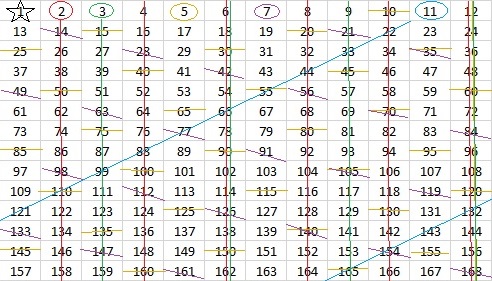
But the next number, 13, is only one number more than 12, and all of its multiples are staring at me making me feel very uncomfortable. It will be very easy to cross out all of the multiples of 13. That means we can extend the list of numbers to one less than the next prime number squared, which is 289 – 1 = 288. This time we get a perfect rectangle because 288 is also a multiple of 12:

All of the circled numbers in the top row and every number that has not been crossed out below the top row are prime numbers.

Someone long ago figured out that if we make the grid six numbers across, all the prime numbers except 2 and 3 will appear in the same two columns, no matter how long the grid is:

Every prime number greater than 3 is either one less or one more than a multiple of 6.

Since we always cross out the multiples of 2 anyway, what would happen if we didn’t include them in the grid at all?

Here is a grid with ten numbers across, but only odd numbers are included. Because 5 is a factor of 10, it is very easy to cross out all of the 5’s. Also, since 9 is one less than 10 and 11 is one more than 10, it is also easy to cross out all the multiples of 3 and 11. Crossing out the 7’s and the 19’s wasn’t too bad, either, but the 13’s and 17’s were not as fun.

In my next post, I will share my favorite size of grid and the method I use to find all of the prime numbers on it. No prime numbers get circled in my method.

Some of the numbers in the grids had several lines through them.
If we made the 36 × 38 grid I mentioned at the beginning of the post, how many lines would 1368 have going through it?  After all, 1368 has 24 factors. What do you think?

Only three lines. One each for its prime factors, 2, 3 and 19.

Here’s more about the number 1368:

  • 1368 is a composite number.
  • Prime factorization: 1368 = 2 × 2 × 2 × 3 × 3 × 19, which can be written 1368 = 2³ × 3² × 19
  • 1368 has at least one exponent greater than 1 in its prime factorization so √1368 can be simplified. Taking the factor pair from the factor pair table below with the largest square number factor, we get √1368 = (√36)(√38) = 6√38
  • The exponents in the prime factorization are 3, 2, and 1. Adding one to each exponent and multiplying we get (3 + 1)(2 + 1)(1 + 1) = 4 × 3 × 2 = 24. Therefore 1368 has exactly 24 factors.
  • The factors of 1368 are outlined with their factor pair partners in the graphic below.

Here’s one of the MANY possible factor trees for 1368: