362 and Level 3

362 is even so it is a composite number. Its factors are listed below the puzzle.

362 Puzzle

Print the puzzles or type the factors on this excel file: 10 Factors 2015-01-19

  • 362 is a composite number.
  • Prime factorization: 362 = 2 x 181
  • The exponents in the prime factorization are 1 and 1. Adding one to each and multiplying we get (1 + 1)(1 + 1) = 2 x 2 = 4. Therefore 362 has exactly 4 factors.
  • Factors of 362: 1, 2, 181, 362
  • Factor pairs: 362 = 1 x 362 or 2 x 181
  • 362 has no square factors that allow its square root to be simplified. √362 ≈ 19.026

A Logical Approach to FIND THE FACTORS: Find the column or row with two clues and find their common factor. Write the corresponding factors in the factor column (1st column) and factor row (top row).  Because this is a level three puzzle, you have now written a factor at the top of the factor column. Continue to work from the top of the factor column to the bottom, finding factors and filling in the factor column and the factor row one cell at a time as you go.

362 Factors

361 Do You See a Pattern?

When 2^361 is divided by 361, the remainder is 116, not 2. That means that 361 is definitely a composite number. Its factors are listed at the end of this post.

361 isn’t used as often, but it is just as special as some of the numbers in the table below:

Multiplication Pattern

The pattern can also be seen along the diagonals in this ordinary multiplication table:

Multiplication Table Pattern

This pattern could be very helpful to students who are learning to multiply. I have seen plenty of students who knew 7 x 7 = 49, but couldn’t remember what 6 x 8 is.

Years after I learned the multiplication facts, I learned how to multiply binomials in an algebra class. I learned about the difference of two squares. In the example below one of the squares is n² and the other square is 1² which is equal to 1. I learned that the equation

(n-1)(n+1)

is true for ALL numbers, but nobody pointed out any practical examples to make it more meaningful. The table at the top of the page contains twelve practical examples. Let’s see how you do applying it to products of a few larger numbers.

Sometimes we find easy ways to remember certain products like
13 and 14 squared

We can use those products to help us remember other products easily by applying the difference of two squares. Try these: (Yes, you can easily do them without a calculator!)

  • 13 x 13 = 169. How much is 12 x 14?
  • 14 x 14 = 196. How much is 13 x 15?
  • 20 x 20 = 400. How much is 19 x 21?
  • If you know that the first ten powers of 2 are 2, 4, 8, 16, 32, 64, 128, 256, 512, 1024, then it’s easy to remember that 16 x 16 = 256. How much is 15 x 17?
  • What if we go in the opposite direction…It isn’t too hard to multiply 18 x 20 in your head to get 360. How much is 19 x 19?
  • 22 x 20 = 440 was also easy to find. How much is 21 x 21?
  • 30 x 30 = 900. How much is 29 x 31?
  • 100 x 100 = 10,000. How much is 99 x 101?

Multiplication Pattern 2

Did you figure out what 361 has to do with this pattern? It is a perfect square just like 1, 4, 9, 16, and 25. Here is its factoring information:

  • 361 is a composite number.
  • Prime factorization: 361 = 19^2
  • The exponent in the prime factorization is 2. Adding one we get (2 + 1) = 3. Therefore 361 has exactly 3 factors.
  • Factors of 361: 1, 19, 361
  • Factor pairs: 361 = 1 x 361 or 19 x 19
  • 361 is a perfect square. √361 = 19

360 What Can You Do With Fraction Circles?

360 has more factors than any previous number. 240 and 336 held the previous record of 20 factors for each of them. How many factors do you think 360 has? Scroll down to the end of the post to find out.

360 can be evenly divided by every number from one to ten except seven, so it was a good number for the ancients to choose when they divided the circle into 360 degrees.

I bought a few fraction circles. Each 51 piece set consists of 1 whole circle as well as circles divided into 2 halves, 3 thirds, 4 fourths, 5 fifths, 6 sixths, 8 eighths, 10 tenths, and 12 twelves. What can you do with fraction circles? You can do a lot with them no matter what your age.

Art and Mathematics

The fraction circle shapes can be used just as tangram shapes to create artwork, big or small. A couple of cool symmetric designs can be found at fraction-art and fraction-circle-art. Adding rectangular fraction pieces will increase the possibilities. Here are some simple artistic designs.

Fraction Relationships

You can use fraction circle shapes to explore the relationship between fractions such as ½, ¼, and  ⅟₈;  ⅟₃, ⅟₆  and ⅟₁₂; or ½, ⅟₅ and ⅟₁₀:

Areas of Parallelograms, Trapezoids, and Circles 

The picture above shows what happens when the circle is divided into four, six, eight, ten or twelve equal wedges, and the wedges are arranged into something that resembles a parallelogram. This idea can be so easily duplicated with these fraction circles without any cutting.

Here are some good questions to ask:

  1. What happens to the top and bottom of the shape when the number of wedges increases?
  2. Sometimes the resulting shape will look like a trapezoid, and sometimes it looks more like a parallelogram. Why does that happen?

We know that the circumference of any circle is 2πr with π defined as the circumference divided by the radius. π is the same value no matter how big or small the circle is.

We can calculate the area of any of the parallelogram-like shapes or trapezoid-like shapes above. Let’s call the length of the bottom of the shape b₁ and the length of the top b₂. The area of the resulting shape is calculated: A = ½ · (b₁ + b₂) · h. Since b₁ + b₂ = 2πr, and the height equals the radius, we can write our formula for the area of a circle as A = ½ · 2πr · r = πr².

This exercise demonstrates that the area of rectangles, parallelograms, trapezoids, and circles are all related!

Introduction to Pie Charts

Pie charts are a great way to display data when we want to look at percentages of a whole. If you use fraction circles, you are limited to using only to certain percentages, but they can still make a good introduction to the subject. To make the pie chart work either the total of all the degrees will have to equal 360 or the total of all the percents will have to equal 100:

Pie Chart Pieces

After a brief introduction using the fraction circles, try Kids Zone Create a Graph. It’s really easy to use!

Exploring Perimeter and Introducing Radians in Trigonometry

The perimeter of each fraction circle piece can be calculated. If the r = 1, the circumference of the circle is 2π, and we can see an important relationship between the degrees and the perimeter of each piece.

Perimeter of Fraction Circle Pieces

What experiences have YOU had with circle fractions? Did you find them frustrating or enlightening? Personally, I like them very much, but I wish they had also been cut into ninths.

Here are some facts about the number 360:

The interior angles of every convex or concave quadrilateral total 360 degrees.

The exterior angles of every convex or concave polygon also total 360 degrees.

Here is all the factoring information about 360:

  • 360 is a composite number.
  • Prime factorization: 360 = 2 x 2 x 2 x 3 x 3 x 5, which can be written 360 = 2³·3²·5
  • The exponents in the prime factorization are 3, 2 and 1. Adding one to each and multiplying we get (3 + 1)(2 + 1)(1 + 1) = 4 x 3 x 2 = 24. Therefore 360 has exactly 24 factors.
  • Factors of 360: 1, 2, 3, 4, 5, 6, 8, 9, 10, 12, 15, 18, 20, 24, 30, 36, 40, 45, 60, 72, 90, 120, 180, 360
  • Factor pairs: 360 = 1 x 360, 2 x 180, 3 x 120, 4 x 90, 5 x 72, 6 x 60, 8 x 45, 9 x 40, 10 x 36, 12 x 30, 15 x 24 or 18 x 20
  • Taking the factor pair with the largest square number factor, we get √360 = (√10)(√36) = 6√10 ≈ 18.974

359 and Level 2

When 2^359 is divided by 359, the remainder is 2, so 359 is VERY LIKELY a prime number. Scroll down past the puzzle to know for sure.

359 Puzzle

Print the puzzles or type the factors on this excel file: 10 Factors 2015-01-19

  • 359 is a prime number.
  • Prime factorization: 359 is prime.
  • The exponent of prime number 359 is 1. Adding 1 to that exponent we get (1 + 1) = 2. Therefore 359 has exactly 2 factors.
  • Factors of 359: 1, 359
  • Factor pairs: 359 = 1 x 359
  • 359 has no square factors that allow its square root to be simplified. √359 ≈ 18.947

How do we know that 359 is a prime number? If 359 were not a prime number, then it would be divisible by at least one prime number less than or equal to √359 ≈ 18.947. Since 359 cannot be divided evenly by 2, 3, 5, 7, 11, 13, or 17, we know that 359 is a prime number.

359 Factors

358 and Level 1

358 is even and therefore a composite number. Scroll down below the puzzle to see its factors.

358 Puzzle

Print the puzzles or type the factors on this excel file: 10 Factors 2015-01-19

  • 358 is a composite number.
  • Prime factorization: 358 = 2 x 179
  • The exponents in the prime factorization are 1 and 1. Adding one to each and multiplying we get (1 + 1)(1 + 1) = 2 x 2 = 4. Therefore 358 has exactly 4 factors.
  • Factors of 358: 1, 2, 179, 358
  • Factor pairs: 358 = 1 x 358 or 2 x 179
  • 358 has no square factors that allow its square root to be simplified. √358 ≈ 18.921

358 Factors

357 Equality, Mathematics, and Dr. Martin Luther King, Jr.

I read several quotes from Dr. Martin Luther Kings, Jr. today, including this one on equality and integration. The last sentence mentions mathematics, but I’m not exactly sure what that last sentence has to do with the rest of the quotation. Can anyone enlighten me? (Check the comments for one interpretation.)

Martin Luther King, Jr. quote

Here is a little about the number 357:

3, 5, and 7 are three consecutive odd numbers so, so 357 is divisible by 3 and is a composite number.

  • 357 is a composite number.
  • Prime factorization: 357 = 3 x 7 x 17
  • The exponents in the prime factorization are 1, 1, and 1. Adding one to each and multiplying we get (1 + 1)(1 + 1)(1 + 1) = 2 x 2 x 2 = 8. Therefore 357 has exactly 8 factors.
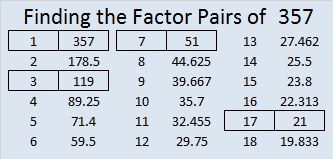
  • Factors of 357: 1, 3, 7, 17, 21, 51, 119, 357
  • Factor pairs: 357 = 1 x 357, 3 x 119, 7 x 51, or 17 x 21
  • 357 has no square factors that allow its square root to be simplified. √357 ≈ 18.894

356 and Level 6

356 is even so it is a composite number. Scroll down past the puzzle to see its factors.

356 Puzzle

Print the puzzles or type the factors on this excel file: 12 Factors 2015-01-12

  • 356 is a composite number.
  • Prime factorization: 356 = 2 x 2 x 89, which can be written 356 = (2^2) x 89
  • The exponents in the prime factorization are 2 and 1. Adding one to each and multiplying we get (2 + 1)(1 + 1) = 3 x 2  = 6. Therefore 356 has exactly 6 factors.
  • Factors of 356: 1, 2, 4, 89, 178, 356
  • Factor pairs: 356 = 1 x 356, 2 x 178, or 4 x 89
  • Taking the factor pair with the largest square number factor, we get √356 = (√4)(√89) = 2√89 ≈ 18.868

356 Logic

355 and Level 5

Five can evenly divide into numbers when the last digit is 5, so 355 is a composite number. Scroll down past the puzzle to see its factors.

355 Puzzle

Print the puzzles or type the factors on this excel file: 12 Factors 2015-01-12

  • 355 is a composite number.
  • Prime factorization: 355 = 5 x 71
  • The exponents in the prime factorization are 1 and 1. Adding one to each and multiplying we get (1 + 1)(1 + 1) = 2 x 2 = 4. Therefore 355 has exactly 4 factors.
  • Factors of 355: 1, 5, 71, 355
  • Factor pairs: 355 = 1 x 355 or 5 x 71
  • 355 has no square factors that allow its square root to be simplified. √355 ≈ 18.841

355 Logic

354 and Level 4

354 is even and thus divisible by 2, so 354 is a composite number. It is also made from three consecutive numbers so it is divisible by 3. Scroll down past the puzzle to see its factors.

354 Puzzle

Print the puzzles or type the factors on this excel file: 12 Factors 2015-01-12

  • 354 is a composite number.
  • Prime factorization: 354 = 2 x 3 x 59
  • The exponents in the prime factorization are 1, 1, and 1. Adding one to each and multiplying we get (1 + 1)(1 + 1)(1 + 1) = 2 x 2 x 2 = 8. Therefore 354 has exactly 8 factors.
  • Factors of 354: 1, 2, 3, 6, 59, 118, 177, 354
  • Factor pairs: 354 = 1 x 354, 2 x 177, 3 x 118, or 6 x 59
  • 354 has no square factors that allow its square root to be simplified. √354 ≈ 18.815

354 Logic

353 and Level 3

When 2^353 is divided by 353, the remainder is 2, so 353 is VERY LIKELY a prime number. Scroll down past the puzzle to know for sure.

353 Puzzle

Print the puzzles or type the factors on this excel file: 12 Factors 2015-01-12

  • 353 is a prime number.
  • Prime factorization: 353 is prime.
  • The exponent of prime number 353 is 1. Adding 1 to that exponent we get (1 + 1) = 2. Therefore 353 has exactly 2 factors.
  • Factors of 353: 1, 353
  • Factor pairs: 353 = 1 x 353
  • 353 has no square factors that allow its square root to be simplified. √353 ≈ 18.788

How do we know that 353 is a prime number? If 353 were not a prime number, then it would be divisible by at least one prime number less than or equal to √353 ≈ 18.788. Since 353 cannot be divided evenly by 2, 3, 5, 7, 11, 13, or 17, we know that 353 is a prime number.

A Logical Approach to FIND THE FACTORS: Find the column or row with two clues and find their common factor. Write the corresponding factors in the factor column (1st column) and factor row (top row).  Because this is a level three puzzle, you have now written a factor at the top of the factor column. Continue to work from the top of the factor column to the bottom, finding factors and filling in the factor column and the factor row one cell at a time as you go.

353 Factors