1305 and Level 4

This level 4 puzzle has clues taken from a standard multiplication table, but the factors of those clues are not in their usual places. Can you figure out where the numbers 1 to 10 belong in this multiplication table?

Print the puzzles or type the solution in this excel file: 10-factors-1302-1310

Now I’ll share some information about the puzzle’s number, 1305:

  • 1305 is a composite number.
  • Prime factorization: 1305 = 3 × 3 × 5 × 29, which can be written 2905 = 3² × 5 × 29
  • The exponents in the prime factorization are 2, 1, and 1. Adding one to each and multiplying we get (2 + 1)(1 + 1)(1 + 1) = 3 × 2 × 2 = 12. Therefore 1305 has exactly 12 factors.
  • Factors of 1305: 1, 3, 5, 9, 15, 29, 45, 87, 145, 261, 435, 1305
  • Factor pairs: 1305 = 1 × 1305, 3 × 435, 5 × 261, 9 × 145, 15 × 87, or 29 × 45
  • Taking the factor pair with the largest square number factor, we get √1305 = (√9)(√145) = 3√145 ≈ 36.12478.

1305 is the sum of two squares in two ways:
36² + 3² = 1305
27² + 24² = 1305

153-1296-1305 calculated by 27² – 24², 2(27)(24), 27² + 24²
216-1287-1305 calculated by 2(36)(3), 36² – 3², 36² + 3²
783-1044-1305 which is (3-4-5) times 261
900-945-1305 which is (20-21-29) times 45

1304 and Level 3

Which factor pairs of 45 and 18 have only numbers from 1 to 10 in them? Answer that question, put the factors in the appropriate places, and then work your way down this level 3 puzzle cell by cell until you’ve solved it.

Print the puzzles or type the solution in this excel file: 10-factors-1302-1310

Here are a few facts about the number 1304:

  • 1304 is a composite number.
  • Prime factorization: 1304 = 2 × 2 × 2 × 163, which can be written 1304 = 2³ × 163
  • The exponents in the prime factorization are 3 and 1. Adding one to each and multiplying we get (3 + 1)(1 + 1) = 4 × 2 = 8. Therefore 1304 has exactly 8 factors.
  • Factors of 1304: 1, 2, 4, 8, 163, 326, 652, 1304
  • Factor pairs: 1304 = 1 × 1304, 2 × 652, 4 × 326, or 8 × 163
  • Taking the factor pair with the largest square number factor, we get √1304 = (√4)(√326) = 2√326 ≈ 36.11094

1304 is the difference of two squares two ways:
327² – 325² = 1304
165² – 161² = 1304

1303 and Level 2

Multiplication tables usually have facts up to 10 × 10 = 100 or possibly 12 × 12 = 144. Numbers like 64 and 25 appear only once in those multiplication tables. Those two clues can help you get a good start solving this level 2 puzzle.

Print the puzzles or type the solution in this excel file: 10-factors-1302-1310

Now I’ll share a few facts about the number 1303:

  • 1303 is a prime number.
  • Prime factorization: 1303 is prime.
  • The exponent of prime number 1303 is 1. Adding 1 to that exponent we get (1 + 1) = 2. Therefore 1303 has exactly 2 factors.
  • Factors of 1303: 1, 1303
  • Factor pairs: 1303 = 1 × 1303
  • 1303 has no square factors that allow its square root to be simplified. √1303 ≈ 36.09709

How do we know that 1303 is a prime number? If 1303 were not a prime number, then it would be divisible by at least one prime number less than or equal to √1303 ≈ 36.1. Since 1303 cannot be divided evenly by 2, 3, 5, 7, 11, 13, 17, 19, 23, 29 or 31, we know that 1303 is a prime number.

1303 is the sum of three consecutive primes:
431 + 433 + 439 = 1303

1301 Cool Patterns of Centered Square Numbers

1301 is a centered square number because it is the sum of two consecutive square numbers. It also happens to be exactly 100 more than the previous centered square number.

1301 is special because it is the sum of two consecutive squares, but it is not the only sum of two squares that is 100 more than another sum of two squares. Here is a chart of some of those squares with some other information. What patterns do you see?

What role did the triangular numbers play on that chart? The pattern you see of 4, 12, 24, etc. is not new. Look at this chart of centered square numbers below. Below each centered square number (in blue) are related sums of squares. The difference of those related sums and the centered square above it follows that same 4, 12, 24, . . .  pattern.

When you look just at centered square numbers, there is a different pattern for them as well. For example, if you know that 1301 is the 26th centered square number, then you can be sure that 1301 + 4(26) = 1405 will be the next centered square number.

When the chart above is “bent in half” so the list of centered square numbers begins at the lower left and ends at the lower right, there is yet another pattern. Look at the differences horizontally to see a cool pattern:

I’ve made it clear that centered square numbers are made when consecutive square numbers are added, such as 26² + 25² = 1301, but what does one look like? Here’s a picture of 1301 tiny little squares arranged as a centered square.

There are 100 tiny green squares around it because it is 100 more than the previous centered square number.

Here are some more facts about the number 1301:

  • 1301 is a prime number and the first prime in a prime triplet.
  • Prime factorization: 1301 is prime.
  • The exponent of prime number 1301 is 1. Adding 1 to that exponent we get (1 + 1) = 2. Therefore 1301 has exactly 2 factors.
  • Factors of 1301: 1, 1301
  • Factor pairs: 1301 = 1 × 1301
  • 1301 has no square factors that allow its square root to be simplified. √1301 ≈ 36.06938

How do we know that 1301 is a prime number? If 1301 were not a prime number, then it would be divisible by at least one prime number less than or equal to √1301 ≈ 36.1. Since 1301 cannot be divided evenly by 2, 3, 5, 7, 11, 13, 17, 19, 23, 29 or 31, we know that 1301 is a prime number.

Every centered square number is a hypotenuse of a Pythagorean triple. For example,
primitive 51-1300-1301 is calculated from 26² – 25², 2(26)(25), 26² + 25²

Here’s another way we know that 1301 is a prime number: Since its last two digits divided by 4 leave a remainder of 1, and 26² + 25² = 1301 with 26 and 25 having no common prime factors, 1301 will be prime unless it is divisible by a prime number Pythagorean triple hypotenuse less than or equal to √1301 ≈ 36.1. Since 1301 is not divisible by 5, 13, 17, or 29, we know that 1301 is a prime number.

1302 and Level 1

If you can tell time on an analog clock, then you can solve this puzzle. Go ahead and see how little time it will take you!

Print the puzzles or type the solution in this excel file: 10-factors-1302-1310

Here are a few facts about the number 1302:

  • 1302 is a composite number.
  • Prime factorization: 1302 = 2 × 3 × 7 × 31
  • The exponents in the prime factorization are 1, 1, 1, and 1. Adding one to each and multiplying we get (1 + 1)(1 + 1)(1 + 1)(1 + 1) = 2 × 2 × 2 × 2 = 16. Therefore 1302 has exactly 16 factors.
  • Factors of 1302: 1, 2, 3, 6, 7, 14, 21, 31, 42, 62, 93, 186, 217, 434, 651, 1302
  • Factor pairs: 1302 = 1 × 1302, 2 × 651, 3 × 434, 6 × 217, 7 × 186, 14 × 93, 21 × 62, or 31 × 42
  • 1302 has no square factors that allow its square root to be simplified. √1302 ≈ 36.08324

1299 Is This Puzzle a Real Turkey?

Happy Thanksgiving, everyone!

Turkeys run but they cannot hide. They all will eventually end up on somebodies’ table. There doesn’t seem to be much of a mystery about that, but I’ve created a mystery level puzzle for today anyway. I promise it can be solved using logic and the basic facts in a 12 × 12 multiplication table.

Print the puzzles or type the solution in this excel file: 12 factors 1289-1299

Now I’ll share some facts about the number 1299:

  • 1299 is a composite number.
  • Prime factorization: 1299 = 3 × 433
  • The exponents in the prime factorization are 1 and 1. Adding one to each and multiplying we get (1 + 1)(1 + 1) = 2 × 2 = 4. Therefore 1299 has exactly 4 factors.
  • Factors of 1299: 1, 3, 433, 1299
  • Factor pairs: 1299 = 1 × 1299 or 3 × 433
  • 1299 has no square factors that allow its square root to be simplified. √1299 ≈ 36.04164

1299 is the hypotenuse of a Pythagorean triple:
435-1224-1299 which is 3 times (145-408-433)

OEIS.org informs us that 8¹²⁹⁹ ≈ 1299 × 10¹¹⁷⁰. You can see it for yourself on a computer calculator!


1298 Another Mystery

Hint #1: Which two clues will use both of the nines?
Hint #2: Which two clues will use both of the sixes?

6, 7, 8, or 12, two of them will use the 1’s. One of those 1’s will be in the first column. They both can’t be. That fact was important when I worked to solve this puzzle.

It won’t be easy, but why don’t you give it a try?

Print the puzzles or type the solution in this excel file: 12 factors 1289-1299

It won’t help to solve the puzzle, but I’ll share some information now about our puzzle number, 1298:

  • 1298 is a composite number.
  • Prime factorization: 1298 = 2 × 11 × 59
  • The exponents in the prime factorization are 1, 1, and 1. Adding one to each and multiplying we get (1 + 1)(1 + 1)(1 + 1) = 2 × 2 × 2 = 8. Therefore 1298 has exactly 8 factors.
  • Factors of 1298: 1, 2, 11, 22, 59, 118, 649, 1298
  • Factor pairs: 1298 = 1 × 1298, 2 × 649, 11 × 118, or 22 × 59
  • 1298 has no square factors that allow its square root to be simplified. √1298 ≈ 36.02777

1298 is the sum of four consecutive prime numbers:
313 + 317 + 331 + 337 = 1298

1297 Mystery

Today’s puzzle has 12 clues, but it still presents quite a mystery. Will you be able to figure out where the factors from 1 to 12 go in the 1st column and the top row of the puzzle, or will you let this mystery stump you?

Print the puzzles or type the solution in this excel file: 12 factors 1289-1299

Now I’ll share a little bit of information about the number 1297:

  • 1297 is a prime number.
  • Prime factorization: 1297 is prime.
  • The exponent of prime number 1297 is 1. Adding 1 to that exponent we get (1 + 1) = 2. Therefore 1297 has exactly 2 factors.
  • Factors of 1297: 1, 1297
  • Factor pairs: 1297 = 1 × 1297
  • 1297 has no square factors that allow its square root to be simplified. √1297 ≈ 36.01389

How do we know that 1297 is a prime number? If 1297 were not a prime number, then it would be divisible by at least one prime number less than or equal to √1297 ≈ 36.01. Since 1297 cannot be divided evenly by 2, 3, 5, 7, 11, 13, 17, 19, 23, 29 or 31, we know that 1297 is a prime number.

1297 is the sum of two squares:
36² +  1² = 1297

1297 is the hypotenuse of a Pythagorean triple:
72-1295-1297 calculated from 2(36)(1), 36² –  1², 36² +  1²

Here’s another way we know that 1297 is a prime number: Since its last two digits divided by 4 leave a remainder of 1, and 36² + 1² = 1297 with 36 and 1 having no common prime factors, 1297 will be prime unless it is divisible by a prime number Pythagorean triple hypotenuse less than or equal to √1297 ≈ 36.01. Since 1297 is not divisible by 5, 13, 17, or 29, we know that 1297 is a prime number.

1296 Last Digit Effort

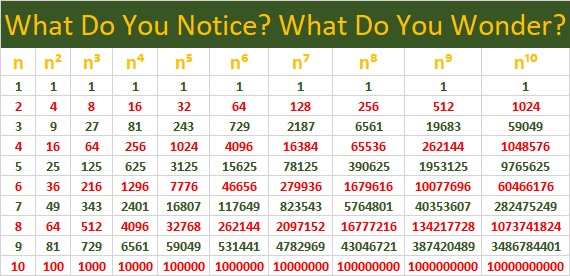
If you always use a calculator to find the roots of perfect powers like 1296, then you will likely miss out on discovering the wonderful patterns those powers have. Look at the table below. What do you notice? What do you wonder?

When I looked at it, I noticed several patterns and I wondered about a few things that I explored to see if they were true. However, I won’t tell you what I noticed or what conjectures I made until the end of this post, because I don’t want to spoil YOUR chance to discover those patterns yourself. I will tell you that there are MANY patterns in the table above and that most of my conjectures were true, but one of them turned out not to be.

Besides the patterns that you will have to discover for yourself, the table can be very useful: You can use the table to find several fractional powers of the numbers in the body of the table. For example, if you wanted to find out what is 1296^(7/4), then you could simply run your finger down the n⁷ column and the n⁴ column simultaneously until you reach 1296 on the n⁴ column (because 4 is the denominator of the fractional power). Your answer, 279936, will be in the n⁷ column on the same row as 1296.

However, if you wanted to find 1296^(3/2), you would either have to expand the table to include 36² and 36³, or you would have to use the fact that 3/2 = 6/4. Then you could use the process of the previous paragraph to see that
1296^(3/2) = 1296^(6/4) = 46656.

Now I’ll share some more facts about the number 1296:

  • 1296 is a composite number, a perfect square, and a perfect fourth power.
  • Prime factorization: 1296 = 2 × 2 × 2 × 2 × 3 × 3 × 3 × 3, which can be written 1296 = 2⁴ × 3⁴
  • The exponents in the prime factorization are 4 and 4. Adding one to each and multiplying we get (4 + 1)(4 + 1) = 5 × 5 = 25. Therefore 1296 has exactly 25 factors.
  • Factors of 1296: 1, 2, 3, 4, 6, 8, 9, 12, 16, 18, 24, 27, 36, 48, 54, 72, 81, 108, 144, 162, 216, 324, 432, 648, 1296
  • Factor pairs: 1296 = 1 × 1296, 2 × 648, 3 × 432, 4 × 324, 6 × 216, 8 × 162, 9 × 144, 12 × 108, 16 × 81, 18 × 72, 24 × 54, 27 × 48, or 36 × 36
  • Taking the factor pair with the largest square number factor, we get √1296 = (√36)(√36) = 36.

1296 is the smallest number with exactly 25 factors.

There are MANY different factor trees you could make for 1296, but here are some made with squares:

1296 is the 21st Friedman number because of its digits and 9²×16 = 1296. (The same digits are on both sides of that equation.)

Since 36 is a triangular number and 36² = 1296, we get this wonderful, powerful fact:
(1 + 2 + 3 + 4 + 5 + 6 + 7 + 8)² = 1³ + 2³ + 3³ + 4³ + 5³ + 6³ + 7³ + 8³ = 1296

1296 looks interesting and often rather square when it is written in several bases:
It’s1210000 in BASE 3,
10000 in BASE 6,
2420 in BASE 8,
1700 in BASE 9,
1296 in BASE 10
900 in BASE 12,
789 in BASE 13 (Ha, ha. Seven ate nine!),
484 in BASE 17,
400 in BASE 18,
169 in BASE 33,
144 in BASE 34,
121 in BASE 35, and
100 in BASE 36

Do you know the square roots in base 10 of all the numbers in bold? Indeed, 1296 is a fascinating square number!

Here are some things I noticed on the table of powers for numbers ending in . . .

  • 1: The last digit is always 1
  • 2: The pattern for the last digit is 2, 4, 8, 6, repeating
  • 3: The pattern for the last digit is 3, 9, 7, 1, repeating
  • 4: The pattern for the last digit is 4, 6, 4, 6, repeating
  • 5: The last digit is always 5
  • 6: The last digit is always 6
  • 7: The pattern for the last digit is 7, 9, 3, 1, repeating (3’s pattern backward but starting with 7)
  • 8: The pattern for the last digit is 8, 4, 2, 6, repeating (2’s pattern backward but starting with 8)
  • 9: The pattern for the last digit is 9, 1, 9, 1, repeating
  • 0: The last digit is always 0

For the squares:

  • 1² and 9² both end in 1, and 1 + 9 = 10
  • 2² and 8² both end in 4, and 2 + 8 = 10
  • 3² and 7² both end in 9, and 3 + 7 = 10
  • 4² and 6² both end in 6, and 4 + 6 = 10

For the cubes:

  • 1³ ends in 1, and 9³ ends in 9
  • 2³ ends in 8, and 8³ ends in 2; 2 + 8 = 10
  • 3³ ends in 7, and 7³ ends in 3; 3 + 7 = 10
  • 4³ ends in 4, and 6³ ends in 6

Other observations:

  • No matter what n is, the last digit of n, n⁵, and n⁹ are always the same. Yes, that pattern continues with n¹³ and so forth.
  • The number of digits for 10ᵃ is a+1, and the number of digits for 9ᵃ is a.

Dan Bach noticed something else.

I had never heard of Benford’s Law before, so I’ve learned something new here!  All of us can learn something new by observing patterns and listening to each other.