The exponents in the prime factorization are 1 and 1. Adding one to each and multiplying we get (1 + 1)(1 + 1) = 2 x 2 = 4. Therefore 634 has exactly 4 factors.
Factors of 634: 1, 2, 317, 634
Factor pairs: 634 = 1 x 634 or 2 x 317
634 has no square factors that allow its square root to be simplified. √634 ≈ 25.1793566.
Each of the sums above has 3 numbers, and 3 is a prime factor of 633. The middle number in each of the sums is 211 which is the other prime factor of 633.
Each of its two prime factors is 104 away from their average, 107.
Thus (107^2) – (104^2) = 633
The numbers in 633’s other factor pair are 1 and 633, and they are each 316 away from their average, 317.
The exponents in the prime factorization are 1 and 1. Adding one to each and multiplying we get (1 + 1)(1 + 1) = 2 x 2 = 4. Therefore 633 has exactly 4 factors.
Factors of 633: 1, 3, 211, 633
Factor pairs: 633 = 1 x 633 or 3 x 211
633 has no square factors that allow its square root to be simplified. √633 ≈ 25.15949.
Prime factorization: 632 = 2 x 2 x 2 x 79, which can be written 632 = (2^3) x 79
The exponents in the prime factorization are 3 and 1. Adding one to each and multiplying we get (3 + 1)(1 + 1) = 4 x 2 = 8. Therefore 632 has exactly 8 factors.
Factors of 632: 1, 2, 4, 8, 79, 158, 316, 632
Factor pairs: 632 = 1 x 632, 2 x 316, 4 x 158, or 8 x 79
Taking the factor pair with the largest square number factor, we get √632 = (√4)(√158) = 2√158 ≈ 25.13961.
630 is the 7th number with exactly 24 factors. So far, the seven numbers counting numbers with 24 factors are 360, 420, 480, 504, 540, 600, and 630. No counting number less than 630 has more than 24 factors.
Two of those seven numbers make up the Pythagorean triple 378-504-630. Which factor of 630 is the greatest common factor of those three numbers in the triple?
Here are a few of the MANY possible factor trees for 630.
Factors of 630:
630 is a composite number.
Prime factorization: 630 = 2 x 3 x 3 x 5 x 7, which can be written 630 = 2 x (3^2) x 5 x 7
The exponents in the prime factorization are 1, 2, 1, and 1. Adding one to each and multiplying we get (1 + 1)(2 + 1)(1 + 1)(1 + 1) = 2 x 3 x 2 x 2 = 24. Therefore 630 has exactly 24 factors.
Factor pairs: 630 = 1 x 630, 2 x 315, 3 x 210, 5 x 126, 6 x 10⁵, 7 x 90, 9 x 70, 10 x 63, 14 x 45, 15 x 42, 18 x 35, or 21 x 30
Taking the factor pair with the largest square number factor, we get √630 = (√9)(√70) = 3√70 ≈ 25.09980.
Sum-Difference Puzzle:
630 has twelve factor pairs. One of the factor pairs adds up to 53, and a different one subtracts to 53. If you can identify those factor pairs, then you can solve this puzzle!
More about the Number 630:
630 is the sum of the six prime numbers from 97 to 113.
629 is the sum of the 17 prime numbers from 7 to 71. Both of its prime factors, 17 and 37, are included in that list.
17 and 37 are both 10 numbers away from their average, 27. That means that 629 + 10² = 729 or 27².
25² + 2² = 629 and 23² + 10² = 629. Notice that 629 plus or minus 100 is a square number.
Both of 629’s prime factors have a remainder of one when divided by four so 629 is the hypotenuse of four Pythagorean triples, two of which are primitives.
100-621-629, a primitive that reminds me of another primitive, 20-21-29
204-595-629, three numbers whose greatest common factor is 17
296-555-629, three numbers whose greatest common factor is 37
429-460-629, a primitive whose shorter leg is exactly 200 less than its hypotenuse.
The exponents in the prime factorization are 1 and 1. Adding one to each and multiplying we get (1 + 1)(1 + 1) = 2 x 2 = 4. Therefore 629 has exactly 4 factors.
Factors of 629: 1, 17, 37, 629
Factor pairs: 629 = 1 x 629 or 17 x 37
629 has no square factors that allow its square root to be simplified. √629 ≈ 25.079872.
The circumference of a circle with a radius of one is approximately 6.28. That’s an important enough number that it has been given the symbol “τ ” which is pronounced “tau”. τ looks a little like half of the number π, but τ = 2π.
Some people think we should get rid of π and only use τ. Other people feel that π has been used for centuries, and there is no compelling reason to change now.
π is perfect for finding the area of a circle: Area = πr². Here’s the area of a circle using tau: Area = r²τ/2.
τ is very good for finding the circumference of a circle: Circumference = τr, but that looks strange compared to 2πr. In fact, it can be difficult to tell if τr is one character or two.
The Tau Manifesto shows angle measurements in degrees, π radians and τ radians. You might want to look at some videos, too. Some people think the τ radians are simpler because the radians correspond exactly to the fractional pieces of the circumference of a circle or, get this, to the fractional pieces of a pie. (τ does that, not π.) Other people think that π radians are just as good because we’re used to them, and they correspond exactly to the area of any wedge in a unit circle or the area of any slice of pie. (Which would you rather eat the circumference or the area of a pie?)
Until I wrote this post and read the link shared in the comments, I hadn’t heard anybody say that π is better for some situations while τ is better for others. (Actually, it appears that π is better except in formulas that use 2π.) Diameters and radii have co-existed peacefully for centuries. I don’t understand why π and τ can’t do the same. Here’s a great video that shows both sides of the argument.
—————————————————————————————————
22² + 12² = 628.
628 is the hypotenuse of the Pythagorean triple 340-528-628. The greatest common factor of those three numbers is the same as the greatest common factor of 22² and 12².
7² + 11² + 13² + 17² = 628. Thank you OEIS.org for that fun fact about the squares of those four consecutive prime numbers.
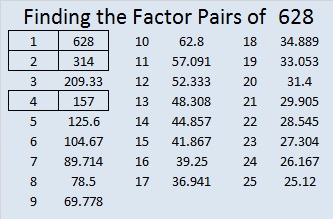
Prime factorization: 628 = 2 x 2 x 157, which can be written 628 = (2^2) x 157
The exponents in the prime factorization are 2 and 1. Adding one to each and multiplying we get (2 + 1)(1 + 1) = 3 x 2 = 6. Therefore 628 has exactly 6 factors.
Factors of 628: 1, 2, 4, 157, 314, 628
Factor pairs: 628 = 1 x 628, 2 x 314, or 4 x 157
Taking the factor pair with the largest square number factor, we get √628 = (√4)(√157) = 2√157 ≈ 25.059928.
The exponents in the prime factorization are 1, 1, and 1. Adding one to each and multiplying we get (1 + 1)(1 + 1)(1 + 1) = 2 x 2 x 2 = 8. Therefore 627 has exactly 8 factors.
Factors of 627: 1, 3, 11, 19, 33, 57, 209, 627
Factor pairs: 627 = 1 x 627, 3 x 209, 11 x 57, or 19 x 33
627 has no square factors that allow its square root to be simplified. √627 ≈ 25.039968.
626 is the hypotenuse of the Pythagorean triple 50-624-626. What is the greatest common factor of those three numbers?
Today my son posted on facebook, “A word that when spelled backwards spells a different word is called a Semordnilap.” That’s a word I hadn’t heard before, and it also applies to phrases and sentences that form different phrases or sentences when read backwards.
“Semordnilap” is a semordnilap for the word “palindromes” which are words, phrases, sentences, and numbers that read the same forward and backward.
Palindrome sentences are sometimes made with words that are semordnilaps: was, saw, live, evil, on, no, desserts, stressed, stop, pots, tops, spot, diaper, repaid.
626 is a number that is a palindrome in several different bases:
10001 in base 5; note that (5^4) + 1 = 626.
626 in base 10
272 in base 16; note that 2(16^2) + 7(16) + 2 = 626
1DI in base 19, if “1” and “I” look the same, and too often they do. Note that 1(19^2) + 13(19) + 18 = 626
101 in base 25; note that (25^2) + 1 = 626
11 in base 625; note that 626 + 1 = 626
I guess we could say that in all other bases 626 is a semordnilap.
The exponents in the prime factorization are 1 and 1. Adding one to each and multiplying we get (1 + 1)(1 + 1) = 2 x 2 = 4. Therefore 626 has exactly 4 factors.
Factors of 626: 1, 2, 313, 626
Factor pairs: 626 = 1 x 626 or 2 x 313
626 has no square factors that allow its square root to be simplified. √626 ≈ 25.019992.
623 is the hypotenuse of Pythagorean triple 273-560-623. What is the greatest common factor of those three numbers?
623 is not divisible by 2, 3, or 5. Is 623 divisible by 7? You can apply either of the following divisibility rules after you separate 623’s digits into 62 and 3:
1st rule: 62 – 2(3) = 62 – 6 = 56. Since 56 is divisible by 7, 623 is divisible by 7.
2nd rule: 62 + 5(3) = 62 + 15 = 77. Since 77 is divisible by 7, 623 is divisible by 7.
86 + 87 + 88 + 89 + 90 + 91 + 92 = 623 (7 consecutive numbers because 623 is divisible by 7)
The exponents in the prime factorization are 1 and 1. Adding one to each and multiplying we get (1 + 1)(1 + 1) = 2 x 2 = 4. Therefore 623 has exactly 4 factors.
Factors of 623: 1, 7, 89, 623
Factor pairs: 623 = 1 x 623 or 7 x 89
623 has no square factors that allow its square root to be simplified. √623 ≈ 24.9599679.
The exponents in the prime factorization are 1 and 1. Adding one to each and multiplying we get (1 + 1)(1 + 1) = 2 x 2 = 4. Therefore 622 has exactly 4 factors.
Factors of 622: 1, 2, 311, 622
Factor pairs: 622 = 1 x 622 or 2 x 311
622 has no square factors that allow its square root to be simplified. √622 ≈ 24.9399.