984 Way Too Big Christmas Factor Tree

Some Christmas trees are so big they are difficult to take home in the car. They might even be too big to set up in the house. This puzzle is the biggest one I have ever made. It looks like a very big Christmas tree waiting to be set up. Is it too big to bring fun this Christmastime?

The table below may be helpful in solving the puzzle. There are 400 places to write products in a 20 × 20 multiplication table, but not all the numbers from 1 to 400 appear in such a table. Some numbers don’t appear at all while other numbers appear more than one times. The chart below is color-coded to show how many times a product appears in the 20 × 20 multiplication table. Clues in the puzzle that appear only once (yellow) or twice (green) in the multiplication table won’t cause much trouble when solving the puzzle. Any other clues might stump you. Notice that the number 60 appears twice in the puzzle but eight times (black) in the 20 × 20 multiplication table!

I’d like to share some information about the number 984.

It is the hypotenuse of a Pythagorean triple:
216-960-984 which is 24 times (9-40-41)

OEIS.org informs us that 8 + 88 + 888 = 984.

984 is 1313 in BASE 9 because 1(9³) + 3(9²) + 1(9¹) + 3(9⁰) = 984.

Here are a couple of the many possible factor trees for 984:

  • 984 is a composite number.
  • Prime factorization: 984 = 2 × 2 × 2 × 3 × 41, which can be written 984 = 2³ × 3 × 41
  • The exponents in the prime factorization are 3, 1, and 1. Adding one to each and multiplying we get (3 + 1)(1 + 1)(1 + 1) = 4 × 2 × 2 = 16. Therefore 984 has exactly 16 factors.
  • Factors of 984: 1, 2, 3, 4, 6, 8, 12, 24, 41, 82, 123, 164, 246, 328, 492, 984
  • Factor pairs: 984 = 1 × 984, 2 × 492, 3 × 328, 4 × 246, 6 × 164, 8 × 123, 12 × 82, or 24 × 41
  • Taking the factor pair with the largest square number factor, we get √984 = (√4)(√246) = 2√246 ≈ 31.36877

983 Candy Cane

Candy canes have been a part of the Christmas season for ages. Here’s a candy cane puzzle for you to try. It’s a level 6 so it won’t be easy, but you will taste its sweetness once you complete it. Go ahead and get started!

Print the puzzles or type the solution in this excel file: 12 factors 978-985

Here’s some information about prime number 983:

983 is the sum of consecutive prime numbers two different ways:
It is the sum of the seventeen prime numbers from 23 to 97.
It is also the sum of the thirteen prime numbers from 47 to 103.

  • 983 is a prime number.
  • Prime factorization: 983 is prime.
  • The exponent of prime number 983 is 1. Adding 1 to that exponent we get (1 + 1) = 2. Therefore 983 has exactly 2 factors.
  • Factors of 983: 1, 983
  • Factor pairs: 983 = 1 × 983
  • 983 has no square factors that allow its square root to be simplified. √983 ≈ 31.35283

How do we know that 983 is a prime number? If 983 were not a prime number, then it would be divisible by at least one prime number less than or equal to √983 ≈ 31.4. Since 983 cannot be divided evenly by 2, 3, 5, 7, 11, 13, 17, 19, 23, 29 or 31, we know that 983 is a prime number.

982 Red-Hot Cinnamon Candy

When I was a child I remember eating a red-hot cinnamon ball around the holidays. I really like cinnamon, but I wasn’t sure I liked how hot the candy was. I hope you enjoy today’s red-hot cinnamon candy puzzle.

Print the puzzles or type the solution in this excel file: 12 factors 978-985

Now here’s something interesting about the number 982:

It is palindrome 292 in BASE 20 because 2(20²) + 9(20) + 2(1) = 982.

  • 982 is a composite number.
  • Prime factorization: 982 = 2 × 491
  • The exponents in the prime factorization are 1 and 1. Adding one to each and multiplying we get (1 + 1)(1 + 1) = 2 × 2 = 4. Therefore 982 has exactly 4 factors.
  • Factors of 982: 1, 2, 491, 982
  • Factor pairs: 982 = 1 × 982 or 2 × 491
  • 982 has no square factors that allow its square root to be simplified. √982 ≈ 31.336879


981 Peppermint Sticks

This time of year you can buy peppermint sticks that don’t just have red stripes, but they might have green ones, too. Today’s puzzle looks like a couple of peppermint sticks. It will be a sweet experience for you to solve it, so be sure to give it a try.

Print the puzzles or type the solution in this excel file: 12 factors 978-985

Here is some information about the number 981:

30² + 9² = 981 making 981 the hypotenuse of a Pythagorean triple:
540-819-981 which is 9 times (60-91-109) but can also be calculated from
2(30)(9), 30² – 9², 30² + 9²

981 is palindrome 171 in BASE 28 because 1(28²) + 7(28) + 1(1) = 981

  • 981 is a composite number.
  • Prime factorization: 981 = 3 × 3 × 109, which can be written 981 = 3² × 109
  • The exponents in the prime factorization are 2 and 1. Adding one to each and multiplying we get (2 + 1)(1 + 1) = 3 × 2  = 6. Therefore 981 has exactly 6 factors.
  • Factors of 981: 1, 3, 9, 109, 327, 981
  • Factor pairs: 981 = 1 × 981, 3 × 327, or 9 × 10⁹
  • Taking the factor pair with the largest square number factor, we get √981 = (√9)(√109) = 3√109 ≈ 31.3209

980 Christmas Factor Trees

This level 4 puzzle has 12 clues in it that are products of factor pairs in which both factors are numbers from 1 to 12. The clues make an evergreen tree, the symbol of everlasting life which is so fitting for Christmas. Can you find the factors for the given clues and put them in the right places?

Print the puzzles or type the solution in this excel file: 12 factors 978-985

Now I’ll tell you a little about the number 980:

It has eighteen factors and many possible factor trees. Here are just three of them:

28² + 14² = 980, so 980 is the hypotenuse of a Pythagorean triple:
588-784-980 which is (3-4-5) times 196, but can also be calculated from
28² – 14², 2(28)(14), 28² + 14²

I like the way 980 looks in some other bases:
It is 5A5 in BASE 13 (A is 10 base 10) because 5(13) + 10(13) + 5(1) = 980,
500 in BASE 14 because 5(14²) = 980,
SS in BASE 34 (S is 28 base 10) because 28(34) + 28(1) = 28(35) = 980
S0 in BASE 35 because 28(35) = 980

  • 980 is a composite number.
  • Prime factorization: 980 = 2 × 2 × 5 × 7 × 7, which can be written 980 = 2² × 5 × 7²
  • The exponents in the prime factorization are 2, 1 and 2. Adding one to each exponent and multiplying we get (2 + 1)(1 + 1)(2 + 1) = 3 × 2 × 3 = 18. Therefore 980 has exactly 18 factors.
  • Factors of 980: 1, 2, 4, 5, 7, 10, 14, 20, 28, 35, 49, 70, 98, 140, 196, 245, 490, 980
  • Factor pairs: 980 = 1 × 980, 2 × 490, 4 × 245, 5 × 196, 7 × 140, 10 × 98, 14 × 70, 20 × 49 or 28 × 35
  • Taking the factor pair with the largest square number factor, we get √980 = (√196)(√5) = 14√5 ≈ 31.30495.

979 Was virgács in your shoes this morning?

Today was Saint Nicholas day in much of Europe. Children woke up and looked in their shoes that they had carefully laid out the night before. They love to find their favorite candies letting them know they’ve been good this last year. In Hungary, where everyone’s behavior is considered to be a mixture of both good and bad, children also found some virgács in their shoes, letting them know they were also naughty some of the time. Today’s puzzle looks a little like virgács.

Print the puzzles or type the solution in this excel file: 12 factors 978-985

1⁴ + 2⁴ + 3⁴ + 4⁴ + 5⁴ = 979

979 is the sum of the eleven prime numbers from 67 to 109.

979 is a palindrome in base 10 and in two other bases:
454 in BASE 15
3D3 in BASE 16 (D is 13 base 10)

979 is the hypotenuse of a Pythagorean triple:
429-880-979 which is 11 times (39-80-89)

  • 979 is a composite number.
  • Prime factorization: 979 = 11 × 89
  • The exponents in the prime factorization are 1 and 1. Adding one to each and multiplying we get (1 + 1)(1 + 1) = 2 × 2 = 4. Therefore 979 has exactly 4 factors.
  • Factors of 979: 1, 11, 89, 979
  • Factor pairs: 979 = 1 × 979 or 11 × 89
  • 979 has no square factors that allow its square root to be simplified. √979 ≈ 31.288976

978 A Gift-Wrapped Puzzle

Today’s puzzle comes gift-wrapped just for you. Figuring out the solution to this puzzle is about as easy as ripping gift-wrap off a present, too. What is the common factor in both parts of the ribbon? There is only one answer to that question that will not put any numbers greater than 12 where the factors go. So put the factors of the clues in the first column and top row so that this puzzle becomes a multiplication table (but with the factors in a different order than usual).

Print the puzzles or type the solution in this excel file: 12 factors 978-985

Here are some facts about the number 978:

It is made from 3 consecutive numbers, 7-8-9, so it is divisible by 3.

OEIS.org reminds us that it is the sum of four consecutive fourth powers:
2⁴ + 3⁴ + 4⁴ + 5⁴ = 978

It is the sum of two consecutive prime numbers:
487 + 491 = 978

I like the way it looks when written in a couple of other bases:
Palindrome 696 in BASE 12 because 6(12²) + 9(12) + 6(1) = 978
369 in BASE 17 because 3(17²) + 6(17) + 9(1) = 978

  • 978 is a composite number.
  • Prime factorization: 978 = 2 × 3 × 163
  • The exponents in the prime factorization are 1, 1, and 1. Adding one to each and multiplying we get (1 + 1)(1 + 1)(1 + 1) = 2 × 2 × 2 = 8. Therefore 978 has exactly 8 factors.
  • Factors of 978: 1, 2, 3, 6, 163, 326, 489, 978
  • Factor pairs: 978 = 1 × 978, 2 × 489, 3 × 326, or 6 × 163
  • 978 has no square factors that allow its square root to be simplified. √978 ≈ 31.27299


977 and Level 6

Can you find the logic that is needed to make these ten clues become a multiplication table with the numbers 1 to 10 in the first column and again in the top row? This is a level 6 puzzle so it should be a little bit of a challenge even for adults. Nevertheless, it probably won’t require too much of your time to solve. Go ahead. Give it a try!

Print the puzzles or type the solution in this excel file: 10-factors-968-977

Prime number 977 is the sum of nine consecutive prime numbers:
89 + 97 + 101 + 103 + 107 + 109 + 113 + 127 + 131 = 977

31² + 4² = 977 making 977 the hypotenuse of a Pythagorean triple:
248-945-977 calculated from 2(31)(4), 31² – 4², 31² + 4²

  • 977 is a prime number.
  • Prime factorization: 977 is prime.
  • The exponent of prime number 977 is 1. Adding 1 to that exponent we get (1 + 1) = 2. Therefore 977 has exactly 2 factors.
  • Factors of 977: 1, 977
  • Factor pairs: 977 = 1 × 977
  • 977 has no square factors that allow its square root to be simplified. √977 ≈ 31.256999

How do we know that 977 is a prime number? If 977 were not a prime number, then it would be divisible by at least one prime number less than or equal to √977 ≈ 31.3. Since 977 cannot be divided evenly by 2, 3, 5, 7, 11, 13, 17, 19, 23, 29 or 31, we know that 977 is a prime number.

Here’s another way we know that 977 is a prime number: Since its last two digits divided by 4 leave a remainder of 1, and 31² + 4² = 977 with 31 and 4 having no common prime factors, 977 will be prime unless it is divisible by a prime number Pythagorean triple hypotenuse less than or equal to √977 ≈ 31.3. Since 977 is not divisible by 5, 13, 17, or 29, we know that 977 is a prime number.


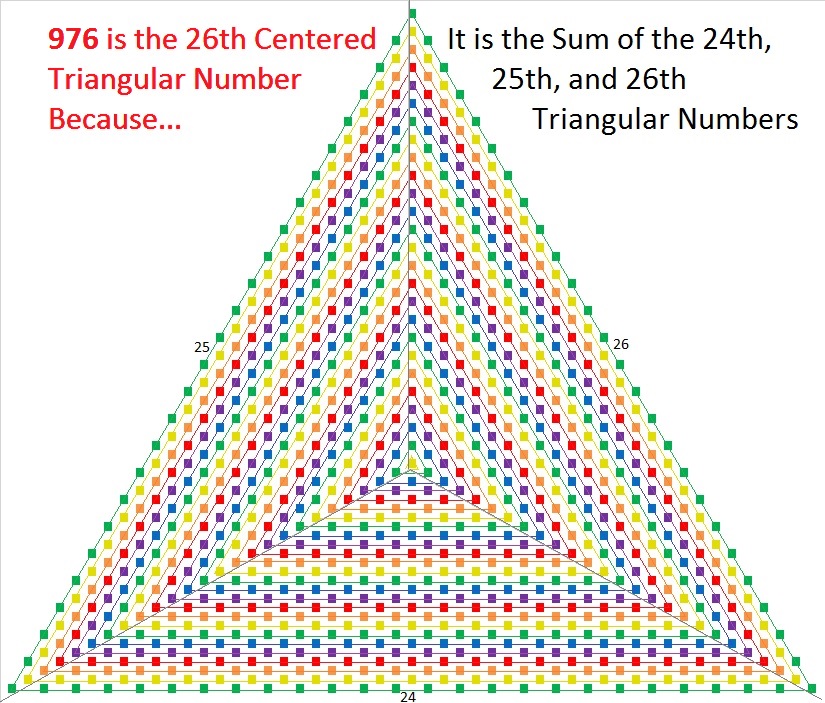
What Kind of Shape is 976 in?

If you look at a list of Centered Triangular Numbers, 976 will be the 26th number on the list. 976 is the sum of the 24th, 25th, and 26th triangular numbers. That means
(24×25 + 25×26 + 26×27)/2 = 976

There’s a formula to compute centered triangular numbers, and this one is found by using
(3(25²) + 3(25) + 2)/2 = 976

As far as the formula is concerned, it is the 25th centered triangular number even though it is the 26th number on the list. I’m calling it the 26th centered triangular number because counting numbers on a list is easier than using a formula.

976 is also the 16th decagonal number because 4(16²) – 3(16) = 976. I couldn’t resist illustrating that 10-sided figure.

16 × 61 is a palindromic expression that happens to equal 976.

976 is also a palindrome when written in some other bases:
It’s 1100011 in BASE 3 because 3⁶ + 3⁵ + 3¹ + 3⁰ = 976,
808 in BASE 11, because 8(11²) + 0(11¹) + 8(11⁰) = 976
1E1 in BASE 25 (E is 14 base 10) because 1(25²) + 14(25¹) + 1(25⁰) = 976

24² + 20² = 976 That makes 976 the hypotenuse of a Pythagorean triple:
176-960-976 calculated from 24² – 20², 2(24)(20), 24² + 20²

  • 976 is a composite number.
  • Prime factorization: 976 = 2 × 2 × 2 × 2 × 61, which can be written 976 = 2⁴ × 61
  • The exponents in the prime factorization are 4 and 1. Adding one to each and multiplying we get (4 + 1)(1 + 1) = 5 × 2 = 10. Therefore 976 has exactly 10 factors.
  • Factors of 976: 1, 2, 4, 8, 16, 61, 122, 244, 488, 976
  • Factor pairs: 976 = 1 × 976, 2 × 488, 4 × 244, 8 × 122, or 16 × 61
  • Taking the factor pair with the largest square number factor, we get √976 = (√16)(√61) = 4√61 ≈ 31.240999

975 and Level 5

This puzzle has eleven clues, some of which are designed to trick you possibly. Will you be tricked, or will you use logic to figure out where to put the factors from 1 to 10 in the first column and the top row? The finished puzzle looks like a multiplication table but with the factors out of numerical order.

Print the puzzles or type the solution in this excel file: 10-factors-968-977

Here are a few facts about the number 975:

975 is the hypotenuse of SEVEN Pythagorean triples. Some factor pairs of 975 are highlighted in red next to those triples.
108-969-975 which is 3 times (36-323-325)
240-945-975 which is 15 times (16-63-65)
273-936-975 which is (7-24-25) times 39
375-900-975 which is (5-12-13) times 75
495-840-975 which is 15 times (33-56-65)
585-780-975 which is (3-4-5) times 195
612-759-975 which is 3 times (204-253-325)

1(5) + 2(5³) + 3(5²) + 4(5¹) + 5(5) = 975

You might think that last fact means that 975 is 12345 in base 5, but it isn’t. The only digits used in base 5 are 0, 1, 2, 3, and 4.

Here is 975 written in some different bases:
1111001111 in BASE 2 because 2⁹ + 2⁸ + 2⁷+ 2⁶ + 2³ + 2² + 2¹ + 2⁰ = 975
33033 in BASE 4 because 3(4⁴) + 3(4³) + 0(4²) + 3(4¹) + 3(4⁰) = 3(256 + 64 + 4 + 1) = 3(325) = 975
1717 in BASE 8 because 1(8³) + 7(8²) + 1(8¹) + 7(8⁰) = 975
303 in BASE 18 because 3(18²) + 0(18¹) + 3(18⁰) = 3(324 + 1) = 3(325) = 975

  • 975 is a composite number.
  • Prime factorization: 975 = 3 × 5 × 5 × 13, which can be written 975 = 3 × 5² × 13
  • The exponents in the prime factorization are 1, 2, and 1. Adding one to each and multiplying we get (1 + 1)(2 + 1)(1 + 1) = 2 × 3 × 2 = 12. Therefore 975 has exactly 12 factors.
  • Factors of 975: 1, 3, 5, 13, 15, 25, 39, 65, 75, 195, 325, 975
  • Factor pairs: 975 = 1 × 975, 3 × 325, 5 × 195, 13 × 75, 15 × 65, or 25 × 39,
  • Taking the factor pair with the largest square number factor, we get √975 = (√25)(√39) = 5√39 ≈ 31.22499