Mathemagical Properties of 1105

1105 is the magic sum of a 13 × 13 magic square. Why?
Because 13×13 = 169 and 169×170÷2÷13 = 13×85 = 1105.
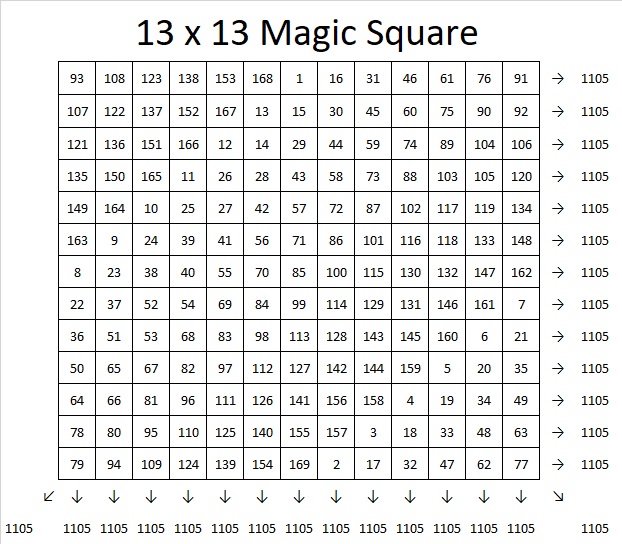
If you follow the location of the numbers 1, 2, 3, 4, all the way to 169 in the magic square, you will see the pattern that I used to make that magic square. If you click on 10-factors-1102-1110  and go to the magic squares tab, you can use the same pattern or try another to create an 11 × 11, 13 × 13, or 15 × 15 magic square. The sums on the rows, columns, and diagonals will automatically populate as you write in the numbers so you can verify that you have indeed created a magic square.

1105 tiny squares can be made into a decagon so we say it is a decagonal number:

Those 1105  tiny squares can also be arranged into a centered square:

Why is 1105 the 24th Centered Square Number? Because it is the sum of consecutive square numbers:
24² + 23² = 1105

But that’s not all! 1105 is the smallest number that is the sum of two squares FOUR different ways:

24² + 23² = 1105
31² + 12² = 1105
32² + 9² = 1105
33² + 4² = 1105

1105 is also the smallest number that is the hypotenuse of THIRTEEN different Pythagorean triples. Yes, THIRTEEN! (Seven was the most any previous number has had.) It is also the smallest number to have FOUR of its Pythagorean triplets be primitives (Those four are in blue type.):

47-1104-1105 calculated from 24² – 23², 2(24)(23), 24² + 23²
105-1100-1105 which is 5 times (21-220-221)
169-1092-1105 which is 13 times (13-84-85)
264-1073-1105 calculated from 2(33)(4), 33² – 4², 33² + 4²
272-1071-1105 which is 17 times (16-63-65)
425-1020-1105 which is (5-12-13) times 85
468-1001-1105 which is 13 times (36-77-85)
520-975-1105 which is (8-15-17) times 65
561-952-1105 which is 17 times (33-56-85)
576-943-1105 calculated from 2(32)(9), 32² – 9², 32² + 9²
663-884-1105 which is (3-4-5) times 221
700-855-1105 which is 5 times (140-171-221)
744-817-1105 calculated from 2(31)(12), 31² – 12², 31² + 12²

Why is it the hypotenuse more often than any previous number? Because of its factors! 1105 = 5 × 13 × 17, so it is the smallest number that is the product of THREE different Pythagorean hypotenuses.

It gets 1 triple for each of its three individual factors: 5, 13, 17, 2 triples for each of the three ways the factors can pair up with each other: 65, 85, 221, and four primitive triples for the one way they can all three be together: 1105. Thus it gets 2º×3 + 2¹×3 + 2²×1 = 3 + 6 + 4 = 13 triples.

Speaking of factors, let’s take a look at 1105’s factoring information:

  • 1105 is a composite number.
  • Prime factorization: 1105 = 5 × 13 × 17
  • The exponents in the prime factorization are 1, 1, and 1. Adding one to each and multiplying we get (1 + 1)(1 + 1)(1 + 1) = 2 × 2 × 2 = 8. Therefore 1105 has exactly 8 factors.
  • Factors of 1105: 1, 5, 13, 17, 65, 85, 221, 1105
  • Factor pairs: 1105 = 1 × 1105, 5 × 221, 13 × 85, or 17 × 65
  • 1105 has no square factors that allow its square root to be simplified. √1105 ≈ 33.24154

1105 is also a palindrome in four different bases, and I also like the way it looks in base 8:
It’s 10001010001 in BASE 2 because 2¹º + 2⁶ + 2⁴ + 2º = 1105,
101101 in BASE 4 because 4⁵ + 4³ + 4² + 4º = 1105,
2121 in BASE 8 because 2(8³) + 1(8²) + 2(8) + 1(1) = 1105,
313 in BASE 19 because 3(19²) + 1(19) + 3(1) = 1105
1M1 in BASE 24 (M is 22 base 10) because 24² + 22(24) + 1 = 1105

Last, but certainly not least, you wouldn’t think 1105 is a prime number, but it is a pseudoprime: the second smallest Carmichael number. Only Carmichael number 561 is smaller than it is.

A Carmichael number is a composite number that behaves like a prime number by giving a false positive to all of certain quick prime number tests:
1105 passes the test p¹¹⁰⁵ Mod 1105 = p for all prime numbers p < 1105. Here is an image of my computer calculator showing 1105 passing the first five tests! Only a prime number should pass all these tests.

1105 is indeed a number with amazing mathemagical properties!

1104 and Level 3

If this were a Find the Factors 1-12 puzzle, the possible common factors for 12 and 48 would be 4, 6, and 12. But we can only have factors from 1 to 10 so only one of those common factors will work with this puzzle. If you know which one, you are well on your way to solving it.

Print the puzzles or type the solution in this excel file: 10-factors-1102-1110

Here are some facts about the number 1104:

  • 1104 is a composite number.
  • Prime factorization: 1104 = 2 × 2 × 2 × 2 × 3 × 23, which can be written 1104 = 2⁴ × 3 × 23
  • The exponents in the prime factorization are 4, 1 and 1. Adding one to each and multiplying we get (4 + 1)(1 + 1)(1 + 1) = 5 × 2 × 2 = 20. Therefore 1104 has exactly 20 factors.
  • Factors of 1104: 1, 2, 3, 4, 6, 8, 12, 16, 23, 24, 46, 48, 69, 92, 138, 184, 276, 368, 552, 1104
  • Factor pairs: 1104 = 1 × 1104, 2 × 552, 3 × 368, 4 × 276, 6 × 184, 8 × 138, 12 × 92, 16 × 69, 23 × 48, or 24 × 46
  • Taking the factor pair with the largest square number factor, we get √1104 = (√16)(√69) = 4√69 ≈ 33.2265.

1104 is the sum of the sixteen prime numbers from 37 to 103. Do you know what those prime numbers are?

1104 is also the sum of eight consecutive primes and two consecutive primes:
113 + 127 + 131 + 137 + 139 + 149 +151 + 157  = 1104
547 + 557 = 1104

1103 and Level 2

The fourteen clues you see in this puzzle are all you need to find all the factors from 1 to 10 and complete the multiplication table. Can you find all those factors?

Print the puzzles or type the solution in this excel file: 10-factors-1102-1110

Here are some facts about the number 1103:

  • 1103 is a prime number.
  • Prime factorization: 1103 is prime.
  • The exponent of prime number 1103 is 1. Adding 1 to that exponent we get (1 + 1) = 2. Therefore 1103 has exactly 2 factors.
  • Factors of 1103: 1, 1103
  • Factor pairs: 1103 = 1 × 1103
  • 1103 has no square factors that allow its square root to be simplified. √1103 ≈ 33.21144

How do we know that 1103 is a prime number? If 1103 were not a prime number, then it would be divisible by at least one prime number less than or equal to √1103 ≈ 33.2. Since 1103 cannot be divided evenly by 2, 3, 5, 7, 11, 13, 17, 19, 23, 29 or 31, we know that 1103 is a prime number.

1103 is the sum of the nineteen prime numbers from 19 to 101.

1103 is palindrome 191 in BASE 29 because 1(29²) + 9(29) + 1(1) = 1103

1102 and Level 1

Write each number from 1 to 10 in both the first column and the top row so that those numbers are the factors of the given clues. This one is not too difficult, so if you haven’t solved one of these puzzles before, give it a try!

Print the puzzles or type the solution in this excel file: 10-factors-1102-1110

Here is some information about the number 1102:

  • 1102 is a composite number.
  • Prime factorization: 1102 = 2 × 19 × 29
  • The exponents in the prime factorization are 1, 1, and 1. Adding one to each and multiplying we get (1 + 1)(1 + 1)(1 + 1) = 2 × 2 × 2 = 8. Therefore 1102 has exactly 8 factors.
  • Factors of 1102: 1, 2, 19, 29, 38, 58, 551, 1102
  • Factor pairs: 1102 = 1 × 1102, 2 × 551, 19 × 58, or 29 × 38
  • 1102 has no square factors that allow its square root to be simplified. √1102 ≈ 33.19639

1102 = 2(29)(19) so we know that 480-1102-1202 is a Pythagorean triple
calculated from 29²-19², 2(29)(19), 29²+19²

1102 is also the hypotenuse of a Pythagorean triple:
760-798-1102 which is (20-21-29) times 38.

1102 is a palindrome when it is written in a couple of other bases:
It’s 2F2 in BASE 20 (F is 15 base 10) because 2(20²) + 15(20) + 2(1) = 1102,
and it’s 262 in BASE 22 because 2(22²) + 6(22) + 2(1) = 1102.

1101 and Level 6

Which common factor of 6 and 24 will help you solve this puzzle? 2, 3, or 6?
Likewise, possible common factors of 8 and 4 are 1, 2, and 4, and for 48 and 36, you must choose between 4, 6, and 12.

In each case, only one choice will work with all the other clues in the puzzle.  You can figure out the correct choices and complete the entire puzzle by using logic. Good luck!

Print the puzzles or type the solution in this excel file: 12 factors 1095-1101

Here are a few facts about the number 1101:

Since it is made with a zero and exactly three identical numbers, it is divisible by 3.

  • 1101 is a composite number.
  • Prime factorization: 1101 = 3 × 367
  • The exponents in the prime factorization are 1 and 1. Adding one to each and multiplying we get (1 + 1)(1 + 1) = 2 × 2 = 4. Therefore 1101 has exactly 4 factors.
  • Factors of 1101: 1, 3, 367, 1101
  • Factor pairs: 1101 = 1 × 1101 or 3 × 367
  • 1101 has no square factors that allow its square root to be simplified. √1101 ≈ 33.18132

1101 is a palindrome when it is written in two other bases:
It’s 373 in BASE 18 because 3(18²) + 7(18) + 3(1) = 1101,
and 1J1 in BASE 25 (J is 19 in base 10) because 25² + 19(25) + 1 = 1101

1100 Now THIS Is a Horse Race!

Most people know that any prime number has exactly 2 factors. Every composite number has more than 2 factors. I’ve made a chart showing the numbers from 1001 to 1100, their prime factorizations, and the amount of factors each of those numbers has.

The fewest factors any of those numbers have is 2 while the most factors any of the numbers have is 32. Which number of factors appears most often? Let’s have a horse race to find out!

Several horses representing different amounts of factors are lined up for the race. Spoiler alert: some of the horses will barely make it out of the gate. THIS will be an exciting horse race. There will be at least one lead change. You won’t know for sure which horse will cross the finish line first until the end. The second place horse will be SO close to winning.

I haven’t made a horse race this exciting since the 601 to 700 Horse Race, so pick your pony, then scroll down and see how your pony does!

Click on the gif below to make the horse race larger.

Factor Horse Race 1100

make science GIFs like this at MakeaGif

How did your pony do? Were you surprised by the results of the race?

Only perfect squares can have an odd number of factors which explains why 9 and 11 barely make it out of the gate. The numbers in pink have square factors so their square roots can be simplified. That describes 41 of the numbers from 1001 to 1100.

I hope this horse race sparks your curiosity about numbers! Each number is fascinating in its own way.

Let me tell you a few things specifically about the number 1100:

  • 1100 is a composite number.
  • Prime factorization: 1100 = 2 × 2 × 5 × 5 × 11, which can be written 1100 = 2² × 5² × 11
  • The exponents in the prime factorization are 2, 2 and 1. Adding one to each and multiplying we get (2 + 1)(2 + 1)(1 + 1) = 3 × 3 × 2 = 18. Therefore 1100 has exactly 18 factors.
  • Factors of 1100: 1, 2, 4, 5, 10, 11, 20, 22, 25, 44, 50, 55, 100, 110, 220, 275, 550, 1100
  • Factor pairs: 1100 = 1 × 1100, 2 × 550, 4 × 275, 5 × 220, 10 × 110, 11 × 100, 20 × 55, 22 × 50 or 25 × 44
  • Taking the factor pair with the largest square number factor, we get √1100 = (√100)(√11) = 10√11 ≈ 33.16625

1100 is the hypotenuse of two Pythagorean triples:
660-880-1100 which is (3-4-5) times 220
308-1056-1100 which is (7-24-25) times 44

It may interest you to know that 1100 is 3131 in BASE 7.
That’s because 3(7³) + 1(7²) + 3(7) + 1( 1) = 1100.

All those fun facts are straight from the horse’s mouth!

1099 and Level 5

The allowable common factors fro 8 and 24 are 2, 4, and 8. Which one of those should you choose? Find a different place to start the puzzle and you shouldn’t have to guess and check to see if you were right.

Print the puzzles or type the solution in this excel file: 12 factors 1095-1101

Here are some facts about the number 1099:

  • 1099 is a composite number.
  • Prime factorization: 1099 = 7 × 157
  • The exponents in the prime factorization are 1 and 1. Adding one to each and multiplying we get (1 + 1)(1 + 1) = 2 × 2 = 4. Therefore 1099 has exactly 4 factors.
  • Factors of 1099: 1, 7, 157, 1099
  • Factor pairs: 1099 = 1 × 1099 or 7 × 157
  • 1099 has no square factors that allow its square root to be simplified. √1099 ≈ 33.15117

1099 = 1 + 0 + 999 + 99. Thank you OEIS.org for that fun fact.

1099 is the sum of the 13 prime numbers from 59 to 109.
That’s a fact that would take little effort to memorize!

1099 is also the sum of these prime numbers:
139 + 149 +  151 + 157 + 163 + 167 + 173 = 1099
359 + 367 + 373 = 1099

1099 is the hypotenuse of a Pythagorean triple:
595-924-1099 which is 7 times (85-132-157)

1099 is repdigit 777 in BASE 12 because 7(12² + 12 + 1) = 7(157) = 1099
1099 is palindrome 4D4 in BASE 15 (D is 13 in base 10)
because 4(15²) + 13(15) + 4(1) = 1099

1098 a Lucky Level 4 Puzzle?

You are lucky that this puzzle has some easy clues in it. You will have no problem getting started. Be warned, later on, you may not feel so lucky! I’m sure you can solve it if you keep with it.

Print the puzzles or type the solution in this excel file: 12 factors 1095-1101

Now, here are a few facts about the number 1098:

  • 1098 is a composite number.
  • Prime factorization: 1098 = 2 × 3 × 3 × 61, which can be written 1098 = 2 × 3² × 61
  • The exponents in the prime factorization are 1, 2, and 1. Adding one to each and multiplying we get (1 + 1)(2 + 1)(1 + 1) = 2 × 3 × 2 = 12. Therefore 1098 has exactly 12 factors.
  • Factors of 1098: 1, 2, 3, 6, 9, 18, 61, 122, 183, 366, 549, 1098
  • Factor pairs: 1098 = 1 × 1098, 2 × 549, 3 × 366, 6 × 183, 9 × 122, or 18 × 61,
  • Taking the factor pair with the largest square number factor, we get √1098 = (√9)(√122) = 3√122 ≈ 33.13608

This first fact from OEIS.org uses only digits found in 1098. It makes 1098 look pretty lucky:
1098 = 11 + 0 + 999 + 88

1098 is the sum of four consecutive prime numbers:
269 + 271 + 277 + 281 = 1098

1098 is the hypotenuse of a Pythagorean triple:
198-1080-1098 which is 18 times (11-60-61)

1098 is a palindrome when it is written in three different bases:
It’s 2112 in BASE 8 because 2(8³) + 8² + 8 + 2(1) = 1098,
909 in BASE 11 because 9(11² + 1) = 9(122) = 1098, and it’s
666 in BASE 13. Oh my! How unlucky can you get? Why does it have two unlucky numbers, 666 and 13? Because 6(13² + 13 + 1) = 6(183) = 1098.


1097 and Level 3

72 and 27 are mirror images of each other. What is the largest number that will divide evenly into both of them? Put the answer to that question under the x, and you will have completed the first step in solving this multiplication table puzzle.

Print the puzzles or type the solution in this excel file: 12 factors 1095-1101

Here’s a little bit more about the number 1097:

  • 1097 is a prime number.
  • Prime factorization: 1097 is prime.
  • The exponent of prime number 1097 is 1. Adding 1 to that exponent we get (1 + 1) = 2. Therefore 1097 has exactly 2 factors.
  • Factors of 1097: 1, 1097
  • Factor pairs: 1097 = 1 × 1097
  • 1097 has no square factors that allow its square root to be simplified. √1097 ≈ 33.12099

How do we know that 1097 is a prime number? If 1097 were not a prime number, then it would be divisible by at least one prime number less than or equal to √1097 ≈ 33.1. Since 1097 cannot be divided evenly by 2, 3, 5, 7, 11, 13, 17, 19, 23, 29 or 31, we know that 1097 is a prime number.

1097 is the final prime number in the prime triplet, 1091-1093-1097.

1097 is the sum of two squares:
29² + 16² = 1097

1097 is the hypotenuse of a primitive Pythagorean triple:
585-928-1097 calculated from 29² – 16², 2(29)(16), 29² + 16²

Here’s another way we know that 1097 is a prime number: Since its last two digits divided by 4 leave a remainder of 1, and 29² + 16² = 1097 with 29 and 16 having no common prime factors, 1097 will be prime unless it is divisible by a prime number Pythagorean triple hypotenuse less than or equal to √1097 ≈ 33.1. Since 1097 is not divisible by 5, 13, 17, or 29, we know that 1097 is a prime number.


1096 and Level 2

There are 17 clues in this level 2 puzzle. Two of those clues are 60 and three of them are 8. In a regular 12 × 12 multiplication table, both of those numbers appear 4 times each. The factors for this multiplication table puzzle won’t be in the usual places. Can you figure out where they need to go?

Print the puzzles or type the solution in this excel file: 12 factors 1095-1101

Here is a little bit about the number 1096:

  • 1096 is a composite number.
  • Prime factorization: 1096 = 2 × 2 × 2 × 137, which can be written 1096 = 2³ × 137
  • The exponents in the prime factorization are 1 and 3. Adding one to each and multiplying we get (3 + 1)(1 + 1) = 4 × 2 = 8. Therefore 1096 has exactly 8 factors.
  • Factors of 1096: 1, 2, 4, 8, 137, 274, 548, 1096
  • Factor pairs: 1096 = 1 × 1096, 2 × 548, 4 × 274, or 8 × 137
  • Taking the factor pair with the largest square number factor, we get √1096 = (√4)(√274) = 2√274 ≈ 33.10589

1096 is the hypotenuse of one Pythagorean triple:
704-840-1096 which is 8 times (88-105-137)