1114 My Rant about the State’s Emissions Test

The valley I live in is often the worst place in the country for air pollution. Of course, when we register our cars we have to prove that the car passes the state’s emissions test. Naturally, it sounds like a good idea. In the past, our cars have always passed their emissions tests, but this year I want to rant about how POLLUTING the emissions test can be.

Two and half weeks before our car registration was due, I took our Honda Civic in for the emissions test. It didn’t pass. It didn’t fail either. I was simply told that the car was not ready for the test. We hadn’t driven it enough. I listened in disbelief. “Drive it around some more and come back,” the service person told me. Something on the car was reset the last time I took the car in for a repair or maintenance, so now the car needs more miles on it to be ready for the test.

We drove the car around and had it checked two more times before we left for Europe, but the car still wasn’t ready. Every place we went the weekend before we left, we took that car. Then I asked a neighbor to drive it some the two weeks we were gone. She didn’t drive it much, but we’ve put about 100 miles on the car since we’ve returned. I took it in to get checked again today. It still isn’t ready.

It’s hot outside. There hasn’t been much rain. There is a wildfire close enough that we can smell the smoke. The mountains in the distance look faded. This is not the time for us to needlessly add more pollutants to the air as we drive it around just to make the car ready for the test.  All cars pollute the air. Everyone in the area is encouraged to carpool or combine trips to try to keep the pollution lower. We, on the other hand, need to drive our car aimlessly around just to put more miles on it so hopefully, the car will be ready for the emissions test. I have a very difficult time doing that, so instead of driving it around, I’m sitting at my computer ranting. The car needs to pass the test by Tuesday or we will have to pay for another test. This whole thing is a waste of time, gasoline, and money. Meanwhile, we couldn’t register our car, so potentially we could get in trouble for driving a car that isn’t registered, too.

Writing about the number 1114 should be a much more pleasant subject than car emissions!

  • 1114 is a composite number.
  • Prime factorization: 1114 = 2 × 557
  • The exponents in the prime factorization are 1 and 1. Adding one to each and multiplying we get (1 + 1)(1 + 1) = 2 × 2 = 4. Therefore 1114 has exactly 4 factors.
  • Factors of 1114: 1, 2, 557, 1114
  • Factor pairs: 1114 = 1 × 1114 or 2 × 557
  • 1114 has no square factors that allow its square root to be simplified. √1114 ≈ 33.37664

33² + 5² = 1114

1114 is the hypotenuse of a Pythagorean triple:
330-1064-1114 calculated from 2(33)(5), 33² – 5², 33² + 5²

1114 is the sum of 10 consecutive primes and 6 consecutive primes:
89 + 97 + 101 + 103 + 107 + 109 + 113 + 127 + 131 + 137 = 1114,
and 173 + 179 + 181 + 191 + 193 + 197 = 1114

1114 is palindrome 4E4 in BASE 15 (E is 14 base 10)
because 4(15²) + 14(15) + 4(1) = 1114


1113 and Level 2

If you’ve never solved a Find the Factors puzzle before, this level 2 puzzle will be a good one to try.  Just make sure each number 1 to 12 is written in the top row and the first column and that those numbers and the clues in the puzzle form a multiplication table. You can fill in the rest of the table later or not at all. Have fun!

Print the puzzles or type the solution in this excel file: 12 factors 1111-1119

Here is some information about the number 1113:

  • 1113 is a composite number.
  • Prime factorization: 1113 = 3 × 7 × 53
  • The exponents in the prime factorization are 1, 1, and 1. Adding one to each and multiplying we get (1 + 1)(1 + 1)(1 + 1) = 2 × 2 × 2 = 8. Therefore 1113 has exactly 8 factors.
  • Factors of 1113: 1, 3, 7, 21, 53, 159, 371, 1113
  • Factor pairs: 1113 = 1 × 1113, 3 × 371, 7 × 159, or 21 × 53
  • 1113 has no square factors that allow its square root to be simplified. √1113 ≈ 33.36165

1113 is the hypotenuse of a Pythagorean triple:
588-945-1113 which is 21 times (28-45-53)

1113 is made with three consecutive digits in these two consecutive bases:
It’s 789 in BASE 12 because 7(144) + 8(12) + 9(1) = 1113, and
it’s 678 in BASE 13 because 6(169) + 7(13) + 8(1) = 1113


1112 The Children of Betkó Mátyás


It was my privilege to go to the archives at Timișoara, Romania last week and look at the Reformed Hungarian Church records from Igazfalva and photograph some of them.  I would not have been able to write even one word of this post had I not seen those records and learned that the members of the Betkó family were Lutherans who had previously lived in Békéscsaba. I am grateful to the archive for allowing me to share the photos I took. The FamilySearch catalog of Békéscsaba Lutheran records helped me find more information about this family. It contains christening (Kereszteltek), marriage (Házasultak), and death (Halottak) records. The christening records from 1832 to 1895 are also indexed in the links labeled névmutatója. Those indexes save a tremendous amount of time especially when more than a thousand children a year were christened.

Békéscsaba is the largest city whose records I’ve searched. Igazfalva was just a little village so I was able to find most of what I wanted there in just a few hours. Igazfalva can be translated as “Truth Village” in English.

Note: for Hungarian name order the surname is first, followed by the given name. The records use that name order, so I’ve used it as well. It may be necessary to register for a free FamilySearch account to look at the records in the given links.

1879-02-21 Betkó Mátyás married Kerepeczki Mária in a city called Békéscsaba in Békés county, Hungary. Both of them listed their ages as 21, so they were both born about 1858. Here is a list of their children that I’ve found mostly in the church records in Békéscsaba.

  1. Their first child was Mária born 1879-05-30.  See Line 423  Unfortunately, Mária was too weak to survive and died two months later on 1879-08-01. See Line 409
  2. 1881-11-17 They had another daughter that they also name Mária. See Line 950
  3. 1883-08-25, a daughter, Ilona. See line 655
  4. About 1887, a son Mátyás
  5. 1889-04-20, a son, György. See line 249

Sadly, Kerepeczki Mária died that same day, 1889-04-20. Line 266 of the record listed her cause of death as Szülésbeni elvérzés, which means she bled excessively after giving birth. She was only 32 years old (born about 1857). Mátyás and Mária had been married 10 years.

Their daughter, Ilona, married Strbán Mihály on 1900-11-27 in Igazfalva. Her marriage record states that she was the daughter of Betkó Mátyás and the late Kerepeczki Mária. She was 17 when she married making her birth about 1883, so she is the daughter listed above. Click on the photo to see it better. (My husband’s grandparents’ marriage is also on this page: Sallai István and Finta Mária married 27 December 1900.)

Although I did not find a christening record for their son, Mátyás,  born about 1887, I placed him on the list of children based on his marriage record below. He was married in Igazfalva on 1911-12-05 to Tóth Rozália. He was 24 years old (born about 1887) and was the son of Betkó Mátyás and Kerepeczki Mária. My husband’s great-grandfather, Sallai Miklós, was a witness of the marriage.

A month and a half after the death of Mária, the widower Mátyás married Kerepeczki Ilona on 1889-06-04. See line 76. Note that the house number for Mátyás on the marriage record is the same as his house number when Mária died.  I have not been able to determine yet if Ilona was any relation to Mária, but they were from the same town and they had the same surname. His age on this marriage record is 30 suggesting he was born about 1859 while Ilona age was 20 suggesting she was born about 1869. Unfortunately, the marriage records from 1853 to 1895 in Békéscsaba do not list even the father’s names for the bride or the groom, so going back to the next generation will be difficult. For example, there were three girls named Kerepeczki Ilona who were born in Békéscsaba in 1869.  Two are on this page and the other one appears on the next page with a twin brother.

Mátyás and Ilona did not have any children christened in Békéscsaba, but they had children born in other places. Were they one of the 69 families from Békés county and surrounding areas in 1893 who formed the village, Igazfalva? I don’t know, but I know that they lived there.

The oldest child of Mátyás and Ilona that I found is Zsófia who was born about 1891 in Medgyesegyháza, wherever that is. I know about her because of her marriage record in Igazfalva. On 1910-12-06, Sallai Imre age 23 (born in Gyoma about 1887) wed Betkó Zsófia, age 19. He was the son of my husband’s great-grandparents, Sallai Miklós and Szalóki Juliánna. She was the daughter of Betkó Mátyás and Kerepecski Ilona.

I went through the records very quickly because we also wanted to visit with my husband’s second cousins later the same day. It is possible I missed some records, perhaps all the records from before 1900. It is also possible the family didn’t move to Igazfalva until then. Here is the 1900-09-04 birth of their daughter, Juliánna. Note that the record states that both Betkó Mátyás and Kerepeczki Ilona are from B.Csaba (Békéscsaba). The next two records also show little Juliánna’s death on 1901-08-26. She was too weak to live more than 3 months 14 days.

1902-10-25 another Juliánna was born. Her death wasn’t listed on her christening record, and I didn’t see one in the death records, but …

1904-07-14 a third Juliánna was born. Her birth and her 1905-04-11 death are listed on the next two records. She was 8 months, 28 days old when she died from kanyaró, the measles.

I did not see the christening record for this fourth Juliánna who died 1910-11-13.  Perhaps I missed the record or perhaps she wasn’t able to be baptized in her short 10-day life. The record states that she had been weak from birth.

Sometime between 1910 and 1916, Kerepeczki Ilona must have died, and I was too rushed to see her death record. Betkó Mátyás married a girl who may have been from another town because I did not see their marriage record. They had one little girl together, but she died before she could be christened.

1917-01-15 Birth of Betkó Mátyás and Filye Erzsébet’s unnamed daughter who died three days later on 1917-01-18. Her death is listed on the next two records.

1930-06-03 Death of Betkó Mátyás, the widower of the late Filye Mária. He was 72 years old. (Born about 1858 in Békéscsaba.)

My husband’s great-grandmother, Szalóki Juliánna, is also listed on that page.

Betkó Mátyás’s death record and his two marriage records suggest that Mátyás was born around 1857, 1858 or 1859. I checked the index of baptisms from 1855 to 1861 in Békéscsaba of children whose surname began with B. There was only one child who was named Betkó Mátyas during that time. Then I found that christening record. 1859-05-28 Line 444, Mátyás born to Betko Mátyás and Szombathy Maria. But as I’ve already demonstrated, not all births make it into the town’s records. I suppose the only way to know for sure that this baptism record belongs to him is to check the civil registration records that were made after 1895 in Hungary, assuming the clerk was given his parents’ information. I suppose I would have to return to the archive in Romania to view those records, but they might have Kerepeczki Ilona’s parents’ names as well.

Nevertheless, his likely parents, Betkó Mátyás and Szombathy Mária, were married 1857-11-10. See Line 97. That’s after 1853, so it will be necessary to figure out who they were, too. He was 21 (born about 1836) and she was 18 (born about 1839).

Mátyás was able to enjoy some grandchildren when he lived in Igazfalva. Here are some records that support that statement:

It is very likely that János born 1900-01-16, the son of Dryenyovszky János and Betkó Mária from B.csaba was one of his grandsons.

As well as their son Mátyás, born 1901-08-02. Sadly, this son died 1906-02-10.

1902-05-05 Ilona, the daughter of Strbán Mihály and Betkó Ilona was definitely Mátyás’s granddaughter.

This next granddaughter was born 1911-07-09. Her name was Sallai Zsófia, the daughter of Sallai Imre and Betkó Zsófia. Her godfather was her uncle, Sallai Antal. Was her godmother, Betkó Judith, also an aunt?

1911-09-03 birth of Strbán János, the son of Strbán Mihály and Betkó Ila (Ilona):

1913-01-12 Sallai Margit, the daughter of Sallai Imre and Betkó Zsófia:

1913-05-11 Strbán Mátyás son of Strbán Mihály and Betkó Ilona. He died 1913-10-31:

1914-01-04 Betkó Róza, daughter of Betkó Mátyás and Tóth Róza:

I was only able to look at christening records that were at least 100 years old, so I don’t know if he knew any other grandchildren than these that I’ve listed.

Since this is my 1112th post, I’ll now write a little bit about the number 1112:

  • 1112 is a composite number.
  • Prime factorization: 1112 = 2 × 2 × 2 × 139, which can be written 1112 = 2³ × 139
  • The exponents in the prime factorization are 3 and 1. Adding one to each and multiplying we get (3 + 1)(1 + 1) = 4 × 2 = 8. Therefore 1112 has exactly 8 factors.
  • Factors of 1112: 1, 2, 4, 8, 139, 278, 556, 1112
  • Factor pairs: 1112 = 1 × 1112, 2 × 556, 4 × 278, or 8 × 139
  • Taking the factor pair with the largest square number factor, we get √1112 = (√4)(√278) = 2√278 ≈ 33.346664

1112 is also the sum of four consecutive prime numbers:
271 + 277 + 281 + 283


1111 and Level 1

This is puzzle number 1111, a number made with four 1’s. The puzzle number doesn’t usually have anything to do with the puzzle, but I made an exception this time:  One of the factors of 1111 is important in solving this particular level 1 puzzle. Have fun solving it!

Print the puzzles or type the solution in this excel file: 12 factors 1111-1119

Here are a few things I’ve learned about the number 1111:

  • 1111 is a composite number.
  • Prime factorization: 1111 = 11 × 101
  • The exponents in the prime factorization are 1 and 1. Adding one to each and multiplying we get (1 + 1)(1 + 1) = 2 × 2 = 4. Therefore 1111 has exactly 4 factors.
  • Factors of 1111: 1, 11, 101, 1111
  • Factor pairs: 1111 = 1 × 1111 or 11 × 101
  • 1111 has no square factors that allow its square root to be simplified. √111133.3316666

1111 is the hypotenuse of exactly one Pythagorean triple:
220-1089-1111 which is 11 times (20-99-101)

1111² = 1234321, a very special palindrome!

1111 is a repdigit in base 10, and it is a palindrome in three consecutive bases plus one more:
It’s 787 in BASE 12 because 7(144) + 8(12) + 7(1) = 1111,
676 in BASE 13 because 6(169) + 7(13) + 6(1) = 1111,
595 in BASE 14 because 5(196) + 9(14) + 5(1) = 1111, and it’s
171 in BASE 30 because 1(900) + 7(30) + 1(1) = 1111


1110 Another Mystery

The common factors of 36 and 12 are 1, 2, 3, 4, 6, and 12. If this were a Find the Factors 1-12 puzzle, you would have to consider most of those common factors. Since it’s a 1 to 10 puzzle, most of those factors aren’t allowed. Can you figure out the solution to this mystery puzzle?

Print the puzzles or type the solution in this excel file: 10-factors-1102-1110

Here are a few facts about the number 1110:

  • 1110 is a composite number.
  • Prime factorization: 1110 = 2 × 3 × 5 × 37
  • The exponents in the prime factorization are 1, 1, 1, and 1. Adding one to each and multiplying we get (1 + 1)(1 + 1)(1 + 1)(1 + 1) = 2 × 2 × 2 × 2 = 16. Therefore 1110 has exactly 16 factors.
  • Factors of 1110: 1, 2, 3, 5, 6, 10, 15, 30, 37, 74, 111, 185, 222, 370, 555, 1110
  • Factor pairs: 1110 = 1 × 1110, 2 × 555, 3 × 370, 5 × 222, 6 × 185, 10 × 111, 15 × 74, or 30 × 37
  • 1110 has no square factors that allow its square root to be simplified. √1110 ≈ 33.31666

1110 is the hypotenuse of FOUR Pythagorean triples:
342-1056-1110 which is 6 times (57-176-185)
360-1050-1110 which is 30 times (12-35-37)
624-918-1110 which is 6 times (104-153-185)
666-888-1110 which is (3-4-5) times 222

1110 looks very cool in some other bases:
It’s 5050 in BASE 6 because 5(6³) + 5(6) = 5(222) = 1110,
456 in BASE 16 because 4(16²) + 5(16) + 6(1) = 1110, and
UU in BASE 36 (U is 30 in base 10) because 30(36) + 30(1) = 30(37) = 1110

1109 Mystery Level

Is this puzzle easy to solve or difficult? That’s part of the mystery. I hope you will give it a try and figure it out.

Print the puzzles or type the solution in this excel file: 10-factors-1102-1110

Here is some information about the number 1109:

  • 1109 is a prime number.
  • Prime factorization: 1109 is prime.
  • The exponent of prime number 1109 is 1. Adding 1 to that exponent we get (1 + 1) = 2. Therefore 1109 has exactly 2 factors.
  • Factors of 1109: 1, 1109
  • Factor pairs: 1109 = 1 × 1109
  • 1109 has no square factors that allow its square root to be simplified. √1109 ≈ 33.30165

How do we know that 1109 is a prime number? If 1109 were not a prime number, then it would be divisible by at least one prime number less than or equal to √1109 ≈ 33.3. Since 1109 cannot be divided evenly by 2, 3, 5, 7, 11, 13, 17, 19, 23, 29 or 31, we know that 1109 is a prime number.

25² + 22² = 1109

1109 is the hypotenuse of a Pythagorean triple:
141-1100-1109 calculated from 25² – 22², 2(25)(22), 25² + 22²

Here’s another way we know that 1109 is a prime number: Since its last two digits divided by 4 leave a remainder of 1, and 25² + 22² = 1109 with 25 and 22 having no common prime factors, 1109 will be prime unless it is divisible by a prime number Pythagorean triple hypotenuse less than or equal to √1109 ≈ 33.3. Since 1109 is not divisible by 5, 13, 17, or 29, we know that 1109 is a prime number.

1109 is palindrome 919 in BASE 11 because 9(121) + 1(11) + 9(1) = 1109

1108 and Level 6

This level 6 puzzle has eleven clues. Which ones give away the most logical place for you to start it? I hope you have a lot of fun solving this one!

Print the puzzles or type the solution in this excel file: 10-factors-1102-1110

Now I’ll share some facts about the number 1108:

  • 1108 is a composite number.
  • Prime factorization: 1108 = 2 × 2 × 277, which can be written 1108 = 2² × 277
  • The exponents in the prime factorization are 1 and 2. Adding one to each and multiplying we get (2 + 1)(1 + 1) = 3 × 2  = 6. Therefore 1108 has exactly 6 factors.
  • Factors of 1108: 1, 2, 4, 277, 554, 1108
  • Factor pairs: 1108 = 1 × 1108, 2 × 554, or 4 × 277
  • Taking the factor pair with the largest square number factor, we get √1108 = (√4)(√277) = 2√277 ≈ 33.28663

1108 is the hypotenuse of a Pythagorean triple:
460-1008-1108 which is 4 times (115-252-277)

1108 is a palindrome when it is written in three other bases:
It’s 454 in BASE 16 because 4(16²) + 5(16) + 4(1) = 1108,
3E3 in BASE 17 (E is 14 base 10) because 3(17²) +14(17) +3(1) = 1108, and
1E1 in BASE 27 because 27² + 14(27) + 1 = 1108

1107 and Level 5

Some of this puzzle might be a little tricky, but you won’t allow it to trick you, right? Of course not!

Print the puzzles or type the solution in this excel file: 10-factors-1102-1110

Let me tell you something about the number 1107:

  • 1107 is a composite number.
  • Prime factorization: 1107 = 3 × 3 × 3 × 41, which can be written 1107 = 3³ × 41
  • The exponents in the prime factorization are 1 and 3. Adding one to each and multiplying we get (3 + 1)(1 + 1) = 4 × 2 = 8. Therefore 1107 has exactly 8 factors.
  • Factors of 1107: 1, 3, 9, 27, 41, 123, 369, 1107
  • Factor pairs: 1107 = 1 × 1107, 3 × 369, 9 × 123, or 27 × 41
  • Taking the factor pair with the largest square number factor, we get √1107 = (√9)(√123) = 3√123 ≈ 33.27161

1107 is the hypotenuse of a Pythagorean triple:
243-1080-1107 which is 27 times (9-40-41)

1106 and Level 4

Can you use logic to figure out where all the numbers from 1 to 10 need to go in both the first column and the top row so that this puzzle can become a multiplication table? Give it a try. It’s fun!

Print the puzzles or type the solution in this excel file: 10-factors-1102-1110

Here is some information about the number 1106:

  • 1106 is a composite number.
  • Prime factorization: 1106 = 2 × 7 × 79
  • The exponents in the prime factorization are 1, 1, and 1. Adding one to each and multiplying we get (1 + 1)(1 + 1)(1 + 1) = 2 × 2 × 2 = 8. Therefore 1106 has exactly 8 factors.
  • Factors of 1106: 1, 2, 7, 14, 79, 158, 553, 1106
  • Factor pairs: 1106 = 1 × 1106, 2 × 553, 7 × 158, or 14 × 79
  • 1106 has no square factors that allow its square root to be simplified. √1106 ≈ 33.25658

1106 is repdigit 222 in BASE 23 because 2(23² + 23+ 1) = 2(553) = 1106

Mathemagical Properties of 1105

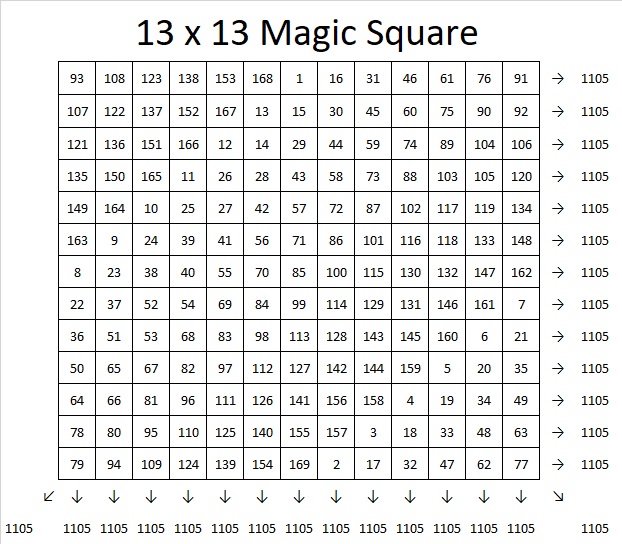
1105 is the magic sum of a 13 × 13 magic square. Why?
Because 13×13 = 169 and 169×170÷2÷13 = 13×85 = 1105.

If you follow the location of the numbers 1, 2, 3, 4, all the way to 169 in the magic square, you will see the pattern that I used to make that magic square. If you click on 10-factors-1102-1110  and go to the magic squares tab, you can use the same pattern or try another to create an 11 × 11, 13 × 13, or 15 × 15 magic square. The sums on the rows, columns, and diagonals will automatically populate as you write in the numbers so you can verify that you have indeed created a magic square.

1105 tiny squares can be made into a decagon so we say it is a decagonal number:

Those 1105  tiny squares can also be arranged into a centered square:

Why is 1105 the 24th Centered Square Number? Because it is the sum of consecutive square numbers:
24² + 23² = 1105

But that’s not all! 1105 is the smallest number that is the sum of two squares FOUR different ways:

24² + 23² = 1105
31² + 12² = 1105
32² + 9² = 1105
33² + 4² = 1105

1105 is also the smallest number that is the hypotenuse of THIRTEEN different Pythagorean triples. Yes, THIRTEEN! (Seven was the most any previous number has had.) It is also the smallest number to have FOUR of its Pythagorean triplets be primitives (Those four are in blue type.):

47-1104-1105 calculated from 24² – 23², 2(24)(23), 24² + 23²
105-1100-1105 which is 5 times (21-220-221)
169-1092-1105 which is 13 times (13-84-85)
264-1073-1105 calculated from 2(33)(4), 33² – 4², 33² + 4²
272-1071-1105 which is 17 times (16-63-65)
425-1020-1105 which is (5-12-13) times 85
468-1001-1105 which is 13 times (36-77-85)
520-975-1105 which is (8-15-17) times 65
561-952-1105 which is 17 times (33-56-85)
576-943-1105 calculated from 2(32)(9), 32² – 9², 32² + 9²
663-884-1105 which is (3-4-5) times 221
700-855-1105 which is 5 times (140-171-221)
744-817-1105 calculated from 2(31)(12), 31² – 12², 31² + 12²

Why is it the hypotenuse more often than any previous number? Because of its factors! 1105 = 5 × 13 × 17, so it is the smallest number that is the product of THREE different Pythagorean hypotenuses.

It gets 1 triple for each of its three individual factors: 5, 13, 17, 2 triples for each of the three ways the factors can pair up with each other: 65, 85, 221, and four primitive triples for the one way they can all three be together: 1105. Thus it gets 2º×3 + 2¹×3 + 2²×1 = 3 + 6 + 4 = 13 triples.

Speaking of factors, let’s take a look at 1105’s factoring information:

  • 1105 is a composite number.
  • Prime factorization: 1105 = 5 × 13 × 17
  • The exponents in the prime factorization are 1, 1, and 1. Adding one to each and multiplying we get (1 + 1)(1 + 1)(1 + 1) = 2 × 2 × 2 = 8. Therefore 1105 has exactly 8 factors.
  • Factors of 1105: 1, 5, 13, 17, 65, 85, 221, 1105
  • Factor pairs: 1105 = 1 × 1105, 5 × 221, 13 × 85, or 17 × 65
  • 1105 has no square factors that allow its square root to be simplified. √1105 ≈ 33.24154

1105 is also a palindrome in four different bases, and I also like the way it looks in base 8:
It’s 10001010001 in BASE 2 because 2¹º + 2⁶ + 2⁴ + 2º = 1105,
101101 in BASE 4 because 4⁵ + 4³ + 4² + 4º = 1105,
2121 in BASE 8 because 2(8³) + 1(8²) + 2(8) + 1(1) = 1105,
313 in BASE 19 because 3(19²) + 1(19) + 3(1) = 1105
1M1 in BASE 24 (M is 22 base 10) because 24² + 22(24) + 1 = 1105

Last, but certainly not least, you wouldn’t think 1105 is a prime number, but it is a pseudoprime: the second smallest Carmichael number. Only Carmichael number 561 is smaller than it is.

A Carmichael number is a composite number that behaves like a prime number by giving a false positive to all of certain quick prime number tests:
1105 passes the test p¹¹⁰⁵ Mod 1105 = p for all prime numbers p < 1105. Here is an image of my computer calculator showing 1105 passing the first five tests! Only a prime number should pass all these tests.

1105 is indeed a number with amazing mathemagical properties!