1374 and Level 2

Can you find the factors that will turn this puzzle into a multiplication table whose products are simply not in the usual order?

Print the puzzles or type the solution in this excel file: 10 Factors 1373-1388

Here are a few facts about the puzzle number, 1374:

  • 1374 is a composite number.
  • Prime factorization: 1374 = 2 × 3 × 229
  • 1374 has no exponents greater than 1 in its prime factorization, so √1374 cannot be simplified.
  • The exponents in the prime factorization are 1, 1, and 1. Adding one to each exponent and multiplying we get (1 + 1)(1 + 1)(1 + 1) = 2 × 2 × 2 = 8. Therefore 1374 has exactly 8 factors.
  • The factors of 1374 are outlined with their factor pair partners in the graphic below.

1374 is the hypotenuse of a Pythagorean triple:
360-1326-1374 which is 6 times (60-221-229)

1373 and Level 1

This puzzle is really just a multiplication table but the factors are missing and the products are not in order. You can figure out where the factors go, and then the clues will all make sense.


Print the puzzles or type the solution in this excel file: 10 Factors 1373-1388

Now I’ll share some facts about the puzzle number, 1373:

  • 1373 is a prime number.
  • Prime factorization: 1373 is prime.
  • 1373 has no exponents greater than 1 in its prime factorization, so √1373 cannot be simplified.
  • The exponent in the prime factorization is 1. Adding one to that exponent we get (1 + 1) = 2. Therefore 1373 has exactly 2 factors.
  • The factors of 1373 are outlined with their factor pair partners in the graphic below.

How do we know that 1373 is a prime number? If 1373 were not a prime number, then it would be divisible by at least one prime number less than or equal to √1373. Since 1373 cannot be divided evenly by 2, 3, 5, 7, 11, 13, 17, 19, 23, 29, 31, or 37, we know that 1373 is a prime number.

1373 is the sum of two squares:
37² + 2² = 1373

1373 is the hypotenuse of a Pythagorean triple:
148-1365-1373 calculated from 2(37)(2), 37² – 2², 37² + 2²

Here’s another way we know that 1373 is a prime number: Since its last two digits divided by 4 leave a remainder of 1, and 37² + 2² = 1373 with 37 and 2 having no common prime factors, 1373 will be prime unless it is divisible by a prime number Pythagorean triple hypotenuse less than or equal to √1373. Since 1373 is not divisible by 5, 13, 17,  29, or 37, we know that 1373 is a prime number.

1372 Yahtzee How-Many-Rolls Variation

Today on the spot I made up a quick variation of Yahtzee, and one of my students played it with me.

The object of the game was to get all five dice to show the same number of dots at the same time, but instead of only being allowed to have up to three rolls, we took as many rolls as need. To take a turn, one of us would roll the dice then look to see if any of the dice were the same. Any die that didn’t match would be included in an additional roll until it did match. We counted each roll we took and got one point for each roll. The lowest score would determine the winner. The student and I played four rounds. He was elated because he won EVERY round so, of course, he was the overall winner, too.

Usually, when we play a game together the scores are much closer. Sometimes I win, sometimes he wins. Today I couldn’t believe my bad luck! Sometimes none of the dice matched after my first roll. And what about my student’s very good luck getting five of a kind in just one roll? I’m sure some good probability discussions could result from this game.

Our data might suggest that 9 rolls is the most that a person could get, but I rolled the dice for the picture included in this post, and it took me 19 rolls to get that Yahtzee! And I actually had four 4’s after just 6 rolls before I took those last 13 rolls.

You never know for sure what will happen when it comes to games of chance. If you study probability, you can have a good idea about what is most likely to happen, but you cannot guarantee it will happen. If we had taken the time to play more rounds, maybe my student would have needed 10 or more rolls to get at least one of his Yahtzees, and the game would have been more competitive. (At least, that was what I was thinking before he rolled on rounds 3 and 4.)

I’d like to encourage you to try playing this game, too. I thought it was a lot of fun even though I lost miserably.

Now I’ll write a little bit about the number 1372:

  • 1372 is a composite number.
  • Prime factorization: 1372 = 2 × 2 × 7 × 7 × 7 which can be written 1372 = 2² × 7³
  • 1372 has at least one exponent greater than 1 in its prime factorization so √1372 can be simplified. Taking the factor pair from the factor pair table below with the largest square number factor, we get √1372 = (√196)(√7) = 14√7
  • The exponents in the prime factorization are 2 and 3. Adding one to each exponent and multiplying we get (2 + 1)(3 + 1) = 3 × 4 = 12. Therefore 1372 has exactly 12 factors.
  • The factors of 1372 are outlined with their factor pair partners in the graphic below.


1371 Today is a Good Day to Review Proof by Induction

0² = 0
1²  = 1

Does that pattern hold for all natural numbers? Could we claim that n²  = n?

Yes, we can, and I’ve written a proof to prove it! The proof uses a valuable concept in mathematics called induction. I remember being introduced to proofs by induction when I was in Junior High. Nowadays, if it is not part of Common Core, it wouldn’t be taught much anymore. Nevertheless, I will use it here to prove that n² = n.

Using a similar proof, we can also prove that n³ = n, n⁴ = n, n⁵ = n, n⁶ = n, and so forth!

Today is the perfect day to review how to use proof by induction so try your hand at proving at least one of those mathematical statements on your own. Use the same steps in my example: prove true for n=1, assume true for n = k, prove true for k + 1, write your conclusion. then have a very Happy April Fools’ Day, Everyone!

Today is also a very good day to review that (x + y)² = x² +2xy + y²  and NOT x²  + y², a very common error students make. Confession: I remember making that exact error in high school when I definitely should have known better. Using induction to prove something in mathematics is a valid technique, but if you use invalid equations like
(x + y)³ = x³ + y³, you will make invalid conclusions. Thus, today might also be a good day to review the binomial theorem and Pascal’s triangle. (Pascal’s triangle has numbers in its interior, not just 1’s going down the sides, after all.)

My post today was inspired by a post written by Sara Van Der Werf titled Why I’ve Started Teaching the FOIL Method Again. In her post, she not only plays a great April Fools’ joke on her readers, but she explains a tried and true way to multiply binomials and other polynomials.

I read her post exactly one year ago today, and since then, I have been waiting for April Fools’ Day to roll around again so that I could share this post with you. It is my hope that you will enjoy my little prank and learn a little mathematics from it as well.

Now I’ll write a little bit about the number 1371:

  • 1371 is a composite number.
  • Prime factorization: 1371 = 3 × 457
  • 1371 has no exponents greater than 1 in its prime factorization, so √1371 cannot be simplified.
  • The exponents in the prime factorization are 1, and 1. Adding one to each exponent and multiplying we get (1 + 1)(1 + 1) = 2 × 2 = 4. Therefore 1371 has exactly 4 factors.
  • The factors of 1371 are outlined with their factor pair partners in the graphic below.

1371 is the hypotenuse of a Pythagorean triple:
504-1275-1371 which is 3 times (168-425-457)

OEIS.org informs us that 1² + 37² + 1² = 1371, and there’s no April Fooling about that!

1370 Detail Left Out of the History Books

Today I was indexing some July 1944 death records from Budapest, Hungary and noticed that Boldizsár Klein and his wife, Regina Leichtmann, died only one day apart from each other. We don’t index causes of death, but I looked at their causes of death because their deaths were so close to each other. The same word was used for both causes of death. I wasn’t sure of all the letters in the word, but it started the same as a word I had seen before, öngyilkos, which literally means self-murder.

First I consulted my hardback Hungarian dictionary, but I didn’t find the word. Next, I looked at two online Hungarian genealogy dictionaries. Finally, I typed what the letters most looked like to me into Google Translate. After a few trials and errors with different letters of the alphabet with and without the prefix, ön, I found the word and their cause of death, önmérgezés, which means self-poisoning or intoxication.

Why did this happen to them?!!

From the record, I knew that both 74-year-old Boldizsár and 66-year-old Regina were Jewish. I googled and learned that the Nazis invaded its previous ally, Hungary, only a few months earlier on 19 March 1944 and mass evacuation of Jews to death camps began immediately. Since this couple lived in Budapest, the horrors of this occupation must have been felt most intensely. I cannot imagine what they went through, but trying to put ourselves in their shoes may help prevent history from repeating itself.

This is my 1370th post, so I’ll write a little bit about that number:

  • 1370 is a composite number.
  • Prime factorization: 1370 = 2 × 5 × 137
  • 1370 has no exponents greater than 1 in its prime factorization, so √1370 cannot be simplified.
  • The exponents in the prime factorization are 1, 1, and 1. Adding one to each exponent and multiplying we get (1 + 1)(1 + 1)(1 + 1) = 2 × 2 × 2 = 8. Therefore 1370 has exactly 8 factors.
  • The factors of 1370 are outlined with their factor pair partners in the graphic below.

1370 is the hypotenuse of four Pythagorean triples:
74-1368-1370 which is 2 times (37-684-685)
312-1334-1370 which is 2 times (156-667-685)
822-1096-1370 which is (3-4-5) times 274
880-1050-1370 which is 10 times (88-105-137)

OEIS.org informs us that 1² + 37² + 0² = 1370.

An Efficient Way to Quickly Find All the Odd Prime Numbers Less Than 1369

As I’ve used different sized grids to play with the Sieve of Eratosthenes, I’ve decided I like one size grid better than all the rest. It has six odd numbers across, but I repeat the first column on the right because of convenience. You already know the only even prime number is 2, so this grid can help you find all the rest of the primes up to 1369 = 37².

Look at the grid. What are some things that you notice about it?

Square numbers are never prime, so why do I have them outlined on the grid? Why are some of them crossed out? Is there a pattern for that, too?

If you’ve done a sieve where you cross out all the multiples of the prime numbers in order, perhaps you’ve noticed that the first multiple to get crossed out that hasn’t been crossed out before is always the prime number squared.

Therefore, don’t start with the prime numbers. Start with their squares! The squares of each of the prime numbers and the next five odd multiples after those squares are listed in a box on the left of the paper. Put a dot in the corner of each of those multiples. Recognize the pattern they make and strike through those numbers with a colored pencil. A ruler will be helpful. Continue the same pattern down to the bottom of the grid. Then do the same thing with the next square of a prime number.  I’ve made a gif of these instructions being applied to a much smaller grid.
Finding Primes Less Than 361

make science GIFs like this at MakeaGif

It feels like I’m wrapping twinkling lights around a long sheet of cardboard!

Do try it on this much longer grid that goes to 1369. You’ll probably want to cut it out and glue or tape it together on the back. If this is an assignment, don’t cut off your name.

Read the following AFTER you’ve tried using the grid. I don’t want to spoil your sense of discovery!

To me, the lines drawn have a slope even if the lines are broken lines.
The slope for the 3s is undefined.
For the 5s, it’s +1; for the 7’s, it’s -1;
For the 11’s, it’s +2; for the 13’s, it’s -2;
For the 17’s, it’s +3; for the 19’s, it’s -3;
For the 23’s, it’s +4; for the 25’s, it’s -4; (You can skip the 25’s because they are already crossed out.)
For the 29’s, it’s +5; for the 31’s, it’s -5;
Cross out 37², and then you are done.

If the grid were longer, you could continue with the same pattern for as long as you want. I think it is pretty cool.

Now I’ll tell you a little bit about the number 1369:

  • 1369 is a composite number and is a perfect square.
  • Prime factorization: 1369 = 37 × 37 which can be written 1369 = 37²
  • 1369 has at least one exponent greater than 1 in its prime factorization so √1369 can be simplified. Taking the factor pair from the factor pair table below with the largest square number factor, we get √1369 = (√37)(√37) = 37
  • The exponent in the prime factorization is 2. Adding one to that exponent, we get (2 + 1) = 3. Therefore 1369 has exactly 3 factors.
  • The factors of 1369 are outlined with their factor pair partners in the graphic below.

1369 is the sum of two squares:
35² + 12² = 1369

1369 is the hypotenuse of two Pythagorean triples:
444-1295-1369 which is (12-35-37) times 37
840-1081-1369 calculated from 2(35)(12), 35² – 12², 35² + 12²


1368 Playing with the Sieve of Eratosthenes

What if we didn’t use ten numbers across for our Sieve of Eratosthenes?

For example, 36 × 38 = 1368. We could make a Sieve of Eratosthenes writing 36 numbers across the grid and 38 numbers down. The last number on the grid would be 1368, and we could find all the prime numbers less than 1369 (which is 17²) by crossing out all the multiples of the prime numbers that appear on the top row. The trouble is that 36 numbers across makes a very big grid. Crossing out multiples of 2, 3, 5, and 7 will be very quick, but crossing out all the multiples of 11, 13, 17, 19, 23, 29, and 31 will not be so fun.

Grids that make use of the fact that (n-1)(n+1) = n²-1 can always give us a perfect rectangle and we will only need to cross out the multiples of the prime numbers in the top row to find ALL the prime numbers in any (n-1)×(n+1) list of numbers.

Here’s a 7 × 9 grid:

Since it was 7 across, it was very easy to cross out all the multiples of 7. The multiples of 2 and 3 weren’t too difficult to find either, but the pattern for the multiples of 5 was not quite as nice. Fortunately, it is easy to spot those multiples, no matter how big a number they are.

Still, the first prime number on the second row is 11, so we should be able to go almost up to 11² = 121 on our grid:

I couldn’t fit 120 on the grid without ruining the rectangle, but here’s a grid using 12 numbers across. Since 12 × 14 = 168 which is one less than 13², we can find all the prime numbers in the list simply by crossing out the multiples of the prime numbers in the top row.
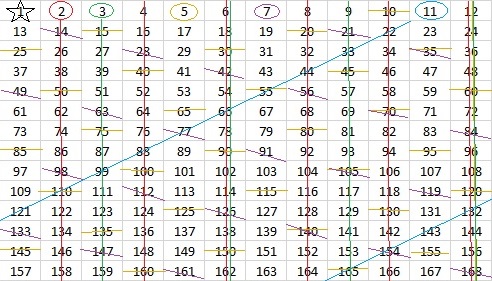
But the next number, 13, is only one number more than 12, and all of its multiples are staring at me making me feel very uncomfortable. It will be very easy to cross out all of the multiples of 13. That means we can extend the list of numbers to one less than the next prime number squared, which is 289 – 1 = 288. This time we get a perfect rectangle because 288 is also a multiple of 12:

All of the circled numbers in the top row and every number that has not been crossed out below the top row are prime numbers.

Someone long ago figured out that if we make the grid six numbers across, all the prime numbers except 2 and 3 will appear in the same two columns, no matter how long the grid is:

Every prime number greater than 3 is either one less or one more than a multiple of 6.

Since we always cross out the multiples of 2 anyway, what would happen if we didn’t include them in the grid at all?

Here is a grid with ten numbers across, but only odd numbers are included. Because 5 is a factor of 10, it is very easy to cross out all of the 5’s. Also, since 9 is one less than 10 and 11 is one more than 10, it is also easy to cross out all the multiples of 3 and 11. Crossing out the 7’s and the 19’s wasn’t too bad, either, but the 13’s and 17’s were not as fun.

In my next post, I will share my favorite size of grid and the method I use to find all of the prime numbers on it. No prime numbers get circled in my method.

Some of the numbers in the grids had several lines through them.
If we made the 36 × 38 grid I mentioned at the beginning of the post, how many lines would 1368 have going through it?  After all, 1368 has 24 factors. What do you think?

Only three lines. One each for its prime factors, 2, 3 and 19.

Here’s more about the number 1368:

  • 1368 is a composite number.
  • Prime factorization: 1368 = 2 × 2 × 2 × 3 × 3 × 19, which can be written 1368 = 2³ × 3² × 19
  • 1368 has at least one exponent greater than 1 in its prime factorization so √1368 can be simplified. Taking the factor pair from the factor pair table below with the largest square number factor, we get √1368 = (√36)(√38) = 6√38
  • The exponents in the prime factorization are 3, 2, and 1. Adding one to each exponent and multiplying we get (3 + 1)(2 + 1)(1 + 1) = 4 × 3 × 2 = 24. Therefore 1368 has exactly 24 factors.
  • The factors of 1368 are outlined with their factor pair partners in the graphic below.

Here’s one of the MANY possible factor trees for 1368:

Finding Primes Like 1367

Ancient Greek Eratosthenes had a method of finding prime numbers. We call it the Sieve of Eratosthenes. You can use this method if you make a list of numbers, circle the first available prime number, cross out all of its multiples on the chart and repeat tat procedure over and over again. The next number that has not been crossed out is the next prime number. Numbers that get crossed out are composite numbers, and they can always be expressed as the product of prime numbers.

Many teachers have given their students a 100 chart to help them find the twenty-five prime numbers less than 100.

If the number 1 were a prime number, we would have to cross out all of its multiples, and that would make 1 be the only prime number!?? That would be an unacceptable conclusion. It turns out that 1 cannot be either prime or composite. Perhaps you will want to put a star around it.

Here is a 100 chart with the multiples of 2, 3, 5, and 7 crossed out.

Since 10 is a multiple of 2 and 5, it was easy to cross out their multiples. 9, a multiple of 3, is one less than 10, so 3’s multiples were also easy to cross out. Crossing out all the multiples of 7 is a little bit tedious at first, but you can even find a pattern for them as well.

Notice that the distance between multiples of any given prime is that prime number whether you count horizontally or vertically. The circled numbers AND all the numbers not crossed out on the chart are prime numbers.

This Sieve of Eratosthenes is a powerful method for finding prime numbers, but some of its power is lost when just a 100 chart is used. For pretty much the same amount of work, we could have used the list of numbers in a 10 × 12 chart because 10 × 12 = 120 which is one less than the next prime number squared, 11² = 121.

But wait a minute! 11 is one more than 10 so its multiples would be SO easy to cross out. Let’s make the chart go to one less than 168 which is one less than 13²:

Yeah, it’s not a perfect rectangle anymore, but for about the same effort, we get an additional fourteen prime numbers. I also like that all of these multiples of seven {21, 42, 63, 84, 105, 126, 147, 168} are sort of on a diagonal. What do you notice about the numbers in that set? The next number in the set isn’t on the chart, but can you figure out what it is and where it goes?

To find out if a number like 1367 is prime, I wouldn’t want to expand a 100 chart into a 1400 chart. That chart would also require me to cross out all the multiples of every prime number from 13 to 31, and that might be a big pain.  It’s much easier to see if 1367 is divisible by any of the prime numbers less than its square root. It isn’t, so I conclude:

  • 1367 is a prime number.
  • Prime factorization: 1367 is prime.
  • 1367 has no exponents greater than 1 in its prime factorization, so √1367 cannot be simplified.
  • The exponent in the prime factorization is 1. Adding one to that exponent we get (1 + 1) = 2. Therefore 1367 has exactly 2 factors.
  • The factors of 1367 are outlined with their factor pair partners in the graphic below.

How do we know that 1367 is a prime number? If 1367 were not a prime number, then it would be divisible by at least one prime number less than or equal to √1367. Since 1367 cannot be divided evenly by 2, 3, 5, 7, 11, 13, 17, 19, 23, 29 or 31, we know that 1367 is a prime number.

1366 Fractions Acting Improperly

In elementary school, we learned about improper fractions. Should we call them that? Is it even possible for any kind of number to be IMPROPER? They are simply fractions greater than one. I’ve recently heard the term fraction form used, and ever since I’ve made a point of saying that fractions greater than one are in fraction form.

On Twitter, I’ve found a few people who also don’t like using the word improper to describe any fraction.

This first tweet has a link explaining why it is improper to use the term improper fraction:

I hope that you will consider not labeling any fraction as improper, as well!

Now I’ll write a little bit about the number 1366:

  • 1366 is a composite number.
  • Prime factorization: 1366 = 2 × 683
  • The exponents in the prime factorization are 1 and 1. Adding one to each and multiplying we get (1 + 1)(1 + 1) = 2 × 2 = 4. Therefore 1366 has exactly 4 factors.
  • Factors of 1366: 1, 2, 683, 1366
  • Factor pairs: 1366 = 1 × 1366 or 2 × 683
  • 1366 has no square factors that allow its square root to be simplified. √1366 ≈ 36.95944

1366 is also the sum of the twenty-six prime number from 5 to 107. Do you know what all those prime numbers are?

1365 Shamrock Mystery

Beautiful shamrocks with their three heart-shaped leaves are not difficult to find. Finding the factors in this shamrock-shaped puzzle might be a different story.  Sure, it might start off to be easy, but after a while, you might find it a wee bit more difficult, unless, of course, the luck of the Irish is with you!

Print the puzzles or type the solution in this excel file: 12 Factors 1357-1365

Now I’ll share some information about the number 1365:

  • 1365 is a composite number.
  • Prime factorization: 1365 = 3 × 5 × 7 × 13
  • The exponents in the prime factorization are 1, 1, 1, and 1. Adding one to each and multiplying we get (1 + 1)(1 + 1)(1 + 1)(1 + 1) = 2 × 2 × 2 × 2 = 16. Therefore 1365 has exactly 16 factors.
  • Factors of 1365: 1, 3, 5, 7, 13, 15, 21, 35, 39, 65, 91, 105, 195, 273, 455, 1365
  • Factor pairs: 1365 = 1 × 1365, 3 × 455, 5 × 273, 7 × 195, 13 × 105, 15 × 91, 21 × 65, or 35 × 39
  • 1365 has no square factors that allow its square root to be simplified. √1365 ≈ 36.94591

1365 is the hypotenuse of FOUR Pythagorean triples:
336-1323-1365 which is 21 times (16-63-65)
525-1260-1365 which is (5-12-13) times 105
693-1176-1365 which is 21 times (33-56-65)
819-1092-1365 which is (3-4-5) times 273

1365 looks interesting in some other bases:
It’s 10101010101 in BASE 2,
111111 in BASE 4,
2525 in BASE 8, and
555 in BASE 16

I’m feeling pretty lucky that I noticed all those fabulous number facts! If you haven’t been so lucky finding the factors of the puzzle, the same puzzle but with more clues might help: