16 Silver Bells

16 is a composite number, and it is 4 squared. 16 = 1 x 16, 2 x 8, or 4 x 4. Factors of 16: 1, 2, 4, 8, 16. Prime factorization: 16 = 2 x 2 x 2 x 2, which can also be written 16 = 2⁴.

Since √16 = 4, a whole number, 16 is a perfect square.

When 16 is a clue in the FIND THE FACTORS puzzles, use either 2 x 8 or 4 x 4. Only one of those sets of factors will work for any particular puzzle.

“Silver bells, silver bells.
It’s Christmas time in the city.”

2013-12-16.42013-12-16.7

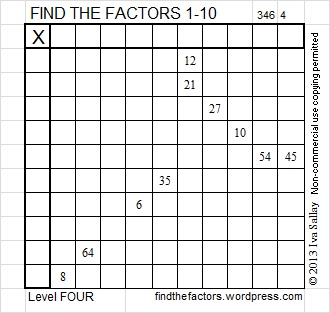
Find the Factors is a type of logic puzzle. To solve one of the above puzzles, place the numbers 1 – 10 in both the top row and in the first column so that those numbers are factors of the given clues. For each puzzle, there is only one solution. Click on 10 Factors 2013-12-16 to find these and a few more puzzles, as well as last Monday’s solutions.

Some of these Related articles have the lyrics or soundtrack to Silver Bells:

15 is the Magic Sum of a 3 x 3 Magic Square

15 is a composite number. 15 = 1 x 15 or 3 x 5. Factors of 15: 1, 3, 5, 15. Prime factorization: 15 = 3 x 5.

When 15 is a clue in the FIND THE FACTORS 1 – 10 or 1 – 12 puzzles, use 3 and 5 as the factors.

If you added the first nine counting numbers together, what sum would you get? What is 1 + 2 +3 + 4+ 5 + 6 + 7 + 8 + 9?

Would you get the same answer by adding (1 + 9) + (2 + 8) + (3 +7) + (4 + 6) + 5?

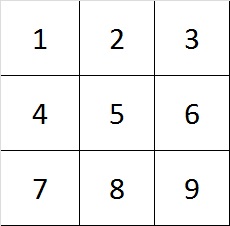
These are two of the many fun questions you can explore when you try to make a magic square. What is a magic square? If you can place the numbers from 1 to 9 in the box below so that the sum of any row, column, or diagonal will equal the sum of any other row, column, or diagonal, then you will have made a 3 x 3 magic square. The sum of a row, column, or diagonal in a magic square is called the magic sum.

1-9

Clearly it is not a magic square yet. In fact, only one of the numbers is positioned where it needs to be. Which number do you think is already in the correct position?

When it becomes a magic square, what will the magic sum be? One student noticed that in its current state the sums of the rows are 6, 15, and 24. The sums of the columns are 12, 15, 18. The sums of the diagonals are 15 and 15. Since 15 occurs most often, could the magic sum be 15? One way to determine what the magic sum should be is to add the sums of all three rows and then divide by the number of rows. Since 1 + 2 + 3 + 4 + 5 + 6 + 7 + 8 + 9 = 45 and 45 ÷ 3 = 15, then 15 is indeed the magic sum.

Here are a few easy-to-remember steps to construct a 3 x 3 magic square quickly.

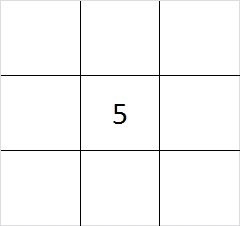
Step 1: Draw a tic-tac-toe board and put 5 in the middle.

step 1 magic

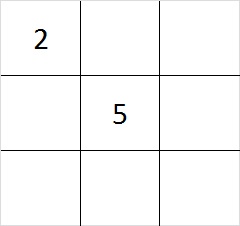
Step 2: Put one of the even numbers in one of the corners.  You have four different choices, 2, 4, 6, or 8. The illustration is for the number 2, but any of the even numbers will work.

step 2 magic

Step 3: Subtract your even number from 10 to find its partner. 4 + 6 are partners and so are 2 + 8. Put the partner of the number you chose for step 1 in the corner that is diagonal to it.

step 1 magic

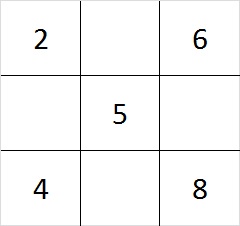
Step 4: Put the other two even numbers in the remaining corners. Yes, you have two choices where to put the numbers. Either choice will work.

step 4 magic

Step 5: Since 6 + 8 = 14 and 15 – 14 = 1, put 1 in the cell between the 6 and the 8. Do similar addition and subtraction problems on each side of the square to determine where to place the 3, 7, and 9. You can work clockwise or counter clockwise, or skip around the square doing the addition and subtraction problems; it doesn’t matter.

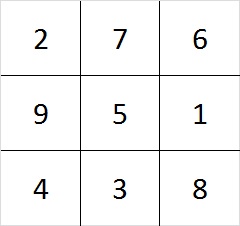
This finished magic square looks like this:

step 5 magic

Check it out! Every row, column, and diagonal adds up to 15!

As we created the square, we made choices. First we chose between 4 even numbers, and later we had 2 more choices. Notice that 4 x 2 = 8. There are 8 different ways to make a 3 x 3 magic square! (However, they are all really the same square turned upside down, rolled on its side, viewed from the back. etc.)

There are 880 different ways to make a 4 x 4 magic square. Look over the related articles at the end of this post to learn more about magic squares that are bigger than 3 x 3.

Speaking of magic squares, when I look at the square logic puzzle below, something magical happens. This puzzle has nine clues in it, and all of them are perfect squares. I can use those nine clues to construct a complete multiplication table. If you finish the same puzzle, your multiplication table will look exactly like mine because this puzzle has only one solution.

2014-01-06.1

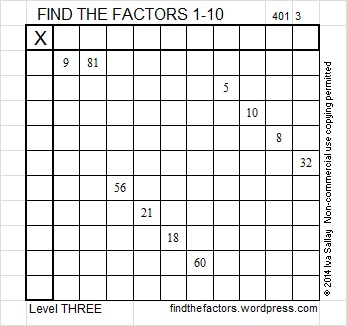
The level 3 puzzle below is only a little bit more difficult. To solve it place the numbers 1 – 10 in the top row and again in the first column so that those placed numbers are the factors of the given clues. Again there is only one solution, and you will need to use logic to find it. Click 10 Factors 2014-01-06 for more puzzles and last week’s answers.

2014-01-06.3

May we all find a little bit more magic in our lives!


14 Oh Christmas Tree

14 is a composite number. 14 = 1 x 14 or 2 x 7. Factors of 14: 1, 2, 7, 14. Prime factorization: 14 = 2 x 7.

When 14 is a clue in the FIND THE FACTORS  1 – 10 or 1 – 12 puzzles, use 2 and 7 as the factors.

O Christmas Tree, O Christmas Tree,

How lovely are your branches…

Do Christmas factor trees have lovely branches?  It depends on how they are constructed. For example here are 2 of the many possible factor trees for 1680. I think one of them is more lovely than the other.

1680.21680.1

This blog is actually about a logic puzzle that is based on the multiplication table. Today we have puzzles that look like Christmas trees, garland, lights, or blocks and a bright star for the very top.

Directions to solve the puzzles: In both the top row and the first column place the numbers 1 – 10 so that they are factors of the given clues. It may be more challenging than you think, especially for the higher level puzzles. If you click 10 Factors 2013-12-09, you can print the puzzles in color or black and white from an excel spreadsheet or you can type the answers directly on the spreadsheet. You must have a spreadsheet program on your device to access the file.

2013-12-09.12013-12-09.2

2013-12-09.32013-12-09.4

2013-12-09.52013-12-09.6

13 Mikulás

  • 13 is a prime number.
  • Prime factorization: 13 is prime.
  • The exponent of prime number 13 is 1. Adding 1 to that exponent we get (1 + 1) = 2. Therefore 13 has exactly 2 factors.
  • Factors of 13: 1, 13
  • Factor pairs: 13 = 1 x 13
  • 13 has no square factors that allow its square root to be simplified. √13 ≈ 3.60555.

How do we know that 13 is a prime number? If 13 were not a prime number, then it would be divisible by at least one prime number less than or equal to √13 ≈ 3.6. Since 13 cannot be divided evenly by 2 or 3, we know that 13 is a prime number.

13 is never a factor in the FIND THE FACTOR 1 – 10 or 1 – 12 puzzles.

Tonight (December 5th) all over Hungary, children will polish their boots and then place them in a window or in front of their door. Once the children are “nestled, all snug in their beds, … visions of sugar-plums (will indeed) dance in their heads” as they await a visit from Mikulás, or St. Nickolas.  When the children get up in the morning, they will find their boots or shoes filled with candy, fruit, and nuts if they have been good. If they have been bad, their boots or shoes will be filled with virgács, a small collection of twigs that have been spray-painted gold and decoratively bound together.

Since most children were good some of the time and naughty once in awhile, they will likely find  the expected goodies as well as virgács in their shoes or boots.
With these traditions in mind, I created the puzzles for today. If you have just a little imagination, you will be able to see different types of candy as well as the virgács in the clues. These puzzles will be a treat to any child or adult who did their homework and learned multiplication, division, and factoring. Click 12 Factors 2013-12-05.
2013-12-05.12013-12-05.22013-12-05.32013-12-05.4
2013-12-05.52012-12-05.6

12 The Doorbell Rang

12 is a composite number. 12 = 1 x 12, 2 x 6, or 3 x 4. Factors of 12: 1, 2, 3, 4, 6, 12. Prime factorization: 12 = 2 x 2 x 3, which can also be written 12 = 2² x 3.

When 12 is a clue in the FIND THE FACTORS 1 – 12 puzzles, any pair of its factors could be the correct choice. In the 1 – 10 puzzles, only 2 x 6 or 3 x 4 will be the correct choice.

The Doorbell Rang by Pat Hutchins is about cookies and sharing. It takes less than five minutes for an adult to read every delightful word aloud to a child.  It is also a good book for beginning readers because it is filled with reliable repetition, and it is also sprinkled with a few interesting multi-syllabic words. Some words that do NOT appear in the text are mathematics, multiplication, division, or factoring. Still, the book very cleverly helps children recognize all the factors of 12. Chiix Moses wrote in a review, “Something I firmly believe is that learning is best when it doesn’t feel like learning, and that is precisely what this book accomplishes.” This book almost effortlessly teaches students to think win-win, so it is also an excellent choice for reinforcing the Seven Habits.

Here is part of an email that my blogging friend, Paula Krieg, sent after reading this post, “I’ve been looking at some Islamic Geometry, learning to draw some of those rosettes, and was struck by how the 12-fold pattern seemed particularly rich. I may be wrong about this, but it got me thinking about 12. 12 makes a dozen. 12 months to a year. 12 inches to a foot. 12 days of Christmas, 12 numbers on a clock,  12 apostles. My cupcake pans make 12 cupcakes, and I guess Grama’s cookie pan makes 12 cookies in The Doorbell Rang book.”

I should also mention that some people think we should switch from base 10 to base 12 because 12 is divisible by 50% of the numbers less than or equal to it while 10 is only divisible by 40% of the numbers less than or equal to it.

The puzzle below will require knowledge of the factors of 12 as well as thirteen other numbers. It is a level five puzzle, meant to be completed by adults or very bright children.

 2013-11-21

Click 12 Factors 2013-11-21 for more puzzles.


11 Counting Blessings

  • 11 is a prime number.
  • Prime factorization: 11 is prime.
  • The exponent of prime number 11 is 1. Adding 1 to that exponent we get (1 + 1) = 2. Therefore 11 has exactly 2 factors.
  • Factors of 11: 1, 11
  • Factor pairs: 11 = 1 x 11
  • 11 has no square factors that allow its square root to be simplified. √11 ≈ 3.31662.

How do we know that 11 is a prime number? If 11 were not a prime number, then it would be divisible by at least one prime number less than or equal to √11 ≈ 3.3. Since 11 cannot be divided evenly by 2 or 3, we know that 11 is a prime number.

Sometimes 11 is a clue in the FIND THE FACTORS 1 – 12 puzzles, and the factors are always 1 and 11.

I have more blessings than I could ever completely count. This is not the place where I will attempt to name them one by one, but I wonder: is the number of blessings that I or anyone else has finite or infinite? Even being able to ponder that question is a blessing. In the last few years in the United States, much of the gratitude part of Thanksgiving has gotten lost in commercialism. Therefore, for some people the number of blessings may be finite and easily measured by counting things. Some of those blessings may be more imaginary than real. Nevertheless, there are still people who can see the hand of God all around them. For them the number of blessings is infinite. Likewise those who rely on the Savior and His infinite atonement have an infinite number of blessings. As I count blessings, I find that some of them are prime, and some are a composite of several blessings working together. Some blessings are rather odd while others are shared evenly. I am grateful for many positive events in my life, but even negative experiences are blessings because they have helped me to grow.

The following blessings may seem trivial, but I am grateful that WordPress has given me a way to share the Find the Factors puzzles not only as jpg pictures, but also in an excel file.  The puzzles have been a blessing to me, and I want to show my gratitude by sharing them with other people. I am grateful for the blogs I follow. They challenge me, entertain me, and teach me so much. I am also thankful to everyone who has looked at my blog.

Click 12 Factors 2013-11-28 to see the same puzzles in excel.

2013-11-28.72013-11-28.82013-11-28.92013-11-28.10

2013-11-28.B2013-11-28.12

10 Just Like Sudoku?

10 is a composite number. 10 = 1 x 10 or 2 x 5. Factors of 10: 1, 2, 5, 10. Prime factorization: 10 = 2 x 5.

When 10 is a clue in the FIND THE FACTORS puzzles, either 1 x 10 or else 2 x 5 will work for that particular puzzle.

On numerous occasions when I have demonstrated how to solve a Find the Factors puzzle, someone will remark that the puzzle is just like Sudoku. What are common factors that both a Find the Factors puzzle and a Sudoku puzzle will have? 1) Both will have only one solution. 2) Both require the solver to be able to count, write, and place the numerals 1 to 9, but Find the Factors also requires the number 10 be placed. 3) Both were originally designed to require logic to be solved. 4) Both puzzles utilize a square grid. 5) Both puzzles have several difficulty levels and variations that make the puzzles more challenging.

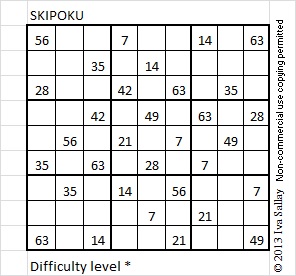
What factors do the two puzzles NOT have in common? 1) A difficult Sudoku puzzle can take some people almost an hour to solve while Find the Factors  would never take that long. 2) Sudoku has been a wildly popular puzzle while Find the Factors is known only among a small circle of people who have had some kind of contact with me. 3) Some more recent Sudoku puzzles require the solvers to guess and check which is getting away from its logic puzzle roots and is making it less popular for some people.  4) Sudoku could just as easily be made with letters of an alphabet, colors, or the names of the planets (if you include Pluto), while Find the Factors has to be made with numbers. 5) Sudoku requires only counting, while Find the Factors also requires the solver to factor and multiply. So really, if Find the Factors were just like Sudoku, it would look like this:

skipoku

Requiring skip counting to solve the Skipoku puzzle does make it more challenging, but I became annoyed with the skip counting by the time I finished the puzzle.

One complaint about some advanced Sudoku puzzles is the need to guess and check to find a solution. Is it necessary to guess and check all the possibilities to solve this level SIX Find the Factors puzzle?

2013-11-25

Click 10 Factors 2013-11-25 for more puzzles.

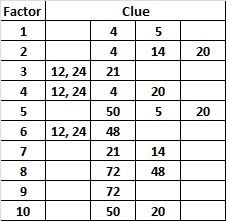
No. Guessing and checking is not necessary even though the clues 12 and 24 have several common factors.  We easily eliminate 1 and 2 because both of them would require a partner greater than 10. We also eliminate 12 because it is greater than 10. What about 3, 4, and 6? Do we have to try each of those possibilities? When we examine the puzzle we notice that it has 10 clues with only two of the clues paired together. We also notice there is one column that contains no clue, so supposedly any factor could fit there. Here is a chart of all the possible factors and the clues each could satisfy.

factors for 2013-11-25

Remember that each factor must be written twice, once in the factor row and one in the factor column. Notice that the number 9 is a factor of only one of the clues. That means that 9 has to be put over the column with no clues. From there it is easy to know where the other 9 goes and both 8’s and so forth until it is completed. Not all level SIX puzzles can be completed that easily, but using logic instead of guessing and checking is the key to solving these puzzles.

8 What Happens When Puzzle Dimensions Change?

My daughter-in-law, Julayne, is brilliant. She earned a master’s degree in mathematics and teaches at the college level. She is also an expert at solving the Hungarian puzzle known as a Rubik’s cube. Since she can easily solve a 3 x 3 x 3 cube, she decided to conquer 4 x 4 x 4, 5 x 5 x 5, and 6 x 6 x 6 cubes. She has even been able to solve the 7 x 7 x 7 cube. Amazing! If you hand her a physical cube in any of those dimensions, she will be able to solve it. She can even easily solve a virtual Rubik’s cube.

When I showed her the Find the Factors puzzles, she naturally asked if I could make one that used factors all the way to fifteen.

Do the dimensions of the puzzle matter? The puzzles usually ask you to find the factors from 1 to 10 or 1 to 12. What if we had a Find the Factors 1-5 puzzle?

Factors 1-5

This puzzle is so easy to solve that most people will not think it worth their time. The number combinations are so few that it should never prove to be very challenging. If you solve this puzzle, you may find it hard to believe that the numbers were chosen at random, but they really were. You probably will agree with me that 5 factors are too few. If we made puzzles with 6 factors, then 7, 8, or 9, they would all be more difficult than a 5-factor puzzle, but a 10-factor puzzle seems like the best place to start. Most everyone is expected to know the times table up to 10 x 10 = 100. Many people were also taught the multiplication facts up to 12 x 12 = 144.

A coworker once mentioned to me that he noticed that puzzles with 12 factors are much more difficult to solve than ones with 10 factors. Whether the factors are prime or composite numbers is only part of what makes a puzzle easy or difficult. For example, even though 2, 3, and 5 are prime numbers, they don’t make a puzzle easier because they have multiples that can also be factors in the puzzle. Prime numbers 7 and 11 help make a puzzle easier, so a Find the Factors 1-11 would actually be easier than a 10-factor puzzle. Adding 12 complicates the puzzle significantly because the following multiples of 12 have other factors that also could be needed to solve the puzzle.

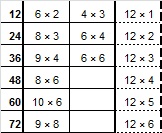
multiples of 12

Thirteen, another prime number, also makes the puzzle a little easier. My brother, Andy, will have his 65 birthday soon. I made him a Find the Factors 1-13 puzzle because I wanted to include the number 65 which is 13 x 5. Most people only know a few of the 13 multiplication facts like 4 suits x 13 ranks = 52 playing cards, but if you solve this puzzle, you will still probably find it easier than a 1-12 factor puzzle.

Happy 65th Birthday

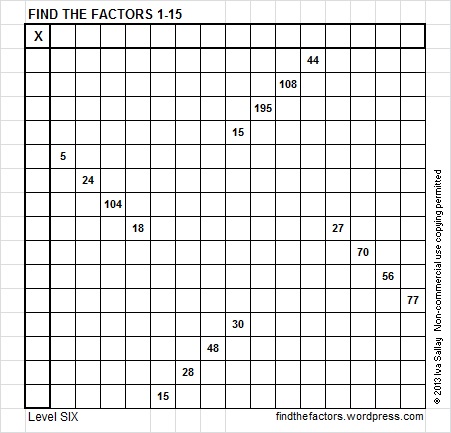
Adding 14 as a possible factor takes away the advantages of prime number 7, so a 14-factor puzzle would be more difficult. Also, most people have not memorized the first 14 multiples of 14. Making or solving a 15-factor puzzle makes the multiples of 3 and 5 become even more complicated clues. Of course, most people don’t recall the first 15 multiples of 15 either. The many possible factors for the clues make it more difficult to create a puzzle that has only one solution. Try to solve this Find the Factors 1-15 puzzle. It expects you to know the two factors of 195 that are both between 1 and 15. Also, the common factor of 15 and 30 could be 3, 5, or 15. This puzzle can still be solved using logic only, but it will be more challenging than puzzles of smaller dimensions.

15 puzzle

You can cut and paste the puzzle into a document and make it any size you wish or you can open 10 Factors 2013-12-02 to view it along with the following puzzles.

2013-12-02.12013-12-02.22013-12-02.32013-12-02.42013-12-02.52013-12-02.6


  • 8 is a composite number.
  • Prime factorization: 8 = 2 × 2 × 2, which can be written 8 = 2³
  • The exponent in the prime factorization is 3. Adding one, we get (3 + 1) = 4. Therefore 8 has exactly 4 factors.
  • Factors of 8: 1, 2, 4, 8
  • Factor pairs: 8 = 1 × 8 or 2 × 4
  • Taking the factor pair with the largest square number factor, we get √8 = (√4)(√2) = 2√2 ≈ 2.828
  • 8 is a perfect cube.

When 8 is a clue in the FIND THE FACTORS puzzles, use either 1 x 8 or 2 x 4.

Here’s a cool tweet about the number 8:


7 Spaghetti and Meatballs for All!

A Wonderful Math-Related Picture Book

Spaghetti and Meatballs for All! by Marilyn Burns is a delightful story, the kind that children enjoy hearing over and over again.

I work at a Leader in Me school, where we promote the Seven Habits. I used this book when I taught about habit 4, think win-win. When we think win-win, we do not allow someone to “step on us’ to give them a win. Mrs. Comfort’s relatives stepped on her over and over again, and they didn’t even realize it. Finally, she cried, “I give up!” and planted herself on a chair. She definitely felt like she was losing. The class listened to the story intently trying to identify places where the Seven Habits were used or could have been used. We had a great discussion afterward. Also since the book did not use the words, “area” or “perimeter” at all, the class hardly realized that the story was also about those concepts. When we followed the suggestions at the back of the book, the class was able to learn about perimeter and area as we had a great discussion about those topics as well. 

Today’s Puzzle:

2013-11-18

Factors of 7:

  • 7 is a prime number.
  • Prime factorization: 7 is prime.
  • The exponent of prime number 7 is 1. Adding 1 to that exponent we get (1 + 1) = 2. Therefore 7 has exactly 2 factors.
  • Factors of 7: 1, 7
  • Factor pairs: 7 = 1 x 7
  • 7 has no square factors that allow its square root to be simplified. √7 ≈ 2.64575.

How do we know that 7 is a prime number? If 7 were not a prime number, then it would be divisible by at least one prime number less than or equal to √7 ≈ 2.6. Since 7 cannot be divided evenly by 2, we know that 7 is a prime number.

More about the Number 7:

When 7 is a clue in the FIND THE FACTORS puzzles, one factor will be 7 and the other will be 1.

6 A Piece of Cake

Birthday Puzzles for My Daughter:

Happy birthday, Kathy! I hope your day is wonderful. You have grown into a beautiful, talented, prayerful, intelligent, hard-working, and loving young woman.  I am grateful you are my daughter.  So for your birthday today and for this blog, I’ve created three special puzzles: the first is a birthday cake to celebrate your happy day. To highlight your love of music, the second puzzle is a quarter note. The third puzzle is either a violin, a guitar, or a ukulele, you decide. I love listening as you sing or as you play any of those instruments or the piano. Today for your birthday I will also cut down a tree and make yet another cake with two birthday candles on top in this blog post.  So have a fun birthday, today.  I love you.

Birthday cake

Click 12 Factors 2013-11-14 for more puzzles.

quarter note

Factor Trees vs. Factor Cakes:

What did I mean by cutting down a tree and making yet another cake? Today I will discuss two methods for finding the prime factors of a whole number. One method is making a factor tree and the other is the cake method. To factor a number means to write it as the product of two or more factors. When those two or more factors are all prime factors, it is called a prime factorization of the number. A composite number always has more than two factors. A prime number always has exactly 2 factors, 1 and itself. (ZERO and ONE are neither prime or composite numbers.) Usually, to find the prime factors of a number, a person will usually make a factor tree. The following example shows how this is done:

factor tree

From this example, you can certainly understand why this algorithm is called a factor tree.  It looks exactly like a perfectly-shaped evergreen tree.  The problem is that a factor tree doesn’t always look so neat and trim.  Here is a factor tree that even Charlie Brown wouldn’t choose:

more common factor tree

720 isn’t even that big of a number, but gathering all of the prime numbers from the factor tree and putting them in numerical order would be like picking up a bunch of scattered leaves. It would be like doing . . . yard work.  Imagine if you had a number that had many more factors. If one or two of the factors gets lost in the mess, your answer wouldn’t be correct. Notice that some of the prime factors of 720 (2,2,2,2,3,3,5) are not as easy to see as others on the factor tree.  That is why I want to chop down that tree. Even if you like to do yard work, do you really want to deal with that big of a mess, . . . especially when you can have cake instead?  Look, the cake method is so much more pleasing to the eye, and it is simply an extension of the very familiar division algorithm:

Cake method

With the cake method, the more factors you have, the bigger the cake will be, but it will always be neatly organized with all the factors on the outside of the cake.  And if the largest prime factor of your given number is eleven, you will also have two candles on top of your cake!  I find using the cake method to be much less confusing than using a factor tree.  Yes, finding prime factors can actually be a piece of cake. The only disadvantage to the cake method is that since you work from the bottom up you have to leave enough space for the cake to rise.

Still, in spite of my opinion, it is best to use whichever method you are more comfortable with.

Now if your appetite for cake has not been satisfied, click on one of the links below for a nice variety of cakes shared by other bloggers.

Factors of the Number 6:

6 is a composite number. 6 = 1 x 6 or 2 x 3. Factors of 6: 1, 2, 3, 6. Prime factorization: 2 x 3.

When 6 is a clue in the FIND THE FACTORS  puzzle, the pair that will work for that particular puzzle might be 1 x 6, or it might be 2 x 3.

A Sum-Difference Puzzle Featuring the Number 6 and its Factors:

Look at the factor pair puzzle above. Perhaps you will notice that
2 + 3 = 5 and 6 – 1 = 5.
Those are the facts you need to complete the Sum-Difference puzzle below.