33 and Some Divisibility Tricks for 3 and 9

33 is a composite number. 33 = 1 x 33 or 3 x 11. Factors of 33: 1, 3, 11, 33. Prime factorization: 33 = 3 x 11.

When 33 is a clue in the FIND THE FACTORS 1 – 12 puzzles, always use 3 and 11 as the factors.

———————————————————————————-

What patterns do you see in the following chart?

multiples of 9 chart

Probably you noticed or a teacher taught you the easy way to remember what 9 times a numbers from one to ten is just as the chart illustrates.

Did you also ever notice that if you add up the digits of the multiples of 9 in the multiplication table, you get 9?

What is really great is if you add up the digits of ANY multiple of 9, you’ll get 9 or some other multiple of 9! This is called a divisibility trick because it is a way to find out if a number is divisible by 9 without actually dividing by 9.

The same trick works on multiples of 3: If you add up the digits of a multiple of 3, you will get 3 or some other multiple of 3! Lets apply these divisibility tricks to a few numbers:

Is 243 divisible by 3 or 9? We don’t have to divide to know the answer:

2 + 4 + 3 = 9, which is divisible by both 3 and 9, so, yes, 243 is divisible by both 3 and 9.

If you do the actual division:

  • 243 ÷ 3 = 81
  • 243 ÷ 9 = 27.

————————————————————

Is 582 divisible by 3 or by 9? Add up the digits to find out: 5 + 8 + 2 = 15.

Since 15 is divisible by 3, but not by 9, we know 582 is divisible by 3, but not by 9.

If you do the actual division:

  • 582 ÷ 3 = 194
  • 582 ÷ 9 = 64 Remainder 6.

When we added the digits of 582, we got 15. Notice that 1 + 5 = 6, the remainder when we divided 582 by 9.

When you add up the digits of a number until you have only one digit left, if that digit is not 9, then that number is the remainder you would get if you did the actual division!

——————————————————————————–

Now let’s see if 1753 is divisible by 3 or 9.

1 + 7 + 5 + 3 = 16; 1 + 6 = 7.

7 cannot be evenly divided by 3 or 9, so 1753 is not divisible by 3 or 9.

If you do the actual division:

  • 1753 ÷ 9 = 194 Remainder 7 (the same 7 that equals 1 + 6 above).
  • 1753 ÷ 3 = 584 Remainder 1

Notice that 7 ÷ 3 = 2 Remainder 1

——————————————————————————–

All of these problems demonstrate that if you add the digits of a number until you are left with a single digit, if that digit is 3, 6, or 9, then the original number is divisible by 3.

The last problem demonstrates that if you divide that single digit by 3, the remainder will be the same if you divided the original number by 3.

These divisibility tricks for 3 and 9 can give quite a bit of valuable information!


32 and Hooked on Factoring

32 is a composite number. 32 = 1 x 32, 2 x 16, or 4 x 8.  Factors of 32: 1, 2, 4, 8, 16, 32. Prime factorization: 32 = 2 x 2 x 2 x 2 x 2, which can also be written 32 = 2⁵.

When 32 is a clue in the FIND THE FACTORS puzzles, always use 4 and 8 as the factors.

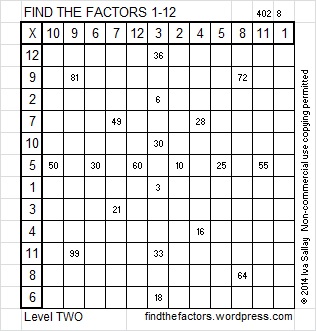
2014-03 Level 2

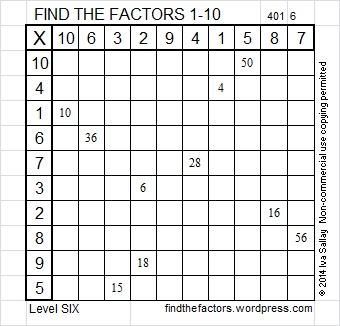
Here is a hook-shaped FIND THE FACTORS 1-10 puzzle, and YOU can solve in by hook or by crook!

The puzzle has a few square numbers: 16, 4, 81, 36, 36, 9, 1, and 25. Several square numbers can only be factored one way in a FIND THE FACTORS puzzle, while others can be factored 2 or 3 ways.

Obviously, 6 x 6 = 36 will not let us off the hook both times that 36 appears. One of those times we must use 4 x 9 = 36. This puzzle reminds us that 36 is sometimes a square and sometimes a rectangle.

The 16 isn’t a square in this puzzle either. Sometimes 4 and 9 are rectangles, but not in this case.

81 and 25 are always square in the FIND THE FACTORS puzzles because even though 1 and 3 are allowed to be factors, 25, 27, and 81 are greater than 10 and not allowed as possible factors to solve the puzzle.

To solve this puzzle, write the numbers from 1 to 10 in the top row and again in the first column so that those numbers are the factors of the given clues. Don’t fall for those slightly tricky clues hook, line, and sinker!

This week’s puzzles are also available in an excel file here. If you have a spreadsheet program on your computer, you can access it. If you enable editing in excel, you can type your answers directly onto the puzzle, and you can also easily print the puzzles. I’m hooked on factoring. I hope you’ll get hooked, too!

Here are all the factors to last week’s level 2 FIND THE FACTORS 1-12 snowflake puzzle:

2014-02 Level 2 Answer

31 and Every Third Grader Should Know

  • 31 is a prime number.
  • Prime factorization: 31 is prime.
  • The exponent of prime number 31 is 1. Adding 1 to that exponent we get (1 + 1) = 2. Therefore 31 has exactly 2 factors.
  • Factors of 31: 1, 31
  • Factor pairs: 31 = 1 x 31
  • 31 has no square factors that allow its square root to be simplified. √31 ≈ 5.56776

How do we know that 31 is a prime number? If 31 were not a prime number, then it would be divisible by at least one prime number less than or equal to √31 ≈ 5.6. Since 31 cannot be divided evenly by 2, 3, or 5, we know that 31 is a prime number.

31 is never a clue in the FIND THE FACTORS puzzles.

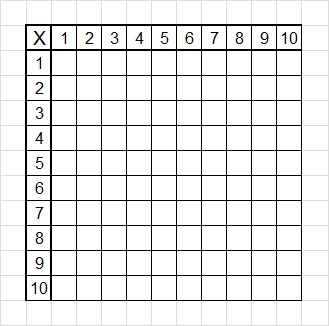
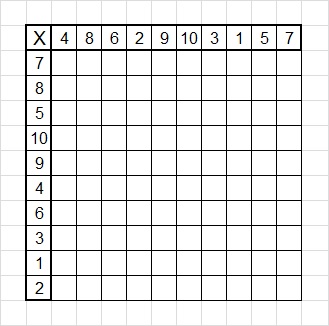
Every third grader should know how to fill in a multiplication table:

Basic multiplication table

By the middle of third grade, every third grade student has been taught the basic multiplication facts. Of course, that doesn’t mean that every third grader has LEARNED those facts. Corestandards.org/Math/Content/3/ lists EVERYTHING a student should learn in third grade math. Multiplication is very key in learning all of these concepts.

Many students, even beyond third grade, rely on skip counting to figure out what a multiplication product should be. Some students have learned rhymes to help them recall a fact. Given the opportunity some students even in middle school will use a calculator to find the answer to a basic multiplication fact.

Practicing every day will help students recall the facts instantly instead of needing a calculator or other crutch to help them remember one of the basic multiplication facts. For variety, every third grader should also know how to fill out a multiplication table that looks like this:

mixed table

This kind of table doesn’t allow a student to simply count by twos, fives, nines or any other number to fill out a particular row or column. This type of table encourages a student to fully memorize all the multiplication facts so the table can be completed as quickly as possible.

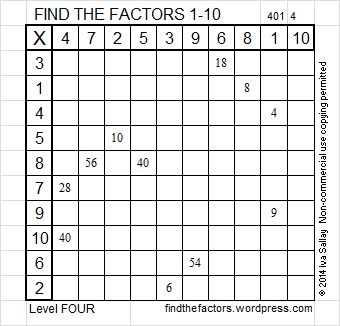
About the middle of third grade, students are introduced to division. As soon as students learn that any number can be divided by 1, they are ready to tackle the easiest of the easiest FIND THE FACTORS puzzles. Here is the level 1 puzzle for the 3rd full week of 2014:

2014-03 Level 1

It is a level 1 puzzle because students only have to know 10 (or 12) division facts to solve the puzzle. Even though it is a simple puzzle, third grade students will need some instruction to complete it. Tell them that this puzzle is going to turn into a multiplication table as soon as they figure out what numbers go into the top row and the first column. Tell them the only numbers that will be written in those two places are numbers from 1 to 10 and that all of those numbers have to be written in both places.

Help the students know what numbers to write in each space on the top row. Some students will likely be confused when they get to the column with 8 clues and to the column with no clues. Help them use logic to figure out what numbers should go in those spaces. When all the factors have been found in both the factor row and the factor column, have them complete the multiplication table. It will be great practice for all of them.

Last week’s puzzle was fairly easy. Here is the puzzle with all of the factors found:

 2014-02 Level 1 Answer

This week’s puzzles are also available in an excel file here, if you have a spreadsheet program on your computer you can access it.

If you enable editing in excel, you can type your answers directly onto the puzzle, and you can also easily print the puzzles. Have fun!

30 and Pieces of Pi

Pieces of Pi:

Haha. There’s no easy way to cut a pie into seven equal slices. . .

But you can find beautiful representations of π at Paula Krieg’s blog. It is a bookbinding blog with just the right artistic touch for pi expressed as π, a fraction (2 ways), or a decimal!

Factors of 30:

30 is a composite number. 30 = 1 x 30, 2 x 15, 3 x 10, or 5 x 6. Factors of 30: 1, 2, 3, 5, 6, 10, 15, 30. Prime factorization: 30 = 2 x 3 x 5.

When 30 is a clue in the FIND THE FACTORS puzzle, use 3 x 10 or 5 x 6. Only one of those pairs will work for that clue in that particular puzzle.

Sum-Difference Puzzle:

30 has four factor pairs. One of those pairs adds up to 13, and another one subtracts to give us 13. If you can find those factor pairs, then you can solve this puzzle!

29 and A Level 6 Snowball

  • 29 is a prime number.
  • Prime factorization: 29 is prime.
  • The exponent of prime number 29 is 1. Adding 1 to that exponent we get (1 + 1) = 2. Therefore 29 has exactly 2 factors.
  • Factors of 29: 1, 29
  • Factor pairs: 29 = 1 x 29
  • 29 has no square factors that allow its square root to be simplified. √29 ≈ 5.38516

How do we know that 29 is a prime number? If 29 were not a prime number, then it would be divisible by at least one prime number less than or equal to √29 ≈ 5.4. Since 29 cannot be divided evenly by 2, 3, or 5, we know that 29 is a prime number.

29 is never a clue in the FIND THE FACTORS puzzles.

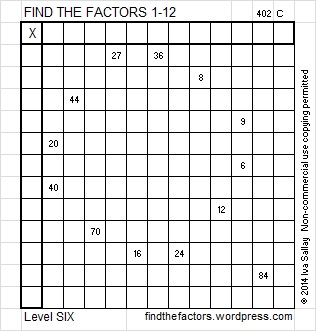
Here is a FIND THE FACTORS 1-12 puzzle that is shaped like a snowball. Because it is a level 6 puzzle, you might feel as if you’re caught in a snowball fight:

2014-01-13.6

The object of the puzzle is to write the numbers 1 to 12 in the top row and again in the first column so that those numbers are the factors of the given clues. If you have attempted a level 6 puzzle, you may have screamed, “IS IT EVEN POSSIBLE to solve a level 6 puzzle without guessing and checking?” I promise you it is, BUT you will need to look at ALL the clues in the puzzle and think about them logically. I don’t want to spoil any of the fun of this week’s puzzle, so I will explain in detail how to solve last week’s puzzle instead.

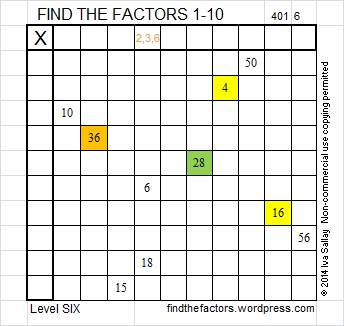
Notice that for last week’s puzzle there is only one row or column with more than one clue, the column with the 6 and 18 in it. Notice there are three possible common factors, 2, 3, and 6 that will allow us to write only the numbers from 1 to 10 in the factor row and the factor column. You may be tempted to guess and check, but doing that often leads to frustration and/or screaming, so let’s ignore that column for now.

2014-01 Level 6 step 1

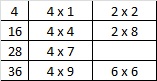
As we examine the other clues, we notice that there are four clues that are divisible by four: 4, 16, 28, and 36. Let’s look at the possible factors for each of those clues.

2014-01 Level 6 step 2

possible 4's Remember that each number from 1 to 10 can only appear once in the factor row and once in the factor column. That means that if 4 is 2 x 2, then 16 must be 4 x 4. Likewise if 16 is 2 x 8, then 4 must be 1 x 4.

If you think about it, you will realize that for this puzzle 4 MUST be a factor of either 4 OR 16. You should also notice that 4 must be a factor of 28. Therefore, in this puzzle, 4 will NOT be one the factors of 36.

We therefore, know that 6 x 6 = 36 works for this puzzle. Since that uses up both 6s, we know that we can’t use 6 as one of the factors of 18, and since 6 x 3 = 18, we also can’t use 3 as its factor. Logic tells us that 2 is the only common factor of 6 and 18 that will work for this puzzle. We now can fill in the corresponding factor cells from the information we have learned so far:

2014-01 Level 6 step 3

Since we found a 9 in the factor column, try to figure out where the 9 goes in the factor row. Since none of the clues that are left are divisible by 9, there is only one place a 9 can go in the factor row: over the column with no clues.

Now if we complete the puzzle using the clues in the order listed on the chart below, we can feel the rhythm as we fill in the rest of the factor cells. The first factor of each multiplication product should be written in the factor row (and the second factor should be written in the factor column):

2014-02.6 logic

Now we have found all the factors using LOGIC only. We did not guess and check at all. Last week’s completed puzzle is shown below.

2014-01 Level 6 Answer

Try to discover the secret of the snowball puzzle on your own as well. This week’s puzzles are also available in an excel file here, if you have a spreadsheet program on your computer you can access it. If you enable editing in excel, you can type your answers directly onto the puzzle, and you can also easily print the puzzles. Good luck!

28 and Level 5 Snowflake

28 is a composite number. 28 = 1 x 28, 2 x 14, or 4 x 7. Factors of 28: 1, 2, 4, 7, 14, 28. Prime factorization: 28 = 2 x 2 x 7, which can also be written 28 = 2² x 7.

When 28 is a clue in the FIND THE FACTORS puzzles, the factors will be 4 and 7.

2014-01-13.5

This snowflake is actually a logic puzzle based on the multiplication table. Because it is a level 5 puzzle, it can be a little tricky to solve, and isn’t for beginners. If you haven’t solved a Find the Factors puzzle before, this level 2 snowflake puzzle might be a better choice:

2014-01-13.2

How do you solve a level 5 FIND THE FACTORS 1 – 12 puzzle? As always the object is to write the numbers 1-12 in the top row and again in the first column so that those numbers are the factors of the given clues. Use logic, not guessing and checking, to find its unique solution. Here is how to solve a level 5 puzzle:

Begin by looking for perfect square clues, 1, 25, 49, 64, 81, 100, 121, or 144, because there is only one way to factor any of them so that both factors are numbers from 1 to 12. IF you find one of THOSE perfect square clues, write down its factors in the corresponding factor row and factor column.

Next locate a row or a column with at least 2 clues. Find ALL the common factors of that row or column that will allow you to write only numbers from 1 to 12 in both the factor row and the factor column. If that row or column has more than one common factor, leave it alone for now. In a level 5 puzzle there will be at least one row or column that has only one common factor. When you find such a row or column, write its factors in the corresponding factor cells.

Let’s use the level 5 puzzle from wk 1 – 2014 as an example. Starting at the top of the puzzle look at all each row to see if it has more than one clue. We notice that there are two rows with 2 clues, but in both cases, there is more than one possible common factor, so we will ignore those rows for now. Starting on the left, look at each column to see if it has more than one clue. There are 2 columns that have 2 clues, and one of those columns has 3 possible common factors. If you were to guess which of those factors were correct, you would have a 67% chance of guessing wrong. Guessing and checking leads to frustration. Use logic and start with the column that has only one possible common factor, in this case: 1.

2014-01 Level 5 1st step

Now you have at least 3 factors written down. Next look at ALL the remaining clues in the puzzle and find one that can only be factored using one of the factors you’ve written down already but haven’t used twice. (You notice that 54 = 9 x 6, so you can write 9 and 6 in the appropriate cells.)

Sometime during this process, you will discover that one or more of the remaining rows or columns that had more than one clue have had some of the possible factors eliminated. Logic, or the process of elimination, will help you know the only common factor that will work for those clues in this puzzle. (In last week’s puzzle, you may notice that 28 = 4 x 7. That means that 16 cannot be 4 x 4 because we can’t have any factor used more than one time in either the factor row or the factor column. That means in this particular puzzle 16 = 8 x 2. Since you already found one 8, it is easy to place this 8 and the 2.)

Continue to look at all the clues and use logic until all (or almost all) of the factors are found.

If a row or a column contains no clues, use logic is determine which number from 1 to 12 (or 1 to 10) should be written there.

While working on these puzzles, occasionally count from 1 to 12 (1 to 10) as you examine numbers in the factor row and factor column to make sure that a number is written only once in either place. Good luck!

This week’s puzzles are also available in an excel file here, if you have a spreadsheet program on your computer you can access it. If you enable editing in excel, you can type your answers directly onto the puzzle, and you can also easily print the puzzles. Here is the solution to the Week 1 – 2014, Level 5 puzzle:

2014-01 Level 5 Answer

27 and There Are Polar Bears Round The Ice-Fishing Hole

27 is a composite number. 27 = 1 x 27, or 3 x 9. Factors of 27: 1, 3, 9, 27. Prime factorization: 27 = 3 x 3 x 3, which can also be written 27 = 3³.

When 27 is a clue in the FIND THE FACTORS puzzles, the factors are always 3 and 9.

Look at these dice:

You might see a full house, but I see 14 Polar Bears around the ice-fishing hole.

What am I talking about?

Click on There are Polar Bears Round the Icehole, a fun puzzle to try on kids or adults. How many polar bears are around an ice-fishing hole? Get out your Yahtzee dice and see who can figure out the pattern of the riddle.

26 and Level 4

26 is a composite number. 26 = 1 x 26 or 2 x 13. Factors of 26: 1, 2, 13, 26. Prime factorization: 26 = 2 x 13.

26 is never a clue in the FIND THE FACTORS 1-10 or 1-12 puzzles.

2014-01-13.4

Write the numbers 1-12 in the top row and again in the first column so that those numbers are the factors of the given clues. Use logic, not guessing and checking, to find its unique solution. Here is how to solve this level 4 “snow shovel” puzzle:

Begin by looking for perfect square clues, 1, 25, 49, 64, 81, 100, 121, or 144 because there is only one way to factor any of them so that both factors are numbers from 1 to 12. If you find one of those perfect square clues, write down its factors in the corresponding factor row and factor column.

Next locate a row or a column with at least 2 clues. Find the common factor of that row or column that will allow you to write only numbers from 1 to 12 in both the factor row and the factor column. If there is more than one row or column with at least 2 clues, repeat the previous step until only rows and columns with one clue remain.

Now you have at least 3 factors written down. Next look at ALL the remaining clues in the puzzle and find one that can only be factored using one of the factors you’ve written down already but haven’t used twice. Repeat the last step until all (or almost all) of the factors are found.

If a row or a column contains no clues, use logic is determine which number from 1 to 12 should be written there.

While working on these puzzles, occasionally count from 1 to 12 to make sure each of those numbers is written exactly once in both the factor row and the factor column. You will notice a rhythm for the answers as you work. Good luck!

This week’s puzzles are also available in an excel file here, if you have a spreadsheet program on your computer. If you enable editing in excel, you can type your answers directly onto the puzzle, and you can also easily print the puzzles.

Here is the solution to the week 1 level 4 puzzle:

2014-01 Level 4 Answer

25 and Level 3

25 is a composite number, and it is 5 squared. 25 = 1 x 25 or 5 x 5. Factors of 25: 1, 5, 25. Prime factorization: 25 = 5 x 5, which can also be written 25 = 5².

Since √25 = 5, a whole number, 25 is a perfect square. 

When 25 is a clue in the FIND THE FACTORS puzzles, write 5 in both the corresponding factor row and the factor column.

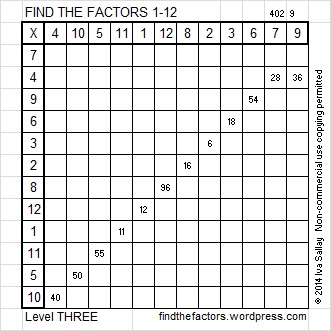
2014-02 Level 3

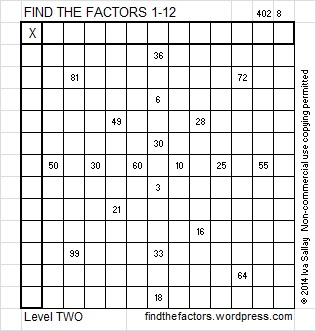
Write the numbers 1-12 in the top row and again in the first column so that those numbers are the factors of the given clues. Use logic, not guessing and checking, to find its unique solution. Level 3 puzzles are designed to be solved starting from a row at the top of the puzzle with 2 clues. First find the common factor of those two clues that will allow you to write only numbers from 1 to 12 in the factor row at the top of the puzzle. Then factor row by row to the bottom of the puzzle making sure each number from 1 to 12 is written only once in both the factor row and the factor column. You will notice a rhythm for the answers as you work. Good luck!

This week’s puzzles are also available in an excel file here if you have a spreadsheet program on your computer. If you enable editing in excel, you can type your answers directly onto the puzzle, and you can also easily print the puzzles.

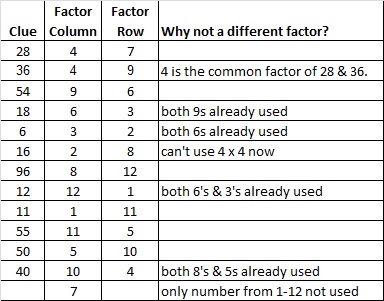
Here is the solution to last week’s level 3 puzzle:
2014-01 Level 3 Answer

24 Think You Have a Snow Problem? Try This:

Snow Related Puzzles:

It’s January, and some of us are a little tired of the snow while others are longing to hit the ski slopes. I’m writing today to suggest a few ways to deal with snow when it seems like more of an obstacle than an opportunity.

I walked into a second-grade classroom last week and saw books and books about snow, snowflakes, snowmen, etc. Celebrating winter is one way to deal with the snow. Here are a few snow problems for you to solve while you review multiplication facts: I’ve created a nightmare of a snowstorm with huge snowflakes and snowballs and only an itsy bitsy snow shovel to deal with it all. Be grateful this isn’t what you are really facing! How do you solve one of these snow-related puzzles? Write the numbers 1 – 12 in the top row and again in the first column so that those numbers are the factors of the given clues. Each puzzle has only one solution.  Click here for some tips to help you solve the puzzles. Click 12 Factors 2014-01-13 for printable versions of these and a couple other puzzles as well as last week’s answers.

2014-01-13.22014-01-13.52014-01-13.42014-01-13.6

Tools to Deal with Actual Snow:

Puzzles are fun, but they can’t help you get the car out of the garage after a snowstorm.

If you wake up to find just under a foot of snow (or even much more) on your driveway (or your roof), a good snow shovel can still be the answer. I recommend a shovel with a crooked handle. It makes lifting snow so much easier. This excellent article has everything you need to know to shovel snow.

I have not used cooking oil on my snow shovels, but I have sprayed it with non-stick cooking spray, and that did help when the snow was sticky. (Snow isn’t always sticky.)

Two places I have lived face winter storms on occasion. Those places were Oklahoma County, Oklahoma and Salt Lake County, Utah.

It didn’t snow very often when we lived near Oklahoma City, but when it did, a crooked-handled shovel allowed me to clear my driveway faster than any of my neighbors who had only a straight-handled shovel. Freezing rain, thunderstorms, and tornadoes were a much bigger concern in Oklahoma than snow.

Compared to Oklahoma, we get much more snow near Salt Lake City where we have lived for the last 20 years.   Now my family has two of these crooked handled shovels. For seventeen years we relied solely on those shovels. We found that shoveling was good exercise, but it also took too much time, and time seems to be getting in shorter supply.

Three years ago we bought a good quality snow blower, and it is definitely a time saver. If you buy a snow blower, make sure it is a model that allows the operator to change the direction where the snow is blown. Also if the snowblower gets clogged with snow, always turn it off before attempting to unclog it. We have a friend who lost a finger because he didn’t turn it off first.

We also know people who own tractor snowplows. They easily clear their driveways and sometimes the sidewalks for their entire block. There is a snowplow on the Sears website. The blade on it is currently for sale for just under $250.00. Ouch.

We dream of someday getting an automatic snowmelt system that will turn itself on and melt any snow that falls on our driveway. One such system is described here.

Yes, there are many places that regularly get pounded with much more snow than Salt Lake City does. I’m not sure how helpful any of the above information will be for people who live in such places, so for anyone suffering in those locations I offer a few diversions:

A Few Diversions from Dealing with the Snow:

My daughter-in-law endured the polar vortex that hit the Eastern half of the United States last week. She wrote, “Public service announcement: 37+ weeks pregnant with a head cold and two small sick kids is no fun. I do not recommend it. Today I am grateful for PBS kid shows, giant boxes of tissues, soft blankets, and easy slow cooker meals.” She also survived by finding humor in the situation. She shared a hilarious Sunny Street cartoon panel featuring a very cold pregnant woman whose water broke and turned immediately into ice cubes.

If you like making greeting cards, you could make a snowflake card using an early iteration of Koch’s snowflake. If you completed a few more iterations, you would discover that this snowflake is a lovely six-sided shape that happens to have a finite area, but an infinite perimeter. Here are the directions: http://renegadegeek.wordpress.com/2013/12/31/koch-snowflake-card/

If none of these tips or diversions help you solve or forget your snow problem, I have one more thing for you to try as a last resort:

I am absolutely amazed at how much more snow the Northern Hemisphere gets compared to the Southern Hemisphere during their respective winters. So as a last resort, maybe it is time to move.

I like this animation showing where it snows on earth each month of the year.

If you stay where you are, you may take comfort in knowing there are places that have much more snow. Check out the Top 12 Biggest Snowfall Events in Recorded History!

Twitter informs us that Alaska can deal with a lot of snow with some unusual snowplows:

Factors of 24:

  1. 24 is a composite number.
  2. Prime factorization: 24 = 2 x 2 x 2 x 3, which can be written 24 = 2³ x 3
  3. The exponents in the prime factorization are 3 and 1. Adding one to each and multiplying we get (3 + 1)(1 + 1) = 4 x 2 = 8. Therefore 24 has exactly 8        factors.
  4. Factors of 24: 1, 2, 3, 4, 6, 8, 12, 24
  5. Factor pairs: 24 = 1 x 24, 2 x 12, 3 x 8, or 4 x 6
  6. Taking the factor pair with the largest square number factor, we get √24 = (√4)(√6) = 2√6 ≈ 4.898979.

Sum-Difference Puzzle:

6 has two factor pairs. One of those factor pairs adds up to 5, and the another one subtracts to 5. Those factor pairs are what you need to solve the first puzzle.

24 has four factor pairs. One of those factor pairs adds up to 10, and another one subtracts to 10. If you know what those factor pairs are, then you can solve the second puzzle.

The second puzzle is really just the first puzzle in disguise. Why would I say that?

More About the Number 24:

There are 4 counting numbers less than √24. Did you notice that all 4 of those numbers less than √24 are in 24’s factor pairs? OEIS.org informs us that 24 is the LARGEST number that can make that claim.

Another fact: 4! = 1 × 2 × 3 × 4 = 24.

But that’s not all! 24 is a repdigit palindrome in 4 bases!

  • 44 BASE 5 because 4(5) + 4(1) = 24.
  • 33 BASE 7 because 3(7) + 3(1) = 24.
  • 22 BASE 11 because 2(11) + 2(1) = 24.
  • 11 BASE 23 because 1(23) + 1(1) = 24.

24 is also the sum of consecutive prime numbers: 11 + 13 = 24.

When 24 is a clue in the FIND THE FACTORS 1-10 Puzzles, the factors will be either 3 × 8 or 4 × 6. When 24 is a clue in the FIND THE FACTORS 1 -12 puzzles, the factors could be 2 × 12, 3 × 8, or 4 × 6. In each case, only one set of factors will be used for each clue in any particular puzzle.