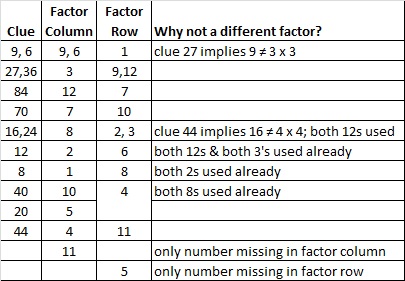
44 and Games again…

Mathematicsgames.wordpress.com that I’ve written about previously is part of the Mathematics, Learning, and Technology blog. This blog is a great resource for teachers, parents, and lovers of mathematics. I really appreciate Find the Factors being included in the post Games, again!

44 is a composite number. 44 = 1 x 44, 2 x 22, or 4 x 11. Factors of 44: 1, 2, 4, 11, 22, 44. Prime factorization: 44 = 2 x 2 x 11, which can also be written 2² x 11.

When 44 is a clue in the FIND THE FACTORS 1 -12 puzzles, always use 4 and 11 as the factors.

42 and A Topological Puzzle

42 is a composite number. 42 = 1 x 42, 2 x 21, 3 x 14, or 6 x 7. Factors of 42: 1, 2, 3, 6, 7, 14, 21, 42. Prime factorization: 42 = 2 x 3 x 7.

When 42 is a clue in the FIND THE FACTORS puzzles always use 6 and 7 as the factors.

I didn’t take Topology in college, but I knew people who did. It looked pretty fun.

Math and Science with My Kids shared a topological puzzle. It was interesting to read of his child’s frustration and eventual triumph. I learned something reading these, and you can too!


41 and Life Is Like A Sudoku Puzzle

  • 41 is a prime number.
  • Prime factorization: 41 is prime.
  • The exponent of prime number 41 is 1. Adding 1 to that exponent we get (1 + 1) = 2. Therefore 41 has exactly 2 factors.
  • Factors of 41: 1, 41
  • Factor pairs: 41 = 1 x 41
  • 41 has no square factors that allow its square root to be simplified. √41 ≈ 6.40312

How do we know that 41 is a prime number? If 41 were not a prime number, then it would be divisible by at least one prime number less than or equal to √41 ≈ 6.4. Since 41 cannot be divided evenly by 2, 3, or 5, we know that 41 is a prime number.

41 is never a clue in the FIND THE FACTORS puzzles.

I read an essay titled Life Is Like a Sudoku Puzzle. Typically the only Sudoku puzzles I do are in the newspaper, and it has been weeks since I’ve started one. If I mess up on one, I don’t try to figure out what I did wrong. I simply put a big x on it and throw the paper in the recycling bin. I accept defeat, but I really don’t learn anything from my mistake. But if I would look at those puzzles a little differently, I could learn a lot about life from them, just as that essay suggests.


40 and M.C. Escher

40 is a composite number. 40 = 1 x 40, 2 x 20, 4 x 10, or 5 x 8. Factors of 40: 1, 2, 4, 5, 8, 10, 20, 40. Prime factorization: 40 = 2 x 2 x 2 x 5, which can also be written 2³ x 5.

When 40 is a clue in the FIND THE FACTORS puzzles always use either 5 x 8 or 4 x 10. Only one of those combinations will work for any particular puzzle.

Today I share a blog post that was part of the 6-word challenge. I encourage other bloggers to accept the challenge on that post and send your finished product to the Figments of a DuTchess blog. Marion Driessen really will visit your blog if you do. She completed this beautiful jigsaw puzzle featuring the mathematically inspired artwork of M. C. Escher and relayed the challenge of putting it together using only six words!

39 and Seriously Hooked on Factoring

39 is a composite number. 39 = 1 x 39 or 3 x 13. Factors of 39: 1, 3, 13, 39. Prime factorization: 39 = 3 x 13.

39 is never a clue in the FIND THE FACTORS 1-10 or 1-12 puzzles.

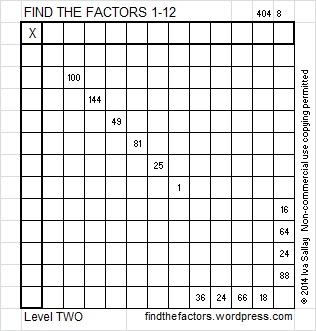
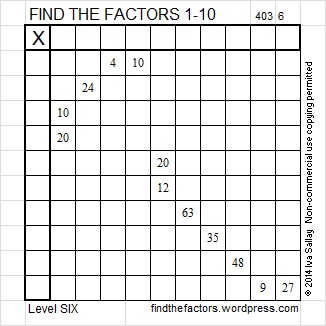
Last Tuesday I published a hook-shaped level 2 puzzle and invited readers to get hooked on factoring. Today I present a level 6 hook-shaped puzzle. Admittedly, one would have to be seriously hooked on factoring to attempt and eventually complete the more difficult level 6 puzzle. I assure you that it can be solved using logic with absolutely no guessing and checking.

2014-03 Level 6

This week’s puzzles are also available in an excel file here. If you have a spreadsheet program on your computer, you can access it. If you enable editing in excel, you can type your answers directly onto the puzzle, and you can also easily print the puzzles.

Here are the factors from last week’s level 6 snowball puzzle:

2014-02 Level 6 Answer

Below is a table showing one possible way to solve the snowball puzzle using logic alone.

2014-02 L6 steps

Seriously, study the clues for this week’s puzzle and see if you can figure out how to solve it using logic alone. Guessing and checking will most likely only frustrate you. Good luck!

38 and Factor Finding

38 is a composite number. 38 = 1 x 38 or 2 x 19. Factors of 38: 1, 2, 19, 38. Prime factorization: 38 = 2 x 19.

38 is never a clue in the FIND THE FACTORS puzzles.

One of my favorite bloggers wrote a post about the FIND THE FACTORS puzzles. I am thrilled to share what he wrote in his post Factor Finding!

37 and How Many Trapezoids I Can Draw

A trapezoid is often defined for young students as a four-sided shape with EXACTLY two parallel sides. Once a person studies higher level math, the definition changes: A trapezoid is a four-sided shape with AT LEAST two parallel sides. How many different kinds of trapezoids can a person draw? It depends on which definition you use. If you use the second definition, you can also include parallelograms, rectangles, rhombuses, and squares. Either definition will allow the standard isosceles trapezoid and several others. But how many? Whichever definition you use, figuring out how many different ones can be drawn is a nice puzzle to solve. NebusResearch’s blog post does a nice job explaining the different ones, and it even came up with ones I hadn’t considered!

Now I’ll share some facts about the number 37:

  • 37 is a prime number.
  • Prime factorization: 37 is prime.
  • The exponent of prime number 37 is 1. Adding 1 to that exponent we get (1 + 1) = 2. Therefore 37 has exactly 2 factors.
  • Factors of 37: 1, 37
  • Factor pairs: 37 = 1 x 37
  • 37 has no square factors that allow its square root to be simplified. √37 ≈ 6.08276

How do we know that 37 is a prime number? If 37 were not a prime number, then it would be divisible by at least one prime number less than or equal to √37 ≈ 6.1. Since 37 cannot be divided evenly by 2, 3, or 5, we know that 37 is a prime number.

37 is never a clue in the FIND THE FACTORS puzzles.

36 and The Six Word Challenge

36 is a composite number, and it is 6 squared. 36 = 1 x 36, 2 x 18, 3 x 12, 4 x 9, or 6 x 6. Factors of 36: 1, 2, 3, 4, 6, 9, 12, 18, 36. Prime factorization: 36 = 2 x 2 x 3 x 3, which can also be written 36 = 2² x 3².

Since √36 = 6, a whole number, 36 is a perfect square.

When 36 is a clue in the FIND THE FACTORS  1 – 10 puzzles, use either 4 x 9 or 6 x 6. When 36 is a clue in the FIND THE FACTORS 1 – 12 puzzles, use either 3 x 12, 4 x 9 or 6 x 6. Only one of those combinations will work for any particular puzzle.

I enjoy this multiplication rhyme: Six times six, magic tricks, abracadabra, thirty-six!

A fellow blogger issued a challenge for her readers to write a puzzling story or tell a story about a puzzle using exactly six words. I’m choosing to give puzzle directions today using these six words:

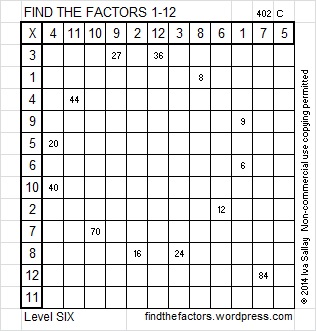
Without guessing, logically decide puzzle’s factors.

2014-03 Level 5

It was a fun challenge. Her blog has a 6-word story written by Ernest Hemingway as well as a few written by other bloggers.

This week’s puzzles are also available in an excel file here. If you have a spreadsheet program on your computer, you can access it. If you enable editing in excel, you can type your answers directly onto the puzzle, and you can also easily print the puzzles.

Here are the factors for last week’s level 5 snowflake puzzle:

2014-02 Level 5 Answer

There was more than one way to logically decide the snowflake puzzle’s factors. Some sets of clues needed to be avoided in the beginning: (18, 6) because both can be factored by 2, 3, and 6; (60, 40) because each can be factored by 5 and 10; and (16, 8) because both can be factored by 2, 4, and 8.

The column with 5 clues was a good place to start the puzzle after we narrowed down the common factor that would work for all the clues. The table below shows a way to find all the factors from 1 to 12 using logic without guessing and checking:

2014-02 L5 steps

Related article:

http://drieskewrites.wordpress.com/2014/01/22/six-word-story-challenge-puzzle/

35 and Pushing an Easy Button

35 is a composite number. 35 = 1 x 35 or 5 x 7. Factors of 35: 1, 5, 7, 35. Prime factorization: 35 = 5 x 7.

When 35 is a clue in the FIND THE FACTORS puzzles, always use 5 and 7 as the factors.

This week’s level 4 puzzle has a couple of easy clues (1 & 81) that will give you a good start solving the puzzle.

Some of the rest of the clues may still be a challenge, but sometimes, once you’ve started something, you’ve already done the hardest part.

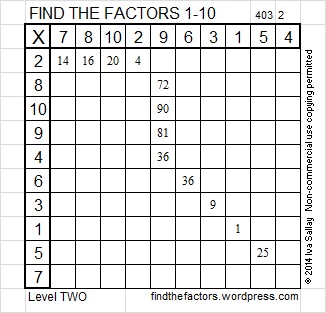
Can you write all the numbers from 1 to 10 in the top row and again in the first column so that the numbers you write become the factors of the given clues? There is only one solution. It’s easier if you use logic. It’s difficult and frustrating if you guess and check.

2014-03 Level 4

This week’s puzzles are also available in an excel file here. If you have a spreadsheet program on your computer, you can access it. If you enable editing in excel, you can type your answers directly onto the puzzle, and you can also easily print the puzzles.

Here are the factors for last week’s level 4 snow shovel puzzle:

2014-02 Level 4 Answers

Below is a chart showing the steps I used to solve this puzzle using logic. The chart states what was written in the factor column and the factor row for each clue or set of clues.

2014-02 L4 step by step

The puzzle could have been solved using the clues in a little different order. Try it!

The more puzzles you work on, the easier they will become, with or without an easy button!

34 and Step by Step Level 3

Level 3 puzzles are designed to be solved starting from a row or column at the top of the puzzle with 2 clues. First, find the common factor of those two clues that will allow you to write only numbers from 1 to 10 in the first column of the puzzle. Then factor row by row to the bottom of the puzzle making sure each number from 1 to 10 is written only once in both the factor row and the factor column. You will notice a rhythm for the answers as you work.

2014-03 Level 3

This week’s puzzles are also available in an excel file here. If you have a spreadsheet program on your computer, you can access it. If you enable editing in excel, you can type your answers directly onto the puzzle, and you can also easily print the puzzles.

Here is the solution to last week’s level 3 puzzle:

2014-02 Level 3 Answer

Since level 3 puzzles are designed to be solved from the top of the puzzle to the bottom, they are fairly easy to solve. I will not usually write step by step instructions for them, but I will today.

Last week’s puzzle was solved by beginning with the clues 28 and 36 because they are both in the same row. Their common factors are 1, 2, and 4. Choose 4 because it is the only common factor that will allow us to write only numbers 10 or less in the factor row. Below is a chart showing the steps IN ORDER that were used to solve this puzzle using logic. The chart states what to write in the factor column and the factor row for each clue.

2014-02 L3 steps

Just as a Find the Factor puzzle can be solved step by step, so can a 4 x 4 Magic Square:

34 is the magic sum of a 4 x 4 magic square. There are 880 ways times 8 different orientations to make a 4 x 4 square. I made a gif that shows one way. Look and you will see that half the numbers are in the correct positions right from the start:

4 x 4 Magic Squaremake science GIFs like this at MakeaGif

To find other 4 x 4 magic squares, try this method.

34 is a composite number. 34 = 1 x 34 or 2 x 17. Factors of 34: 1, 2, 17, 34. Prime factorization: 34 = 2 x 17.

34 is never a clue in the FIND THE FACTORS puzzles.