115 is a composite number. 115 = 1 x 115 or 5 x 23. Factors of 115: 1, 5, 23, 115. Prime factorization: 115 = 5 x 23.

115 is never a clue in the FIND THE FACTORS puzzles.

Excel file of puzzles and the previous week’s solutions: 12 Factors 2014-05-05

115 is a composite number. 115 = 1 x 115 or 5 x 23. Factors of 115: 1, 5, 23, 115. Prime factorization: 115 = 5 x 23.
115 is never a clue in the FIND THE FACTORS puzzles.
Excel file of puzzles and the previous week’s solutions: 12 Factors 2014-05-05
114 is a composite number. 114 = 1 x 114, 2 x 57, 3 x 38, or 6 x 19. Factors of 114: 1, 2, 3, 6, 19, 38, 57, 114. Prime factorization: 114 = 2 x 3 x 19.

114 is never a clue in the FIND THE FACTORS puzzles.
My recently married daughter and her husband will be moving to London in June where he will be employed by Medopad. In the meantime he has an assignment to get Likes on Medopad’s facebook page, so he is sponsoring a contest until May 22, 2014 for people living in the United States, Great Britian, or Germany for a $100 Visa gift card. To enter all you have to do is click the link below and follow the instructions. If you also invite your Facebook friends to like Medopad and they fill out the application, not only does it enter them in the contest, but it also increases YOUR chances of winning as well. If you live outside those 3 countries, you can still like Medopad’s facebook page and Medopad will contribute $5 for every new like towards a mHealth Impact Foundation that saves lives.

Click https://a.pgtb.me/Qx0cNZ to like. Visit www.medopad.com to learn more about this revolutionary company.

How do we know that 113 is a prime number? If 113 were not a prime number, then it would be divisible by at least one prime number less than or equal to √113 ≈ 10.6 Since 113 cannot be divided evenly by 2, 3, 5, or 7, we know that 113 is a prime number.
113 is never a clue in the FIND THE FACTORS puzzles.
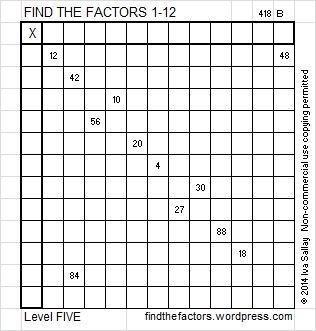
Excel file of puzzles and the previous week’s solutions: 12 Factors 2014-05-05
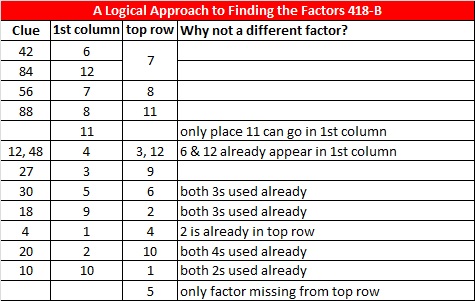
Some people get the factors of 54 and 56 mixed up. If you get them mixed up on this particular puzzle, you could still think you solved the puzzle correctly even if you haven’t. Here’s a couple of tricks that might prevent the mix-ups:
One of my favorite multiplication rhymes is “Five, Six, Seven, Eight, Fifty-Six is Seven Times Eight,” so 56 = 7 x 8.
Notice that 5 + 4 = 9. The sum of the digits of any multiple of 9 will always be 9 or another multiple of 9, so 54 = 9 x 6. On the other hand, 5 + 6 = 11, so 56 cannot have 9 as one of its factors.
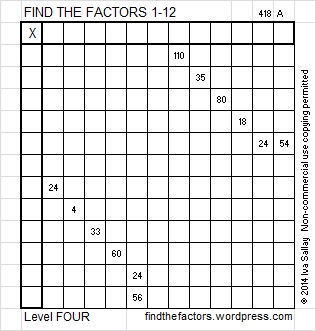
Excel file of six puzzles and the previous week’s solutions: 12 Factors 2014-05-05

112 is a composite number. 112 = 1 x 112, 2 x 56, 4 x 28, 7 x 16, or 8 x 14. Factors of 112: 1, 2, 4, 7, 8, 14, 16, 28, 56, 112. Prime factorization: 112 = 2 x 2 x 2 x 2 x 7, which can also be written 112 = 2⁴ x 7.

112 is never a clue in the FIND THE FACTORS puzzles.
24 is divisible by the sum of its digits and by the product of its digits. So too is 112. Is there a four-digit number with this property? A five-digit one? In general, for each count of digits, is there a number double divisible in this way? pic.twitter.com/PkruSSvx9K
— James Tanton (@jamestanton) March 21, 2021
In general, adults understand how to add and subtract one-digit numbers, and most adults also have learned how to count in at least one language other than their native language. Does that mean these adults can add and subtract in those other languages in which they have learned how to count? I am curious to know the answer to that question. Let me tell you how counting, adding, and subtracting in a foreign language work for me.
I studied Spanish for three years in High School. I remember doing some basic addition and subtraction problems back then. Even though I remember very little Spanish vocabulary, I can still add and subtract one-digit numbers in Spanish fairly well.
I studied German for one and a half years in college. I remember even less German than I remember Spanish. All of the number words LOOK familiar, but I failed miserably when I tried to add and subtract using German numbers.
I lived in Turkey for two years when my husband was stationed at İncirlik Air Base near Adana. I learned a bit of vocabulary and how to count in Turkish. I actually remember the Turkish numbers a little better than the German ones, but my ability to add and subtract in Turkish isn’t much better.

Now I am motivated to learn Hungarian. (I want to be able to understand my husband’s relatives better someday when I get to visit them in Hungary again.) The numbers in Hungarian are fresh in my mind, and I have even passed the time counting up to 1000 in Hungarian when I’ve gone for a walk.
When it came to doing basic addition or subtraction in Hungarian at this game site I found my ability to count did not help as much as I supposed. However, with PRACTICE, I have been able to greatly improve my ability to add and subtract in Hungarian.
After gaining the ability to add and subtract in Hungarian, I added another wrench to the process: I required myself to say complete number sentences in Hungarian instead of allowing English words like plus, minus, or equals to be used.From Hungarian Verbs & Essentials of Grammar, I learned that there are a few ways to say a number sentence when adding in Hungarian. The easiest two ways to say 4 + 3 = 7 are “Négy meg három (az) hét” or “Négy plusz három (az) hét.” Subtraction is a little more complicated because different numbers take two different case endings, ból or ből, in order to maintain vowel harmony. 10 – 4 = 6 is “Tízből négy az hat.” while 6 – 2 = 4 is “Hatból kettő az négy.”
Requiring myself to use complete Hungarian sentences has made me a little slower, and sometimes the hourglass empties before I click next to the correct number word. However, with PRACTICE I am getting better, and I will move on to the number games that use numbers up to 20 and 100 very soon.
This activity reinforces my belief that practice really does make a difference. I can see the merits of children practicing basic number facts in English or any other language they can speak. The FIND THE FACTORS puzzles are an excellent way for people of all ages to practice basic multiplication and division facts.
If you would like to see how well you can add and subtract using these learning games in other languages go to http://www.digitaldialects.com/.
Select one of the 70 available languages (listed in alphabetical order from left to right), select Numbers 1 -12, and begin the adding and subtracting game in the chosen language. I would love to know how well you do, so try it and leave a comment if your results don’t embarrass you too much!
Now I’ll tell you a little bit about the number 111:
111 is a composite number. 111 = 1 x 111 or 3 x 37. Factors of 111: 1, 3, 37, 111. Prime Factorization: 111 = 3 x 37.

111 is never a clue in the FIND THE FACTORS puzzles.
111 = (1 + 2 + 3 + . . . + 35 +36)/6, which can be more easily calculated by using 111 = (36 x 37)/(2 x 6). Therefore, 111 is the magic sum of any 6 x 6 magic square that contains all the integers from 1 to 36.

110 is a composite number. 110 = 1 x 110, 2 x 55, 5 x 22, or 10 x 11. Factors of 110: 1, 2, 5, 10, 11, 22, 55, 110. Prime factorization: 110 = 2 x 5 x 11.

When 110 is a clue in the FIND THE FACTORS 1 – 12 puzzles, use 10 and 11 as the factors.

Excel file of puzzles and the previous week’s solutions: 12 Factors 2014-05-05
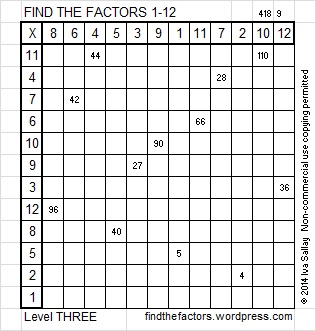
A Logical Approach to FIND THE FACTORS: Find the column or row with two clues and find their common factor. Write the corresponding factors in the factor column (1st column) and factor row (top row). Because this is a level three puzzle, you have now written a factor at the top of the factor column. Continue to work from the top of the factor column to the bottom, finding factors and filling in the factor column and the factor row one cell at a time as you go:

How do we know that 109 is a prime number? If 109 were not a prime number, then it would be divisible by at least one prime number less than or equal to √109 ≈ 10.4 Since 109 cannot be divided evenly by 2, 3, 5, or 7, we know that 109 is a prime number.
109 is never a clue in the FIND THE FACTORS puzzles.
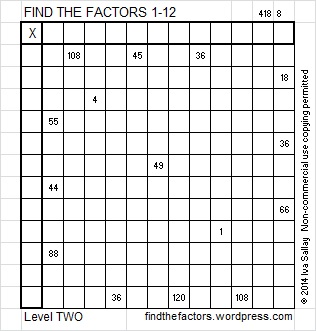
This week’s puzzles and last weeks solutions: 12 Factors 2014-05-05

108 is a composite number. 108 = 1 x 10⁸, 2 x 54, 3 x 36, 4 x 27, 6 x 18, or 9 x 12. Factors of 108: 1, 2, 3, 4, 6, 9, 12, 18, 27, 36, 54, 108. Prime factorization: 108 = 2 x 2 x 3 x 3 x 3, which can also be written 108 = 2² x 3³

When 108 is a clue in the FIND THE FACTORS 1 – 12 puzzles, use 9 and 12 as the factors.

This week’s puzzles and last weeks solutions: 12 Factors 2014-05-05


How do we know that 107 is a prime number? If 107 were not a prime number, then it would be divisible by at least one prime number less than or equal to √107 ≈ 10.3 Since 107 cannot be divided evenly by 2, 3, 5, or 7, we know that 107 is a prime number.
107 is never a clue in the FIND THE FACTORS puzzles.
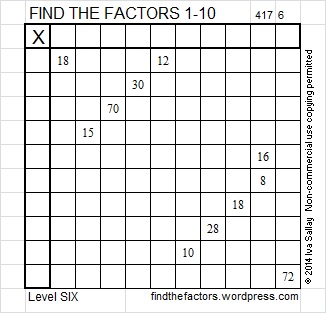
This week’s puzzles and last week’s solutions: 10 Factors 2014-04-28

106 is a composite number. 106 = 1 x 10⁶ or 2 x 53. Factors of 106: 1, 2, 53, 106. Prime factorization: 106 = 2 x 53.

106 is never a clue in the FIND THE FACTORS puzzles.

This week’s puzzles and last week’s solutions: 10 Factors 2014-04-28
