622 and Level 1

Can 622 be written as the sum of consecutive numbers?

622 is greater than 6 and is divisible by 2, but not by 4, thus it can be expressed as the sum of 4 consecutive numbers:

154 + 155 + 156 + 157 = 622

622  is the sum of the sixteen prime numbers from 11 to 71.

622 Puzzle

Print the puzzles or type the solution on this excel file: 12 Factors 2015-09-21

—————————————————————————————————

  • 622 is a composite number.
  • Prime factorization: 622 = 2 x 311
  • The exponents in the prime factorization are 1 and 1. Adding one to each and multiplying we get (1 + 1)(1 + 1) = 2 x 2 = 4. Therefore 622 has exactly 4 factors.
  • Factors of 622: 1, 2, 311, 622
  • Factor pairs: 622 = 1 x 622 or 2 x 311
  • 622 has no square factors that allow its square root to be simplified. √622 ≈ 24.9399.

—————————————————————————————————

622 Factors


621 and Level 6

Since 23 x 27 = 621, and both of those factors are 2 away from their average, 25, we know that 621 is only 2^2 numbers away from 25^2. Mathematically we write (25-2)(25+2 ) = (25^2) – (2^2) or 23 x 27 = 625 – 4 = 621.

621 is sandwiched between 595 and 630, the 34th and the 35th triangular numbers. It can be written as the sum of consecutive numbers 7 different ways. The numbers in bold are in the exact middle of each sum. What is the relationship between the numbers in bold and the amount of numbers in the sums?

  1. 310 + 311 = 621 ( 2 consecutive numbers because 621 is divisible by 1, but not by 2)
  2. 206 + 207 + 208 = 621 (3 consecutive numbers because it is divisible by 3)
  3. 101 + 102 + 103 + 104 + 105 + 106 + 107 = 621 (6 consecutive numbers because it is divisible by 3, but not by 2)
  4. 65 + 66 + 67 + 68 + 69 + 70 + 71 + 72 + 73 = 621 (9 consecutive numbers because it is divisible by 9)
  5. 26 + 27 + 28 + 29 + 30 + 31 + 32 + 33 + 34 + 35 + 36 + 37 + 38 + 39 + 40 + 41 + 42 + 43 = 621 (18 consecutive numbers because it is divisible by 9, but not by 2)
  6. 16 + 17 + 18 + 19 + 20 + 21 + 22 + 23 + 24 + 25 + 26 + 27 + 28 + 29 + 30 + 31 + 32 + 33 + 34 + 35 + 36 + 37 + 38 = 621 (23 consecutive numbers because it is divisible by 23)
  7. 10 + 11 + 12 + 13 + 14 + 15 + 16 + 17 + 18 + 19 + 20 + 21 + 22 + 23 + 24 + 25 + 26 + 27 + 28 + 29 + 30 + 31 + 32 + 33 + 34 + 35 + 36 = 621 (27 consecutive numbers because it is divisible by 27)

621 Puzzle

Print the puzzles or type the solution on this excel file: 10 Factors 2015-09-14

—————————————————————————————————

  • 621 is a composite number.
  • Prime factorization: 621 = 3 x 3 x 3 x 23, which can be written 621 = (3^3) x 23
  • The exponents in the prime factorization are 3 and 1. Adding one to each and multiplying we get (3 + 1)(1 + 1) = 4 x 2 = 8. Therefore 621 has exactly 8 factors.
  • Factors of 621: 1, 3, 9, 23, 27, 69, 207, 621
  • Factor pairs: 621 = 1 x 621, 3 x 207, 9 x 69, or 23 x 27
  • Taking the factor pair with the largest square number factor, we get √621 = (√9)(√69) = 3√69 ≈ 24.91987.

—————————————————————————————————

621 Logic

620 and Level 5

620 is the sum of the four prime numbers from 149 to 163, and it is also the sum of the eight prime numbers from 61 to 97.

620 is the hypotenuse of the Pythagorean triple 372-496-620. What is the greatest common factor of those three numbers?

Today’s puzzle may be a little more difficult than most Level 5 puzzles, but go ahead, embrace the challenge!

620 Puzzle

Print the puzzles or type the solution on this excel file: 10 Factors 2015-09-14

—————————————————————————————————

  • 620 is a composite number.
  • Prime factorization: 620 = 2 x 2 x 5 x 31, which can be written 620 = (2^2) x 5 x 31
  • The exponents in the prime factorization are 2, 1, and 1. Adding one to each and multiplying we get (2 + 1)(1 + 1)(1 + 1) = 3 x 2 x 2 = 12. Therefore 620 has exactly 12 factors.
  • Factors of 620: 1, 2, 4, 5, 10, 20, 31, 62, 124, 155, 310, 620
  • Factor pairs: 620 = 1 x 620, 2 x 310, 4 x 155, 5 x 124, 10 x 62, or 20 x 31
  • Taking the factor pair with the largest square number factor, we get √620 = (√4)(√155) = 2√155 ≈ 24.899799

—————————————————————————————————

620 Logic


619 and Level 4

619  is the 12th strobogrammatic number because it looks like the same number when it is turned upside down. The first 4 strobogrammatic prime numbers are 11, 101, 181, and 619.

619 Puzzle

Print the puzzles or type the solution on this excel file: 10 Factors 2015-09-14

—————————————————————————————————

  • 619 is a prime number.
  • Prime factorization: 619 is prime.
  • The exponent of prime number 619 is 1. Adding 1 to that exponent we get (1 + 1) = 2. Therefore 619 has exactly 2 factors.
  • Factors of 619: 1, 619
  • Factor pairs: 619 = 1 x 619
  • 619 has no square factors that allow its square root to be simplified. √619 ≈ 24.87971.

How do we know that 619 is a prime number? If 619 were not a prime number, then it would be divisible by at least one prime number less than or equal to √619 ≈ 24.9. Since 619 cannot be divided evenly by 2, 3, 5, 7, 11, 13, 17, 19, or 23, we know that 619 is a prime number.

—————————————————————————————————

619 Logic


618 and Level 3

618 is even so it is obviously divisible by 2. Is it divisible by 3?

Yes, 618 has the same digits as 16 & 8. Since 16 is 8 doubled, 618 is divisible by 3.

618  is the sum of consecutive prime numbers 307 and 311.

618 can be written as the sum of 4 consecutive numbers because 618 is greater than 6 and is divisible by 2, but not by 4. Thus 153 + 154 + 155 + 156 = 618.

618 Puzzle

Print the puzzles or type the solution on this excel file: 10 Factors 2015-09-14

—————————————————————————————————

  • 618 is a composite number.
  • Prime factorization: 618 = 2 x 3 x 103
  • The exponents in the prime factorization are 1, 1, and 1. Adding one to each and multiplying we get (1 + 1)(1 + 1)(1 + 1) = 2 x 2 x 2 = 8. Therefore 618 has exactly 8 factors.
  • Factors of 618: 1, 2, 3, 6, 103, 206, 309, 618
  • Factor pairs: 618 = 1 x 618, 2 x 309, 3 x 206, or 6 x 10³
  • 618 has no square factors that allow its square root to be simplified. √618 ≈ 24.8596.

—————————————————————————————————

A Logical Approach to solve a FIND THE FACTORS puzzle: Find the column or row with two clues and find their common factor. (None of the factors are greater than 10.)  Write the corresponding factors in the factor column (1st column) and factor row (top row).  Because this is a level three puzzle, you have now written a factor at the top of the factor column. Continue to work from the top of the factor column to the bottom, finding factors and filling in the factor column and the factor row one cell at a time as you go.

618 Factors

617 Do You See a Pattern?

If you divide any even square number by 4, there will be no remainder.

If you divide any odd square number by 4, the remainder is always 1.

So if you add an even square number to an odd square number and divide the sum by 4, the remainder will ALWAYS be 1.

If you get a remainder of 1 when you divide a prime number by 4, it will ALWAYS be the sum of two squares. If you get a remainder of 1 when you divide a composite number by 4, it MIGHT be the sum of two squares.  (Note: If the last 2 digits of a number is divisible by 4, then the entire number is divisible by 4. The same thing can be said about remainders when dividing by 4.)

The last two digits of 617 yield a remainder of 1 when they are divided by 4, so 617 is a candidate for being the sum of two squares. To find out if it is, I wrote out all the square numbers less than 617:

1, 4, 9, 16, 25, 36, 49, 64, 81, 100, 121, 144, 169, 196, 225, 256, 289, 324, 361, 400, 441, 484, 529, and 576.

Then I calculated 617 – 1 – 3 – 5 – 7 – 9 – 11 – 13 – 15 – 17 – 19 – 21 – 23 – 25 – 27 – 29 – 31, and stopped there because 361 or 19^2 appeared on the calculator screen.

Since (31 + 1)/2 = 16, I knew that 19² + 16² = 617.

Having recently seen that 18² + 17² = 613, I was surprised. The difference between 18 and 17 is one, the difference between 19 and 16 is three, and the difference between 617 and 613 is four. I immediately thought of some multiplication facts:

  • 7 x 8 = 56
  • 6 x 9 = 54     (Note: 56 – 54 = 2)
  • 5 x 10 = 50   (54 – 50 = 4)
  • 4 x 11 = 44    (50 – 44 = 6)
  • 3 x 12 = 36    (44 – 36 = 8)

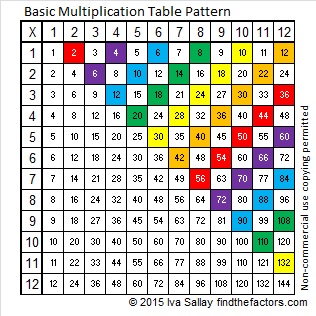
In the standard multiplication table these facts can be seen on a single diagonal. The facts above have been highlighted in red. (The table is symmetrical so the diagonal actually extends in both directions.)

Basic Multiplication Table Pattern

If we look at the orange diagonal on the multiplication table above, we see 42, 40, 36, 30, 22, and 12. The differences between each consecutive member in that set are 2, 4, 6, 8, and 10. No matter which diagonal we choose the differences in the numbers follow that same pattern.

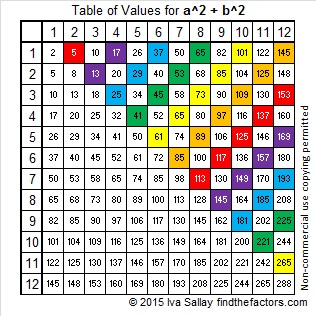
I asked myself, “Would there be a similar pattern if instead of multiplying two numbers together, we added their squares?” Let’s look at this table and see:

Table of values for sum of two squares

On the orange diagonal we see 85, 89, 97, 109, 125, and 145. The differences between each consecutive member in this set are 4,  8, 12, 16, and 20. No matter which diagonal we choose the differences in the numbers will follow that same pattern.

Both of these tables can be extended infinitely in two directions and the patterns will hold true even for numbers on a diagonal that aren’t visible on a 12 x 12 table. For example, here are the numbers for the tables for such a diagonal.

Difference between numbers in set for 2 operations

There is even an odd and rather square relationship between the product a x b and the sum a² + b²:

  • (306 x 2) + 1 = 613
  • (304 x 2) + 9 = 617
  • (300 x 2) + 25 = 625
  • (294 x 2) + 49 = 637
  • (286 x 2) + 81 = 653
  • (276 x 2) + 121 = 673 and so forth

So I ask again, Do you see a pattern? Mathematics is filled with them!

—————————————————————————————————

617 is the sum of the five prime numbers from 109 to 137

As mentioned previously 617 is the sum of two square numbers, specifically 19² + 16².

617 is the hypotenuse of the primitive Pythagorean triple 105-608-617 which was calculated using 19² – 16², 2(19)(16), and 19² + 16².

I learned from OEIS.org that 1!² + 2!² + 3!² + 4!² = 617.

—————————————————————————————————

  • 617 is a prime number.
  • Prime factorization: 617 is prime.
  • The exponent of prime number 617 is 1. Adding 1 to that exponent we get (1 + 1) = 2. Therefore 617 has exactly 2 factors.
  • Factors of 617: 1, 617
  • Factor pairs: 617 = 1 x 617
  • 617 has no square factors that allow its square root to be simplified. √617 ≈ 24.83948.

How do we know that 617 is a prime number? If 617 were not a prime number, then it would be divisible by at least one prime number less than or equal to √617 ≈ 24.8. Since 617 cannot be divided evenly by 2, 3, 5, 7, 11, 13, 17, 19, or 23, we know that 617 is a prime number.

Here’s another way we know that 617 is a prime number: Since 19² + 16² = 617, an odd number, and 19 and 16 have no common prime factors, we know that 617 will be a prime number unless it is divisible by 5, 13, or 17. We can tell just by looking at it that it isn’t divisible by 5 or 17, but we will have to do the division to see if it is divisible by 13. Since 617 ÷ 13 = 47 R6, it cannot be evenly divided by 13, and thus we know that 617 is a prime number.

616 and Level 2

The Padovan sequence produces a lovely spiral of equilateral triangles similar to the spiral made from golden rectangles and the Fibonacci sequence.

The Padovan sequence begins with the following numbers: 1, 1, 1, 2, 2, 3, 4, 5, 7, 9, 12, 16, 21, 28, 37, 49, 65, 86, 114, 151, 200, 265, 351, 465, 616, 816, 1081 …

The first two numbers in the Fibonacci sequence are both 1’s. After that a number, n, in the Fibonacci sequence is found by adding together (n-2) and (n-1).

The first three numbers in the Padovan sequence are all 1’s. After that a number, n, in the Padovan sequence is found by adding together (n-3) and (n-2), and 616 is one of those numbers.

616 Puzzle

Print the puzzles or type the solution on this excel file: 10 Factors 2015-09-14

—————————————————————————————————

  • 616 is a composite number.
  • Prime factorization: 616 = 2 x 2 x 2 x 7 x 11, which can be written 616 = (2^3) x 7 x 11
  • The exponents in the prime factorization are 1, 3, and 1. Adding one to each and multiplying we get (3 + 1)(1 + 1)(1 + 1) = 4 x 2 x 2 = 16. Therefore 616 has exactly 16 factors.
  • Factors of 616: 1, 2, 4, 7, 8, 11, 14, 22, 28, 44, 56, 77, 88, 154, 308, 616
  • Factor pairs: 616 = 1 x 616, 2 x 308, 4 x 154, 7 x 88, 8 x 77, 11 x 56, 14 x 44, or 22 x 28
  • Taking the factor pair with the largest square number factor, we get √616 = (√4)(√154) = 2√154 ≈ 24.819347.

—————————————————————————————————

616 Factors


615 and Level 1

615 is the hypotenuse of four Pythagorean triples. Can you find the greatest common factor for each triple?

  • 135-600-615
  • 252-561-615
  • 369-492-615
  • 399-468-615

615 Puzzle

Print the puzzles or type the solution on this excel file: 10 Factors 2015-09-14

—————————————————————————————————

  • 615 is a composite number.
  • Prime factorization: 615 = 3 x 5 x 41
  • The exponents in the prime factorization are 1, 1, and 1. Adding one to each and multiplying we get (1 + 1)(1 + 1)(1 + 1) = 2 x 2 x 2 = 8. Therefore 615 has exactly 8 factors.
  • Factors of 615: 1, 3, 5, 15, 41, 123, 205, 615
  • Factor pairs: 615 = 1 x 615, 3 x 205, 5 x 123, or 15 x 41
  • 615 has no square factors that allow its square root to be simplified. √615 ≈ 24.79919.

—————————————————————————————————

615 Factors

614 and Level 6

I learned from OEIS.org that 614 is the smallest integer that can be expressed as the sum of 3 squares 9 different ways. I decided to see if I could find those 9 ways. Here they are:

614 is the sum of 3 squares 9 different ways

614 Puzzle

Print the puzzles or type the solution on this excel file: 12 Factors 2015-09-07

—————————————————————————————————

  • 614 is a composite number.
  • Prime factorization: 614 = 2 x 307
  • The exponents in the prime factorization are 1 and 1. Adding one to each and multiplying we get (1 + 1)(1 + 1) = 2 x 2 = 4. Therefore 614 has exactly 4 factors.
  • Factors of 614: 1, 2, 307, 614
  • Factor pairs: 614 = 1 x 614 or 2 x 307
  • 614 has no square factors that allow its square root to be simplified. √614 ≈ 24.77902

—————————————————————————————————

614 Logic

I can tell that 613 is a prime number just by looking at it!

613 is the 18th centered square number because 17 and 18 are consecutive numbers and 18² + 17² = 613.

613 Centered Square Number

613 is the hypotenuse of the primitive Pythagorean triple 35-612-613, which was calculated using (18^2) – (17^2), 2 x 17 x 18, and (18^2) + (17^2).

Knowing that (18^2) + (17^2) = 613, I can tell that 613 is a prime number just by looking at it! Here’s what I see:

  • 613 obviously is not divisible by 5.
  • It is almost as obvious that 613 is not divisible by 13.
  • 18^2 is not divisible by 17 so (18^2) + (17^2) is not divisible by 17. Thus 613 is not divisible by 17.
  • Since 613 is not divisible by 5, 13, or 17, it is a prime number.

“What?” you say. What about all the other possible prime factors less than 24.8, the approximate value of √613? Don’t we need to TRY to divide 613 by 2, 3, 7, 11, 19, and 23?

No, we don’t. Those numbers don’t matter at all. Since 17^2 + 18^2 = 613, and because 17 and 18 have NO common prime factors and only one of them is odd, I already know that none of those numbers will divide into 613. Let me show you what I mean.

Look at this chart of ALL the primitive Pythagorean triple hypotenuses less than 1000:

Primitive Pythagorean Triple Hypotenuses Less Than 1000

The numbers in red are all prime numbers and appear on the chart only one time. Every prime number less than 1000 that can be written in the form 4N + 1 appears somewhere on the chart. 613 can be found at the intersection of the column under 17 and the row labeled 18.

The black numbers on the colorful squares are composite numbers and many of them appear on the chart above more than one time. There is something very interesting about the prime factors of these composite numbers. Every single one of those factors is also the hypotenuse of a primitive Pythagorean triple! Also notice that at least one of those factors is less than or equal to the square root of the composite number. Here is a chart of those composite numbers, how many times they appear on the chart above, and their prime factorizations:

Composite Primitive Pythagorean Triple Hypotenuses and Their Factors

Also notice that if you divide any of the above composite numbers OR their factors by 4, the remainder is always 1.

I have demonstrated that the following is true for any integer less than 1000. I wasn’t sure if it had been proven for integers in general so I asked Gordan Savin, a professor at the University of Utah, who teaches number theory. He informed me that it has been proven and that it follows from the uniqueness of factorization of Gaussian integers.

In conclusion, if an integer can be written as the sum of two squares, one odd and one even, and the numbers being squared have no common prime factors, then ALL the factors of that odd integer will be hypotenuses of primitive Pythagorean triples. If the integer is a composite number, at least one of those primitive hypotenuses will be less than or equal to the square root of that integer.

Here’s the same thing in more standard mathematical language:

If a natural number of the form 4N + 1 can be written as the sum of two squares (a^2)+ (b^2) and if a and b have no common prime factors, then ALL the factors of 4N + 1 will be of the form 4n + 1. If 4N + 1 is a composite number, there will exist at least one prime factor, 4n + 1 ≤  √(4N + 1). If no such factor exists, then 4N + 1 is a prime number.

  • 613 is a prime number.
  • Prime factorization: 613 is prime.
  • The exponent of prime number 613 is 1. Adding 1 to that exponent we get (1 + 1) = 2. Therefore 613 has exactly 2 factors.
  • Factors of 613: 1, 613
  • Factor pairs: 613 = 1 x 613
  • 613 has no square factors that allow its square root to be simplified. √613 ≈ 24.7588

How do we know that 613 is a prime number? If 613 were not a prime number, then it would be divisible by at least one prime number less than or equal to √613 ≈ 24.8. Since 613 cannot be divided evenly by 2, 3, 5, 7, 11, 13, 17, 19, or 23, we know that 613 is a prime number. But as I explained above since (18^2) + (17^2) = 613, and consecutive integers 18 and 17 have no common prime factors, it is only necessary to check to see if 613 is divisible by 5, 13, or 17. Since it isn’t divisible by any of those three numbers, 613 is a prime number.