64 and Can You See the Logic Here?

64 is a composite number, and it is 8 squared. 64 = 1 x 64, 2 x 32, 4 x 16, or 8 x 8. Factors of 64: 1, 2, 4, 8, 16, 32, 64. Prime factorization: 64 = 2 x 2 x 2 x 2 x 2 x 2, which can also be written 64 = 2⁶.

Since √64 = 8, a whole number, 64 is a perfect square.

Sometimes 64 is a clue in the FIND THE FACTORS puzzles. Even though it has other factors, when it is a clue, the factors are always 8 x 8.

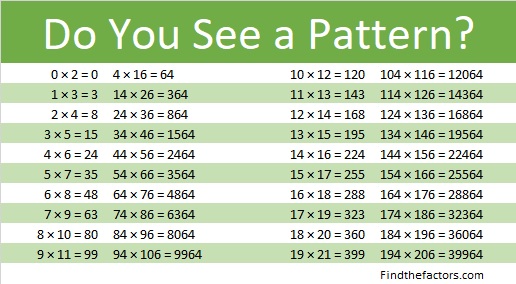
64 is in this cool pattern:

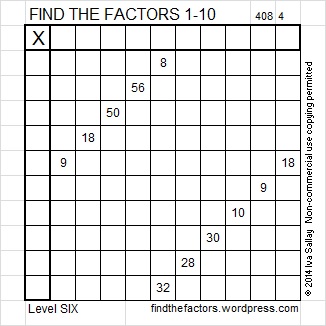
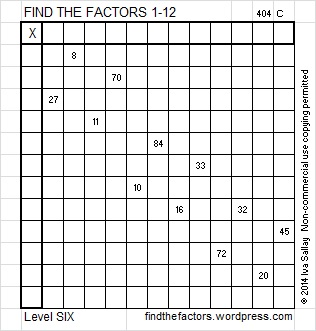
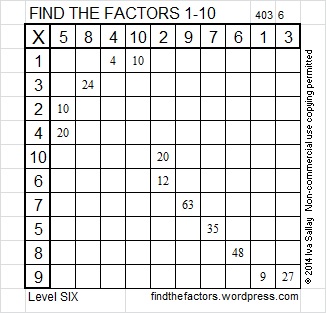
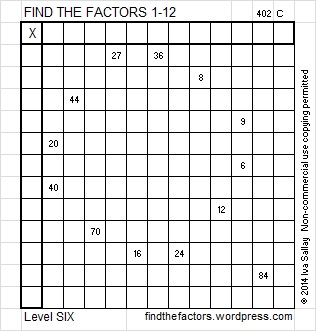
2014-08 Level 6

All Previously Published Puzzles

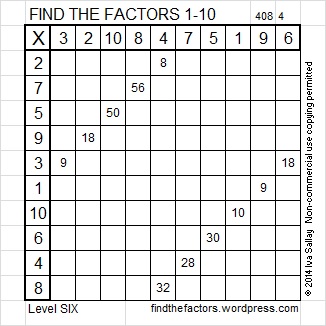
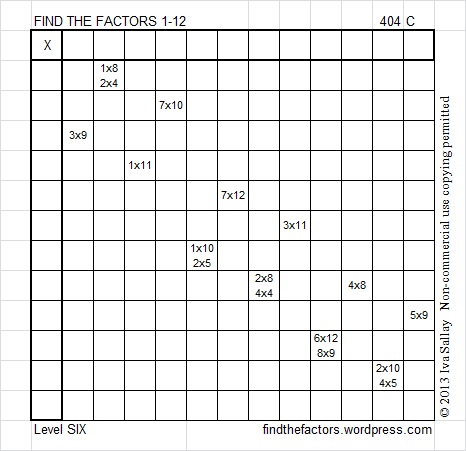
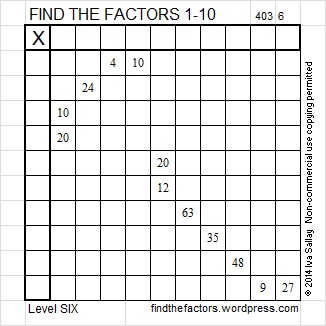
2014-08 Level 6 Answer

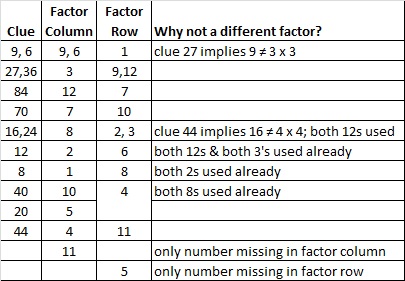
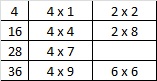
This solution is complicated, but here is a logical explanation:

There are only two 3s available, so at most one 9 can be 3 x 3.

Can both 9s be 9 x 1? If both were, then both 1s would be used, leaving 8 = 2 x 4 and 10 = 2 x 5 as the only possibilities for 8 and 10. But if both 9s were 9 x 1, then the 18 in the same row as the 9 would have to be 18 = 9 x 2, and that would use too many twos. Therefore, EXACTLY ONE of the nines can use 9 = 9 x 1.

Since one 9 = 3 x 3, using both 3s, 30 must equal 5 x 6. And since both 30 and 50 must use both 5s, 10 must equal 10 x 1.

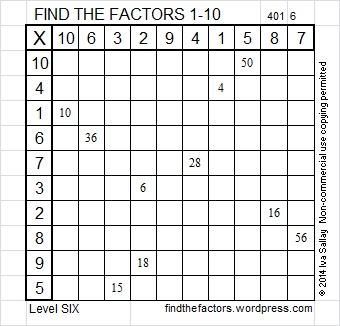
Since 10 = 10 x 1 and a 9 = 9 x 1, 8 must equal 2 x 4. So now finally we can begin filling out the puzzle:

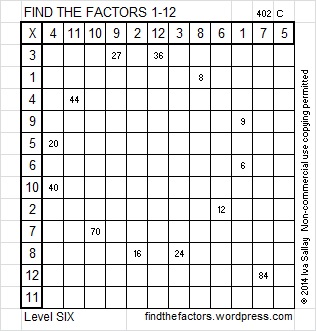
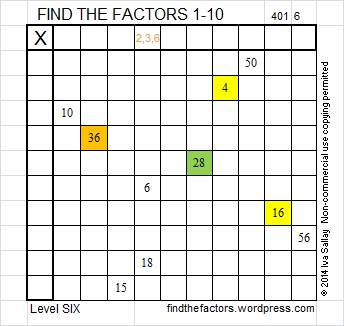
2014-08 Level 6 Logic

63 and Twelve Quick Clues

63 is a composite number. 63 = 1 x 63, 3 x 21, or 7 x 9. Factors of 63: 1, 3, 7, 9, 21, 63. Prime factorization: 63 = 3 x 3 x 7, which can also be written 63 = 3² x 7.

Sometimes 63 is a clue in the FIND THE FACTORS puzzles. Even though it has other factors, the only multiplication fact we use is 7 x 9 = 63.

2014-07 Level 6

All Previously Published Puzzles

2014-07 steps

62 and Love: Challenging But Worth It

62 is a composite number. 62 = 1 x 62 or 2 x 31. Factors of 62: 1, 2, 31, 62. Prime factorization: 62 = 2 x 31.

62 is never a clue in the FIND THE FACTORS puzzles.

valentine 2014

All Previously Published Puzzles

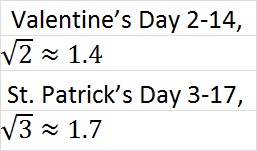
square root mems


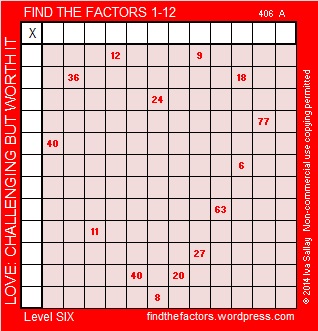
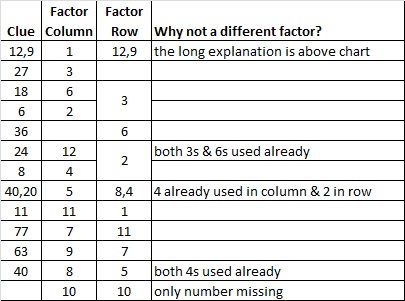
Here is the logic to solve the puzzle & a chart showing one way to get the solution:

9 has to be the factor of both the 27 and the 63.  Therefore 3 x 6 = 18, (not 2 x 9).

3 is one of the factors of both the 18 and the 27.  Therefore 9 x 1 = 9, (not 3 x 3).

Valentine 2014 steps


60 and Pay No Attention to That Man Behind the Curtain

Today’s Puzzle:

When solving a level 6 puzzle, trying to place the numbers from 1 to 10 in the top row as well as the first column can be frustrating. Every single clue appears to have more than one possible answer. How can someone guess right with every single number placement? Is seeing the answer the only way to solve the puzzle?

Here is this week’s level 6 puzzle. Usually, to solve a puzzle, you start with a row or column with 2 clues.  There are 6 rows or columns with more than one clue, and every one of them is no help!

2014-05 Level 6

You can also find this and a few other puzzles in an excel file here. If you have a spreadsheet program on your computer, you can access it. If you enable editing in excel, you can type your answers directly onto the puzzle, and you can also easily print the puzzles.

A Peek at the Possible Factors for Each of Last Week’s Clues:

“Pay no attention to the that man behind the curtain!” is a famous line from The Wizard of Oz.  Everyone in Oz thought the Wizard was powerful enough to solve any problem. When Dorthy and her friends looked behind the curtain they discovered that he was really an ordinary man who was able to find an advantage in what other people didn’t know. It turns out that other people actually had the abilities they thought only the Wizard had. Today we will take a peek behind the curtain of a level 6 puzzle and discover that it really isn’t as intimidating as we might imagine and that you have the ability to solve such a puzzle, too. This is what last week’s level 6 puzzle looks like from behind the curtain: 2014-04 Level 6 Hint Many people try to start with the row that contains the clue 4 x 8 = 32. (When I solve this puzzle, that row is actually the one I FINISH with!) Instead, look at the row with no clues. If you study all the clues in the puzzle, you will notice that 6 is listed as a factor only once. If there were a clue in the row without any clues, that clue would be a multiple of 6. That hint will keep you going for several clues. It also eliminates 8 as a possible factor of 72 and ensures that 1 x 8, not 2 x 4, must be used for the clue 8. This means that 2 x 5, not 1 x 10, must be used for the clue 10 because both ones will have been used. That means that 2 x 10, not 4 x 5, must be used for the clue 20 because the number 10 has to be used as a factor twice. Here is the completed puzzle: 2014-04 Level 6 Answer

Factors of 60:

60 is a composite number. 60 = 1 x 60, 2 x 30, 3 x 20, 4 x 15, 5 x 12, or 6 x 10. Factors of 60: 1, 2, 3, 4, 5, 6, 10, 12, 15, 20, 30, 60. Prime factorization: 60 = 2 x 2 x 3 x 5, which can also be written 60 = 2² x 3 x 5.

Sometimes 60 is a clue in the FIND THE FACTORS puzzles. Even though it has many other factors, we only use 6 x 10 for the FIND THE FACTORS 1-10 puzzles and 6 x 10 or 5 x 12 for the FIND THE FACTORS 1-12 puzzles.

Sum-Difference Puzzle:

60 has six factor pairs. One of those factor pairs adds up to 17, and another one subtracts to 17. If you can identify those factor pairs, then you can solve this puzzle:


54 and How Many Squares Are in This Puzzle?

How Many Squares?

How many squares are in this puzzle? Finding that answer is too tedious for me to pursue. There is 1 square that is bigger than all the rest, 169 of the smallest size squares, and some different number between 1 and 169 for each size square in between. Also, I think the clues seem to form three little squares, and one of the clues, 16, happens to be a perfect square. It’s a trick question, and most people don’t like trick questions!

Solving the actual puzzle will actually be less work and more fun. The actual puzzle challenges you to write the numbers 1 through 12 in the top row and again in the first column so that the answers you write and the clues inside the puzzle work together as a multiplication table. Use logic to find the unique solution to the puzzle. 2014-04 Level 6 This week’s puzzles are available in an excel file here. If you have a spreadsheet program on your computer, you can access it. If you enable editing in excel, you can type your answers directly onto the puzzle, and you can also easily print the puzzles.

Factors of 54:

54 is a composite number. 54 = 1 x 54, 2 x 27, 3 x 18, or 6 x 9. Factors of 54: 1, 2, 3, 6, 9, 18, 27, 54. Prime factorization: 54 = 2 x 3 x 3 x 3, which can also be written 2 x 3³.

Sometimes 54 is a clue in the FIND THE FACTORS puzzles. Even though it has other factors, the only multiplication fact the puzzle uses is 6 x 9 = 54.

Sum-Difference Puzzle:

The number 6 has two factor pairs. One of those factor pairs adds up to 5, and the other one subtracts to 5. Can you put those factors in the correct places in the first puzzle?

The number 54 has four factor pairs. One of those factor pairs adds up to 15, and another one subtracts to 15. If you can identify those factor pairs, then you can solve the second puzzle.

The second puzzle is really just the first puzzle in disguise. Why would I say that?

Solution to Last Week’s Level 6 Puzzle:

2014-03 Level 6 Answer

Here is one way those factors can be found using logic.

2014-03 L-6 steps

39 and Seriously Hooked on Factoring

39 is a composite number. 39 = 1 x 39 or 3 x 13. Factors of 39: 1, 3, 13, 39. Prime factorization: 39 = 3 x 13.

39 is never a clue in the FIND THE FACTORS 1-10 or 1-12 puzzles.

Last Tuesday I published a hook-shaped level 2 puzzle and invited readers to get hooked on factoring. Today I present a level 6 hook-shaped puzzle. Admittedly, one would have to be seriously hooked on factoring to attempt and eventually complete the more difficult level 6 puzzle. I assure you that it can be solved using logic with absolutely no guessing and checking.

2014-03 Level 6

This week’s puzzles are also available in an excel file here. If you have a spreadsheet program on your computer, you can access it. If you enable editing in excel, you can type your answers directly onto the puzzle, and you can also easily print the puzzles.

Here are the factors from last week’s level 6 snowball puzzle:

2014-02 Level 6 Answer

Below is a table showing one possible way to solve the snowball puzzle using logic alone.

2014-02 L6 steps

Seriously, study the clues for this week’s puzzle and see if you can figure out how to solve it using logic alone. Guessing and checking will most likely only frustrate you. Good luck!

29 and A Level 6 Snowball

  • 29 is a prime number.
  • Prime factorization: 29 is prime.
  • The exponent of prime number 29 is 1. Adding 1 to that exponent we get (1 + 1) = 2. Therefore 29 has exactly 2 factors.
  • Factors of 29: 1, 29
  • Factor pairs: 29 = 1 x 29
  • 29 has no square factors that allow its square root to be simplified. √29 ≈ 5.38516

How do we know that 29 is a prime number? If 29 were not a prime number, then it would be divisible by at least one prime number less than or equal to √29 ≈ 5.4. Since 29 cannot be divided evenly by 2, 3, or 5, we know that 29 is a prime number.

29 is never a clue in the FIND THE FACTORS puzzles.

Here is a FIND THE FACTORS 1-12 puzzle that is shaped like a snowball. Because it is a level 6 puzzle, you might feel as if you’re caught in a snowball fight:

2014-01-13.6

The object of the puzzle is to write the numbers 1 to 12 in the top row and again in the first column so that those numbers are the factors of the given clues. If you have attempted a level 6 puzzle, you may have screamed, “IS IT EVEN POSSIBLE to solve a level 6 puzzle without guessing and checking?” I promise you it is, BUT you will need to look at ALL the clues in the puzzle and think about them logically. I don’t want to spoil any of the fun of this week’s puzzle, so I will explain in detail how to solve last week’s puzzle instead.

Notice that for last week’s puzzle there is only one row or column with more than one clue, the column with the 6 and 18 in it. Notice there are three possible common factors, 2, 3, and 6 that will allow us to write only the numbers from 1 to 10 in the factor row and the factor column. You may be tempted to guess and check, but doing that often leads to frustration and/or screaming, so let’s ignore that column for now.

2014-01 Level 6 step 1

As we examine the other clues, we notice that there are four clues that are divisible by four: 4, 16, 28, and 36. Let’s look at the possible factors for each of those clues.

2014-01 Level 6 step 2

possible 4's Remember that each number from 1 to 10 can only appear once in the factor row and once in the factor column. That means that if 4 is 2 x 2, then 16 must be 4 x 4. Likewise if 16 is 2 x 8, then 4 must be 1 x 4.

If you think about it, you will realize that for this puzzle 4 MUST be a factor of either 4 OR 16. You should also notice that 4 must be a factor of 28. Therefore, in this puzzle, 4 will NOT be one the factors of 36.

We therefore, know that 6 x 6 = 36 works for this puzzle. Since that uses up both 6s, we know that we can’t use 6 as one of the factors of 18, and since 6 x 3 = 18, we also can’t use 3 as its factor. Logic tells us that 2 is the only common factor of 6 and 18 that will work for this puzzle. We now can fill in the corresponding factor cells from the information we have learned so far:

2014-01 Level 6 step 3

Since we found a 9 in the factor column, try to figure out where the 9 goes in the factor row. Since none of the clues that are left are divisible by 9, there is only one place a 9 can go in the factor row: over the column with no clues.

Now if we complete the puzzle using the clues in the order listed on the chart below, we can feel the rhythm as we fill in the rest of the factor cells. The first factor of each multiplication product should be written in the factor row (and the second factor should be written in the factor column):

2014-02.6 logic

Now we have found all the factors using LOGIC only. We did not guess and check at all. Last week’s completed puzzle is shown below.

2014-01 Level 6 Answer

Try to discover the secret of the snowball puzzle on your own as well. This week’s puzzles are also available in an excel file here, if you have a spreadsheet program on your computer you can access it. If you enable editing in excel, you can type your answers directly onto the puzzle, and you can also easily print the puzzles. Good luck!