858 and Level 4

There are sixteen numbers less than 1000 that have four different prime factors. 858 is one of them, and it is the ONLY one that is also a palindrome. Thank you, OEIS.org for alerting us to that fact. No smaller palindrome has four different prime factors!

The sixteen products on that chart each have exactly sixteen factors!

Here’s a Find the Factors 1-10 puzzle for you to solve:

Print the puzzles or type the solution on this excel file: 10-factors-853-863

Here’s a little more about the number 858:

858 is the hypotenuse of a Pythagorean triple: 330-792-858

  • 858 is a composite number.
  • Prime factorization: 858 = 2 × 3 × 11 × 13
  • The exponents in the prime factorization are 1, 1, 1, and 1. Adding one to each and multiplying we get (1 + 1)(1 + 1)(1 + 1)(1 + 1) = 2 × 2 × 2 × 2 = 16. Therefore 858 has exactly 16 factors.
  • Factors of 858: 1, 2, 3, 6, 11, 13, 22, 26, 33, 39, 66, 78, 143, 286, 429, 858
  • Factor pairs: 858 = 1 × 858, 2 × 429, 3 × 286, 6 × 143, 11 × 78, 13 × 66, 22 × 39, or 26 × 33
  • 858 has no square factors that allow its square root to be simplified. √858 ≈ 29.291637


849 and Level 4

Print the puzzles or type the solution on this excel file: 12 factors 843-852

8 + 4 + 9 = 21, a number divisible by 3 so odd number 849 can be evenly divided by 3, AND 849 can be written as the sum of three consecutive numbers and six consecutive numbers.

  • 282 + 283 + 284 = 849.
  • 139 + 140 + 141 + 142 + 143 + 144 = 849

849 can also be written as the sum of three odd numbers: 281 + 283 + 285 = 849.

849 can be written as the difference of two squares two different ways:

  • 143² – 140² = 849
  • 425² – 424² = 849

True, similar things can be written about every other number that is divisible by 3, but they are still fun facts about the number 849.

  • 849 is a composite number.
  • Prime factorization: 849 = 3 × 283
  • The exponents in the prime factorization are 1 and 1. Adding one to each and multiplying we get (1 + 1)(1 + 1) = 2 × 2 = 4. Therefore 849 has exactly 4 factors.
  • Factors of 849: 1, 3, 283, 849
  • Factor pairs: 849 = 1 × 849 or 3 × 283
  • 849 has no square factors that allow its square root to be simplified. √849 ≈ 29.1376

In Which Bases is 838 a Palindrome?

838 is a palindrome in base 10. Is it a palindrome in any other bases? Yes, two others.

  • 262 BASE 19 because 2(19²) + 6(19¹) + 2(19º) = 838
  • 141 BASE 27 because 1(27²) + 4(27¹) + 1(27º) = 838

There is only one way 838 can be written as the sum of consecutive numbers:

  • 208 + 209 + 210 + 211 = 838

Print the puzzles or type the solution on this excel file: 10-factors-835-842

  • 838 is a composite number.
  • Prime factorization: 838 = 2 × 419
  • The exponents in the prime factorization are 1 and 1. Adding one to each and multiplying we get (1 + 1)(1 + 1) = 2 × 2 = 4. Therefore 838 has exactly 4 factors.
  • Factors of 838: 1, 2, 419, 838
  • Factor pairs: 838 = 1 × 838 or 2 × 419
  • 838 has no square factors that allow its square root to be simplified. √838 ≈ 28.9482


832 and Level 4

Print the puzzles or type the solution on this excel file: 12 factors 829-834

832 has many factors, but it can be written as the sum of consecutive numbers only one way:

  • 58 + 59 + 60 + 61 + 62 + 63 + 64 + 65 + 66 + 67 + 68 + 69 + 70 = 832; that’s thirteen consecutive numbers.

832 can be written as the difference of two squares five different ways because it has five factor pairs in which both numbers are even:

  • 416 × 2 = 832 means 209² – 207² = 832
  • 208 × 4 = 832 means 106² – 102² = 832
  • 104 × 8 = 832 means 56² – 48² = 832
  • 52 × 16 = 832 means 34² – 18² = 832
  • 32 × 26 = 832 means 29² – 3² = 832

832 is also the sum of two squares:

  • 24² + 16² = 832

832 is the hypotenuse of a Pythagorean triple:

  • 320-768-832 calculated from 24² – 16², 2(24)(16), 24² + 16²
  • 320-768-832 is also 64 times (5-12-13)

832 is repdigit QQ in BASE 31 (Q is 26 base 10). That’s because 26(31) + 26(1) = 832, which is the same as saying 26 × 32 = 832.

  • 832 is a composite number.
  • Prime factorization: 832 = 2 × 2 × 2 × 2 × 2 × 2 × 13, which can be written 832 = 2⁶ × 13
  • The exponents in the prime factorization are 6, and 1. Adding one to each and multiplying we get (6 + 1)(1 + 1) = 7 × 2 = 14. Therefore 832 has exactly 14 factors.
  • Factors of 832: 1, 2, 4, 8, 13, 16, 26, 32, 52, 64, 104, 208, 416, 832
  • Factor pairs: 832 = 1 × 832, 2 × 416, 4 × 208, 8 × 10⁴, 13 × 64, 16 × 52, or 26 × 32
  • Taking the factor pair with the largest square number factor, we get √832 = (√64)(√13) = 8√13 ≈ 28.8444102

How to Find Consecutive Numbers That Sum to 826

Most numbers greater than 2 can be written as the sum of consecutive numbers. How can you know what those consecutive numbers are? By factoring, of course! Let’s take 826 as an example.

To find consecutive numbers that add up to 826, we are only interested in its odd factors that are less than or equal to 40 AND its factor that is the greatest power of 2. (We arrived at the number 40 because the largest triangular number less than 826 is the 40th triangular number, 820. We could also find the number 40 if we round √(1 + 826×2) – 1 to the nearest whole number.)

The factor of 820 that is the greatest power of 2 is 2. When we double that greatest power of 2, we get 4. The odd factors of 826 that are less than or equal to 40 are 1 and 7. Now we don’t ever count a number being the sum of just 1 consecutive number. So for 826, we are interested in just three numbers, all of which are less than or equal to the maximum number allowable, 40. Those numbers are 7, 1×4, and 7×4.

Thus, we can conclude that 826 can be written as the sum of 4 consecutive numbers, 7 consecutive numbers, and 28 consecutive numbers. Can you figure out what all those consecutive numbers are? How are the consecutive number sums derived from an odd factor different from the sums derived from an even number?

I’ve written out the sum of 4 consecutive numbers as an example and given some hints to help you figure out or check your answer to those two questions:

  • 826÷4 = 206.5, and that number lies right smack in the middle of the 4 consecutive numbers that make this sum: 205 + 206 + 207 + 208 = 826. Note that 205 + 208 and 206 + 207 both add up to 413, a factor of 826.
  • 826÷7 = 118, which is the exact middle number of the 7 consecutive numbers that sum up to 826. Note that 7 × 118 = 826.
  • 826÷28 = 29.5 so the 14 numbers from 16 to 29 plus the 14 numbers from 30 to 43 make the 28 numbers from 16 to 43 that add up to 826. Note that 16 + 43 = 59, a factor of 826.

Here’s today’s puzzle:

Print the puzzles or type the solution on this excel file: 10-factors-822-828

In order for (821, 823, 827, 829) to be the 4th prime decade, 825 or one of the even numbers between 820 and 830 has to be divisible by 7.

826 is the one that answered that call. Here is the 7 divisibility trick applied to 826:

  • 82-2(6) = 70, a number divisible by 7, so 826 is divisible by 7.

Why does 826 become the palindrome 181 in BASE 25? Because 1(25²) + 8(25¹) + 1(25º) = 826

Let’s begin with 826’s factoring information:

  • 826 is a composite number.
  • Prime factorization: 826 = 2 × 7 × 59
  • The exponents in the prime factorization are 1, 1, and 1. Adding one to each and multiplying we get (1 + 1)(1 + 1)(1 + 1) = 2 × 2 × 2 = 8. Therefore 826 has exactly 8 factors.
  • Factors of 826: 1, 2, 7, 14, 59, 118, 413, 826
  • Factor pairs: 826 = 1 × 826, 2 × 413, 7 × 118, or 14 × 59
  • 826 has no square factors that allow its square root to be simplified. √826 ≈ 28.7402


818 How Many Steps Do You Take Each Day?

My brother, Doug, recently visited me. He told me about his goal to get 11,000 steps every day. The American Heart Association recommends 10,000 steps a day.  Is it worth trying to get a thousand steps more than the recommended number?

My brother shared the cool mathematics of an 11,000 daily step goal with me, and now I want to share it with you:

Now I think 11,000 steps a day is a very worthy goal! It helps me see the big picture of 1,000,000 steps each quarter and 4,000,000 steps each year and that will help me be more likely to meet the 11,000 step goal EVERY day.

I wear a Fitbit to keep track of my steps everyday. A fellow blogger recently wrote a fun poem about wearing a Fitbit to keep track of steps, and it made me smile.

It will take you far fewer than 11,000 steps to complete this multiplication table puzzle. It isn’t the most difficult puzzle I make, but it can still be a challenge:

Print the puzzles or type the solution on this excel file: 12 factors 815-820

Now here is a little bit about the number 818:

  • 818 is a composite number.
  • Prime factorization: 818 = 2 x 409
  • The exponents in the prime factorization are 1 and 1. Adding one to each and multiplying we get (1 + 1)(1 + 1) = 2 x 2 = 4. Therefore 818 has exactly 4 factors.
  • Factors of 818: 1, 2, 409, 818
  • Factor pairs: 818 = 1 x 818 or 2 x 409
  • 818 has no square factors that allow its square root to be simplified. √818 ≈ 600699

818 looks the same right side up or upside down so we call it is a strobogrammatic number.

23² +  17² = 818

Finally, 818 can be found in these two Pythagorean triple equations:

  • 240² + 782² = 818²
  • 818² + 167280² = 167282²


812 How Many Triangles in All?

Here’s a puzzle for you. How many total triangles are there in the figure below?

Okay, if you guessed 812 because this is my 812th post, you would be right. But what if you were asked that question in some real world situation where accessing the internet to get the answer isn’t permitted. How would you know the answer then?

True, you might have memorized the formula I mentioned in 658-How Many Triangles Point Up? How Many Triangles Point Down? How Many Triangles in All?:

  • The total number of triangles = ⌊n(n+2)(2n+1)/8⌋ where the brackets mean round decimals DOWN to the closest integer. 
  • Here n = 14, so the number of triangles is 14×16×29/8 = 812. Rounding down wasn’t necessary since the product of two consecutive even numbers is always divisible by 8.

Still, you probably wouldn’t remember that formula unless you had seen it VERY recently or you have a photographic memory.

You could actually COUNT all the triangles. In the post about 658 total triangles, I noted that the 13 rows of small triangles formed a total of 169 of the smallest triangles, but I suggested that it would be easier to ignore that nice square number and instead count the number of triangles pointing UP separately from the number pointing DOWN. You will add up a lot of triangular numbers as you sum up the number of them pointing up and again as you sum up the number pointing down.

Making a chart of the number of triangles pointing UP would be easy. It’s just a list of triangular numbers in order. However, the chart for the ones pointing down might be confusing because you don’t use all of the triangular numbers, and the ones you use will be different for an even number of rows than for an odd number of rows. For example,

  • the pointing DOWN portion of the chart for 14 rows of triangles below uses these seven triangular numbers: 1, 6, 15, 28, 45, 66, and 91,
  • while the pointing DOWN chart for 13 rows of triangles uses six different triangular numbers: 3, 10, 21, 36, 55, and 78.

Here is a chart listing the number of triangles of any size that are contained in a triangular figure made with 14 rows of small triangles. Interesting note: Because 14 + 2 = 16, a multiple of 8, the total number of triangles in this case will be divisible by 14, the number of line segments on each side.

Making such a chart works. However, remembering  which triangular numbers to use and how many you should use, especially when counting the odd number of rows of triangles pointing DOWN, might be difficult.

Today I was thinking about triangular numbers and their relationship to square numbers:

  • The sum of two consecutive triangular numbers always makes a square number. On the chart above, I’ve paired up certain consecutive triangular numbers by coloring them the same color. The sizes of the triangles being paired together by like colors are not the same size (with one exception), but their sums are nevertheless square numbers every time.
  • Thus, we also can come up with a single list of numbers to add to arrive at the total number of triangles as illustrated below. This has made me changed my mind about using those square numbers to help count! Notice how every other number on each list below, including the last number to be added, is a square number.

Of the methods discussed in this post, this one that includes square numbers might be the easiest one to remember. Here are the steps I used to find the total number of triangles:

  • Count the rows and determine if that number is even or odd.
  • Write the triangular numbers in order until the amount of numbers written equals the number of rows.
  • If the number of rows is even, replace the 2nd, 4th, 6th, etc. entries with corresponding square numbers: 4, 16, 36, etc.
  • If the number of rows is odd, replace the 1st, 3rd, 5th, etc entries with corresponding square numbers: 1, 9, 25, etc.
  • Add all the numbers remaining in the list. The sum will be the total number of triangles for that many rows of small triangles.

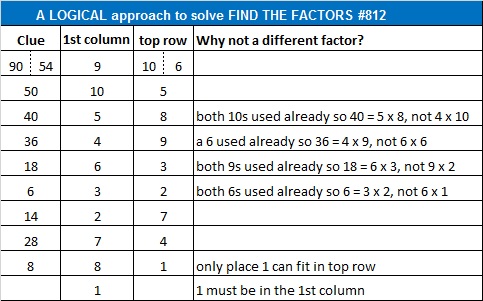
Okay, that puzzle was rather difficult and took a while to explain. You may find this Level 4 puzzle easier:

Print the puzzles or type the solution on this excel file: 10-factors 807-814

Here’s a little more about the number 812:

  • 812 is a composite number.
  • Prime factorization: 812 = 2 x 2 x 7 x 29, which can be written 812 = 2² x 7 x 29
  • The exponents in the prime factorization are 2, 1, and 1. Adding one to each and multiplying we get (2 + 1)(1 + 1)(1 + 1) = 3 x 2 x 2 = 12. Therefore 812 has exactly 12 factors.
  • Factors of 812: 1, 2, 4, 7, 14, 28, 29, 58, 116, 203, 406, 812
  • Factor pairs: 812 = 1 x 812, 2 x 406, 4 x 203, 7 x 116, 14 x 58, or 28 x 29
  • Taking the factor pair with the largest square number factor, we get √812 = (√4)(√203) = 2√203 ≈ 28.4956 (That was three multiples of 7)

812 = 28 × 29, which means it is the sum of the first 28 even numbers.

  • Thus, 2 + 4 + 6 + 8 + . . .  + 52 + 54 + 56 = 812

It also means that we are halfway between 28² and 29², or halfway between 784 and 841. The average of those two numbers is 812.5.

AND it means that 28² + 29² – 1 = 2(812) = 2(28 × 29)

Since 29 is one of its factors, 812 is also the hypotenuse of a Pythagorean triple:

  • 560-588-812 which is 28 times 20-21-29.
805 and Level 4

23 × 35 = 805 so we shouldn’t be surprised that 805 is palindrome NN in BASE 34. N is the same as 23 in base 10. Thus NN can be derived from 23(34) + 23(1) = 23(34 + 1) = 23 × 35 = 805. NN obviously is divisible by 11 like all 2 digit palindromes are.

Since 23 = 22 + 1, should we expect that 805 is a palindrome in BASE 22? No, and that is for the same reason that not all multiples of 11 are palindromes.

Finding the factors in today’s puzzle shouldn’t be very difficult, but the last few might be trickier than the rest:

Print the puzzles or type the solution on this excel file: 10-factors 801-806

  • 805 is a composite number.
  • Prime factorization: 805 = 5 x 7 x 23
  • The exponents in the prime factorization are 1, 1, and 1. Adding one to each and multiplying we get (1 + 1)(1 + 1)(1 + 1) = 2 x 2 x 2 = 8. Therefore 805 has exactly 8 factors.
  • Factors of 805: 1, 5, 7, 23, 35, 115, 161, 805
  • Factor pairs: 805 = 1 x 805, 5 x 161, 7 x 115, or 23 x 35
  • 805 has no square factors that allow its square root to be simplified. √805 ≈ 28.37252

805 is the hypotenuse of a Pythagorean triple:

  • 483-644-805, which is 3-4-5 times 161

805 can be written as the sum of three squares four ways:

  • 25² + 12² + 6² = 805
  • 24² + 15² + 2² = 805
  • 20² + 18² + 9² = 805
  • 18² + 16² + 15² = 805


798 Cupid’s Arrow and Target

Here are two puzzles that go together and yet look out of sync. Sometimes cupid’s arrow reaches its target, and sometimes it doesn’t.

798-puzzle

Print the puzzles or type the solution on this excel file: 12-factors-795-799

Here’s a little about the number 798:

798 is made from three consecutive numbers (7, 8, and 9), so it is divisible by three. The middle number, 8, is not divisible by three, so 798 is NOT divisible by nine.

798 is a palindrome in two bases:

  • 666 BASE 11 because 6(121) + 6(11) + 6(1) = 798
  • 383 BASE 15 because 3(225) + 8(15) + 3(1) = 798

798 is also the sum of two consecutive prime numbers: 397 + 401 = 798.

798 can be written as the sum of three squares four different ways:

  • 26² + 11² + 1² = 798
  • 25² + 13² + 2² =798
  • 23² + 13² + 10² = 798
  • 22² + 17² + 5² = 798

Here is 798’s factoring information:

  • 798 is a composite number.
  • Prime factorization: 798 = 2 x 3 x 7 x 19
  • The exponents in the prime factorization are 1, 1, 1, and 1. Adding one to each and multiplying we get (1 + 1)(1 + 1)(1 + 1)(1 + 1) = 2 x 2 x 2 x 2 = 16. Therefore 798 has exactly 16 factors.
  • Factors of 798: 1, 2, 3, 6, 7, 14, 19, 21, 38, 42, 57, 114, 133, 266, 399, 798
  • Factor pairs: 798 = 1 x 798, 2 x 399, 3 x 266, 6 x 133, 7 x 114, 14 x 57, 19 x 42, or 21 x 38
  • 798 has no square factors that allow its square root to be simplified. √798 ≈ 28.24889.

798-factor-pairs

791 and Level 4

To see if 791 is divisible by 7, you could try either one of these divisibility tricks:

  • 791 is divisible by 7 because 79 – 2(1) = 77 which obviously is divisible by 7.
  • 791 is divisible by 7 because 79 + 5(1) = 84 which most people know is 12 × 7.

791-puzzle

Print the puzzles or type the solution on this excel file: 10-factors-788-794

————————————–

  • 791 is a composite number.
  • Prime factorization: 791 = 7 x 113
  • The exponents in the prime factorization are 1 and 1. Adding one to each and multiplying we get (1 + 1)(1 + 1) = 2 x 2 = 4. Therefore 791 has exactly 4 factors.
  • Factors of 791: 1, 7, 113, 791
  • Factor pairs: 791 = 1 x 791 or 7 x 113
  • 791 has no square factors that allow its square root to be simplified. √791 ≈ 28.12472222.

791-factor-pairs

791 is the hypotenuse of Pythagorean triple 105-784-791 which is 15-112-113 times 7.

791 is also the sum of seven consecutive prime numbers:

  • 101 + 103 + 107 + 109 + 113 + 127 + 131 = 791