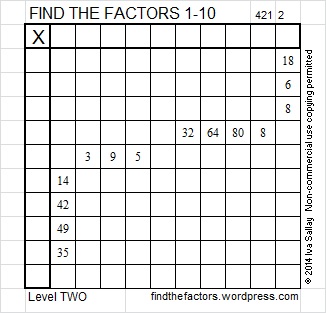
181 and Level 2

  • 181 is a prime number.
  • Prime factorization: 181 is prime.
  • The exponent of prime number 181 is 1. Adding 1 to that exponent we get (1 + 1) = 2. Therefore 181 has exactly 2 factors.
  • Factors of 181: 1, 181
  • Factor pairs: 181 = 1 x 181
  • 181 has no square factors that allow its square root to be simplified. √181 ≈ 13.45362

How do we know that 181 is a prime number? If 181 were not a prime number, then it would be divisible by at least one prime number less than or equal to √181 ≈ 13.5. Since 181 cannot be divided evenly by 2, 3, 5, 7, 11, or 13, we know that 181 is a prime number.

2014-29 Level 2

Excel file of puzzles and previous week’s factor solutions: 10 Factors 2014-07-21

2014-29 Level 2 Factors

175 and Level 2


175 is a composite number.
Factor pairs: 175 = 1 x 175, 5 x 35, or 7 x 25
Factors of 175, 1, 5, 7, 25, 35, 175
Prime factorization: 175 = 5 x 5 x 7 which can be written 175 = (5^2) x 7

When the double-the-last-digit-and-subtract-it-from-the-remaining-numbers divisibility trick for 7 is applied to 175 we get: 17 – (5 x 2) = 17 – 10 = 7, a multiple of 7, so 175 can be evenly divided by 7.

2014-28 Level 2

Excel file of puzzles and previous week’s factor solutions: 12 Factors 2014-07-14

2014-28 Level 2 Factors


169 and Level 2

169 is a composite number and a perfect square.
Factor pairs: 169 = 1 x 169 or 13 x 13
Factors of 169: 1, 13, 169
Prime factorization: 169 = 13 x 13 which can be written 13²

—————————————————————–

2014-27 Level 2

Excel file of puzzles and previous week’s factor solutions: 10 Factors 2014-07-07

2014-27 Level 2 Factors

162 and Level 2

162 is a composite number.
Factor pairs: 162 = 1 x 162, 2 x 81, 3 x 54, 6 x 27, 9 x 18
Factors of 162: 1, 2, 3, 6, 9, 18, 27, 54, 81, 162
Prime factorization: 162 = 2 x 3 x 3 x 3 x 3, which can be written 162 = 2 x (3^4)

————————————————————————————————————————-

 2014-26 Level 2

Excel file of puzzles and previous week’s factor solutions: 12 Factors 2014-06-30

2014-26 Level 2 Factors

156 and Level 2

156 is a composite number.
Factor pairs: 156 = 1 x 156, 2 x 78, 3 x 52, 4 x 39, 6 x 26, or 12 x 13
Factors of 156: 1, 2, 3, 4, 6, 12, 13, 26, 39, 52, 78, 156
Prime factorization: 156 = 2 x 2 x 3 x 13, which can be written (2^2) x 3 x 13

———————————————————————————————————————

2014-25 Level 2

Excel file of puzzles and previous week’s factor solutions: 10 Factors 2014-06-23

2014-25 Level 2 Factors

151 and Why you shouldn’t even bother with that divisibility trick for 9 and 3

  • 151 is a prime number.
  • Prime factorization: 151 is prime.
  • The exponent of prime number 151 is 1. Adding 1 to that exponent we get (1 + 1) = 2. Therefore 151 has exactly 2 factors.
  • Factors of 151: 1, 151
  • Factor pairs: 151 = 1 x 151
  • 151 has no square factors that allow its square root to be simplified. √151 ≈ 12.2882

How do we know that 151 is a prime number? If 151 were not a prime number, then it would be divisible by at least one prime number less than or equal to √151 ≈ 12.3. Since 151 cannot be divided evenly by 2, 3, 5, 7, or 11, we know that 151 is a prime number.

——————————————————————————————————————–

Don't add digits

I’m serious. Don’t bother using that trick that wants you to add up all the digits of a number to see if the number can be evenly divided by 3 or 9. Really, Don’t use it.

Even if it does take less time than actually dividing a whole number by 3 or by 9, it isn’t the best use of your time, and there are too many opportunities to make mistakes using it, especially if the whole number has more than a few digits.

One out of every three randomly chosen whole numbers will be divisible by 3. That’s pretty good odds if you guess, but I’m not advocating guessing.

I’m suggesting that you ignore most of the numbers and only add up a few them. Let me exaggerate the point I’m trying to make:  the following number is too big to put in your calculator, but would you really add up all its digits to see if it’s divisible by 3 or 9?

99999999999999999999997599999999999999999981999999999

No, you wouldn’t. You were probably able to tell that the number is divisible by 3 but not by 9 in seconds by ignoring most of the digits. What about this next number? It has the same digits but not in the same order. I’m sure you can tell almost as quickly that it is also divisible by 3 but not by 9.

99999999979999999999999599999999999999999991999999998

Yes, it’s true that the digits of most whole numbers aren’t mostly nines, but they can form small groups of numbers that are mostly multiples of nine. What are some common multiples of nine that you can ignore in any whole number? 0, 18, 27, 36, 45, 90, 234, 333, 567, 666, and even 1234567890. These digits can be ignored or eliminated no matter what order they appear in the whole number.

Let’s apply this process of elimination to a whole number that is too big for any standard calculator:
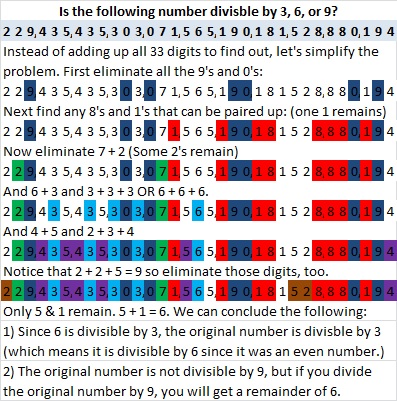
Process of Elimination

Look at the number at the top of this article, 473685. All of the digits can be eliminated so it is divisible by both 3 and 9 (but not by 6 because the original number wasn’t even.) See how quick and easy it can be to use this process of elimination?

So the next time you need to determine if a whole number is divisible by 3, 6, or 9, try ignoring or eliminating as many digits as you can before you do any addition. It will save you so much time. With some of that time you save you could complete a puzzle such as this one whose clues are all divisible by 3.

2014-24 Extra


149 and Level 2

  • 149 is a prime number.
  • Prime factorization: 149 is prime.
  • The exponent of prime number 149 is 1. Adding 1 to that exponent we get (1 + 1) = 2. Therefore 149 has exactly 2 factors.
  • Factors of 149: 1, 149
  • Factor pairs: 149 = 1 x 149
  • 149 has no square factors that allow its square root to be simplified. √149 ≈ 12.2065556

How do we know that 149 is a prime number? If 149 were not a prime number, then it would be divisible by at least one prime number less than or equal to √149 ≈ 12.2. Since 149 cannot be divided evenly by 2, 3, 5, 7, or 11, we know that 149 is a prime number.

2014-24 Level 2

Excel file of puzzles and previous week’s factor solutions: 12 Factors 2014-06-16

2014-24 Level 2 Factors

143 and Level 2

143 is a composite number. Factor pairs: 143 = 1 x 143 or 11 x 13. Factors of 143: 1, 11, 13, 143. Prime factorization: 143 = 11 x 13.

143 is never a clue in the FIND THE FACTORS 1-10 or 1-12 puzzles.

2014-23 Level 2

Excel file of puzzles and previous week’s factor solutions: 10 Factors 2014-06-09

2014-23 Level 2 Factors

135 and Level 2

135 is a composite number. 135 = 1 x 135, 3 x 45, 5 x 27, or 9 x 15. Factors of 135: 1, 3, 5, 9, 15, 27, 45, 135. Prime factorization: 135 = 3 x 3 x 3 x 5, which can also be written 135 = 3³ x 5.

1 + 3 + 5 = 9. Nine is a multiple of both 3 and 9, so this quick divisibility trick lets us know that both 3 and 9 are factors of 135.

135 = 1 x 3³ x 5¹. Click 135 to learn two other ways to have 1, 3, 5 on both sides of the equal sign.

135 is never a clue in the FIND THE FACTORS puzzles.

2014-22 Level 2

Excel file with puzzles and the previous week’s factor solutions: 12 Factors 2014-06-02

2014-22 Level 2 Factors

129 and Level 2

129  is a composite number. 129 = 1 x 129 or 3 x 43. Factors of 129: 1, 3, 43, 129. Prime factorization: 129 = 3 x 43.

2 + 3 + 5 + 7 + 11 + 13 + 17 + 19 + 23 + 29 = 129, thus 129 is the sum of the first 10 prime numbers.

129 is never a clue in the FIND THE FACTORS puzzles.

2014-21 Level 2

Excel file of puzzles and previous week’s solutions: 10 Factors 2014-05-26

2014-21 Level 2 Factors