45 and A Change in Order

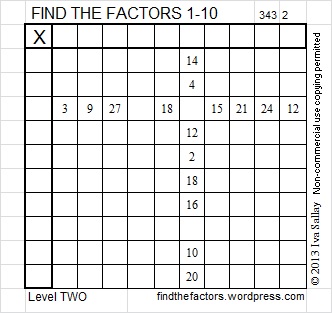
45 is a composite number. 45 = 1 x 45, 3 x 15, or 5 x 9. Factors of 45: 1, 3, 5, 9, 15, 45. Prime factorization: 45 = 3 x 3 x 5, which can also be written 45 = 3² x 5.

When 45 is a clue in the FIND THE FACTORS puzzles, always use 5 and 9 as the factors.

2014-04 Level 1

When I introduce the FIND THE FACTORS puzzles to elementary school students, I only print copies of level 1 and level 2 puzzles. After students have completed those puzzles, I will demonstrate how a level 3 puzzle is completed.

A few students have downloaded the puzzles at home. One very bright sixth grade student was able to complete a level 6 puzzle with the help of his dad.

Kids can be very determined. They may die several times fighting dragons, but they will eventually find the way to save the princess. They can be just as determined to find the way to write the numbers from 1 to 12 in the top row and the first column to make the puzzle work as a multiplication table, especially when I compare it to winning a computer or video game.

Many students tend to guess and check and will get frustrated unless they are shown how to solve the puzzles logically. Frustration can be the enemy of determination.

This week’s puzzles are available in an excel file here. If you have a spreadsheet program on your computer, you can access it. If you enable editing in excel, you can type your answers directly onto the puzzle, and you can also easily print the puzzles. If you click on the excel file you may notice that I have changed the order of the puzzles on the main page.

puzzle order

If the puzzles are printed on both sides of a sheet of paper, the paper can be cut down the middle. In this way I can print puzzles for an entire classroom using only half as much paper.

I instruct students to treat the sheet of puzzles like a computer game and see what level they can achieve. They know upfront that I will be extremely surprised if any of them find all the factors to all six puzzles. That statement motivates some students while it reduces stress in others. Not all students like solving the puzzles, but it is a joy to observe the ones who do.

front & back sides

Here is solution for last week’s level 1 puzzle:

2014-03 Level 1 Answer


31 and Every Third Grader Should Know

  • 31 is a prime number.
  • Prime factorization: 31 is prime.
  • The exponent of prime number 31 is 1. Adding 1 to that exponent we get (1 + 1) = 2. Therefore 31 has exactly 2 factors.
  • Factors of 31: 1, 31
  • Factor pairs: 31 = 1 x 31
  • 31 has no square factors that allow its square root to be simplified. √31 ≈ 5.56776

How do we know that 31 is a prime number? If 31 were not a prime number, then it would be divisible by at least one prime number less than or equal to √31 ≈ 5.6. Since 31 cannot be divided evenly by 2, 3, or 5, we know that 31 is a prime number.

31 is never a clue in the FIND THE FACTORS puzzles.

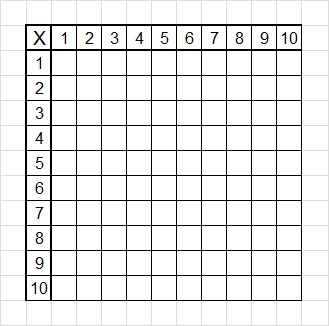
Every third grader should know how to fill in a multiplication table:

Basic multiplication table

By the middle of third grade, every third grade student has been taught the basic multiplication facts. Of course, that doesn’t mean that every third grader has LEARNED those facts. Corestandards.org/Math/Content/3/ lists EVERYTHING a student should learn in third grade math. Multiplication is very key in learning all of these concepts.

Many students, even beyond third grade, rely on skip counting to figure out what a multiplication product should be. Some students have learned rhymes to help them recall a fact. Given the opportunity some students even in middle school will use a calculator to find the answer to a basic multiplication fact.

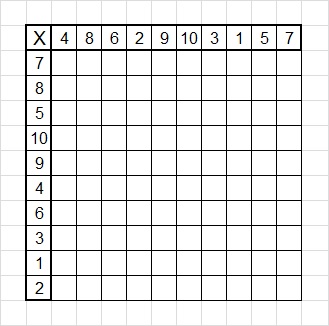
Practicing every day will help students recall the facts instantly instead of needing a calculator or other crutch to help them remember one of the basic multiplication facts. For variety, every third grader should also know how to fill out a multiplication table that looks like this:

mixed table

This kind of table doesn’t allow a student to simply count by twos, fives, nines or any other number to fill out a particular row or column. This type of table encourages a student to fully memorize all the multiplication facts so the table can be completed as quickly as possible.

About the middle of third grade, students are introduced to division. As soon as students learn that any number can be divided by 1, they are ready to tackle the easiest of the easiest FIND THE FACTORS puzzles. Here is the level 1 puzzle for the 3rd full week of 2014:

2014-03 Level 1

It is a level 1 puzzle because students only have to know 10 (or 12) division facts to solve the puzzle. Even though it is a simple puzzle, third grade students will need some instruction to complete it. Tell them that this puzzle is going to turn into a multiplication table as soon as they figure out what numbers go into the top row and the first column. Tell them the only numbers that will be written in those two places are numbers from 1 to 10 and that all of those numbers have to be written in both places.

Help the students know what numbers to write in each space on the top row. Some students will likely be confused when they get to the column with 8 clues and to the column with no clues. Help them use logic to figure out what numbers should go in those spaces. When all the factors have been found in both the factor row and the factor column, have them complete the multiplication table. It will be great practice for all of them.

Last week’s puzzle was fairly easy. Here is the puzzle with all of the factors found:

 2014-02 Level 1 Answer

This week’s puzzles are also available in an excel file here, if you have a spreadsheet program on your computer you can access it.

If you enable editing in excel, you can type your answers directly onto the puzzle, and you can also easily print the puzzles. Have fun!

1 Perfect Square

1 has 1 factor. 2 has 2 factors…that is the end of that pattern because no number greater than 2 equals its number of factors.

  • 1 is not a prime number, and 1 is not a composite number. 1 is in a category all by itself. It is classified as a unit.
  • 1 has no Prime factorization.
  • p⁰ = 1, where p is any prime number, so 1 is a factor of every prime number and every composite number.
  • 1 is also the only number to have exactly 1 factor.
  • Factors of 1: 1
  • Factor pairs: 1 = 1 x 1
  • √1 = 1. Since its square root is a whole number, 1 is a perfect square.

1(n) = n and n ÷ 1 = n for every number n.

Also 1⁰ = 1, 1¹ = 1, 1² = 1, 1³ = 1, 1⁴ = 1, 1⁵ = 1, 1⁶ = 1, 1⁷ = 1, 1⁸ = 1, 1⁹ = 1. In fact, 1 raised to any power equals 1. Even 1⁻⁹⁸⁷⁶⁵⁴³²¹⁰ = 1.

Not only that, but any number (EXCEPT 0) raised to the zeroth power is equal to 1.

One of my college professors wrote something like the following on the board to show why 0º is NOT defined:

When 1 is a clue in the FIND THE FACTORS puzzle, write 1 in both the corresponding factor row and the corresponding factor column.

————————————————————————

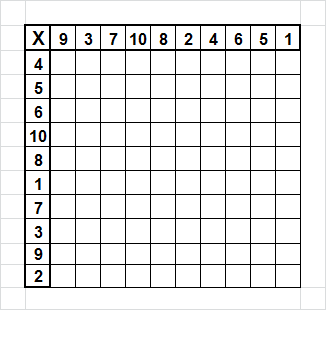
Like most people, you probably know how to fill in a multiplication table even if it looks like this:

standard random table

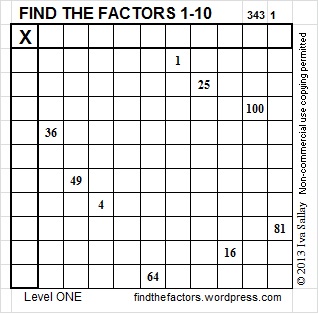
The numbers that are given on a table can be called clues. The table above has 20 clues. What is the least number of clues that a table could have and still only have one way to fill it out?

343-1

Although the table above has just nine clues, there is still only one way to complete it. Nine is the fewest number of clues that will still yield a unique solution.  All of those clues would have to be perfect squares: 1, 4, 9, 16, 25, 36, 49, 64, 81, and 100. One of the clues will be missing, but it isn’t difficult to figure out where the missing clue should go.  Always find the factors on the outside of the puzzle BEFORE writing down the products on the inside of the puzzle.

The puzzle above is rated difficulty level ONE because you only need to know 10 multiplication facts to find all the factors. If this puzzle is too easy for you, you can try a more difficult puzzle. Levels FOUR, FIVE, or SIX will be much more challenging, even for adults.

This link, 10 Factors 2013-10-28, will bring up an excel file with the puzzles that are on this post.  After you enable editing, you can print the puzzles or type the factor answers directly onto the excel file.

An answer key will be posted one week after a puzzle is published.

If you don’t want to open the excel file, the rest of the puzzles will be printed below. If you cut and paste them on a document, you can make them any size you want.

2013-10-28.2

2013-10-28.32013-10-28.4

2013-10-28.52013-10-28.6

If you want to check your work, the answers are given in a tab of the excel file that was published a week later: 10 factors 2013-11-04.