645 Four Consecutive Odd Numbers Pass a Prime Number Test

There is a quick test to see if an odd number is prime: Plug in the number for x in the equation y = 2^x (mod x). If y = 2, then x is VERY LIKELY a prime number. I call that equation the quick prime number test.

The smallest composite number that gives a false positive to this test is 341. Click on that number to see an in depth description of this quick prime number test and how it relates to Pascal’s triangle.

mod 341 calculator

This is only a picture of a calculator.

The second smallest number to give a false positive is 561. Click on that number to see MANY false positives for other tests for that composite number.

645 is not usually tested to see if it is prime because it ends with a 5 and the sum of its digits is a multiple of 3. From those two divisibility rules, we know that 645 is a composite number divisible by both 3 and 5.

Still 645 is the third smallest number to give a false positive to the quick prime number test.

Here is a chart of the quick prime number test applied to the odd numbers from 343 to 681. (A similar chart for odd numbers up to 341 can be seen here.) Whenever y equals 2, I’ve made that 2 red. Prime numbers have been highlighted in yellow. Pseudoprimes 561 and 645 are in bold print.

Prime Number Test 343-681

There are 119 numbers less than or equal to 561 that pass this prime number test, and only 3 of those numbers are composite numbers that give a false positive. Amazing.

Perhaps you noticed something else that’s pretty amazing: 641, 643, 645, and 647 are FOUR consecutive odd numbers that pass the quick prime number test, and 645 is the only composite number of the four. Those are the smallest four consecutive odd numbers that pass the test.

It makes me wonder if longer strings of numbers that pass the test are possible. As almost everybody knows 3, 5, and 7 are the only consecutive odd numbers that are also prime numbers. All other strings of three or more consecutive odd numbers contain at least one composite number that is a multiple of 3. Including pseudoprimes like 645 certainly opens up the possibility of longer strings of prime and pseudoprime numbers.

I also continue to be fascinated by the amount of times on the chart that y equals an odd power of 2 (2, 8, 32, 128, 512).

Interesting observation: All three of these pseudoprimes are of the form 4n + 1. All prime numbers of the form 4n + 1 can be written as the sum of two square numbers that have no common factors. 341, 561, and 645 cannot be written as such a sum so they cannot be prime numbers.

______________________________________

645 is the hypotenuse of the Pythagorean triple 387-516-645. What 3-digit number is the greatest common factor of those three numbers?

  • 645 is a composite number.
  • Prime factorization: 645 = 3 x 5 x 43
  • The exponents in the prime factorization are 1, 1, and 1. Adding one to each and multiplying we get (1 + 1)(1 + 1)(1 + 1) = 2 x 2 x 2 = 8. Therefore 645 has exactly 8 factors.
  • Factors of 645: 1, 3, 5, 15, 43, 129, 215, 645
  • Factor pairs: 645 = 1 x 645, 3 x 215, 5 x 129, or 15 x 43
  • 645 has no square factors that allow its square root to be simplified. √645 ≈ 25.39685.

642 Was This Venn Diagram Made Correctly?

The first six multiples of 642 are 642, 1284, 1926, 2568, 3210, and 3852.

2 is a digit in each one of those numbers. OEIS.org reports that 642 is the smallest number that can make that claim.

  • 642 is a composite number.
  • Prime factorization: 642 = 2 x 3 x 107
  • The exponents in the prime factorization are 1, 1, and 1. Adding one to each and multiplying we get (1 + 1)(1 + 1)(1 + 1) = 2 x 2 x 2 = 8. Therefore 642 has exactly 8 factors.
  • Factors of 642: 1, 2, 3, 6, 107, 214, 321, 642
  • Factor pairs: 642 = 1 x 642, 2 x 321, 3 x 214, or 6 x 10⁷
  • 642 has no square factors that allow its square root to be simplified. √642 ≈ 25.3377.

642 is made from 3 different even numbers. I thought it might be fun to make a Venn diagram comparing 642 with other numbers made with the same three digits. I had never made a Venn diagram on a computer before so I first tried making one in Microsoft Word, but apparently the version of Word we have doesn’t allow any writing in the parts of the Venn diagram that intersect.

I looked online for a Venn diagram maker, but didn’t use any of them for various reasons.

Finally I made a Venn diagram using different colored circles in Paint to surround information I had copied from Excel. I had to redo the work in Excel and Paint several times, but it became easier and better looking with each attempt.

Permutations of 642 and Their Factors

I attempted to show in the Venn diagram that all six numbers are divisible by 2, 3, and 6, but I’m not sure that is clear looking at the diagram. I wondered if I was even making the Venn diagram correctly in every way. Having three circles can certainly complicate the diagram. I consulted a post on Purple Math on how to solve problems using Venn diagrams , but I’m still not 100% sure I made it correctly.

I looked at Wikipedia. It showed many different types of Venn diagrams including one that sorts letters of the Greek, Latin, and Cyrillic alphabets, but the diagram wasn’t labeled.

I also saw a great Venn diagram in a post for job seekers, but it contained no data.

Being confused, what could I do? I made a completely different Venn diagram this time using Microsoft Word.

Every counting number 3 or greater is part of at least one Pythagorean triple. A number being the hypotenuse doesn’t happen as often. An even number can only be the hypotenuse if at least one of its prime factors is also an hypotenuse.

Permutations of 642-no outline

13 is a hypotenuse, and its multiple, 624, is the hypotenuse of the Pythagorean triple 240-576-624.

41 is also a hypotenuse, and its multiple, 246, is the hypotenuse of the triple 54-240-246.

————————————————————–

An even number being part of a primitive Pythagorean triple also only happens half the time because only numbers divisible by 4 can be part of a primitive triple.

Of the six permutations of 6-4-2, only 264 and 624 are divisible by 4, so they are the only two that are part of any primitive triples. Each of them is part of four different primitive Pythagorean triples:

  • 264-1073-1105 calculated from 2(33)(4), 33² – 4², 33² + 4²
  • 264-1927-1945 calculated from 2(44)(3), 44² – 3², 44² + 3²
  • 264-17423-17425 calculated from 2(132)(1), 132² – 1², 132² + 1²
  • 23-264-265 calculated from 12² – 11², 2(12)(11), 12² + 11²
  • 624-1457-1585 calculated from 2(39)(8), 39² – 8², 39² + 8²
  • 624-10807-10825 calculated from 2(104)(3), 104² – 3², 104² + 3²
  • 624-97343-97345 calculated from 2(312)(1), 312² – 1², 312² + 1²
  • 407-624-745 calculated from 24² – 13², 2(24)(13), 24² + 13²

I wanted the circles on the Venn diagram to be outlined so I did only one edit to them. They looked amazing in Word, but when I cut and pasted them into Paint, this is how my picture looked:

Permutations of 642

It looks like making a Venn diagram with only two circles isn’t too difficult, but adding even one more circle makes it much more complicated. Typing anything in the intersecting areas also presents a challenge no matter how many circles are used, at least in the version of Word I used.

What experiences have you had making Venn diagrams?

635 Some Multiplication Facts to Know Backwards and Forwards

Something amazing happens in the multiplication table when an even number is multiplied by 6.

Something just as amazing (but backwards) happens in the multiplication table when a multiple of 3 is multiplied by 7.

Here is a graphic that may be helpful for students memorizing some of those 6 and 7 multiplication facts. It is meant to be read from left to right and contains some cool coincidences:

2-4-6-8 Number Facts

Knowing those 6 and 7 multiplication facts will help any student know the multiplication table backwards and forwards!

While it isn’t necessary to memorize the following number facts, some of the patterns in the graphic above continue with them:

  • 10 + 5 = 15, and 15 x 7 = 105
  • 12 + 6 = 18, and 18 x 7 = 126
  • 14 + 7 = 21, and 21 x 7 = 147
  • 16 + 8 = 24, and 24 x 7 = 168
  • 18 + 9 = 27, and 27 x 7 = 189

———————————————————

What makes 635 an interesting number?

635 is the sum of the nine prime numbers from 53 to 89.

It is also the sum of the thirteen prime numbers from 23 to 73.

635 can be written as the sum of 5 consecutive numbers:

125 + 126 + 127 + 128 + 129 = 635.

635 is a part of exactly 4 Pythagorean triples. Which factors of 635 are greatest common factors for the non-primitive triples?

  • 635 is the hypotenuse of the Pythagorean triple 381-508-635
  • 635 is the short leg in the triple 635-1524-1650
  • 635 is the short leg in the triple 635-40320-40325
  • 635 is the short leg in the primitive triple 635-201612-201613

———————————————————————–

  • 635 is a composite number.
  • Prime factorization: 635 = 5 x 127
  • The exponents in the prime factorization are 1 and 1. Adding one to each and multiplying we get (1 + 1)(1 + 1) = 2 x 2 = 4. Therefore 635 has exactly 4 factors.
  • Factors of 635: 1, 5, 127, 635
  • Factor pairs: 635 = 1 x 635 or 5 x 127
  • 635 has no square factors that allow its square root to be simplified. √635 ≈ 25.199206.

625 Where did all those Pythagorean triples come from?

625 Pythagorean triple

625 is the hypotenuse of FOUR Pythagorean triples. Where did all those Pythagorean triples come from?

They come from 4 of the 5 factors of 625, all of which are powers of 5, a prime number of the form (4n + 1).

5 is the hypotenuse of the primitive Pythagorean triple 3-4-5 that was calculated from (2^2) – (1^2); 2(2)(1); (2^2) + (1^2).

25 is the hypotenuse of 5 times that triple plus it has a primitive of its own:

  • 15-20-25 which is 5 times 3-4-5
  • 7-24-25 calculated from (4^2) – (3^2); 2(4)(3); (4^2) + (3^2)

125 is the hypotenuse of 5 times 25’s two triples plus it has a primitive of its own:

  • 75-100-125 which is 5 times 15-20-25 or 25 times 3-4-5
  • 35-120-125 which is 5 times 7-24-25
  • 44-117-125 calculated from 2(11)(2); (11^2) – (2^2); (11^2) + (2^2)

625 is the hypotenuse of 5 times 125’s three triples plus it has a primitive of its own:

  • 375-500-625 which is 5 times 75-100-125, or 25 times 15-20-25, or 125 times 3-4-5
  • 175-600-625 which is 5 times 35-120-125, or 25 times 7-24-25
  • 220-585-625 which is 5 times 44-117-125
  • 336-527-625 calculated from 2(24)(7); (24^2) – (7^2); (24^2) + (7^2)

—————————————————————————————————

625 Short Leg

625 is also the short leg of FOUR Pythagorean triples. Where did all those Pythagorean triples come from?

They come from 4 of the 5 factors of 625, all of which are odd. (Every odd number greater than one is the short leg of at least one Pythagorean triple.)

5 is the short leg of the primitive Pythagorean triple 5-12-13. Notice that 12 + 13 = 25 which is 5^2.

25 is the short leg of 5 times that triple plus it has a primitive of its own:

  • 25-60-65 which is 5 times 5-12-13
  • 25-312-313; Notice that 312 + 313 = 625 = (25^2)

125 is the short leg of 5 times 25’s two triples plus it has a primitive of its own:

  • 125-300-325 which is 5 times 25 -60-65 or 25 times 5-12-13
  • 125-1560-1565 which is 5 times 25-312-313
  • 125-7812-7813; Notice that 7812 + 7813 = (125^2)

625 is the short leg of 5 times 125’s three triples plus it has a primitive of its own:

  • 625-1500-1625 which is 5 times 125-300-325, or 25 times 25-60-65, or 125 times 5-12-13
  • 625-7800-7825 which is 5 times 125-1560-1565 or 25 times 25-312-313
  • 625-39060-39065 which is 5 times 125-7812-7813
  • 625-195312-195313; Notice that 195312 + 195313 = (625^2)

Thus 625 appears in 8 Pythagorean triples, and now you know where they all came from.

—————————————————————————————————

Here are some other fun facts about the number 625:

Look at this pattern:

  • (5^2) = 25
  • (25^2) = 625
  • (625^2) = 390,625
  • but (390,625^2) = 152,587,890,625 so one digit discontinued the pattern!

625 is the sum of the seven prime numbers from 73 to 103.

What would happen if we ran the following prime number tests on 625?

(24^2) + (7^2) = 625, and 24 and 7 have no common prime factors. That means that 625’s only possible prime factors less than √625 are 5, 13, and 17. Obviously 625 is divisible by 5 so it isn’t a prime number.

Also note that (20^2) + (15^2) = 625, but 20 and 15 have a common prime factor, 5. The fact that they have a common prime factor means that 625 cannot be a prime number.

—————————————————————————————————

  • 625 is a composite number.
  • Prime factorization: 625 = 5 x 5 x 5 x 5, which can be written 625 = 5^4
  • The exponent in the prime factorization is 4. Adding one, we get (4 + 1) = 5. Therefore 625 has exactly 5 factors.
  • Factors of 625: 1, 5, 25, 125, 625
  • Factor pairs: 625 = 1 x 625, 5 x 125 or 25 x 25
  • 625 is a perfect square and a perfect fourth power. √625 = (√25)(√25) = 25

617 Do You See a Pattern?

If you divide any even square number by 4, there will be no remainder.

If you divide any odd square number by 4, the remainder is always 1.

So if you add an even square number to an odd square number and divide the sum by 4, the remainder will ALWAYS be 1.

If you get a remainder of 1 when you divide a prime number by 4, it will ALWAYS be the sum of two squares. If you get a remainder of 1 when you divide a composite number by 4, it MIGHT be the sum of two squares.  (Note: If the last 2 digits of a number is divisible by 4, then the entire number is divisible by 4. The same thing can be said about remainders when dividing by 4.)

The last two digits of 617 yield a remainder of 1 when they are divided by 4, so 617 is a candidate for being the sum of two squares. To find out if it is, I wrote out all the square numbers less than 617:

1, 4, 9, 16, 25, 36, 49, 64, 81, 100, 121, 144, 169, 196, 225, 256, 289, 324, 361, 400, 441, 484, 529, and 576.

Then I calculated 617 – 1 – 3 – 5 – 7 – 9 – 11 – 13 – 15 – 17 – 19 – 21 – 23 – 25 – 27 – 29 – 31, and stopped there because 361 or 19^2 appeared on the calculator screen.

Since (31 + 1)/2 = 16, I knew that 19² + 16² = 617.

Having recently seen that 18² + 17² = 613, I was surprised. The difference between 18 and 17 is one, the difference between 19 and 16 is three, and the difference between 617 and 613 is four. I immediately thought of some multiplication facts:

  • 7 x 8 = 56
  • 6 x 9 = 54     (Note: 56 – 54 = 2)
  • 5 x 10 = 50   (54 – 50 = 4)
  • 4 x 11 = 44    (50 – 44 = 6)
  • 3 x 12 = 36    (44 – 36 = 8)

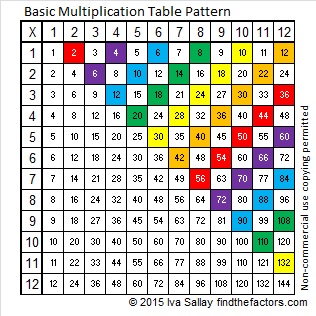
In the standard multiplication table these facts can be seen on a single diagonal. The facts above have been highlighted in red. (The table is symmetrical so the diagonal actually extends in both directions.)

Basic Multiplication Table Pattern

If we look at the orange diagonal on the multiplication table above, we see 42, 40, 36, 30, 22, and 12. The differences between each consecutive member in that set are 2, 4, 6, 8, and 10. No matter which diagonal we choose the differences in the numbers follow that same pattern.

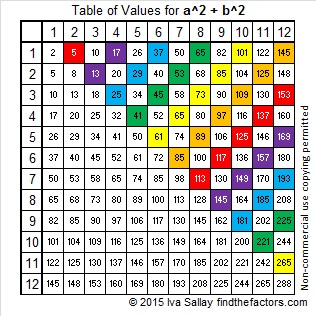
I asked myself, “Would there be a similar pattern if instead of multiplying two numbers together, we added their squares?” Let’s look at this table and see:

Table of values for sum of two squares

On the orange diagonal we see 85, 89, 97, 109, 125, and 145. The differences between each consecutive member in this set are 4,  8, 12, 16, and 20. No matter which diagonal we choose the differences in the numbers will follow that same pattern.

Both of these tables can be extended infinitely in two directions and the patterns will hold true even for numbers on a diagonal that aren’t visible on a 12 x 12 table. For example, here are the numbers for the tables for such a diagonal.

Difference between numbers in set for 2 operations

There is even an odd and rather square relationship between the product a x b and the sum a² + b²:

  • (306 x 2) + 1 = 613
  • (304 x 2) + 9 = 617
  • (300 x 2) + 25 = 625
  • (294 x 2) + 49 = 637
  • (286 x 2) + 81 = 653
  • (276 x 2) + 121 = 673 and so forth

So I ask again, Do you see a pattern? Mathematics is filled with them!

—————————————————————————————————

617 is the sum of the five prime numbers from 109 to 137

As mentioned previously 617 is the sum of two square numbers, specifically 19² + 16².

617 is the hypotenuse of the primitive Pythagorean triple 105-608-617 which was calculated using 19² – 16², 2(19)(16), and 19² + 16².

I learned from OEIS.org that 1!² + 2!² + 3!² + 4!² = 617.

—————————————————————————————————

  • 617 is a prime number.
  • Prime factorization: 617 is prime.
  • The exponent of prime number 617 is 1. Adding 1 to that exponent we get (1 + 1) = 2. Therefore 617 has exactly 2 factors.
  • Factors of 617: 1, 617
  • Factor pairs: 617 = 1 x 617
  • 617 has no square factors that allow its square root to be simplified. √617 ≈ 24.83948.

How do we know that 617 is a prime number? If 617 were not a prime number, then it would be divisible by at least one prime number less than or equal to √617 ≈ 24.8. Since 617 cannot be divided evenly by 2, 3, 5, 7, 11, 13, 17, 19, or 23, we know that 617 is a prime number.

Here’s another way we know that 617 is a prime number: Since 19² + 16² = 617, an odd number, and 19 and 16 have no common prime factors, we know that 617 will be a prime number unless it is divisible by 5, 13, or 17. We can tell just by looking at it that it isn’t divisible by 5 or 17, but we will have to do the division to see if it is divisible by 13. Since 617 ÷ 13 = 47 R6, it cannot be evenly divided by 13, and thus we know that 617 is a prime number.

I can tell that 613 is a prime number just by looking at it!

613 is the 18th centered square number because 17 and 18 are consecutive numbers and 18² + 17² = 613.

613 Centered Square Number

613 is the hypotenuse of the primitive Pythagorean triple 35-612-613, which was calculated using (18^2) – (17^2), 2 x 17 x 18, and (18^2) + (17^2).

Knowing that (18^2) + (17^2) = 613, I can tell that 613 is a prime number just by looking at it! Here’s what I see:

  • 613 obviously is not divisible by 5.
  • It is almost as obvious that 613 is not divisible by 13.
  • 18^2 is not divisible by 17 so (18^2) + (17^2) is not divisible by 17. Thus 613 is not divisible by 17.
  • Since 613 is not divisible by 5, 13, or 17, it is a prime number.

“What?” you say. What about all the other possible prime factors less than 24.8, the approximate value of √613? Don’t we need to TRY to divide 613 by 2, 3, 7, 11, 19, and 23?

No, we don’t. Those numbers don’t matter at all. Since 17^2 + 18^2 = 613, and because 17 and 18 have NO common prime factors and only one of them is odd, I already know that none of those numbers will divide into 613. Let me show you what I mean.

Look at this chart of ALL the primitive Pythagorean triple hypotenuses less than 1000:

Primitive Pythagorean Triple Hypotenuses Less Than 1000

The numbers in red are all prime numbers and appear on the chart only one time. Every prime number less than 1000 that can be written in the form 4N + 1 appears somewhere on the chart. 613 can be found at the intersection of the column under 17 and the row labeled 18.

The black numbers on the colorful squares are composite numbers and many of them appear on the chart above more than one time. There is something very interesting about the prime factors of these composite numbers. Every single one of those factors is also the hypotenuse of a primitive Pythagorean triple! Also notice that at least one of those factors is less than or equal to the square root of the composite number. Here is a chart of those composite numbers, how many times they appear on the chart above, and their prime factorizations:

Composite Primitive Pythagorean Triple Hypotenuses and Their Factors

Also notice that if you divide any of the above composite numbers OR their factors by 4, the remainder is always 1.

I have demonstrated that the following is true for any integer less than 1000. I wasn’t sure if it had been proven for integers in general so I asked Gordan Savin, a professor at the University of Utah, who teaches number theory. He informed me that it has been proven and that it follows from the uniqueness of factorization of Gaussian integers.

In conclusion, if an integer can be written as the sum of two squares, one odd and one even, and the numbers being squared have no common prime factors, then ALL the factors of that odd integer will be hypotenuses of primitive Pythagorean triples. If the integer is a composite number, at least one of those primitive hypotenuses will be less than or equal to the square root of that integer.

Here’s the same thing in more standard mathematical language:

If a natural number of the form 4N + 1 can be written as the sum of two squares (a^2)+ (b^2) and if a and b have no common prime factors, then ALL the factors of 4N + 1 will be of the form 4n + 1. If 4N + 1 is a composite number, there will exist at least one prime factor, 4n + 1 ≤  √(4N + 1). If no such factor exists, then 4N + 1 is a prime number.

  • 613 is a prime number.
  • Prime factorization: 613 is prime.
  • The exponent of prime number 613 is 1. Adding 1 to that exponent we get (1 + 1) = 2. Therefore 613 has exactly 2 factors.
  • Factors of 613: 1, 613
  • Factor pairs: 613 = 1 x 613
  • 613 has no square factors that allow its square root to be simplified. √613 ≈ 24.7588

How do we know that 613 is a prime number? If 613 were not a prime number, then it would be divisible by at least one prime number less than or equal to √613 ≈ 24.8. Since 613 cannot be divided evenly by 2, 3, 5, 7, 11, 13, 17, 19, or 23, we know that 613 is a prime number. But as I explained above since (18^2) + (17^2) = 613, and consecutive integers 18 and 17 have no common prime factors, it is only necessary to check to see if 613 is divisible by 5, 13, or 17. Since it isn’t divisible by any of those three numbers, 613 is a prime number.

601 The Other Side of a Twin Prime

601 and 599 are twin primes because there is only one number between them. That number happens to be 600, a number with 24 factors.

Twin primes certainly are not identical twins. That solitary number between them and the fact that they are both primes is usually all they have in common.

Twin Onesies Raglan - Yes We Are Twins No We Are Not Identical - Funny Twin Onesies - Raglan Boy/Girl Twin Shirts - Twin Gifts Boy/Girl -

599 and 601 could wear these cute onesies. Click on the picture for the etsy link.

Other famous twin primes are 11 and 13, 17 and 19, 29 and 31, and 41 and 43.

3, 5, 7 is the only prime triplet that consists of three consecutive odd numbers because 3 is the only prime number divisible by 3, and all sets of three consecutive odd numbers must have at least one number in the set that is divisible by 3. Other than 2, 3, 5, all other so-called prime triplets come from four consecutive odd numbers. Three of the four numbers will be prime while either the second or the third number will not be.

Twin primes like 599 and 601 can be prime factors. That is something 600 can never do.

For example, 599 x 601 = 359, 999 which is 600² – 1. They are its prime factors. 600 is a factor of an infinite amount of numbers, but it is not a prime factor of any number.

What are some ways twin primes are different from each other? I’ll use twin primes 599 and 601 as examples.

When each prime in a twin prime is divided by 4, the remainder will be 1 for one of them and 3 for the other. The one that has a remainder of 1 will be the sum of two square numbers and will also be the hypotenuse of a primitive Pythagorean triple. The one with a remainder of 3 will never be either of those things. In the triple and twin primes listed above 5, 13, 17, 29, 41, and 601 have a remainder of 1 when divided by 4.

601 = 24² + 5², and is the hypotenuse of the primitive Pythagorean triple 480, 551, 601 while 599 doesn’t do either of those things.

599 is the smallest number whose digits add up to 23. If you add up 601’s digits, you’ll get 7. Figure out how many numbers less than 601 have digits that add up to 7. It’s a lot.

601 has accomplished some other impressive things:

601 Centered Pentagonal Number

1 + 5 + 10 + 15 + 20 + 25 + 30 + 35 + 40 + 45 + 50 + 55 + 60 + 65 + 70 + 75 = 601 which makes 601 the 16th centered pentagonal number

Because it is a centered pentagonal number, 601 is one more than five times the 15th triangular number.

The factors of numbers from 601 to 607 form a symmetrical shape.

601 to 607 factors

I gave the factoring information for 599 previously. Here is the information for 601:

  • 601 is a prime number.
  • Prime factorization: 601 is prime.
  • The exponent of prime number 601 is 1. Adding 1 to that exponent we get (1 + 1) = 2. Therefore 601 has exactly 2 factors.
  • Factors of 601: 1, 601
  • Factor pairs: 601 = 1 x 601
  • 601 has no square factors that allow its square root to be simplified. √601 ≈ 24.5153

How do we know that 601 is a prime number? If 601 were not a prime number, then it would be divisible by at least one prime number less than or equal to √601 ≈ 24.5. Since 601 cannot be divided evenly by 2, 3, 5, 7, 11, 13, 17, 19, or 23, we know that 601 is a prime number.

How Many Factors Do the Numbers Up to 600 Have?

Not Much of a Horse Race:

In my 300th, 400th, or 500th posts, I reviewed the amount of factors numbers up to 500 have. I even had a horse race for the numbers from 401 to 500 because there were three lead changes which made watching a gif of it a little more interesting.

For the numbers from 501 to 600, there is no horse race: 4 was the first out of the gate and soon left all the other factor amounts in the dust. Click on the graphic below to see it better.

501 to 600 Same Number of Factors

I also like to keep track of how many integers have square roots that can be simplified. 40% of these numbers do, but the total numbers from 1 to 600 that have simplifiable square roots is a little lower than that. You can see that in red in the chart below that also shows the amount of numbers up to 600 which have a particular number of factors:

Total Number of Integers with the Same Amounts of Factors 1 - 600

Factors of 600:

  • 600 is a composite number.
  • Prime factorization: 600 = 2 x 2 x 2 x 3 x 5 x 5, which can be written 600 = (2^3) x 3 x (5^2)
  • The exponents in the prime factorization are 3, 1 and 2. Adding one to each and multiplying we get (3 + 1)(1 + 1)(2 + 1) = 4 x 2 x 3 = 24. Therefore 600 has exactly 24 factors.
  • Factors of 600: 1, 2, 3, 4, 5, 6, 8, 10, 12, 15, 20, 24, 25, 30, 40, 50, 60, 75, 100, 120, 150, 200, 300, 600
  • Factor pairs: 600 = 1 x 600, 2 x 300, 3 x 200, 4 x 150, 5 x 120, 6 x 100, 8 x 75, 10 x 60, 12 x 50, 15 x 40, 20 x 30 or 24 x 25
  • Taking the factor pair with the largest square number factor, we get √600 = (√100)(√6) = 10√6 ≈ 24.494897. (Note: 2 + 4 = 6 and 49 + 48 = 97 so this square root and √6 can be easy to remember.)

Sum-Difference Puzzles:

6 has two factor pairs. One of those pairs adds up to 5, and the other one subtracts to 5. Put the factors in the appropriate boxes in the first puzzle.

600 has twelve factor pairs. One of the factor pairs adds up to 50, and a different one subtracts to 50. If you can identify those factor pairs, then you can solve the second puzzle!

More about the Number 600:

600 ties 360, 420, 480, 504, and 540 for having more factors than all other previous whole numbers.

600 is the sum of consecutive prime numbers 293 and 307.

600 is the hypotenuse of two Pythagorean triples: 360-480-600 and 168-576-600. What are the greatest common factors of each of those triples?

What often happens to a number like 599 when a number next to it has so many factors?

The square root of any number from 576 to 624 is between 24 and 25. That means the first number in any of their factor pairs will be 24 or less. The combined number of factor pairs for the 49 integers from 576 to 624 is 189. The number of factor pairs for any given number ranges from 1 to 12. Let’s look at the averages: The mean (189/49) is 3.857 factor pairs per number. The median is 3 factor pairs, and the mode (the number of factor pairs that occurs most often) is 4 factor pairs.

Distribution of the Number of Factor Pairs from 576 to 624

What happens to a number like 599 when a number next to it has far more than the average number of factor pairs? Quite often, but not always, that number has no choice but to be a prime number.

Number of Factor Pairs around 599

Even though 600 has only three prime factors (2, 3 and 5), it still managed to be divisible by 50% of the numbers from 1 to 24, and there just aren’t many possibilities left for the numbers immediately before or after it.

The twelve numbers less than or equal to 24 that will divide into 600 are 1, 2, 3, 4, 5, 6, 8, 10, 12, 15, 20 and 24.

Because 9, 14, 16, 18, 21, and 22 each have 2 or 3 as a prime factor, those six numbers also are not possible factors of 599 or 601.

Every whole number is divisible by 1, but besides that, there are only six numbers available as possible factors for those two numbers: 7, 11, 13, 17, 19, and 23. Since neither 599 nor 601 is divisible by any of those numbers, they turn out to be twin primes.

Usually at least one of the numbers before or after a number with far more than its fair share of factor pairs will be a prime number.

119 and 121, the numbers before and after 120 are notable exceptions. √120 ≈ 10.95441. The factors of 120 that are less than or equal to 10 are 1, 2, 3, 4, 5, 6, 8, and 10 which is 80% of the possible factors. Yet 119 managed to be divisible by 7, and 121 managed to be divisible by 11 so neither one of them is a prime number.

————————————————————————————-

If you add up the digits of 499, 589, or 598, you will get 22.

599 is the smallest whole number whose digits add up to 23. Thank you, OEIS.org for that number fact.

  • 599 is a prime number and a twin prime with 601.
  • Prime factorization: 599 is prime.
  • The exponent of prime number 599 is 1. Adding 1 to that exponent we get (1 + 1) = 2. Therefore 599 has exactly 2 factors.
  • Factors of 599: 1, 599
  • Factor pairs: 599 = 1 x 599
  • 599 has no square factors that allow its square root to be simplified. √599 ≈ 24.4744765

How do we know that 599 is a prime number? If 599 were not a prime number, then it would be divisible by at least one prime number less than or equal to √599 ≈ 24.5. Since 599 cannot be divided evenly by 2, 3, 5, 7, 11, 13, 17, 19, or 23, we know that 599 is a prime number.

592 and The Broken Internet Connection

There is a lot of road construction near my house. I don’t know if it is related, but the outside cable that provides us internet connection died sometime on the morning of Sunday, 23 August 2015.

That broken cable line meant that we had no home phone service, no internet, no banking information, no twitter, no facebook = no looking at the latest pictures of my grandchildren, no reading Blogspot, no watching Netflix or Youtube, and no reading or writing on WordPress.

I don’t have a smart phone, but my husband uses the Wifi in our house for his. His smart phone wasn’t smart enough to switch to our phone’s data plan. Instead it relentlessly tried to connect to the Wifi every time either of us tried to use it.

My dead internet connection meant that if you were looking for information about the number 592 (and who isn’t), you had to wait a few days:

___________________________________

592 is a palindrome in three bases:

  • 727 BASE 9 because 7(81) + 2(9) + 7(1) = 592
  • 414 BASE 12 because 4(144) + 1(12) + 4(1) = 592
  • GG BASE 36 (G is 16 in base 10) because 16(36) + 16(1) = 592

592 is the hypotenuse of the Pythagorean triple 192-560-592. Which factor of 592 is the greatest common factor of those three numbers?

  • 592 is a composite number.
  • Prime factorization: 592 = 2 x 2 x 2 x 2 x 37, which can be written 592 = (2^4) x 37
  • The exponents in the prime factorization are 4 and 1. Adding one to each and multiplying we get (4 + 1)(1 + 1) = 5 x 2 = 10. Therefore 592 has exactly 10 factors.
  • Factors of 592: 1, 2, 4, 8, 16, 37, 74, 148, 296, 592
  • Factor pairs: 592 = 1 x 592, 2 x 296, 4 x 148, 8 x 74, or 16 x 37
  • Taking the factor pair with the largest square number factor, we get √592 = (√16)(√37) = 4√37 ≈ 24.33105