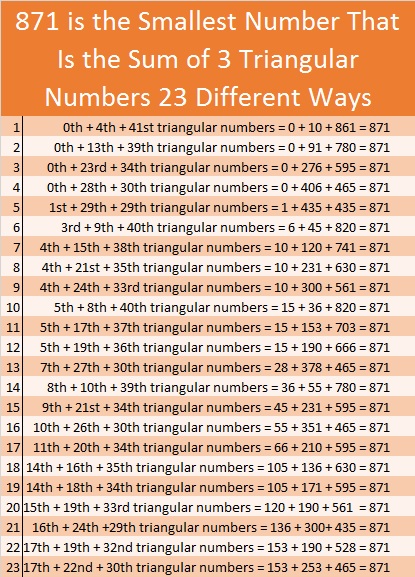
871 Is the Smallest Number That Is the Sum of 3 Triangular Numbers 23 Different Ways

OEIS.org alerted me to the fact that 871 is the smallest number that is the sum of three triangular numbers 23 different ways. I set out to find those 23 ways. We’ll have to count 0 as the 0th triangular number for four of them, but here are those record-breaking 23 ways:

871 is the hypotenuse of Pythagorean triple 335-804-871 which is (5-12-13) times 67.

871 is also repdigit 111 in BASE 29 because 1(29²) + 1(29¹) + 1(29º) = 871.

  • 871 is a composite number.
  • Prime factorization: 871 = 13 × 67
  • The exponents in the prime factorization are 1 and 1. Adding one to each and multiplying we get (1 + 1)(1 + 1) = 2 × 2 = 4. Therefore 871 has exactly 4 factors.
  • Factors of 871: 1, 13, 67, 871
  • Factor pairs: 871 = 1 × 871 or 13 × 67
  • 871 has no square factors that allow its square root to be simplified. √871 ≈ 29.512709

870 If You Can Solve a 3×3 and a 4×4 Magic Square, Then You Can Solve a 12×12 Magic Square

It’s simple multiplication, folks!

3×4 = 12, so if you can solve a 3×3 Magic Square and a 4×4 Magic Square, then you can solve a 12×12 Magic Square, too.

Seriously. Really. It’s true! You really can solve a 12×12 Magic Square. I did it. Twice. You’ll see. You can do it, too.

That solution consists of sixteen 3×3 Magic Squares that use all the numbers from 1 to 144. The one in the corner is the most familiar one. The other ones are just that familiar Magic Square plus 9, 18, 27 and a few other multiples of 9. I used the 4×4 Magic Square below as a guide as I placed the sixteen 3×3 Magic Squares on the excel file I made, 12 factors 864-874.

4 x 4 Magic Square

make science GIFs like this at MakeaGif

There is 1 solution times 8 orientations (right-side-up, upside-down, etc.) for the 3×3 Magic Square, and there are 880 solutions times 8 orientations for the 4×4 Magic Square. That’s a lot of different possible solutions!

I also solved the 12×12 Magic Square by using nine 4×4 Magic Squares and placing them on the second grid in 12 factors 864-874. This arrangement also has many more possibilities than the one shown here.

You can easily solve your own 12×12 Magic Square by opening this excel file, 12 factors 864-874, going to the 12×12 Magic Square tab, and following the directions.

Here’s more about the awesome number 870:

29 × 30 = 870. That means 870 is 29 × (29+1), so 870 is the sum of the first 29 even numbers.

870 is the sum of the ten prime numbers from 67 to 107.

Because 5 and 29 are its factors, 870 is the hypotenuse of four Pythagorean triples: ( Note that 5 × 29 = 145)

  • 102-864-870, which is 6 times (17-144-145)
  • 144-858-870, which is 6 times (24-143-145)
  • 522-696-870, which is (3-4-5) times 174
  • 600-630-870, which is (20-21-29) times 30

870 has some interesting representations in other bases:

  • 606 in BASE 12, because 6(12²) + 0(12¹) + 6(12º) = 6(145) = 870
  • 303 in BASE 17, because 3(17²) + 0(17¹) + 3(17º) = 3(290) = 870
  • 110 in BASE 29, because 1(29²) + 1(29¹) + 0(29º) = 870
  • T0 in BASE 30 (T is 29 base 10), because 29(30¹) + 0(30º) = 29(30) = 870

8 + 0 + 7 + 8³ + 0³ + 7³ = 870. Thank you OEIS.org for that fun fact.

  • 870 is a composite number.
  • Prime factorization: 870 = 2 × 3 × 5 × 29
  • The exponents in the prime factorization are 1, 1, 1, and 1. Adding one to each and multiplying we get (1 + 1)(1 + 1)(1 + 1)(1 + 1) = 2 × 2 × 2 × 2 = 16. Therefore 870 has exactly 16 factors.
  • Factors of 870: 1, 2, 3, 5, 6, 10, 15, 29, 30, 58, 87, 145, 174, 290, 435, 870
  • Factor pairs: 870 = 1 × 870, 2 × 435, 3 × 290, 5 × 174, 6 × 145, 10 × 87, 15 × 58, or 29 × 30
  • 870 has no square factors that allow its square root to be simplified. √870 ≈ 29.495762

Palindrome 868 Has a Fun Square Root

Obviously, 868 is a palindrome in base 10. It has some interesting representations in some other bases, too:

  • 868 is 4004 in BASE 6, because 4(6³) + 0(6²) + 0(6¹) + 4(6º) = 868
  • SS in BASE 30 (S is 28 base 10), because 28(30) + 28(1) = 28(31) = 868
  • S0 in BASE 31, because 28(31) = 868

From OEIS.org I learned that all the digits from 1 to 9 make up the first nine decimal places of √868, so I decided to make a gif showing that fun fact:

Square root of 868

make science GIFs like this at MakeaGif
  • 868 is a composite number.
  • Prime factorization: 868 = 2 × 2 × 7 × 31, which can be written 868 = 2² × 7 × 31
  • The exponents in the prime factorization are 2, 1, and 1. Adding one to each and multiplying we get (2 + 1)(1 + 1)(1 + 1) = 3 × 2 × 2 = 12. Therefore 868 has exactly 12 factors.
  • Factors of 868: 1, 2, 4, 7, 14, 28, 31, 62, 124, 217, 434, 868
  • Factor pairs: 868 = 1 × 868, 2 × 434, 4 × 217, 7 × 124, 14 × 62, or 28 × 31,
  • Taking the factor pair with the largest square number factor, we get √868 = (√4)(√217) = 2√217 ≈ 29.461839725

866 Please Help with the September 2017 Math Education Blog Carnival!

Carnivals are part of most state fairs, including the Utah State Fair.

Here is a mathematically nonsensical commercial encouraging us to “Go Beyond Ordinary at the Utah State Fair – Sept 7 – 17, 2017.” (You will have to click this picture and the facebook post to see the video.)

I will be hosting the September 2017 Math Education Blog Carnival in a couple of weeks! I am excited, but also a bit terrified. I have never done anything like this before, and, fellow bloggers, I would really appreciate your support.

As always, the Math Education Blog Carnival will include posts about math that will make sense and be great fun for teachers, their students, and even parents. If you have a math education blog post, please submit it to this month’s blog carnival! Click here for instructions on how to submit your post. You can also contact me on twitter: Iva Sallay @findthefactors.

Now here’s a little bit about the number 866:

29² + 5² = 866, so 866 is the hypotenuse of a Pythagorean triple:

290-816-866 which is 2(29)(5) , 29² – 5² , 29² + 5² and 2 times (145-408-433)

  • 866 is a composite number.
  • Prime factorization: 866 = 2 × 433
  • The exponents in the prime factorization are 1 and 1. Adding one to each and multiplying we get (1 + 1)(1 + 1) = 2 × 2 = 4. Therefore 866 has exactly 4 factors.
  • Factors of 866: 1, 2, 433, 866
  • Factor pairs: 866 = 1 × 866 or 2 × 433
  • 866 has no square factors that allow its square root to be simplified. √866 ≈ 29.4278779


864 Factor Trees

Factor Trees for 864:

The prime factorization of 864 is 2⁵ × 3³. The sum of the exponents is 5 + 3 = 8. Since 8 is a power of 2,  a couple of 864’s factor trees are full and well-balanced:

All of those prime factors lined up in numerical order. That didn’t happen for the next one, but it still makes a good looking tree, and all the prime factors are easy to find.

Is it possible to make a factor tree for 864 that hardly looks like a tree and isn’t as easy to find all the prime factors? Yes, it is. Here’s an example:

Factors of 864:

  • 864 is a composite number.
  • Prime factorization: 864 = 2 × 2 × 2 × 2 × 2 × 3 × 3 × 3, which can be written 864 = 2⁵ × 3³
  • The exponents in the prime factorization are 5 and 3. Adding one to each and multiplying we get (5 + 1)(3 + 1) = 6 × 4 = 24. Therefore 864 has exactly 24 factors.
  • Factors of 864: 1, 2, 3, 4, 6, 8, 9, 12, 16, 18, 24, 27, 32, 36, 48, 54, 72, 96, 108, 144, 216, 288, 432, 864
  • Factor pairs: 864 = 1 × 864, 2 × 432, 3 × 288, 4 × 216, 6 × 144, 8 × 10⁸, 9 × 96, 12 × 72, 16 × 54, 18 × 48, 24 × 36, or 27 × 32
  • Taking the factor pair with the largest square number factor, we get √864 = (√144)(√6) = 12√6 ≈ 29.3938769

Sum-Difference Puzzles:

6 has two factor pairs. One of those pairs adds up to 5, and the other one subtracts to 5. Put the factors in the appropriate boxes in the first puzzle.

864 has twelve factor pairs. One of the factor pairs adds up to ­60, and a different one subtracts to 60. If you can identify those factor pairs, then you can solve the second puzzle!

More Facts about the Number 864:

864 looked interesting to me in a few other bases:

  • 4000 BASE 6 because 4(6³) = 864
  • 600 BASE 12 because 6(12²) = 864
  • RR BASE 31 (R is 27 base 10) because 27(31) + 27(1) = 27(32) = 864
  • OO BASE 35 (O is 24 base 10) because 24(35) + 24(1) = 24(36) = 864
  • O0 BASE 36 (Oh zero) because 24(36) + 0(1) = 864

864 is the sum of the 20 prime numbers from 7 to 83.

131 + 137 + 139 + 149 + 151 + 157 = 864; that’s six consecutive primes.

431 + 433 = 864; that’s the sum of twin primes.

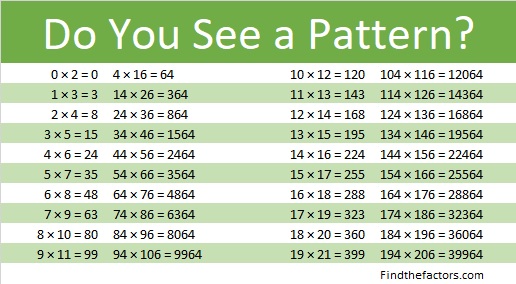
864 is in this cool pattern:


863 These Primitive Pythagorean Triples Have Some Terrific Legs!

We’ve seen that the sum of the hypotenuse of a primitive Pythagorean triple and either of its legs is either a perfect square or two times a perfect square. What about just the legs themselves? Is there anything special about their sums? I think so. I think primitive Pythagorean triples have some terrific legs! Look at this chart and see if you agree.

If a sum is a prime number, there is only one way to get that sum. If the sum is repeated, then its prime factorization only uses prime numbers already on the list.

I’m not as impressed with the differences of the legs, but it is interesting that the same prime numbers show up:

863 is the sum of consecutive primes several ways:

  • 863 is the sum of the fifteen prime numbers from 29 to 89.
  • 863 is the sum of the thirteen prime numbers from 41 to 97.
  • 107 + 109 + 113 + 127 + 131 + 137 + 139 = 863; that’s seven consecutive primes.
  • 163 + 167+ 173 + 179 + 181 = 863; that’s five consecutive primes.

863(863 + 6) = 749,947, a palindrome. Thank you OEIS.org for that fun fact.

  • 863 is a prime number.
  • Prime factorization: 863 is prime.
  • The exponent of prime number 863 is 1. Adding 1 to that exponent we get (1 + 1) = 2. Therefore 863 has exactly 2 factors.
  • Factors of 863: 1, 863
  • Factor pairs: 863 = 1 × 863
  • 863 has no square factors that allow its square root to be simplified. √863 ≈ 29.37686

How do we know that 863 is a prime number? If 863 were not a prime number, then it would be divisible by at least one prime number less than or equal to √863 ≈ 29.4. Since 863 cannot be divided evenly by 2, 3, 5, 7, 11, 13, 17, 19, 23, or 29, we know that 863 is a prime number.


857 Why do Primitive Pythagorean Triples Do That?

29² + 4² = 857, so 857 is the hypotenuse of a Pythagorean triple that just happens to be primitive:

  • 232-825-857 which was calculated from 2(29)(4), 29² – 4², 29² + 4².

Now, one of the legs of a primitive Pythagorean triple will be divisible by 4. In this case that number is 232. As I indicated when I wrote 821 Why Do Primitive Pythagorean Triples Do That? The sum of the number divisible by 4 in a primitive Pythagorean triple and the hypotenuse always equals a perfect square. So 232 + 857 = 1089 = 33².

This week I noticed something about the OTHER leg that might be even more amazing! The other leg in the triple, 825, is not divisible by 4, but get this: One half of the sum of a primitive’s hypotenuse and that leg that is NOT divisible by 4 also equals a square number: For example, (857 + 825)/2 = 1681/2 = 841 = 29².

But not only that, one half of the DIFFERENCE of a primitive’s hypotenuse and that leg that is NOT divisible by 4 equals a perfect square, too: (857 – 825)/2 = 32/2 = 16 = 4².

Now 29² and 4² look a little familiar to me today. Hmm… We’ve seen those two numbers together earlier in this post!

It seems that for Primitive Pythagorean Triples, what goes around comes around!

Check out the sums and difference of these other primitive Pythagorean triples:

Go ahead, try it with any other primitive triple on this list or otherwise!

If we let s = √(Sum/2) and let d = √(Difference/2), then we can rewrite some Pythagorean triple like this:

  • s² – d², 2sd, s² + d², so s² and d² are REALLY significant perfect squares!

Besides being the hypotenuse of a primitive Pythagorean triple, here are some other facts about the number 857:

857 is the sum of three consecutive prime numbers: 281 + 283 + 293.

857 is also the sum of the nineteen prime numbers from 11 to 83.

  • 857 is a prime number.
  • Prime factorization: 857 is prime.
  • The exponent of prime number 857 is 1. Adding 1 to that exponent we get (1 + 1) = 2. Therefore 857 has exactly 2 factors.
  • Factors of 857: 1, 857
  • Factor pairs: 857 = 1 × 857
  • 857 has no square factors that allow its square root to be simplified. √857 ≈ 29.27456

How do we know that 857 is a prime number? If 857 were not a prime number, then it would be divisible by at least one prime number less than or equal to √857 ≈ 29.3. Since 857 cannot be divided evenly by 2, 3, 5, 7, 11, 13, 17, 19, 23, or 29, we know that 857 is a prime number.


Here’s another way we know that 857 is a prime number: Since its last two digits divided by 4 leave a remainder of 1, and 29² + 4² = 857 with 29 and 4 having no common prime factors, 857 will be prime unless it is divisible by a prime number Pythagorean triple hypotenuse less than or equal to √857 ≈ 29.3. Since 853 is not divisible by 5, 13, 17, or 29, we know that 857 is a prime number.

Something Cool about 854 and Its Square

OEIS.org informs us that you can find all the digits 1 to 9 exactly one time when 854 is combined with its square. I thought that was pretty cool so I made this gif:

854 and Its Square

make science GIFs like this at MakeaGif

854 can be written as the sum of consecutive numbers in several different ways:

  • as the sum of 4 consecutive numbers: 212 + 213 + 214 + 215 = 854
  • as the sum of the 7 consecutive numbers from 119 to 125 with 122 as the middle number.
  • as the sum of the 28 consecutive numbers from 17 to 44 with 30 and 31 as the middle numbers.
  • as the sum of 2 consecutive even numbers: 426 + 428 = 854
  • as the sum of the 7 consecutive even numbers from 116 to 128 with 122 as the middle number.
  • as the sum of the 14 consecutive even numbers from 48 to 74 with 60 and 62 as the middle numbers.
  • Even number 854 does not have any factor pairs in which both numbers are even, so it cannot be written as the sum of consecutive odd numbers.
854 is the hypotenuse of a Pythagorean triple: 154-840-854, which is 14 times (11-60-61).
  • 854 is a composite number.
  • Prime factorization: 854 = 2 × 7 × 61
  • The exponents in the prime factorization are 1, 1, and 1. Adding one to each and multiplying we get (1 + 1)(1 + 1)(1 + 1) = 2 × 2 × 2 = 8. Therefore 854 has exactly 8 factors.
  • Factors of 854: 1, 2, 7, 14, 61, 122, 427, 854
  • Factor pairs: 854 = 1 × 854, 2 × 427, 7 × 122, or 14 × 61
  • 854 has no square factors that allow its square root to be simplified. √854 ≈ 29.223278.

How Often is 850 the Hypotenuse of a Pythagorean Triple?

We can tell if a number is the hypotenuse of a Pythagorean triple by looking at its prime factorization.

  • If NONE of its prime factors leave a remainder of 1 when divided by 4, then it will NOT be the hypotenuse of Pythagorean triple.
  • If at least one of its prime factors leave a remainder of 1 when divided by 4, then it WILL be the hypotenuse of Pythagorean triple.
  • If ALL of its prime factors leave a remainder of 1 when divided by 4, then it will also be the hypotenuse of at least one PRIMITIVE Pythagorean triple.

850 = 2 × 5² × 17¹. Its factor, 2, prevents 850 from being the hypotenuse of a primitive Pythagorean triple, but 5² × 17¹ will actually make it the hypotenuse of SEVEN Pythagorean triples. Some of those we can find by looking at the ways we can make 850 from the sum of two squares:

29² + 3² = 850, 27² + 11² = 850, and 25² + 15² = 850

  • 29² + 3² gives us 174-832-850, calculated from 2(29)(3), 29² – 3², 29² + 3², and is 2 times (87-416-425)
  • 27² + 11² gives us 594-608-850, calculated from 27² – 11², 2(27)(11), 27² + 11², and is 2 times (297-304-425)
  • 25² + 15² gives us 400-750-850 calculated from 2(25)(15), 25² – 15², 25² + 15², and is (8-15-17) times 50.

Let’s look a little closer at 850’s factoring information:

  • 850 is a composite number.
  • Prime factorization: 850 = 2 × 5 × 5 × 17, which can be written 850 = 2 × 5² × 17
  • The exponents in the prime factorization are 1, 2, and 1. Adding one to each and multiplying we get (1 + 1)(2 + 1)(1 + 1) = 2 × 3 × 2 = 12. Therefore 850 has exactly 12 factors.
  • Factors of 850: 1, 2, 5, 10, 17, 25, 34, 50, 85, 170, 425, 850
  • Factor pairs: 850 = 1 × 850, 2 × 425, 5 × 170, 10 × 85, 17 × 50, or 25 × 34
  • Taking the factor pair with the largest square number factor, we get √850 = (√25)(√34) = 5√34 ≈ 29.154759.

Here are the SEVEN ways 850 is the hypotenuse of a Pythagorean triple with five of 850’s factor pairs in bold print:

  • 174-832-850 which is 2 times (87-416-425)
  • 594-608-850 which is 2 times (297-304-425)
  • 510-680-850 which is (3-4-5) times 170.
  • 130-840-850 which is 10 times (13-84-85).
  • 360-770-850 which is 10 times (36-77-85).
  • 400-750-850 which is (8-15-17) times 50
  • 238-816-850 which is(7-24-25) times 34

When I wrote about 845, I said I would explore a conjecture a little more:

My conjecture: If prime numbers x and y are Pythagorean triple hypotenuses, and A and B are integers with B ≥ A and A ≥ 1, then xᴬ × y will have two primitive triples. The total number of triples xᴬ × yᴮ will have will be A + B + 2Bᴬ

So…how many Pythagorean triples does 2 × 5³ × 17¹ = 4250 have? It will have the same number as 5³ × 17¹ = 2125.

From the conjecture I figure that 2125 and 4250 will each have 1 + 3 + 2(3¹) = 10 total triples. Let’s see if I’m right …

Besides 1 and itself, the factors of 2125 are 5, 17, 25, 85, 125, and 425, all Pythagorean triple hypotenuses. Each of their respective primitive Pythagorean triples has a multiple with 4250 as the hypotenuse:

  1. 850 times 5’s primitive
  2. 250 times 17’s primitive
  3. 175 times 25’s primitive
  4. 34 times 125’s primitive
  5. 50 times 85’s two primitives
  6. 10 times 425’s two primitives

That’s a total of 8 Pythagorean triples from that list. We will also have triples that are 2 times 2125’s primitives. We can find those triples by looking at the sums of two squares that equal 4250.

  1. 65² + 5² = 4250; but 5 is a factor of both 65 and 5, so this will produce a duplicate of one of the triples already given.
  2. 61² + 23² = 4250; gives us 2806-3192-4250, calculated from 2(61)(23), 61² – 23², 61² + 23²
  3. 55² + 35² = 4250; but 5 is a factor of both 55 and 35, so this will produce a duplicate of one of the triples already given.
  4. 49² + 43² = 4250; gives us 552-4214-4250, calculated from 49² – 43², 2(49)(43), 49² + 43²

That gives us 2 more triples to add to the previous 8 for a total of 10 Pythagorean triples, and my conjecture still holds true.

Now one more thing about the number 850, here’s how to write it in a couple other bases:

  • 505 BASE 13, because 5(13²) + 5(1) = 5(170) = 850.
  • PP BASE 33 (P is 25 base 10) because 25(33) + 25(1) = 25(34) = 850


How Often Is 845 the Hypotenuse in a Pythagorean Triple?

Mathematics is a wonderful collection of patterns.

If we look at the patterns of Pythagorean triples, can we predict how often 845 is the hypotenuse of a Pythagorean triple? Yes, we can.

The prime factorization of 845 is 5 × 13². Now 5, 13, 169 each has one primitive triple while 65 has two primitive triples. That’s a total of five primitive triples. Each of those primitives has a multiple with 845 as the hypotenuse.

  1. 5’s primitive (3-4-5) times 169 is 507-676-845
  2. 13’s primitive (5-12-13) times 65 is 325-780-845
  3. 169’s primitive (119-120-169) times 5 is 595-600-845
  4. 65’s first primitive (16-63-65) times 13 is 208-819-845
  5. 65’s second primitive (33-56-65) times 13 is 429-728-845

Because ALL of its prime factors are primitive Pythagorean triple hypotenuses, 845 will also have some primitives of its own. How many?

Now 325, which is 5² × 13, has five non-primitive triples and two primitive triples, 36-323-325 and 204-253-325 . Since 325 and 845 have the same number of non-primitive triples, and similar looking prime factorizations, is it reasonable to assume that 845 will have two primitive triples as well? Yes, it is!

We can find 845’s primitive Pythagorean triples by looking at the ways to write 845 as the sum of two squares:

29² + 2² = 845, 26² + 13² = 845, and 22² + 19² = 845

26 is a multiple of 13 so it will duplicate one of the triples given by one of 845’s factors. The other two equations give us these two primitive Pythagorean triples:

  1. 116-837-845, which was calculated from 2(29)(2), 29² – 2², 29² + 2²
  2. 123-836-845, which was calculated from 22² – 19², 2(22)(19), 22² + 19²

Thus 845 has a total of 5 + 2 = 7 Pythagorean triples in which it is the hypotenuse!

What if we wanted to know how many times 5² × 13² = 4225 is the hypotenuse of a Pythagorean triple. Could we predict how many times that would be? Yes, we can!

Besides 1 and itself, the factors of 4225 are 5, 13, 25, 65, 169, 325, and 845, all Pythagorean triple hypotenuses. Each of their respective primitive Pythagorean triples has a multiple with 4225 as the hypotenuse:

  1. 845 times 5’s primitive
  2. 325 times 13’s primitive
  3. 169 times 25’s primitive
  4. 25 times 169’s primitive
  5. 65 times 65’s two primitives
  6. 13 times 325’s two primitives
  7. 5 times 845’s two primitives

That’s a total of 10 non-primitive Pythagorean triples for 4225.

We know that 4225 will have some primitives of its own. If the pattern holds true, I hypothesize that 4225 will also have two primitives. So I ask, “What sums of two squares equal 4225?”

  • 63² + 16² = 4225; 63 and 16 have no common prime factors so this will produce a primitive triple.
  • 60² + 25² = 4225; 60 and 25 have 5 as a common factor so this will duplicate one of 4225’s other non-primitives.
  • 56² + 33² = 4225; 56 and 33 have no common prime factors so this will produce a primitive triple.
  • 52² + 39² = 4225; 52 and 39 have 13 as a common factor so this will duplicate one of 4225’s other non-primitives.

Thus the pattern held true and my hypothesis was correct! 4225 has a total of 10 + 2 = 12 Pythagorean triples! All of this has led me to some conclusions:

If x is a prime number with a remainder of 1 when divided by 4, and a is an integer that is greater than or equal to one, then xᴬ will have one primitive triple while the total number of Pythagorean triples will be A.

If x and y are prime numbers each with a remainder of 1 when divided by 4, and if A and B are integers with B ≥ A and A ≥ 1, then xᴬ × y will have two primitive triples. It appears that the total number of triples xᴬ × yᴮ will have will be A + B + 2Bᴬ. That is my conjecture.

Let’s check my conjecture for the numbers discussed in this post:

  • 5¹ and 13¹ each have 1 triple
  • 5² and 13² each have 2 triples
  • 5² × 13¹ and 5¹ × 13² each have 1 + 2 + 2(2¹) = 7 triples
  • 5² × 13² has 2 + 2 + 2(2²) = 12 triples

So far the conjecture appears to ring true. Perhaps I’ll explore it a little more when I write post 2 × 5² × 17¹ later this week.

Now here’s a little more about the number 845:

844, 845, 846, 847, and 848 are the smallest five consecutive numbers whose square roots can be simplified.

845 is palindrome 5A5 in BASE 12 (A is 10 base 10) because 5(12²) + 10(12¹) + 5(12º) = 845

845 is 500 in BASE 13 because 5(13²) = 845

  • 845 is a composite number.
  • Prime factorization: 845 = 5 × 13 × 13, which can be written 845 = 5 × 13²
  • The exponents in the prime factorization are 1 and 2. Adding one to each and multiplying we get (1 + 1)(2 + 1) = 2 × 3  = 6. Therefore 845 has exactly 6 factors.
  • Factors of 845: 1, 5, 13, 65, 169, 845
  • Factor pairs: 845 = 1 × 845, 5 × 169, or 13 × 65
  • Taking the factor pair with the largest square number factor, we get √845 = (√169)(√5) = 13√5 ≈ 29.06888