1006 and Level 5

Just like when I solved the previous puzzle, several times I had to pick a factor and see if there was only one place in the first column or the top row where it could go. Find as many of the other factors as you can before you employ that strategy, but when you need to use it, go for it. It is often very helpful!


Print the puzzles or type the solution in this excel file: 10-factors-1002-1011

1005 and Level 4

At first, this puzzle is fairly easy to solve, but before long you will probably get stuck. To get unstuck, pick a number. See if there is only one place in the first column or the top row where that number can go. I had to use that strategy over and over again to solve this particular puzzle. Good luck!

Print the puzzles or type the solution in this excel file: 10-factors-1002-1011

996 Christmas Factor Tree

The puzzles this week might look rather plain, but together the seven puzzles make a lovely Christmas tree factoring puzzle. The difficulty level of each of the puzzles is not identified. Some of them are very easy, and some of them are difficult. Some are in-between. How many of them can you solve?

Print the puzzles or type the solution in this excel file: 12 factors 993-1001

Here’s a little about the number 996:

Here are a few of its possible factor trees. They look a little like Christmas trees, too.


Usually,  I only go up to base 36 when I look for palindromes or repdigits. 966 is NOT a palindrome or repdigit in any of those bases, but can it ever be one? To me, repdigits are more interesting than palindromes because you can find them by factoring.  966 has 6 factors greater than 36: 83, 166, 249, 332, 498, 996. If you subtract 1 from each of those, then 996 will be a repdigit in each of those bases.
In BASE 82, it’s CC (C is 12 base 10)
In BASE 165, it’s 66
In BASE 248, it’s 44
In BASE 331, it’s 33
In BASE 497, it’s 22
In BASE 995, it’s 11
Don’t be surprised when I tell you that 12, 6, 4, 3, 2, and 1 are also factors of 996!

  • 996 is a composite number.
  • Prime factorization: 996 = 2 × 2 × 3 × 83, which can be written 996 = 2² × 3 × 83
  • The exponents in the prime factorization are 2, 1, and 1. Adding one to each and multiplying we get (2 + 1)(1 + 1)(1 + 1) = 3 × 2 × 2 = 12. Therefore 996 has exactly 12 factors.
  • Factors of 996: 1, 2, 3, 4, 6, 12, 83, 166, 249, 332, 498, 996
  • Factor pairs: 996 = 1 × 996, 2 × 498, 3 × 332, 4 × 249, 6 × 166, or 12 × 83,
  • Taking the factor pair with the largest square number factor, we get √996 = (√4)(√249) = 2√249 ≈ 31.55947

985 Make an Origami Santa Star

Almost immediately when I saw Paula Beardell Krieg’s origami stars, I thought about turning one into a Santa Star. It occurred to me that the white pentagon formed on the back of the star would make a nice beard for Santa. I made a prototype and tweaked it and tweaked it until I got this result:

Why did I want to do this? My daughter-in-law, Michelle, adores Santa Stars. They are her favorite Christmas decoration. When I gave her this Santa Star, she got so excited. She recently took a picture of her collection, and I am thrilled that the one I made for her was included.

If you would like to make this Santa Star, follow these steps.

  1. Click on the pentagon above, then copy and paste it into a document. Make it as big as your printer allows.
  2. Print the pentagon and cut it out.
  3. Follow the directions in the video by Tobias that Paula recommends.

Here are some pictures I took as I folded mine. Click on them if you want to see them better. I’ve also included a few tips to help you in folding the star:

In this picture, you can see that the pentagon was folded in half five different ways in the first set of folds. The second set of folds creates a smaller pentagon in the center of the pentagon as well as a star-like shape.

The third set of folds creates a new crease. I make a flower-like shape by refolding that crease on each side. To me, this “flower” is a very important step to get the paper to form the star.

Those creases will help form the small white pentagon you see in the picture below that will become Santa’s beard.

Turn the paper over to reveal a bigger pentagon. You will fold the vertices of this pentagon to the center of the pentagon. Fold the red and black tips at the same time as you fold the vertices. After you make the first fold, I recommend unfolding it. Fold the other vertices in order so that first fold will eventually become your last fold. The last fold is the most difficult to do. If it has already been folded once, it will be much easier to fold at the end.

Again, here is the finished Santa star.

Now I’ll share some facts about the number 985:

985 is the sum of three consecutive prime numbers:
317 + 331 + 337 = 985

29² + 12² = 985 and 27² + 16² = 985

985 is the hypotenuse of FOUR Pythagorean triples
140-975-985
591-788-985
473-864-985
696-697-985

When is 985 a palindrome?
It’s 505 in BASE 14 because 5(14²) + 5(1) = 5(196 + 1) = 5(197) = 985
It’s 1H1 BASE in 24 (H is 17 base 10) because 1(24²) + 17(24) + 1(1) = 985

  • 985 is a composite number.
  • Prime factorization: 985 = 5 × 197
  • The exponents in the prime factorization are 1 and 1. Adding one to each and multiplying we get (1 + 1)(1 + 1) = 2 × 2 = 4. Therefore 985 has exactly 4 factors.
  • Factors of 985: 1, 5, 197, 985
  • Factor pairs: 985 = 1 × 985 or 5 × 197
  • 985 has no square factors that allow its square root to be simplified. √985 ≈ 31.3847

What Kind of Shape is 976 in?

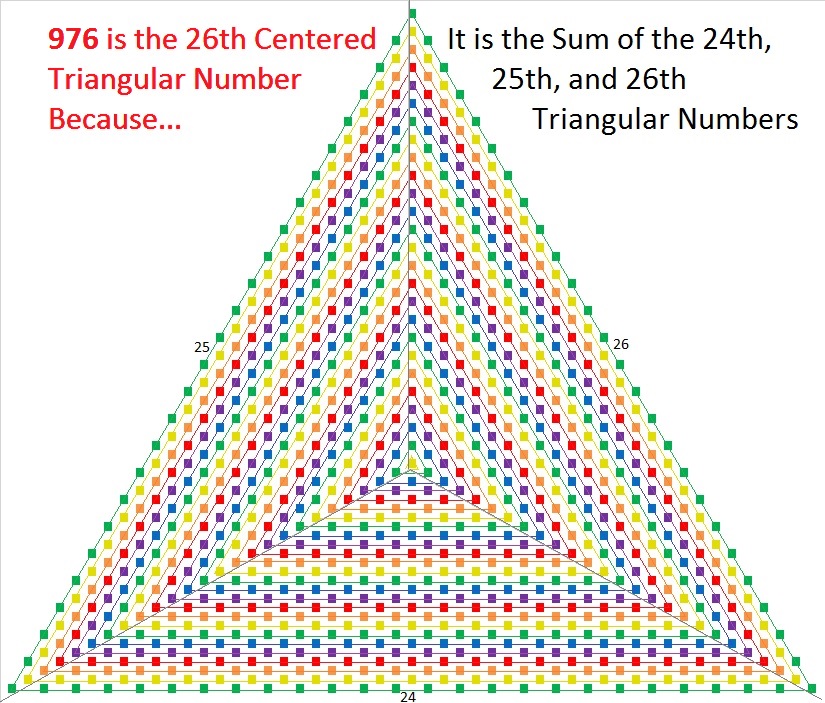
If you look at a list of Centered Triangular Numbers, 976 will be the 26th number on the list. 976 is the sum of the 24th, 25th, and 26th triangular numbers. That means
(24×25 + 25×26 + 26×27)/2 = 976

There’s a formula to compute centered triangular numbers, and this one is found by using
(3(25²) + 3(25) + 2)/2 = 976

As far as the formula is concerned, it is the 25th centered triangular number even though it is the 26th number on the list. I’m calling it the 26th centered triangular number because counting numbers on a list is easier than using a formula.

976 is also the 16th decagonal number because 4(16²) – 3(16) = 976. I couldn’t resist illustrating that 10-sided figure.

16 × 61 is a palindromic expression that happens to equal 976.

976 is also a palindrome when written in some other bases:
It’s 1100011 in BASE 3 because 3⁶ + 3⁵ + 3¹ + 3⁰ = 976,
808 in BASE 11, because 8(11²) + 0(11¹) + 8(11⁰) = 976
1E1 in BASE 25 (E is 14 base 10) because 1(25²) + 14(25¹) + 1(25⁰) = 976

24² + 20² = 976 That makes 976 the hypotenuse of a Pythagorean triple:
176-960-976 calculated from 24² – 20², 2(24)(20), 24² + 20²

  • 976 is a composite number.
  • Prime factorization: 976 = 2 × 2 × 2 × 2 × 61, which can be written 976 = 2⁴ × 61
  • The exponents in the prime factorization are 4 and 1. Adding one to each and multiplying we get (4 + 1)(1 + 1) = 5 × 2 = 10. Therefore 976 has exactly 10 factors.
  • Factors of 976: 1, 2, 4, 8, 16, 61, 122, 244, 488, 976
  • Factor pairs: 976 = 1 × 976, 2 × 488, 4 × 244, 8 × 122, or 16 × 61
  • Taking the factor pair with the largest square number factor, we get √976 = (√16)(√61) = 4√61 ≈ 31.240999

969 is the 17th Tetrahedral Number and the 17th Nonagonal Number

A tetrahedron is a pyramid whose base and sides are all triangles.

The nth tetrahedral number is the sum of the first n triangular numbers. So if you made a pyramid of the first n triangular numbers, you would get the nth triangular pyramidal number, also known as the nth tetrahedral number.

969 is the 17th tetrahedral number.

That image might look a little like a Christmas tree lot where you could select a tree in several different sizes. If we had tiny cubes instead of squares, we could stack them on top of each other to make a tetrahedron. That is the visual reason why 969 is a tetrahedron.

Look at the graphic below of a portion of Pascal’s triangle. You can easily see the first 19 counting numbers. The first 18 triangular numbers are highlighted in red, and the first 17 tetrahedral numbers are highlighted in green. The 16th tetrahedral number, 816, plus the 17th triangular number, 153, equals 969.

Because of its spot on Pascal’s triangle, I know that (17·18·19)/(1·2·3) = 969. That is the algebraic reason 969 is a tetrahedral number.

969 is also the 17th nonagonal number because 17(7·17 – 5)/2 = 969. I am not going to try to illustrate a 9-sided figure, but I’m sure it would be a cool image if I could.

All of this means that 969 is the 17th tetrahedral number AND the 17th nonagonal number. 1 is the smallest number to be both a tetrahedral number and a nonagonal number. 969 is the next smallest number to be both. Amazingly, it is the 17th of both, too!

969 obviously is a palindrome in base 10.

In base 20, it is 289. I find that quite curious because 17² = 289, and 17 is a factor of 969. Why would we write this number as 289 in base 20? Because 2(20²) + 8(20) + 9(1) = 969

Because 17 is one of its factors, 969 is the hypotenuse of a Pythagorean triple:
456-855-969 which is 57 times (8-15-17)

  • 969 is a composite number.
  • Prime factorization: 969 = 3 × 17 × 19
  • The exponents in the prime factorization are 1, 1, and 1. Adding one to each and multiplying we get (1 + 1)(1 + 1)(1 + 1) = 2 × 2 × 2 = 8. Therefore 969 has exactly 8 factors.
  • Factors of 969: 1, 3, 17, 19, 51, 57, 323, 969
  • Factor pairs: 969 = 1 × 969, 3 × 323, 17 × 57, or 19 × 51
  • 969 has no square factors that allow its square root to be simplified. √969 ≈ 31.12876


Reasons to Celebrate 968

9 – 6 + 8 = 11, so 968 is divisible by 11. In fact, 11 is its largest prime factor so we can make a beautiful factor cake for 968 with two candles on top.

Guess what, 968 is also divisible by 11², so its factor cake can have even more candles!

Look at its factor cake. Notice that each of 968’s prime factors is repeated at least once. 2³ × 11² = 968

OEIS.org alerts us to the fact that 968 is the twelfth Achilles number. That means that each of its prime factors has an exponent greater than one yet the greatest common factor of those exponents is still one. (Perfect squares, cubes, etc. are not Achilles numbers.)

There are thirteen Achilles numbers less than 1000. Here is a chart of them and their prime factorizations. These numbers appear to be few and far between. The previous Achilles number was 104 less than 968, but the next one is only 4 numbers away!

Being only 4 numbers away is pretty amazing. Consecutive Achilles numbers actually exist. You can find the smallest pair of them in the Wikipedia article. Both numbers are greater than 5 billion. Again, being only 4 numbers away is pretty amazing.

The smallest Achilles number made with three different prime numbers raised to various powers is 2³·3²·5² = 1800. Notice that each exponent is greater than one yet the greatest common factor of those exponents is still one.

Here’s a little more about the number 968:

I like the way 968 looks in a few other bases:
It’s 2552 in BASE 7 because 2(7³) + 5(7²) + 5(7¹) + 2(7⁰) = 968,
800 in BASE 11 because 8(11²) = 8(121) = 968,
242 in BASE 21 because 2(21²) + 4(21¹) + 2(21⁰) = 968,
200 in BASE 22 because 2(22²) = 2(484) = 968.

  • 968 is a composite number.
  • Prime factorization: 968 = 2 × 2 × 2 × 11 × 11, which can be written 968 = 2³ × 11²
  • The exponents in the prime factorization are 3 and 2. Adding one to each and multiplying we get (3 + 1)(2 + 1) = 4 × 3 = 12. Therefore 968 has exactly 12 factors.
  • Factors of 968: 1, 2, 4, 8, 11, 22, 44, 88, 121, 242, 484, 968
  • Factor pairs: 968 = 1 × 968, 2 × 484, 4 × 242, 8 × 121, 11 × 88, or 22 × 44
  • Taking the factor pair with the largest square number factor, we get √968 = (√484)(√2) = 22√2 ≈ 31.11269837


967 Black Friday Shopping Advantage

If your shopping cart were a go-kart, you would have an advantage getting all the shopping bargains Black Friday offers. Not only would you be able to move much faster than the average shopping cart, but you would also be able to do wheelies to get through the crowds, around corners, or tight spaces. After you complete the shopping spree of your dreams, you can lie down exhausted, but ecstatic and work on a puzzle, like this one.

Print the puzzles or type the solution in this excel file: 12 factors 959-967

I realize I’m really pushing it to make this puzzle have a Thanksgiving week theme. I love that Black Friday has turned into Black November because it means bargains without all the crowds.

You can also imagine the puzzle is a toy on a child’ wishlist. Whatever you think, I hope you enjoy solving the puzzle.

Here’s a little about prime number 967:

It is 595 in BASE 13 because 5(13²) + 9(13¹) + 5(13⁰) = 967
It is also 1J1 in BASE 23 (J is 19 in base 10) because 1(23²) + 19(23¹) + 1(23⁰) = 967

  • 967 is a prime number.
  • Prime factorization: 967 is prime.
  • The exponent of prime number 967 is 1. Adding 1 to that exponent we get (1 + 1) = 2. Therefore 967 has exactly 2 factors.
  • Factors of 967: 1, 967
  • Factor pairs: 967 = 1 × 967
  • 967 has no square factors that allow its square root to be simplified. √967 ≈ 31.09662

How do we know that 967 is a prime number? If 967 were not a prime number, then it would be divisible by at least one prime number less than or equal to √967 ≈ 31.1. Since 967 cannot be divided evenly by 2, 3, 5, 7, 11, 13, 17, 19, 23, 29, or 31, we know that 967 is a prime number.

961 is a Perfect Square in More Ways Than One

961 is a perfect square. Its square root is 31. Look what happens when their digits are reversed. We still get a perfect square!

The digits 1, 6, and 9 form six different 3-digit numbers when each of those digits is used only one time. Here are some square facts about each of those numbers:

169 = 13²
196 = 14²
619 = 310² – 309²
691 = 346² – 345²
916 = 30² + 4²
961 = 31²

Of course, 169 also equals 5² + 12²

So 961 is a perfect square forward, backward, and upside-down!

My friend, Muthu Yuvaraj, shared a couple of similar square facts with me:

and

Fascinating!

Here’s more information about perfect square 961:

It is the sum of three consecutive square numbers:
313 + 317 + 331 = 961

It is the sum of five consecutive square numbers:
181 + 191 + 193 + 197 + 199 = 961

And it is the sum of the twenty-three prime numbers from 3 to 89.

It is palindrome 12321 in BASE 5 because 1(5⁴) + 2(5³) + 3(5²) + 2(5¹) + 1(5⁰) = 961

961 is a perfect square in base 10, and it looks like a perfect square in some other bases, too:
100 in BASE 31 because 1(31²) = 961
121 in BASE 30 because 1(30²) + 2(30¹) + 1(30⁰) = 961
144 in BASE 29 because 1(29²) + 4(29¹) + 4(29⁰) = 961
169 in BASE 28 because 1(28²) + 6(28¹) + 9(28⁰) = 961
441 in BASE 15 because 4(15²) + 4(15¹) + 1(15⁰) = 961
Remarkably, we saw 961, 169, 144, and 441 already in graphics for this post! So here’s one more graphic:

  • 961 is a composite number.
  • Prime factorization: 961 = 31²
  • The exponent in the prime factorization is 2. Adding one we get (2 + 1) = 3. Therefore 961 has exactly 3 factors.
  • Factors of 961: 1, 31, 961
  • Factor pairs: 961 = 1 × 961 or 31 × 31
  • 961 is a perfect square. √961 = 31

951 is the 20th Centered Pentagonal Number

Since 951 is the 20th centered pentagonal number, I decided to make the following graphic with 20 concentric pentagons. I’ve outlined the pentagons in the center to make them clearer. The graphic also shows that 951 is one more than five times the 19th triangular number.

951 is also the hypotenuse of a Pythagorean triple:
225-924-951 which is 3 times (75-308-317)

As numbers get bigger, palindromes in base 2 get rarer, but 951 is one of them:
1110110111 in BASE 2 because 1(2⁹) + 1(2⁸) + 1(2⁷) + 0(2⁶) + 1(2⁵) + 1(2⁴) + 0(2³) + 1(2²) + 1(2¹) +1(2⁰) = 951
It is also 1D1 in BASE 25 (D is 14 base 10) because 1(25²) + 13(25¹) + 1(25⁰) = 951

  • 951 is a composite number.
  • Prime factorization: 951 = 3 × 317
  • The exponents in the prime factorization are 1 and 1. Adding one to each and multiplying we get (1 + 1)(1 + 1) = 2 × 2 = 4. Therefore 951 has exactly 4 factors.
  • Factors of 951: 1, 3, 317, 951
  • Factor pairs: 951 = 1 × 951 or 3 × 317
  • 951 has no square factors that allow its square root to be simplified. √951 ≈ 30.83828789