120 and Level 5

Today’s Puzzle:

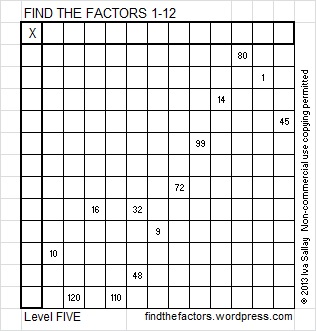
Write the numbers from 1 to 10 in both the top row and the first column so that this puzzle functions like a multiplication table.

2014-19 Level 5

Excel file of this week’s puzzles and last week’s factors: 10 Factors 2014-05-12

Thinking process using divisibility rules to find the factor pairs of 120:

√120 is irrational and approximately equal to 10.95. Every factor pair of 120 will have one factor less than 10.95 and one factor greater than 10.95, and we will find both factors in each pair at the same time. The following numbers are less than 10.95. Are they factors of 120?

  1. Yes, all whole numbers are divisible by 1, so 1 x 120 = 120.
  2. Yes, 120 is an even number. 120 ÷ 2 = 60, so 2 x 60 = 120. (Since 60 is even, 4 will also be a factor of 120.)
  3. Yes, 1 + 2 + 0 = 3 which is divisible by 3 (but not by 9), so 120 is divisible by 3. 120 ÷ 3 = 40, so 3 x 40 = 120. Note 120 will not be divisible by 9.
  4. Yes, the number formed from its last two digits, 20, is divisible by 4, so 120 is divisible by 4, and 4 x 30 = 120. (Note since 30 is even, 8 will also be a factor of 120.)
  5. Yes, the last digit is 0 or 5, so 120 is divisible by 5, and 5 x 24 = 120.
  6. Yes, 120 is divisible by both 2 and 3, so it is divisible by 6, and 6 x 20 = 120.
  7. No. The divisibility trick for 7 requires us to split 120 into 12 and 0. We double 0 and subtract the double from 12. 12 – (2 x 0) = 12 – 0 = 12. Since 12 is not divisible by 7, 120 also is not divisible by 7.
  8. Yes, see 4 above. 120 = 8 x 15. (This will mean that ANY number whose last 3 digits are 120 will also be divisible by 8.)
  9. No, see 3 above. 120 is not divisible by 9.
  10. Yes, 120 ends with a zero, so 10 is a factor of 120, and 10 x 12 = 120.

From this thinking process we conclude that the factor pairs of 120 are 1 x 120, 2 x 60, 3 x 40, 4 x 30, 5 x 24, 6 x 20, 8 x 15, and 10 x 12.

Factors of 120:

120  is a composite number. 120 = 1 x 120, 2 x 60, 3 x 40, 4 x 30, 5 x 24, 6 x 20, 8 x 15, or 10 x 12. Factors of 120: 1, 2, 3, 4, 5, 6, 8, 10, 12, 15, 20, 24, 30, 40, 60, 120. Prime factorization: 120 = 2 x 2 x 2 x 3 x 5, which can also be written 120 = 2³ x 3 x 5.

When 120 is a clue in the FIND THE FACTORS 1 – 12 puzzles, use 10 and 12 as the factors.

Sum-Difference Puzzle:

30 has four factor pairs. One of those factor pairs adds up to 13, and another one subtracts to 13. Can you write those factors in their proper places in the first puzzle below?

120 has eight factor pairs. One of those factor pairs adds up to 26, and another one subtracts to 26. If you can identify those factor pairs, then you can solve the second puzzle!

The second puzzle is really just the first puzzle in disguise. Why would I say that?

More about the Number 120:

120 = 5! because 1·2·3·4·5 = 120

120 is also the smallest positive multiple of 6 that is neither preceded nor followed by a prime number! (119 = 7 ×1 7, and 121 = 11 × 11, so neither one is prime.)

What kind of shape is 120 in?

  • 120 is the 15th triangular number because 15(16)/2 = 120,
    it’s the 8th tetrahedral number because (8)(9)(10)/6 = 120 (That means
  • 120 is the sum of the first eight triangular numbers), and
  • it is the 8th hexagonal number because (8)(2·8-1) = 120.

120 is the hypotenuse of a Pythagorean triple:
72-96-120, which is 24 times (3-4-5).

A Logical Way to Find the Solution to Today’s Puzzle:

2014-19 Level 5 Logic

33 and Some Divisibility Tricks for 3 and 9

33 is a composite number. 33 = 1 x 33 or 3 x 11. Factors of 33: 1, 3, 11, 33. Prime factorization: 33 = 3 x 11.

When 33 is a clue in the FIND THE FACTORS 1 – 12 puzzles, always use 3 and 11 as the factors.

———————————————————————————-

What patterns do you see in the following chart?

multiples of 9 chart

Probably you noticed or a teacher taught you the easy way to remember what 9 times a numbers from one to ten is just as the chart illustrates.

Did you also ever notice that if you add up the digits of the multiples of 9 in the multiplication table, you get 9?

What is really great is if you add up the digits of ANY multiple of 9, you’ll get 9 or some other multiple of 9! This is called a divisibility trick because it is a way to find out if a number is divisible by 9 without actually dividing by 9.

The same trick works on multiples of 3: If you add up the digits of a multiple of 3, you will get 3 or some other multiple of 3! Lets apply these divisibility tricks to a few numbers:

Is 243 divisible by 3 or 9? We don’t have to divide to know the answer:

2 + 4 + 3 = 9, which is divisible by both 3 and 9, so, yes, 243 is divisible by both 3 and 9.

If you do the actual division:

  • 243 ÷ 3 = 81
  • 243 ÷ 9 = 27.

————————————————————

Is 582 divisible by 3 or by 9? Add up the digits to find out: 5 + 8 + 2 = 15.

Since 15 is divisible by 3, but not by 9, we know 582 is divisible by 3, but not by 9.

If you do the actual division:

  • 582 ÷ 3 = 194
  • 582 ÷ 9 = 64 Remainder 6.

When we added the digits of 582, we got 15. Notice that 1 + 5 = 6, the remainder when we divided 582 by 9.

When you add up the digits of a number until you have only one digit left, if that digit is not 9, then that number is the remainder you would get if you did the actual division!

——————————————————————————–

Now let’s see if 1753 is divisible by 3 or 9.

1 + 7 + 5 + 3 = 16; 1 + 6 = 7.

7 cannot be evenly divided by 3 or 9, so 1753 is not divisible by 3 or 9.

If you do the actual division:

  • 1753 ÷ 9 = 194 Remainder 7 (the same 7 that equals 1 + 6 above).
  • 1753 ÷ 3 = 584 Remainder 1

Notice that 7 ÷ 3 = 2 Remainder 1

——————————————————————————–

All of these problems demonstrate that if you add the digits of a number until you are left with a single digit, if that digit is 3, 6, or 9, then the original number is divisible by 3.

The last problem demonstrates that if you divide that single digit by 3, the remainder will be the same if you divided the original number by 3.

These divisibility tricks for 3 and 9 can give quite a bit of valuable information!


21 Factors of the Year 2013 and 2014

21 is a composite number. 21 = 1 x 21 or 3 x 7. Factors of 21: 1, 3, 7, 21. Prime factorization: 21 = 3 x 7.

When 21 is a clue in the FIND THE FACTORS puzzles, use 3 x 7.

Scroll down the page to find factoring information about 2013 and 2014.

2013 year

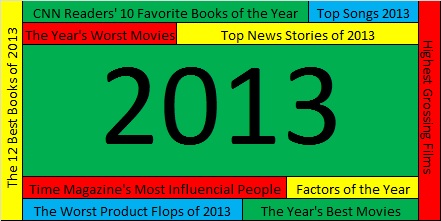
Near the end of each year movie critics make lists of the ten best movies and the ten worse movies of the year. News agencies list the ten most significant news stories. Time magazine lists the ten most influential people of the year. The music industry lists the top ten songs of the year. As 2013 draws to a close, it is most appropriate for me to review the factors of the year.

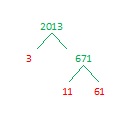
2013 had exactly 8 positive factors. These factors were 1, 3, 11, 33, 61, 183, 671, and 2013.

There is no room for argument. I am absolutely certain this list is complete. No one will make any comments disagreeing with me, calling me names, or asking how I could have left Two or Five or Seven off the list. Also no one will wonder why I would include forgettable 671 on the list. Do the Math. 671 was clearly a factor in 2013. Three of the factors of 2013 were also prime factors. They were 3, 11, and 61. This graphic clearly shows those prime factors.

2013 tree

2013 also had 8 negative factors. The first negative factor on the list is no surprise: Minus One. Year in and year out we can count on Minus One being a negative factor. Some other factors were just as negative in 2013, namely -3, -11, -33, – 61, -183, -671, and -2013. Of course, many of those factors were so obscure that most people never gave them a second thought all year long. Again I expect no arguments or negative comments on these selections. Anyone who knows anything about factors will have to agree with this list.

Even though 2014 hasn’t even started, I am going to predict the factors of 2014, and I am absolutely positive that my predictions will be 100% correct. You will not even have to wait until the end of 2014 to verify my accuracy.

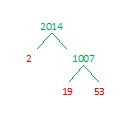
The positive factors of 2014 will be (drum roll) 1, 2, 19, 38, 53, 106,1007, and 2014.

Most people expect the number One to be a positive factor every single year, and it will not let us down in 2014. The number Two has a reputation of being a factor only about half the time. Since she was not a factor at all in 2013, I am confident that she will get her act together again in 2014 and become a factor once more. All the other factors I’ve listed have not been factors for a very long time, and each one of them is due to make a difference over and over again in 2014 until they have nothing leftover. I predict that 2014 will have three prime factors, namely 2, 19, and 53, as illustrated in the following graphic.

2014 tree

How can I make such accurate assessments and spot on predictions? I will tell you: I work with factors almost every single day, and I’ve spent years observing them. Every time I have been given an assignment to become acquainted with them, I have approached that assignment with enthusiasm and determination.

Regardless of my astounding record, YOU can become just as much an expert as I am with just a little bit of knowledge and effort. You may discover, as I have, that factoring can be great fun. Here are a couple of logic puzzles that require factoring to solve: 

2013-12-30.22013-12-30.3

All you have to do to solve one of the puzzles is write the numbers 1 – 12 in the top row and again in the first column so that those numbers are the factors of the given clues. Each puzzle has only one solution.

At the top of this post is a page titled How to Find the Factors, and it gives hints to solve the puzzles.   Click 12 Factors 2013-12-30 to find a printable version of these and a few other puzzles as well as the solutions for last week’s puzzles. Excel or comparable spreadsheet program is needed to open the file.

Have a great 2014 and happy factoring!

Related Articles

15 is the Magic Sum of a 3 x 3 Magic Square

15 is a composite number. 15 = 1 x 15 or 3 x 5. Factors of 15: 1, 3, 5, 15. Prime factorization: 15 = 3 x 5.

When 15 is a clue in the FIND THE FACTORS 1 – 10 or 1 – 12 puzzles, use 3 and 5 as the factors.

If you added the first nine counting numbers together, what sum would you get? What is 1 + 2 +3 + 4+ 5 + 6 + 7 + 8 + 9?

Would you get the same answer by adding (1 + 9) + (2 + 8) + (3 +7) + (4 + 6) + 5?

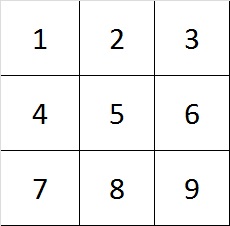
These are two of the many fun questions you can explore when you try to make a magic square. What is a magic square? If you can place the numbers from 1 to 9 in the box below so that the sum of any row, column, or diagonal will equal the sum of any other row, column, or diagonal, then you will have made a 3 x 3 magic square. The sum of a row, column, or diagonal in a magic square is called the magic sum.

1-9

Clearly it is not a magic square yet. In fact, only one of the numbers is positioned where it needs to be. Which number do you think is already in the correct position?

When it becomes a magic square, what will the magic sum be? One student noticed that in its current state the sums of the rows are 6, 15, and 24. The sums of the columns are 12, 15, 18. The sums of the diagonals are 15 and 15. Since 15 occurs most often, could the magic sum be 15? One way to determine what the magic sum should be is to add the sums of all three rows and then divide by the number of rows. Since 1 + 2 + 3 + 4 + 5 + 6 + 7 + 8 + 9 = 45 and 45 ÷ 3 = 15, then 15 is indeed the magic sum.

Here are a few easy-to-remember steps to construct a 3 x 3 magic square quickly.

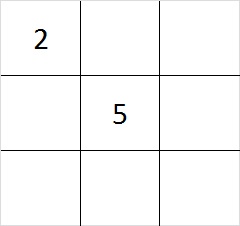
Step 1: Draw a tic-tac-toe board and put 5 in the middle.

step 1 magic

Step 2: Put one of the even numbers in one of the corners.  You have four different choices, 2, 4, 6, or 8. The illustration is for the number 2, but any of the even numbers will work.

step 2 magic

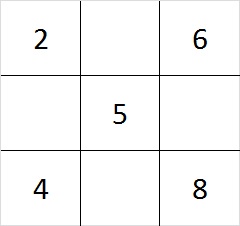
Step 3: Subtract your even number from 10 to find its partner. 4 + 6 are partners and so are 2 + 8. Put the partner of the number you chose for step 1 in the corner that is diagonal to it.

step 1 magic

Step 4: Put the other two even numbers in the remaining corners. Yes, you have two choices where to put the numbers. Either choice will work.

step 4 magic

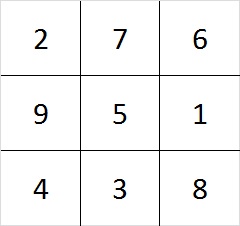
Step 5: Since 6 + 8 = 14 and 15 – 14 = 1, put 1 in the cell between the 6 and the 8. Do similar addition and subtraction problems on each side of the square to determine where to place the 3, 7, and 9. You can work clockwise or counter clockwise, or skip around the square doing the addition and subtraction problems; it doesn’t matter.

This finished magic square looks like this:

step 5 magic

Check it out! Every row, column, and diagonal adds up to 15!

As we created the square, we made choices. First we chose between 4 even numbers, and later we had 2 more choices. Notice that 4 x 2 = 8. There are 8 different ways to make a 3 x 3 magic square! (However, they are all really the same square turned upside down, rolled on its side, viewed from the back. etc.)

There are 880 different ways to make a 4 x 4 magic square. Look over the related articles at the end of this post to learn more about magic squares that are bigger than 3 x 3.

Speaking of magic squares, when I look at the square logic puzzle below, something magical happens. This puzzle has nine clues in it, and all of them are perfect squares. I can use those nine clues to construct a complete multiplication table. If you finish the same puzzle, your multiplication table will look exactly like mine because this puzzle has only one solution.

2014-01-06.1

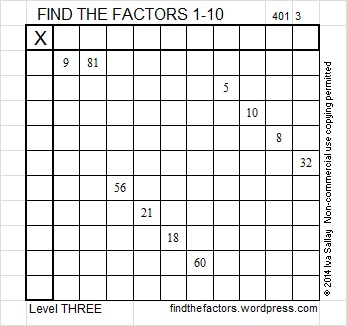
The level 3 puzzle below is only a little bit more difficult. To solve it place the numbers 1 – 10 in the top row and again in the first column so that those placed numbers are the factors of the given clues. Again there is only one solution, and you will need to use logic to find it. Click 10 Factors 2014-01-06 for more puzzles and last week’s answers.

2014-01-06.3

May we all find a little bit more magic in our lives!


14 Oh Christmas Tree

14 is a composite number. 14 = 1 x 14 or 2 x 7. Factors of 14: 1, 2, 7, 14. Prime factorization: 14 = 2 x 7.

When 14 is a clue in the FIND THE FACTORS  1 – 10 or 1 – 12 puzzles, use 2 and 7 as the factors.

O Christmas Tree, O Christmas Tree,

How lovely are your branches…

Do Christmas factor trees have lovely branches?  It depends on how they are constructed. For example here are 2 of the many possible factor trees for 1680. I think one of them is more lovely than the other.

1680.21680.1

This blog is actually about a logic puzzle that is based on the multiplication table. Today we have puzzles that look like Christmas trees, garland, lights, or blocks and a bright star for the very top.

Directions to solve the puzzles: In both the top row and the first column place the numbers 1 – 10 so that they are factors of the given clues. It may be more challenging than you think, especially for the higher level puzzles. If you click 10 Factors 2013-12-09, you can print the puzzles in color or black and white from an excel spreadsheet or you can type the answers directly on the spreadsheet. You must have a spreadsheet program on your device to access the file.

2013-12-09.12013-12-09.2

2013-12-09.32013-12-09.4

2013-12-09.52013-12-09.6

6 A Piece of Cake

Birthday Puzzles for My Daughter:

Happy birthday, Kathy! I hope your day is wonderful. You have grown into a beautiful, talented, prayerful, intelligent, hard-working, and loving young woman.  I am grateful you are my daughter.  So for your birthday today and for this blog, I’ve created three special puzzles: the first is a birthday cake to celebrate your happy day. To highlight your love of music, the second puzzle is a quarter note. The third puzzle is either a violin, a guitar, or a ukulele, you decide. I love listening as you sing or as you play any of those instruments or the piano. Today for your birthday I will also cut down a tree and make yet another cake with two birthday candles on top in this blog post.  So have a fun birthday, today.  I love you.

Birthday cake

Click 12 Factors 2013-11-14 for more puzzles.

quarter note

Factor Trees vs. Factor Cakes:

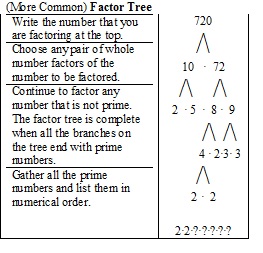
What did I mean by cutting down a tree and making yet another cake? Today I will discuss two methods for finding the prime factors of a whole number. One method is making a factor tree and the other is the cake method. To factor a number means to write it as the product of two or more factors. When those two or more factors are all prime factors, it is called a prime factorization of the number. A composite number always has more than two factors. A prime number always has exactly 2 factors, 1 and itself. (ZERO and ONE are neither prime or composite numbers.) Usually, to find the prime factors of a number, a person will usually make a factor tree. The following example shows how this is done:

factor tree

From this example, you can certainly understand why this algorithm is called a factor tree.  It looks exactly like a perfectly-shaped evergreen tree.  The problem is that a factor tree doesn’t always look so neat and trim.  Here is a factor tree that even Charlie Brown wouldn’t choose:

more common factor tree

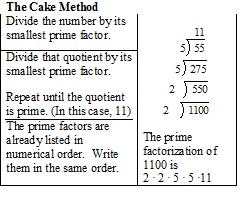
720 isn’t even that big of a number, but gathering all of the prime numbers from the factor tree and putting them in numerical order would be like picking up a bunch of scattered leaves. It would be like doing . . . yard work.  Imagine if you had a number that had many more factors. If one or two of the factors gets lost in the mess, your answer wouldn’t be correct. Notice that some of the prime factors of 720 (2,2,2,2,3,3,5) are not as easy to see as others on the factor tree.  That is why I want to chop down that tree. Even if you like to do yard work, do you really want to deal with that big of a mess, . . . especially when you can have cake instead?  Look, the cake method is so much more pleasing to the eye, and it is simply an extension of the very familiar division algorithm:

Cake method

With the cake method, the more factors you have, the bigger the cake will be, but it will always be neatly organized with all the factors on the outside of the cake.  And if the largest prime factor of your given number is eleven, you will also have two candles on top of your cake!  I find using the cake method to be much less confusing than using a factor tree.  Yes, finding prime factors can actually be a piece of cake. The only disadvantage to the cake method is that since you work from the bottom up you have to leave enough space for the cake to rise.

Still, in spite of my opinion, it is best to use whichever method you are more comfortable with.

Now if your appetite for cake has not been satisfied, click on one of the links below for a nice variety of cakes shared by other bloggers.

Factors of the Number 6:

6 is a composite number. 6 = 1 x 6 or 2 x 3. Factors of 6: 1, 2, 3, 6. Prime factorization: 2 x 3.

When 6 is a clue in the FIND THE FACTORS  puzzle, the pair that will work for that particular puzzle might be 1 x 6, or it might be 2 x 3.

A Sum-Difference Puzzle Featuring the Number 6 and its Factors:

Look at the factor pair puzzle above. Perhaps you will notice that
2 + 3 = 5 and 6 – 1 = 5.
Those are the facts you need to complete the Sum-Difference puzzle below.

5 Easy as 1-2-3

  • 5 is a prime number.
  • Prime factorization: 5 is prime.
  • The exponent of prime number 5 is 1. Adding 1 to that exponent we get (1 + 1) = 2. Therefore 5 has exactly 2 factors.
  • Factors of 5: 1, 5
  • Factor pairs: 5 = 1 x 5
  • 5 has no square factors that allow its square root to be simplified. √5 ≈ 2.236.

How do we know that 5 is a prime number? If 5 were not a prime number, then it would be divisible by at least one prime number less than or equal to √5 ≈ 2.2. Since 5 cannot be divided evenly by 2, we know that 5 is a prime number.

5 is the only number that is the sum of ALL the prime numbers less than itself.

2² + 1² = 5 and 3² + 4² = 5² so 5 is the smallest Pythagorean triple hypotenuse.

When 5 is a clue in a FIND THE FACTORS puzzle, use 1 for one of the factors and 5 for the other.

Being able to identify factors of a whole number is a very important skill in mathematics.  It is a skill that is commonly used in many areas of mathematics ranging from reducing fractions to solving differential equations.  The Find the Factors puzzles can help make that skill second nature.

2013-11-11

Click 10 Factors 2013-11-11 for more puzzles.

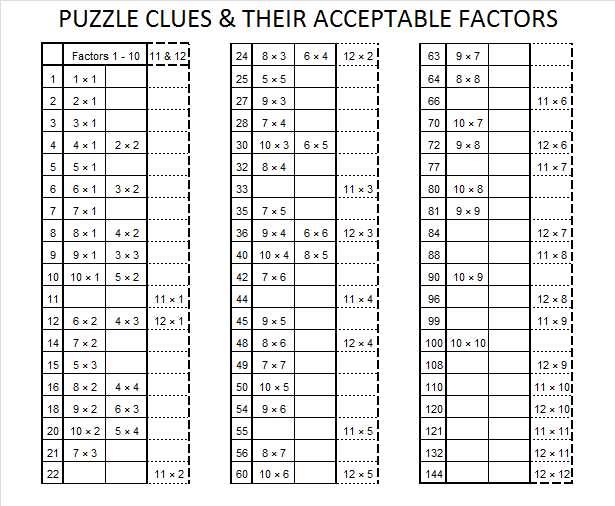
To solve the puzzles, we are only interested in the limited set of factors that are represented in the following table:

Puzzle Clues Chart

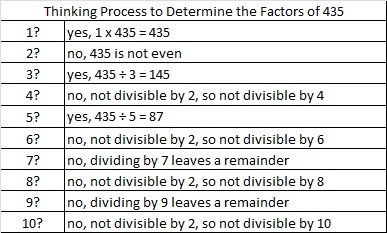
What about all the other factors of these numbers?  And what about all the other whole numbers not on the chart?  How do you find ALL of the factors of a given whole number?  For example, suppose you were asked to find all of the factors of 435.  Some people might notice right away that it is divisible by 5 because its last digit is 5.  While that is true, beginning with 5 is not the best place to start because there is an advantage in considering all possible factors in an organized way.  When you are asked to find ALL of the factors of any number, starting at 1 will make finding all of the factors as easy as 1-2-3. So what are the factors of 435?  Using a calculator, I notice that the square root of 435 is about 20.85.  That means I can find absolutely all of the factors of 435 by considering as  divisors just the whole numbers from 1 to 20!  Each factor will have a partner that is greater than 20 but will be found at the same time with these few short calculations. To demonstrate my thinking process, I will put each possible factor from 1 to 20 in a chart and write my thoughts as I consider each one.

Thinking part 1

Thinking part 2

As you may notice, once a possible factor is eliminated, it is not necessary to do any actual division by ANY of the multiples of that number. (4, 6, 8, 10, 12, 14, 16, 18, and 20 are all multiples of 2, which was not a factor, so I didn’t actually divide 435 by any of those multiples.)

As I carefully consider each possible factor, I only WRITE DOWN a number if it is an actual factor.  Therefore, with only a little bit of effort I would list ALL of the factors of 435 in one tidy list: 1 x 435, 3 x 145, 5 x 87, 15 x 29.
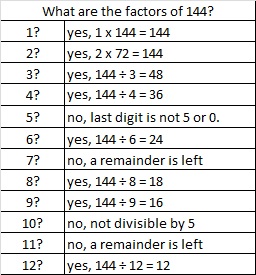
See, it was as easy as 1-2-3!  Now let’s find all of the factors of 144.

factors of 144

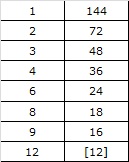
Even though 144 is less than 435, it has more factors. One of its factors is paired with itself because the square root of 144  is 12.  That fact is also the signal that we can stop looking for more factors, and we can list all the factors of 144 on the following chart:

144 table

There are 8 multiplication facts that produce 144, but 12 x 12 = 144 is the only fact we consider when solving a Find the Factors 1-12 puzzle with 144 as one of the clues. In every other case one of the pair of numbers in the multiplication fact will be greater than 12 and not eligible to be written in the factor row or factor column. However in solving mathematical problems, any of the factors of a whole number could be the star of the show. Knowing how to find those factors is indeed an important skill and is as easy as 1-2-3.