1333 and Level 1

How well do you know the multiplication table? If you don’t know it very well, this puzzle can be a fun, no-pressure way to get more familiar with it. Give it a try!

Print the puzzles or type the solution in this excel file: 12 factors 1333-1341

Now I’ll share some facts about the puzzle number, 1333:

  • 1333 is a composite number.
  • Prime factorization: 1333 = 31 × 43
  • The exponents in the prime factorization are 1 and 1. Adding one to each and multiplying we get (1 + 1)(1 + 1) = 2 × 2 = 4. Therefore 1333 has exactly 4 factors.
  • Factors of 1333: 1, 31, 43, 1333
  • Factor pairs: 1333 = 1 × 1333 or 31 × 43
  • 1333 has no square factors that allow its square root to be simplified. √1333 ≈ 36.51027

1333 is the difference of two squares two different ways:
667²-666² = 1333
37² – 6² = 1333

1332 Yet Another Christmas Tree


Here is yet another Christmas tree for you to enjoy this holiday season.

Print the puzzles or type the solution in this excel file:10-factors-1321-1332

Here are a few facts about the number 1332:

  • 1332 is a composite number.
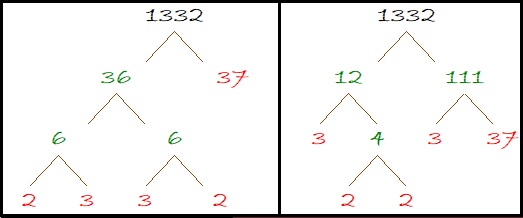
  • Prime factorization: 1332 = 2 × 2 × 3 × 3 × 37, which can be written 1332 = 2² × 3² × 37
  • The exponents in the prime factorization are 2, 2 and 1. Adding one to each and multiplying we get (2 + 1)(2 + 1)(1 + 1) = 3 × 3 × 2 = 18. Therefore 1332 has exactly 18 factors.
  • Factors of 1332: 1, 2, 3, 4, 6, 9, 12, 18, 36, 37, 74, 111, 148, 222, 333, 444, 666, 1332
  • Factor pairs: 1332 = 1 × 1332, 2 × 666, 3 × 444, 4 × 333, 6 × 222, 9 × 148, 12 × 111, 18 × 74 or 36 × 37
  • Taking the factor pair with the largest square number factor, we get √1332 = (√36)(√37) = 6√37 ≈ 36.49658

Here are a couple of factor trees for 1332:

Since 36 × 37 = 1332, we know that 1332 is the sum of the first 36 even numbers. (The first 36 numbers add up to the infamous 666, and 2 times 666 is 1332.)

Because 1332 is divisible by both 3 and 37, it has several repdigits as factors, 111, 222, 333, 444, and 666.

1332 is the sum of four consecutive prime numbers:
317 + 331 + 337 + 347 = 1332

1332 is the sum of two square numbers:
36² + 6² = 1332

1332 is the hypotenuse of a Pythagorean triple:
432-1260-1332 which is 36 times (12-35-37)
It can also be calculated from 2(36)(6), 36² – 6², 36² + 6²

What 1331 in Pascal’s Triangle Means

1331 is the third row of Pascal’s triangle. What does that mean?
It means that 11³ = 1331,
and it means that 1 + 3 + 3 + 1 = 8 = 2³
Those third powers are not a coincidence.

It means that (x + y)³ = 1x³yº + 3x²y¹ + 3x¹y² + 1xºy³ or written more simply,
(x + y)³ = x³ + 3x²y¹ + 3x¹y² + y³

Likewise, (x – y)³ = 1x³yº – 3x²y¹ + 3x¹y² – 1xºy³ or simply
(x – y)³ = x³ – 3x²y¹ + 3x¹y² – y³

It also means that if you flip a coin three times, you’ll get
three heads and no tails 1 way: (HHH),
two head and one tail 3 ways: (HHT); (HTH); (THH),
one head and two tails 3 ways: (HTT); (THT); (TTH), and
no heads and three tails 1 way: (TTT).

That’s just some of what that third row being 1331 means but here are a few more facts about the number 1331.

  • 1331 is a composite number.
  • Prime factorization: 1331 = 11 × 11 × 11, which can be written 1331 = 11³
  • The exponent in the prime factorization is 3. Adding one, we get (3 + 1) = 4. Therefore 1331 has exactly 4 factors.
  • Factors of 1331: 1, 11, 121, 1331
  • Factor pairs: 1331 = 1 × 1331 or 11 × 121
  • Taking the factor pair with the largest square number factor, we get √1331 = (√121)(√11) = 11√11 ≈ 36.48287
  • 1331 is a perfect cube.

1331 is cool in some other bases, too:
It is 1000 in BASE 11, and
it’s 131 in BASE 35

1330 is the 19th tetrahedral Number

The product of any three consecutive counting numbers is always divisible by 6. Why? Because one of the numbers has to be divisible by 3 and at least one number has to be divisible by 2. Dividing the product by 6 always results in a  tetrahedral number. 1330 is a good example:
(19)(20)(21)/6 = 1330

Since the first number in that product was 19, we know that 1330 is the 19th tetrahedral number, and it is the sum of the first 19 triangular numbers:

You can count all 1330 little green squares if you want in the graphic above if you choose.

Here are some more facts about the number 1330:

  • 1330 is a composite number.
  • Prime factorization: 1330 = 2 × 5 × 7 × 19
  • The exponents in the prime factorization are 1, 1, 1, and 1. Adding one to each and multiplying we get (1 + 1)(1 + 1)(1 + 1)(1 + 1) = 2 × 2 × 2 × 2 = 16. Therefore 1330 has exactly 16 factors.
  • Factors of 1330: 1, 2, 5, 7, 10, 14, 19, 35, 38, 70, 95, 133, 190, 266, 665, 1330
  • Factor pairs: 1330 = 1 × 1330, 2 × 665, 5 × 266, 7 × 190, 10 × 133, 14 × 95, 19 × 70, or 35 × 38
  • 1330 has no square factors that allow its square root to be simplified. √1330 ≈ 36.46917

1330 is the sum of the twenty-two prime numbers from 17 to 107. How cool is that?

1330 is the hypotenuse of a Pythagorean triple:
798-1064-1330 which is (3-4-5) times 266

1329 Flight Plans

Many people fly home or away from home for the holidays. Here’s a puzzle to occupy some of your time while you’re in flight.

Print the puzzles or type the solution in this excel file:10-factors-1321-1332

Now I’ll write a little bit about the number 1329:

  • 1329 is a composite number.
  • Prime factorization: 1329 = 3 × 443
  • The exponents in the prime factorization are 1 and 1. Adding one to each and multiplying we get (1 + 1)(1 + 1) = 2 × 2 = 4. Therefore 1329 has exactly 4 factors.
  • Factors of 1329: 1, 3, 443, 1329
  • Factor pairs: 1329 = 1 × 1329 or 3 × 443
  • 1329 has no square factors that allow its square root to be simplified. √1329 ≈ 36.45545


1329 is divisible by 3 because it is made with three consecutive numbers (1, 2, 3) and 9, a number divisible by 3.

1329 looks interesting in some other bases:
It’s 929 in BASE 12,
369 in BASE 20
234 in BASE 25

1328 Christmas Tree


Can you figure out where to put the numbers from 1 to 10 in both the first column and the top row so that the lights on this Christmas tree work properly?

Print the puzzles or type the solution in this excel file:10-factors-1321-1332

Now I’ll share some facts about the puzzle number, 1328:

  • 1328 is a composite number.
  • Prime factorization: 1328 = 2 × 2 × 2 × 2 × 83, which can be written 1328 = 2⁴ × 83
  • The exponents in the prime factorization are 4 and 1. Adding one to each and multiplying we get (4 + 1)(1 + 1) = 5 × 2 = 10. Therefore 1328 has exactly 10 factors.
  • Factors of 1328: 1, 2, 4, 8, 16, 83, 166, 332, 664, 1328
  • Factor pairs: 1328 = 1 × 1328, 2 × 664, 4 × 332, 8 × 166, or 16 × 83
  • Taking the factor pair with the largest square number factor, we get √1328 = (√16)(√83) = 4√83 ≈ 36.44173


Because 28 is divisible by 4, but not by 8, and 3 (the digit before the 28) is an odd number, I know that 1328 is divisible by 8. I can use that fact to make this simple factor tree:

1328 is the difference of two squares three different ways:
333² – 331² = 1328
168² – 164² = 1328
87² – 79²  = 1328

1327 Record Breaking Prime Gap

Here is a table of prime numbers with the gaps between them and the next prime number. When a prime gap is larger than any previous prime gap, I’ve highlighted it in yellow. As you can see 1327 breaks the previous record of 22 held by 1129.

That the next 33 numbers after 1327 are all composite is pretty remarkable. Even more remarkable is the fact that 1327 will hold the record for being the smallest prime number with the biggest prime gap until 9551 breaks it with a slightly larger prime gap of 36.

Here is some additional information about the number 1327:

  • 1327 is a prime number.
  • Prime factorization: 1327 is prime.
  • The exponent of prime number 1327 is 1. Adding 1 to that exponent we get (1 + 1) = 2. Therefore 1327 has exactly 2 factors.
  • Factors of 1327: 1, 1327
  • Factor pairs: 1327 = 1 × 1327
  • 1327 has no square factors that allow its square root to be simplified. √1327 ≈ 36.42801

How do we know that 1327 is a prime number? If 1327 were not a prime number, then it would be divisible by at least one prime number less than or equal to √1327 ≈ 36.4. Since 1327 cannot be divided evenly by 2, 3, 5, 7, 11, 13, 17, 19, 23, 29 or 31, we know that 1327 is a prime number.

The Shape of 1326

1326 is the 51st triangular number because 26 × 51 = 1326 and 2(26) is 1 more than 51.

Since 51 is an odd number, 1326 is also a hexagonal number. It is the 26th hexagonal number because 26 is half of 52 which is 1 more than 51.

Triangular numbers aren’t hard to visualize, but hexagonal numbers might be. Here are 1326 tiny dots showing that 1326 is a hexagonal number:

Here are some more facts about the number 1326:

  • 1326 is a composite number.
  • Prime factorization: 1326 = 2 × 3 × 13 × 17
  • The exponents in the prime factorization are 1, 1, 1, and 1. Adding one to each and multiplying we get (1 + 1)(1 + 1)(1 + 1)(1 + 1) = 2 × 2 × 2 × 2 = 16. Therefore 1326 has exactly 16 factors.
  • Factors of 1326: 1, 2, 3, 6, 13, 17, 26, 34, 39, 51, 78, 102, 221, 442, 663, 1326
  • Factor pairs: 1326 = 1 × 1326, 2 × 663, 3 × 442, 6 × 221, 13 × 102, 17 × 78, 26 × 51, or 34 × 39
  • 1326 has no square factors that allow its square root to be simplified. √1326 ≈ 36.41428

Here are some factor trees for 1326 that won’t topple over.

1326 is also the long side of four different Pythagorean triple triangles:
840-1026-1326 which is 6 times (140-171-221)
126-1320-1326 which is 6 times (21-220-221)
510-1224-1326 which is (5-12-13) times 102
624-1170-1326 which is (8-15-17) times 78

1325 Hockey Stick


If someone you know loves hockey and wants a fun way to practice multiplication facts, this hockey stick could be the perfect gift.

Print the puzzles or type the solution in this excel file:10-factors-1321-1332

  • 1325 is a composite number.
  • Prime factorization: 1325 = 5 × 5 × 53, which can be written 1325 = 5² × 53
  • The exponents in the prime factorization are 2 and 1. Adding one to each and multiplying we get (2 + 1)(1 + 1) = 3 × 2  = 6. Therefore 1325 has exactly 6 factors.
  • Factors of 1325: 1, 5, 25, 53, 265, 1325
  • Factor pairs: 1325 = 1 × 1325, 5 × 265, or 25 × 53
  • Taking the factor pair with the largest square number factor, we get √1325 = (√25)(√53) = 5√53 ≈ 36.40055

1325 is the sum of two squares in three different ways:
29² + 22² = 1325 
34² + 13² = 1325
35² + 10² = 1325

1325 is the hypotenuse of SEVEN Pythagorean triples:
115-1320-1325 which is 5 times (23-264-265)
357-1276-1325 calculated from 29² – 22², 2(29)(22), 29² + 22²
371-1272-1325 which is (7-24-25) times 53
480-1235-1325 which is 5 times (96-247-265)
700-1125-1325 calculated from 2(35)(10), 35² – 10², 35² + 10²
795-1060-1325 which is (3-4-5) times 265
884-987-1325 calculated from 2(34)(13), 34² – 13², 34² + 13²

1324 Gingerbread Man


The Gingerbread man can be tricky so be careful while solving this puzzle. He has fooled and run away from many different people and animals. The mystery is can YOU outfox this one?

Print the puzzles or type the solution in this excel file:10-factors-1321-1332

The factoring information for the number 1324 is far less tricky than you might imagine:

  • 1324 is a composite number.
  • Prime factorization: 1324 = 2 × 2 × 331, which can be written 1324 = 2² × 331
  • The exponents in the prime factorization are 2 and 1. Adding one to each and multiplying we get (2 + 1)(1 + 1) = 3 × 2  = 6. Therefore 1324 has exactly 6 factors.
  • Factors of 1324: 1, 2, 4, 331, 662, 1324
  • Factor pairs: 1324 = 1 × 1324, 2 × 662, or 4 × 331
  • Taking the factor pair with the largest square number factor, we get √1324 = (√4)(√331) = 2√331 ≈ 36.38681

1324 is palindrome 1M1 in BASE 27 (M is 22 base 10) because
27² + 22(27) + 1 = 1324