1662 Declare Your Independence!

Today’s Puzzle:

Tomorrow is Independence Day in the United States. Happy Independence Day! Wherever you live, you can have a different kind of independence day, and it can happen any day of the year:

Are you dependent on a calculator, Siri, or someone or something else to give you any of the products or divisors in a multiplication table? Solving these Find the Factors puzzles can help you be more familiar with the table and declare your independence from those outside sources! Use logic to help you find its unique solution. Yes, mystery-level puzzles can be tricky, but I’ll give you a hint under the puzzle if you need it.

The logic to get started: One column has 40, 50 and another column has 10, 60. There are only two numbers that can go at the top of either one of those columns: 5 and 10. We don’t know which column gets which number, however. But it is still enough to tell us that the other 5 and 10 must go in the first column with the 10 being a factor of 70 and the 5 being a factor of 50.

Factors of 1662:

Knowing some divisibility rules can also help you declare your independence!

1662 is even, so it is divisible by 2.
1 + 2 = 3, so 1662 is divisible by 3. (Why wasn’t it necessary to include the 6’s in that calculation?)
Since 1662 is divisible by both 2 and 3, it is divisible by 6, too.

  • 1662 is a composite number.
  • Prime factorization: 1662 = 2 × 3 × 277.
  • 1662 has no exponents greater than 1 in its prime factorization, so √1662 cannot be simplified.
  • The exponents in the prime factorization are 1, 1, and 1. Adding one to each exponent and multiplying we get (1 + 1)(1 + 1)(1 + 1) = 2 × 2 × 2 = 8. Therefore 1662 has exactly 8 factors.
  • The factors of 1662 are outlined with their factor pair partners in the graphic below.

More About the Number 1662:

1662 is the hypotenuse of a Pythagorean triple:
690-1512-1662, which is 6 times (115-252-277).
Did you notice all the repeating digits in that triple?

 

1661 A Little About Palindromes

Today’s Puzzle:

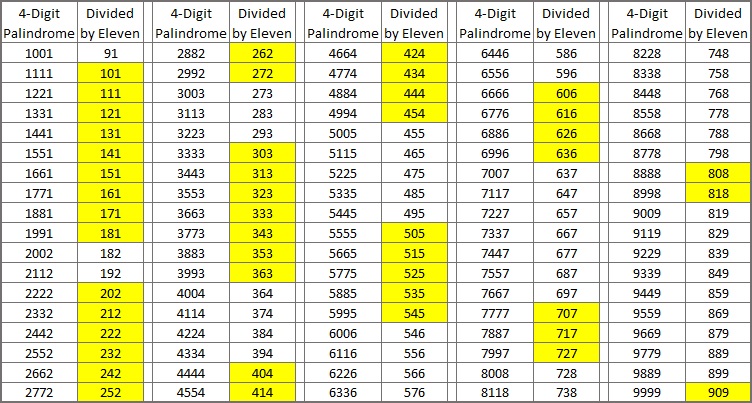
A number is a palindrome if it reads the same backward as it does forward. For example, 1661 is a 4-digit palindrome. Today’s puzzle asks you to explore number palindromes and their factors.

Half of the time when a 4-digit palindrome is divided by 11, we get a 3-digit palindrome. Why does that happen?

Are there 3-digit palindromes that were NOT included in the Divided by Eleven column in the table above?

All 2-digit palindromes are divisible by 11. They are 11, 22, 33, 44, 55, 66, 77, 88, 99.

There are only eight 3-digit palindromes that are divisible by 11. They are 121, 242, 363, 484, 616, 737, 858, 979. Some 3-digit palindromes are prime numbers. Others are divisible by 101 or 111. Still, there are plenty of 3-digit palindromes that are composite numbers but not divisible by 11, 101, or 111.

Most 5-digit palindromes are NOT divisible by 11. I was able to construct one that is, 76967, because the red digits minus the blue digits are 2312 = 11, a number divisible by 11.

Here’s another: 81818. It works because 242 = 22, a number divisible by 11.

What 5-digit palindrome can you construct that is divisible by 11?

Will an N-digit palindrome be divisible by 11? What difference does it make if N is an even number or if N is an odd number?

Factors of 1661:

1661 is divisible by 11 because the red digits minus the blue digits equal 0, a number divisible by 11.

  • 1661 is a composite number.
  • Prime factorization: 1661 = 11 × 151.
  • 1661 has no exponents greater than 1 in its prime factorization, so √1661 cannot be simplified.
  • The exponents in the prime factorization are 1 and 1. Adding one to each exponent and multiplying we get (1 + 1)(1 + 1) = 2 × 2 = 4. Therefore 1661 has exactly 4 factors.
  • The factors of 1661 are outlined with their factor pair partners in the graphic below.

More about the Number 1661:

1661 is also a palindrome in base 18:
1661₁₀ = 525₁₈ because
5(18²) + 2(18¹) + 5(18º) =
5(324) + 2(18) + 5(1) =
1620 + 36 + 5 =
1661.

1660 A 14×14 Mystery Puzzle

Today’s Puzzle:

Adding a few more factors to the multiplication table really complicates this mystery-level puzzle. For example, will the common factor of 28 and 56 be 4, 7, or 14? If it were just a 10 × 10 or a 12 × 12 puzzle, answering that question would be easy. Not so with a 14 × 14 puzzle. Remember to use logic on every step while you find its unique solution.

You can print the puzzle or type the solution on this excel sheet: 10 Factors 1650-1660 with Taxman Scoring Calculator

Factors of 1660:

  • 1660 is a composite number.
  • Prime factorization: 1660 = 2 × 2 × 5 × 83, which can be written 1660 = 2² × 5 × 83.
  • 1660 has at least one exponent greater than 1 in its prime factorization so √1660 can be simplified. Taking the factor pair from the factor pair table below with the largest square number factor, we get √1660 = (√4)(√415) = 2√415.
  • The exponents in the prime factorization are 2, 1, and 1. Adding one to each exponent and multiplying we get (2 + 1)(1 + 1)(1 + 1) = 3 × 2 × 2 = 12. Therefore 1660 has exactly 12 factors.
  • The factors of 1660 are outlined with their factor pair partners in the graphic below.

More About the Number 1660:

1660 is the hypotenuse of a Pythagorean triple:
996-1328-1660, which is (3-4-5) times 332.


1659 Another Mystery

Today’s Puzzle:

Both 20, 10, 30 and 12, 24, 36 have two possible common factors that will only put numbers from 1 to 10 in the first column and the top row of this mystery level puzzle. However, the puzzle has only one solution. Examine all the clues in the puzzle and think logically to determine what those common factors must be.

Factors of 1659:

  • 1659 is a composite number.
  • Prime factorization: 1659 = 3 × 7 × 79.
  • 1659 has no exponents greater than 1 in its prime factorization, so √1659 cannot be simplified.
  • The exponents in the prime factorization are 1, 1, and 1. Adding one to each exponent and multiplying we get (1 + 1)(1 + 1)(1 + 1) = 2 × 2 × 2 = 8. Therefore 1659 has exactly 8 factors.
  • The factors of 1659 are outlined with their factor pair partners in the graphic below.

More About the Number 1659:

1659 is the difference of two squares in FOUR different ways:
830² – 829² = 1659,
278² – 275² = 1659,
122² – 115² = 1659, and
50² – 29² = 1659.

1658 Mystery Puzzle

Today’s Puzzle:

What’s the mystery?
Will the common factor of 30 and 20 be 5 or 10?
Will the common factor of 36 and 18 be 6 or 9?
Will the common factor of 60 and 30 be 6 or 10? and
Will the common factor of 8 and 16 be 2, 4, or 8?

Don’t guess which common factors to use! Look at all the clues. They work together to help you logically arrive at the puzzle’s unique solution.

Factors of 1658:

  • 1658 is a composite number.
  • Prime factorization: 1658 = 2 × 829.
  • 1658 has no exponents greater than 1 in its prime factorization, so √1658 cannot be simplified.
  • The exponents in the prime factorization are 1 and 1. Adding one to each exponent and multiplying we get (1 + 1)(1 + 1) = 2 × 2 = 4. Therefore 1658 has exactly 4 factors.
  • The factors of 1658 are outlined with their factor pair partners in the graphic below.

More About the Number 1658:

1658 is the sum of two squares:
37² + 17² = 1658.

1658 is the hypotenuse of a Pythagorean triple:
1080-1258-1658, which is 2 times (540-629-829),
and can also be calculated from 37² – 17², 2(37)(17), 37² + 17².

1658 is also a leg in the Pythagorean triple
calculated from 2(829), 829² – 1², 829² + 1².

Prime Number 1657 is the 24th Centered Hexagonal Number

Today’s Puzzle:

Draw six triangles on the graphic below to show that 1657 is one more than 6 times the 23rd triangular number.

Factors of 1657:

  • 1657 is a prime number.
  • Prime factorization: 1657 is prime.
  • 1657 has no exponents greater than 1 in its prime factorization, so √1657 cannot be simplified.
  • The exponent in the prime factorization is 1. Adding one to that exponent we get (1 + 1) = 2. Therefore 1657 has exactly 2 factors.
  • The factors of 1657 are outlined with their factor pair partners in the graphic below.

How do we know that 1657 is a prime number? If 1657 were not a prime number, then it would be divisible by at least one prime number less than or equal to √1657. Since 1657 cannot be divided evenly by 2, 3, 5, 7, 11, 13, 17, 19, 23, 29, 31, or 37, we know that 1657 is a prime number.

More About the Number 1657:

1657 is the sum of two squares:
36² + 19² = 1657.

1657 is the hypotenuse of a primitive Pythagorean triple:
935-1368-1657, calculated from 36² – 19², 2(36)(19), 36² + 19².

Here’s another way we know that 1657 is a prime number: Since its last two digits divided by 4 leave a remainder of 1, and 36² + 19² = 1657 with 36 and 19 having no common prime factors, 1657 will be prime unless it is divisible by a prime number Pythagorean triple hypotenuse less than or equal to √1657. Since 1657 is not divisible by 5, 13, 17, 29, or 37, we know that 1657 is a prime number.

Do you notice anything else special about the number 1657 in this color-coded chart?

1656 Seven Ate Nine: Puzzle and a Picture Book

Today’s Puzzle:

Today’s Puzzle is a relatively easy level 6 puzzle with consecutive numbers 7, 8, and 9 prominent among the clues. Write the numbers 1 to 10 in both the 1st column and the top row so that those numbers and all the given clues work together to make a multiplication table. Will the common factor of 24 and 32 be 4 or 8? Will 20 and 12’s common factor be 2 or 4? Don’t guess! Look at the other clues. They all work together to help you find a logical way to solve the puzzle.

The Book Seven Ate Nine:

I ordered several books from my granddaughter’s book order. One of those books was Seven Ate Nine, a delightful tale whose characters are numbers and letters. The back cover summaries the story, “6 has a problem. Everyone knows that 7 is always after him. Word on the street is that 7 ate 9. If that’s true, 6’s days are numbered. Lucky for him, Private I is on the case. But the facts just don’t add up. It’s odd. Will Private I put two and two together and solve the problem . . . or is 6 next in line to be subtracted?”

My preschool grandchildren loved listening to this story. It is filled with math puns and surprising twists and turns. Other than familiarity with the concept of counting, mathematical understanding is not a prerequisite to following the story. Older kids and even adults will enjoy references to several mathematical concepts including odd, even, addition, subtraction, multiplication, division, doubling, measurement, positives, negatives, and pi.

Factors of 1656:

  • 1656 is a composite number.
  • Prime factorization: 1656 = 2 × 2 × 2 × 3 × 3 × 23, which can be written 1656 = 2³ × 3² × 23.
  • 1656 has at least one exponent greater than 1 in its prime factorization so √1656 can be simplified. Taking the factor pair from the factor pair table below with the largest square number factor, we get √1656 = (√36)(√46) = 6√46.
  • The exponents in the prime factorization are 3, 2, and 1. Adding one to each exponent and multiplying we get (3 + 1)(2 + 1)(1 + 1) = 4 × 3 × 2 = 24. Therefore 1656 has exactly 24 factors.
  • The factors of 1656 are outlined with their factor pair partners in the graphic below.

More About the Number 1656:

1656 is the difference of two squares SIX different ways:
415² – 413² = 1656,
209² – 205² = 1656,
141² – 135² = 1656,
75² – 63² = 1656,
55² – 37² = 1656, and
41² – 5² – = 1656.
That last one means we are only 25 numbers away from the next perfect square, 1681.

1655 and Level 5

Today’s Puzzle:

Using logic, write all the numbers from 1 to 10 in both the first column and the top row of this puzzle so that those numbers are the factors of the given clues.

Factors of 1655:

  • 1655 is a composite number.
  • Prime factorization: 1655 = 5 × 331.
  • 1655 has no exponents greater than 1 in its prime factorization, so √1655 cannot be simplified.
  • The exponents in the prime factorization are 1 and 1. Adding one to each exponent and multiplying we get (1 + 1)(1 + 1) = 2 × 2 = 4. Therefore 1655 has exactly 4 factors.
  • The factors of 1655 are outlined with their factor pair partners in the graphic below.

More About the Number 1655:

1655 is the hypotenuse of a Pythagorean triple:
993-1324-1655, which is (3-4-5) times 331.

1654 and Level 4

Today’s Puzzle:

Use logic to write all the numbers 1 to 10 in both the first column and the top row of the puzzle so that those numbers are the factors of the given clues.

Factors of 1654:

  • 1654 is a composite number.
  • Prime factorization: 1654 = 2 × 827.
  • 1654 has no exponents greater than 1 in its prime factorization, so √1654 cannot be simplified.
  • The exponents in the prime factorization are 1 and 1. Adding one to each exponent and multiplying we get (1 + 1)(1 + 1) = 2 × 2 = 4. Therefore 1654 has exactly 4 factors.
  • The factors of 1654 are outlined with their factor pair partners in the graphic below.

More About the Number 1654:

1654 is a leg in one Pythagorean triple:
1654-683928-683930, calculated from 2(827)(1), 827² – 1², 827² + 1².

$1653, Fake Primes, and Taxman’s “Rigged” Counting

Today’s Puzzle:

If you’ve ever played Taxman or watched someone else play it, you know that the Taxman gets all available factors of each card you take. You can only take a card if the Taxman can also take at least one card on that turn. When the game is over, the Taxman gets ALL the leftover cards.

1653 is the 57th triangular number so if all the cards in the puzzle were envelopes containing dollar amounts indicated on the outside of the envelope, there would be $1653 at stake.

Many people start Taxman by taking the largest prime number followed by the largest prime number squared. What if a person claimed long before the game started that the only way he or she could lose is if the game is rigged? Most people have never played this game and might believe that claim especially if they perceive that the person making that claim is pretty good at math. Besides given the opportunity, won’t the Taxman take far more than his fair share just so he can spend it on frivolous projects? The fact that all remaining cards at the end of the game go to the Taxman will make the rigged claim seem even more plausible. Furthermore, what if “our math whiz” confidently called out his or her first two number choices, fake prime number 57 followed by perfect square 49? (57 is a composite number, but it often fools people into thinking it’s prime. You could call it a fake prime because it looks like a prime number but isn’t actually prime. Other fake primes are 51, 87, and 91.)

For today’s puzzle, I would like you to play this Taxman game with the mistaken assumption that 57 and 51 are prime numbers. Of course, the Taxman will know better. It will still be possible to win, but it will be much more difficult.

You can print the cards to play Taxman from this file: 10 Factors 1650-1660 with Taxman Scoring Calculator. You might choose to have someone else be the Taxman while you stand far enough away not to be able to see the factors listed on the top of the cards. Whether you are close to the cards or far away, don’t allow yourself any do-overs.

I’ve included a taxman scoring calculator in that excel file. Only enter numbers under “My Cards” and “Taxman Cards”. The rest of the data will auto-populate. You win if your tax rate is less than 50%. I would be very interested to know if you win or if you lose.

Factors of 1653:

  • 1653 is a composite number.
  • Prime factorization: 1653 = 3 × 19 × 29.
  • 1653 has no exponents greater than 1 in its prime factorization, so √1653 cannot be simplified.
  • The exponents in the prime factorization are 1, 1, and 1. Adding one to each exponent and multiplying we get (1 + 1)(1 + 1)(1 + 1) = 2 × 2 × 2 = 8. Therefore 1653 has exactly 8 factors.
  • The factors of 1653 are outlined with their factor pair partners in the graphic below.

More About the Number 1653:

1653 is the hypotenuse of a Pythagorean triple:
1140-1197-1653, which is (20-21-29) times 57.

1653 = 29 × 57.
1653 is the 29th hexagonal number, and
1653 is the 57th triangular number.

All hexagonal numbers are also triangular numbers. Can you look at the graphic above and see why that’s true? The broken line that I drew might be helpful. It separates the odd numbers from the even ones.

1653 is the 57th triangular number because (57)(58)/2 = 1653.
It is the 29th hexagonal number because 2(29²) – 29 = 1653.