1725 A Toast to You on This Last Day of the Year

Today’s Puzzle:

I haven’t posted as much this past year as I ought, but thank you for bearing with me. Here is a toast to you, faithful reader! Here’s hoping for a great new year for all of us! Write the numbers from 1 to 10 in both the first column and the top row so that the given clues are the products of the factors you write.

Factors of 1725:

  • 1725 is a composite number.
  • Prime factorization: 1725 = 3 × 5 × 5 × 23, which can be written 1725 = 3 × 5² × 23.
  • 1725 has at least one exponent greater than 1 in its prime factorization so √1725 can be simplified. Taking the factor pair from the factor pair table below with the largest square number factor, we get √1725 = (√25)(√69) = 5√69.
  • The exponents in the prime factorization are 1, 2, and 1. Adding one to each exponent and multiplying we get (1 + 1)(2 + 1)(1 + 1) = 2 × 3 × 2 = 12. Therefore 1725 has exactly 12 factors.
  • The factors of 1725 are outlined with their factor pair partners in the graphic below.

More About the Number 1725:

1725 is the difference of two squares in six different ways:

863² – 862² = 1725,
289² – 286² = 1725,
175² – 170² = 1725,
65² – 50² = 1725,
49² – 26² = 1725, and
47² – 22² = 1725.


Facts, Factors, and a Countdown to 2023

Countdown to 2023:

The last 10 seconds of the year, we like to countdown from 10 to the new year. I like a mathematical way of counting down so I try to make an equation with the numbers from 10 to 1 that equals the coming year. This year I could have based my countdown  on last year’s countdown and said
(10-9+8×7×6)(5-4)(3)(2)+1 = 2023,
but this is a blog about factoring so I want a countdown that takes you to the prime factors of 2023 first. Here’s my countdown: (Note: Even though I used 1 as a factor twice in the countdown, I am very much aware that 1 is not a prime factor of any number.)

Countdown to 2023

make science GIFs like this at MakeaGif
Here’s the final shot from the Countdown:

A Puzzle for 2023:

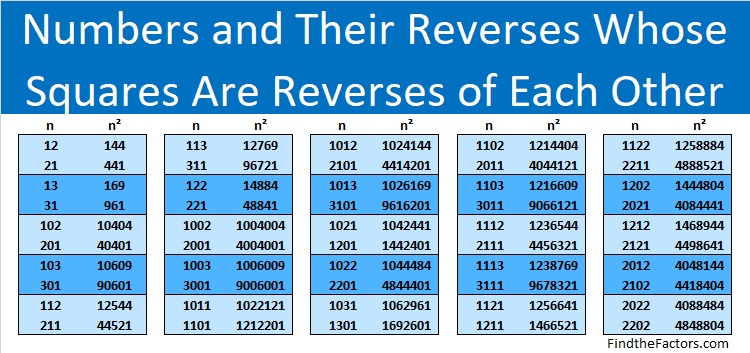
2023 has something in common with 2022. When either number and their reverses are squared, something interesting happens…it’s almost like looking in a mirror!

Only 50 numbers less than 10000 can make a similar claim to fame:

Factors of 2023:

  • 2023 is a composite number.
  • Prime factorization: 2023 = 7 × 17 × 17, which can be written 2023 = 7 × 17².
  • 2023 has at least one exponent greater than 1 in its prime factorization so √2023 can be simplified. Taking the factor pair from the factor pair table below with the largest square number factor, we get √2023 = (√289)(√7) = 17√7.
  • The exponents in the prime factorization are 1 and 2. Adding one to each exponent and multiplying we get (1 + 1)(2 + 1) = 2 × 3 = 6. Therefore 2023 has exactly 6 factors.
  • The factors of 2023 are outlined with their factor pair partners in the graphic below.

More About the Number 2023:

What do 2023 tiny squares look like?

2023 is the sum of consecutive numbers in five different ways:

And it is the sum of consecutive odd numbers in two ways:

2023 is a palindrome in base 16 because
7(16²) + 14(16) + 7(1) = 2023.

This tweet demonstrates that the prime factors of 2023 have a relationship with the digits of 2023.

I saw this tweet on Twitter and immediately recognized something else cool about 2023.

That might seem like a lot of mathematical mumble jumble, but with a little bit of explanation, it can be understood. And even though I made the problem look scarier because I substituted 2+0+2+3 for 7, some older elementary students who already understand powers, factorials, and/or remainders, will get it. I’m confident you can too.

You could also give the following list of facts to older elementary students and ask them to use it to find the remainder when they divide 823,543 by 5040.

1×5040 =    5040
2×5040 = 10080
3×5040 = 15120
4×5040 = 20160
5×5040 = 25200
6×5040 = 30240
7×5040 = 35280
8×5040 = 40320
9×5040 = 45360

Because its factors, 17 and 289, are hypotenuses of Pythagorean triples, 2023 is also the hypotenuse of some Pythagorean triples:
952-1785-2023 which is 119(8-15-17) , and
1127-1680-2023 which is 7(161-240-289).

Ureczky József also pointed out in the comments of this post, that 2023 is the short leg in SIX Pythagorean triples, and thus
2023² = 2046265² – 2046264²
2023²= 292327² – 292320²
2023² = 120377² – 120360²
2023² = 17255² – 17136²
2023² = 41785² – 41736²
2023² = 7225² – 6936²

One of those triples is a primitive triple. Can you determine which one?

Ureczky József shared one more amazing fact in the comments that I’m replicating here:

2023=9³+8³+7³+6³+5³+4³+3³+2³-1³

More Mathematical Tweets About 2023:

These tweets are more or less in the order I saw them, not in order of mathematical difficulty. I will add more as I see them.


v

1724 Carol of the Ukrainian Bells

Today’s Puzzle:

As I sit in my warm, peaceful house, I often think about the people of Ukraine whose country has been ravaged by war. Many of them, including children, are also facing a winter with no heat. My heart goes out to them.

My childhood was so unlike theirs. I was able to attend school classes and learn about many different topics without fear of dying. In Junior High School choir class, one of the songs I learned was called Carol of the Bells. I just recently learned from Slate magazine of the song’s Ukrainian roots:

A little over a hundred years ago Mykola Leontovych, a Ukrainian composer, arranged several of his country’s folk songs together in a piece he titled Shchedryk. Tragically, he was murdered by a Russian assassin on January 23, 1921, in the Red Terror, when the Bolsheviks were intent on eliminating Ukrainian leaders, intellectuals, and clergy.

During this time of great unrest, the Ukrainian National Chorus performed Shchedryk around the world and in cities large and small in the United States. One performance was even given at the famed Carnegie Hall on October 5, 1922. The haunting melody was heard by Peter Wilhousky who penned alternate words for it: Hark how the bells, Sweet silver bells,…

Now it is one of our most beloved Christmas carols. I am grateful I learned the words and tune in junior high, although I wish I had learned of its Ukrainian history then as well.

These two bells puzzles are reminiscent of Ukraine’s flag. Long may it wave. Write each number 1 to 10 in the yellow columns and rows so that the given clues are the products of the numbers you write.

Here are the same puzzles if you prefer to use less of your printer ink.

Factors of 1724:

  • 1724 is a composite number.
  • Prime factorization: 1724 = 2 × 2 × 431, which can be written 1724 = 2² × 431.
  • 1724 has at least one exponent greater than 1 in its prime factorization so √1724 can be simplified. Taking the factor pair from the factor pair table below with the largest square number factor, we get √1724 = (√4)(√431) = 2√431.
  • The exponents in the prime factorization are 2 and 1. Adding one to each exponent and multiplying we get (2 + 1)(1 + 1) = 3 × 2 = 6. Therefore 1724 has exactly 6 factors.
  • The factors of 1724 are outlined with their factor pair partners in the graphic below.

More About the Number 1724:

1724 is the difference of two squares:
432² – 430² = 1724.

1724₁₀ = 464₂₀, a palindrome, because
4(20²) + 6(20¹) + 4(20°) = 1724.

1723 A Little Virgács

Today’s Puzzle:

I haven’t blogged much this year so I guess I deserved a little bit of virgács in my shoes this morning. Mikulás (St. Nick) leaves virgács in the boots of naughty little boys or girls in the wee hours of December 6. Treats are for the good kids. What is virgács? It is small golden spray-painted twigs bound with some pretty red ribbon.  Of course, all children are sometimes naughty and sometimes nice, so they could all expect to get virgács along with their treats in their boots this morning.

You can solve this virgács puzzle by starting with the clues at the top of the grid, finding their factors, and working down the puzzle row by row until you have found all the factors. Each number from 1 to 10 must appear exactly one time in both the first column and the top row.

Factors of 1723:

  • 1723 is a prime number.
  • Prime factorization: 1723 is prime.
  • 1723 has no exponents greater than 1 in its prime factorization, so √1723 cannot be simplified.
  • The exponent in the prime factorization is 1. Adding one to that exponent we get (1 + 1) = 2. Therefore 1723 has exactly 2 factors.
  • The factors of 1723 are outlined with their factor pair partners in the graphic below.

How do we know that 1723 is a prime number? If 1723 were not a prime number, then it would be divisible by at least one prime number less than or equal to √1723. Since 1723 cannot be divided evenly by 2, 3, 5, 7, 11, 13, 17, 19, 23, 29, 31, 37, or 41, we know that 1723 is a prime number.

More About the Number 1723:

1723 and 1721 are twin primes.

1723 is the sum of consecutive numbers:
861 + 862 = 1723.

1723 is the difference of consecutive squares:
862² – 861² = 1723.

1722 Mikulás, Fill My Boot With Goodies!

Today’s Puzzle:

Today is December 5, so children in Hungary and some other countries will shine their boots and put them out for Mikulás (Saint Nick) to fill with candies. Can you solve this boot puzzle? Write the numbers 1 to 10 in both the first column and the top row so that the given clues are the products of the numbers you write.

Here is a song children will sing in Hungary today. You are already familiar with the tune. This particular video includes subtitles.

Here are the lyrics in Hungarian and Google’s translation into English:

Hull a pelyhes fehér hó, jöjj el kedves Télapó!
Minden gyermek várva vár, vidám ének hangja száll.
Van zsákodban minden jó, piros alma, mogyoró,
Jöjj el hozzánk, várunk rád, kedves öreg Télapó.

Nagy szakállú Télapó jó gyermek barátja.
Cukrot,diót, mogyorót rejteget a zsákja.
Amerre jár reggelig kis cipőcske megtelik,
megtölti a Télapó, ha üresen látja!

The fluffy white snow is falling, come dear Santa!
Every child waits expectantly, the sound of happy singing is heard.
You have everything good in your bag, red apples, hazelnuts,
Come to us, we are waiting for you, dear old Santa Claus.

Santa Claus with a big beard is a good friend of children.
His sack hides sugar, walnuts and hazelnuts.
Wherever you go, your little shoe will be full by morning,
Santa will fill it if he sees it empty!

Factors of 1722:

  • 1722 is a composite number.
  • Prime factorization: 1722 = 2 × 3 × 7 × 41.
  • 1722 has no exponents greater than 1 in its prime factorization, so √1722 cannot be simplified.
  • The exponents in the prime factorization are 1, 1, 1, and 1. Adding one to each exponent and multiplying we get (1 + 1)(1 + 1)(1 + 1)(1 + 1) = 2 × 2 × 2 × 2 = 16. Therefore 1722 has exactly 16 factors.
  • The factors of 1722 are outlined with their factor pair partners in the graphic below.

More About the Number 1722:

Since 1722 = 41·42, we know that 1722 is the sum of the first 41 EVEN numbers. It is two times the 41st triangular number.

1721 A Gift With Multiple Treasures

Today’s Puzzle:

‘Tis the season of giving, and here’s a gift with multiple treasures inside. Write the numbers from 1 to 10 in both the first column and the top row so that the given clues are the products of the numbers you write. After you find the factors, you can complete the puzzle by finding all of the products.

Factors of 1721:

  • 1721 is a prime number.
  • Prime factorization: 1721 is prime.
  • 1721 has no exponents greater than 1 in its prime factorization, so √1721 cannot be simplified.
  • The exponent in the prime factorization is 1. Adding one to that exponent we get (1 + 1) = 2. Therefore 1721 has exactly 2 factors.
  • The factors of 1721 are outlined with their factor pair partners in the graphic below.

How do we know that 1721 is a prime number? If 1721 were not a prime number, then it would be divisible by at least one prime number less than or equal to √1721. Since 1721 cannot be divided evenly by 2, 3, 5, 7, 11, 13, 17, 19, 23, 29, 31, 37, or 41, we know that 1721 is a prime number.

More About the Number 1721:

1721 is the sum of two squares:
40² + 11² = 1721.

Here’s another way we know that 1721 is a prime number: Since its last two digits divided by 4 leave a remainder of 1, and 40² + 11² = 1721 with 40 and 11 having no common prime factors, 1721 will be prime unless it is divisible by a prime number Pythagorean triple hypotenuse less than or equal to √1721. Since 1721 is not divisible by 5, 13, 17, 29, 37, or 41, we know that 1721 is a prime number.

1721 and 1723 are twin primes.