242 and Level 4

  • 242 is a composite number.
  • Prime factorization: 242 = 2 x 11 x 11, which can be written 2 x (11^2)
  • The exponents in the prime factorization are 1 and 2. Adding one to each and multiplying we get (1 + 1)(2 + 1) = 2 x 3 = 6. Therefore 242 has 6 factors.
  • Factors of 242: 1, 2, 11, 22, 121, 242
  • Factor pairs: 242 = 1 x 242, 2 x 121, or 11 x 22
  • Taking the factor pair with the largest square number factor, we get √242 = (√2)(√121) = 11√2 ≈ 15.556

2014-38 Level 4

Print the puzzles or type the factors on this excel file: 12 Factors 2014-09-22

2014-38 Level 4 Logic

A Forest of 240 Factor Trees

Factor Trees for 240:

Because 240 has so many factors, it is possible to make MANY different factor trees that create a forest of 240 factor trees. This post only contains eleven of those many possibilities. The two trees below demonstrate different permutations that can be made from the same basic tree. The mirror images of both, as well as mirror images of parts of either tree, would be other permutations.

240 Factor Trees


A good way to make a factor tree for a composite number is to begin with one of its factor pairs and then make factor trees for the composite numbers in that factor pair.

240 Factor Trees 1 - 3

In this first set of three factor trees we can also see the factor trees for 120, 80, 4, & 60.

240 Factor Trees 4 - 6

These three factor trees also include factor trees for 48, 6, 40, 8, and 30.

240 Factor Trees 7 - 9

Finally, these three factor trees also include factor trees for 10, 24, 12, 20, 15, and 16.

This forest of 240 factor trees is dedicated to Joseph Nebus. Read the comments to his post, You might also like, because, I don’t know why, to discover why I was inspired to create images of parts of this forest.

Factors of 240:

  • 240 is a composite number.
  • Prime factorization: 240 = 2 x 2 x 2 x 2 x 3 x 5, which can be written 2⁴ x 3 x 5
  • The exponents in the prime factorization are 4, 1 and 1. Adding one to each and multiplying we get (4 + 1)(1 + 1)(1 + 1) = 5 x 2 x 2 = 20. Therefore 240 has 20 factors.
  • Factors of 240: 1, 2, 3, 4, 5, 6, 8, 10, 12, 15, 16, 20, 24, 30, 40, 48, 60, 80, 120, 240
  • Factor pairs: 240 = 1 x 240, 2 x 120, 3 x 80, 4 x 60, 5 x 48, 6 x 40, 8 x 30, 10 x 24, 12 x 20, or 15 x 16
  • Taking the factor pair with the largest square number factor, we get √240 = (√16)(√15) = 4√15 ≈ 15.492

Sum-Difference Puzzle:

60 has six factor pairs. One of those factor pairs adds up to 17, and a different one subtracts to 17. Can you find those factor pairs to solve the first puzzle below?

240 has ten factor pairs. One of them adds up to 34, and another one subtracts to 34. If you can identify those factor pairs, then you can solve the second puzzle.

The second puzzle is really just the first puzzle in disguise. Why would I say that?

Another Fact about the Number 240:

2 + 4 + 6 + 8 + 10 + 12 + 14 + 16 + 18 + 20 + 22 + 24 + 26 + 28 + 30 = 240; that’s the sum of the first 15 even numbers.


How Many Factors Does 224 Have, and Why Does It Have That Many?

  • 224 is a composite number.
  • Prime factorization: 224 = 2 x 2 x 2 x 2 x 2 x 7, which can be written 224 = 2⁵ x 7
  • The exponents in the prime factorization are 5 and 1. Adding one to each and multiplying we get (5 + 1)(1 + 1) = 6 x 2 = 12. Therefore 224 has 12 factors.
  • Factors of 224: 1, 2, 4, 7, 8, 14, 16, 28, 32, 56, 112, 224
  • Factor pairs: 224 = 1 x 224, 2 x 112, 4 x 56, 7 x 32, 8 x 28, or 14 x 16
  • Taking the factor pair with the largest square number factor, we get √224 = (√16)( √14) = 4√14 ≈ 14.967

It may seem like a little mathemagic to state that 224 has 12 factors because the exponents in its prime factorization are 5 and 1 and because 6 x 2 = 12. If we look at the factors of 224 in a different way, all of the mathemagician’s secrets will be revealed.

First it must be understood that any number (except zero) raised to the zeroth power is equal to one.

Since the prime factorization of 224 is 2⁵ x 7¹, every one of its factors can be written as the product of certain powers of 2 and 7:

factors of 224

Counting all the factors of 224 is similar to counting the number of possible sandwiches when there are 5 different meats (and vegetarians are given the option of no meat) and one type of bread (and those counting carbs are given the option of no bread). Even though there are 5 different types of meat, there are 6 possible choices about meat, while bread or no bread makes 2 possible choices about bread. The fundamental counting principle states that we can count the total number of possible sandwiches by multiplying together the number of possible choices of meat and bread. In this case that is 6 x 2 = 12.

(We are allowing people to chose to have no meat and/or no bread. Usually when the fundamental counting principle is used we don’t make that allowance.  Allowing the sandwiches to be made without meat and/or bread means we have to add 1 to the 5 types of meat and 1 to the 1 type of bread before we multiply those numbers together, giving us (5 + 1)(1 + 1) or 6 x 2. If we did not allow anyone to choose to leave out the meat and/or bread we would not add 1.)

Adding even one more number in the prime factorization or adding even one more ingredient to the sandwich can make counting the factors or sandwiches more tedious:

If we also allow 3 different types of lettuce (or no lettuce for those who don’t want any), the problem becomes a little more complicated, but the fundamental counting principle makes it easy to find the number of possible types of sandwiches. Since we now have 4 lettuce choices, we simply multiply the previous information by that number: (6 x 2) x 4 = 12 x 4 = 48. Finding the number of possible sandwiches is easy, but listing all 48 sandwiches might make some people lose their appetite.

Just as it worked for finding the number of possible sandwiches, the fundamental counting principle also helps us know the number of factors a whole number has. When each number in a factor pair is written using a modified version of its prime factorization (to allow us to write a factor to the zeroth power), then we can clearly see how to make (2^5) x (7 ^1) with every factor pair.

factor pairs for 224


If the prime factorization of a number were (2^5) x (7^1) x (11^3), it would have (5+1)(1+1)(3+1) = 6 x 2 x 4 = 48 factors. Finding the number of factors may be much easier than listing all of them, but knowing how many factors there are helps us make sure we don’t list too few or too many.

When a number is prime such as 7, it has no prime factorization, but 7 can be represented as (7^1). Its exponent is 1; (1 + 1) = 2, and its two factors can be listed as (7^0) and (7^1) or 1 and 7. All prime numbers have exactly 2 factors.

Factor pairs obviously come in 2’s, so will the number of factors a number has always be an even number?

We know from number theory when we multiply an even number by any other number, we always get an even number. To get an odd number as the product, EVERY number that is multiplied together would have to be odd. Therefore, the only way to get an odd number when we use the fundamental counting principle is if all the numbers being multiplied together are odd. In the case of counting the number of factors of a number, we only get an odd number of factors when the number being factored is a perfect square. That is the only way ALL of the exponents in its prime factorization are even numbers, and those even exponents plus 1 will ALL be odd.

For example, if the prime factorization were (2^6)(3^2), then the number of factors would be (6 + 1)(2 + 1) = 7 x 3 = 21, a odd number. One of its factor pairs could be written (2^3)(3^1) x (2^3)(3^1), but is normally listed as 24 x 24. So when we list the factor pairs there will be 11 pairs, but when we list the 21 factors of 576, we only list 24 once. Fortunately teachers and textbooks rarely choose numbers with that many factors.

When factoring numbers, making sandwiches, or making many other choices, the fundamental counting principle gives the number of all the possible outcomes and makes it easier not to overlook any possibilities.

213 and Level 1

  • 213 is a composite number.
  • Prime factorization: 213 = 3 x 71
  • The exponents in the prime factorization are 1 and 1. Adding one to each and multiplying we get (1 + 1)(1 + 1) = 2 x 2 = 4. Therefore 213 has 4 factors.
  • Factors of 213: 1, 3, 71, 213
  • Factor pairs: 213 = 1 x 213 or 3 x 71
  • Since 213 has no square factors, the square root of 213 cannot be simplified. √213 ≈ 14.595

I recommend reading a-math-book-to-change-your-teaching, an article written by a fellow blogger about a book that simplifies the teaching of mathematics while making the subject more meaningful for students.

2014-34 Level 1

Excel file of puzzles and previous week’s factor solutions: 12 Factors 2014-08-25

2014-34 Level 1 Factors

201 World Elephant Day

Why Is There a World Elephant Day Each Year?

Today is World Elephant Day, and today, like every other day in recent history, about 100 elephants will be killed by poachers.

Elephant Multiplication Rhyme

I’ve written the multiplication rhyme above not only to help children remember 11 x 11 = 121, but also to teach them never to buy ivory and to work to protect elephant families. Elephants are magnificent for many reasons, and they live in family units just like we do.

Picture your family sitting down with a few other families for dinner in an outdoor cafe when suddenly all the adults are fired upon and killed by thieves. Your orphaned children witness as the thieves remove rings from your fingers and other valuables from your now dead body.

That is what happens to scores of elephant families EVERYDAY as poachers selfishly remove ivory from the elephants they massacre.

Imagine a world with NO elephants. That day is in our future unless we do all we can to change the present.

Please, take a few minutes to check out some of these blogs that are written by people who truly love elephants:

runnergirlrobin world-elephant-day-a-cause-near-dear-to-my-heart

saltwaterspeculation world-elephant-day

world-elephant-day-here-are-some-interesting-facts

kenyan-elephant-activist-wants-an-ivory-arrest

go-grey-for-elephants

remembering-our-elephants

celebrate-world-elephant-day

mama-and-baby-elephant

Factors of 201:

2 + 0 + 1 = 3, so 201 is divisible by 3.

  • 201 is a composite number.
  • Prime factorization: 201 = 3 x 67
  • The exponents in the prime factorization are 1 and 1. Adding one to each and multiplying we get (1 + 1)(1 + 1) = 2 x 2 = 4. Therefore 201 has exactly 4 factors.
  • Factors of 201: 1, 3, 67, 201
  • Factor pairs: 201 = 1 x 201 or 3 x 67
  • 201 has no square factors that allow its square root to be simplified. √201 ≈ 14.1774

More About the Number 201:

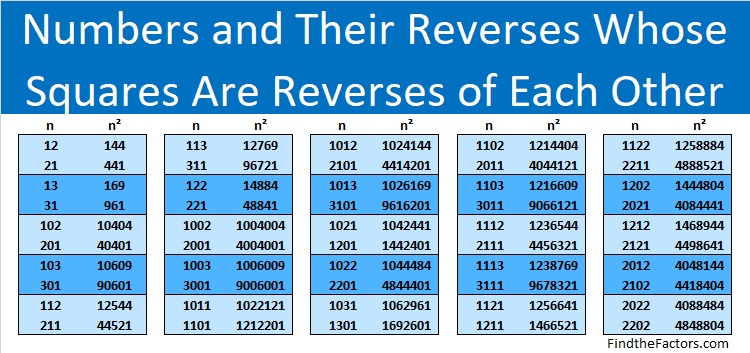
When 201 and 102 are squared, it is almost like they are looking in a mirror at each other:

201² = 40401, and
102² = 10404.

How uncommon is it that the square of a number and the square of the number made by reversing its digits are reverses of each other? This chart lists the 50 numbers that are the ONLY numbers less than 10000 that can make that claim.

Numbers-and-Their-Reverses-and-Squares.jpg (750×353)

199 My List of Multiplication Rhymes

  • 199 is a prime number.
  • Prime factorization: 199 is prime.
  • The exponent of prime number 199 is 1. Adding 1 to that exponent we get (1 + 1) = 2. Therefore 199 has exactly 2 factors.
  • Factors of 199: 1, 199
  • Factor pairs: 199 = 1 x 199
  • 199 has no square factors that allow its square root to be simplified. √199 ≈ 14.1067

How do we know that 199 is a prime number? If 199 were not a prime number, then it would be divisible by at least one prime number less than or equal to √199 ≈ 14.1. Since 199 cannot be divided evenly by 2, 3, 5, 7, 11, or 13, we know that 199 is a prime number.

———————————

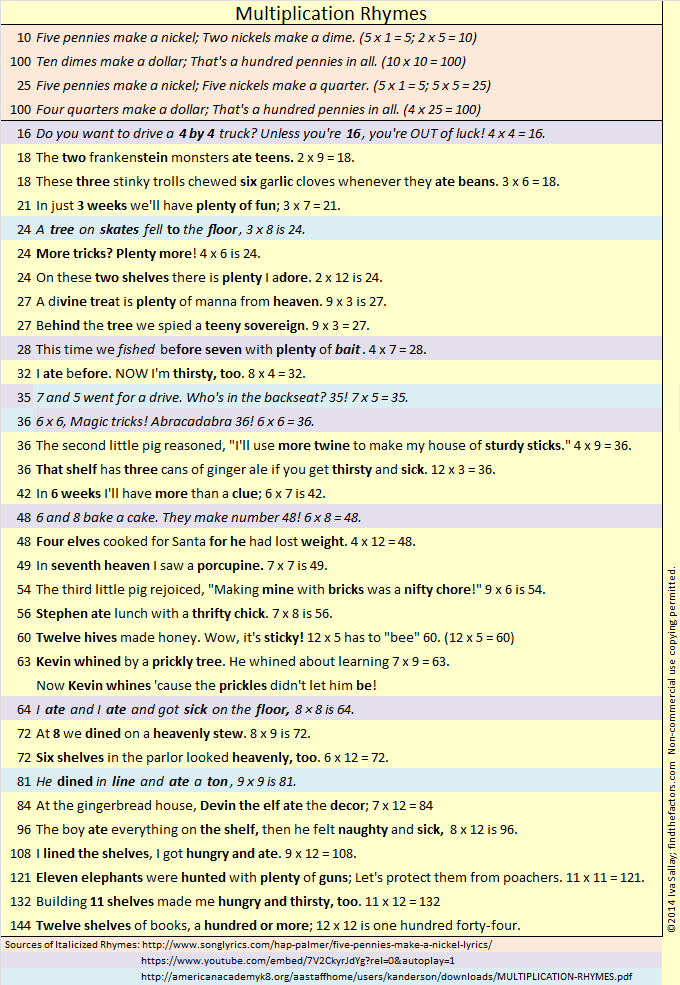
I recently wrote a post that asked “Are Multiplication Rhymes Able to Help Kids Learn the Multiplication Table?” Here is a list of rhymes that I’ve put together.

Multiplication Rhymes


Most of the rhymes have rhyming clues to help students remember both numbers being multiplied as well as their product. I wrote the rhymes that are highlighted in yellow. Those highlighted in peach, purple, or blue are from other sources, but I did alter the rhymes for 24, 28, and 81. A black and white pdf of the rhymes is also available here.

194 Are Multiplication Rhymes Able to Help Kids Learn the Multiplication Table?

194 is a composite number. Factor pairs: 194 = 1 x 194 or 2 x 97. Factors of 194: 1, 2, 97, 194. Prime factorization: 194 = 2 x 97.

Are multiplication rhymes able to help kids learn the multiplication table? The obvious answer is, of course, YES! Duh!

Little Pigs Multiplication Rhymes

However, sometimes this obvious answer may not be correct. I recently read a researched article on the effectiveness of certain teaching practices in helping first-grade children learn mathematics. The points made in the article would likely apply to third and fourth-grade students learning multiplication as well. The article states that alternative techniques (music, movement, m&m’s, other manipulatives, etc.) do reinforce concepts for students who already understand what is being taught, but students who struggle actually make no gains when unproven techniques are used. The researcher hypothesized that when students struggle to learn mathematical concepts “alternative techniques tend to demand more, cognitively, from [these] students.” Demanding more cognitively can backfire: Requiring a student to memorize a rhyme and the math fact could put that student’s brain on overload with even fewer facts learned.

I have now modified my opinion of multiplication rhymes. If rhyme-and-rhythm is helpful, use it, if not, don’t. What is good for some of the class, may not be good for all of the class. If a student doesn’t make progress using the rhymes, it may be better to stick with more direct instruction to learn the math facts. Additionally, each rhyme should be examined individually and its own pros and cons considered.

Here are two of my FAVORITE sources of multiplication rhymes: American Academy’s MULTIPLICATION-RHYMES.pdf now requires registration to view, but it has rhymes printed in pretty colors and contains a few of my favorite multiplication rhymes. Kids would probably like looking at this pdf multiple times.

Multiplication Rhymes 1 is an entertaining You-tube video made by Mrs. Rice that children would probably enjoy watching over and over again, and it also has a few very memorable rhymes.

Although these two sources are great, I think some of the rhymes are too similar:

  • From the pdf, we have “8 and 4 were sad and blue, 8 x 4 = 32” while the video recites “6 and 7 are sad and blue, they make number 42.” If students learned either of those rhymes, they may have difficulty remembering the product or which two numbers were sad and blue several weeks later.
  • The video also gave two other rhymes that were too similar to each other: “9 and 8 what do they do? They go play (tag) with 72.” and  “9 and 9 are having fun. They play tag with 81.” “Tag” is in parentheses because it wasn’t on the note card that was shown, but it was spoken on the video. Again weeks later, groups or individuals may not remember which numbers were playing tag or what the product was when they were multiplied together.

I compiled my own List of Multiplication Rhymes which focus on the multiplication facts highlighted in the multiplication table below. I included some rhymes from the above pdf and the video and added some from the song Five Pennies Make a Nickel. All of those rhymes are in italics. The rhymes that I wrote myself are in regular print. If I modified an existing rhyme, the modifications are in regular print while the rest of the rhyme is in italics. I also ordered the rhymes in a way that should make finding the rhyme for any particular fact much easier. I hope there will be many rhymes on this list that you enjoy as well, and that they get used to help many students learn the very important multiplication facts highlighted in the table below.

Multiplication Rhymes Table

 Multiplication Rhymes

187 and Level 2

187 is a composite number.
Factor pairs: 187 = 1 x 187 or 11 x 17
Factors of 187: 1, 11, 17, 187
Prime factorization: 187 = 11 x 17

———————————————————————————————————————

2014-30 Level 2

Excel file of puzzles and previous week’s factor solutions: 12 Factors 2014-07-28

2014-30 Level 2 Factors

171 and Level 4

171 is a composite number.
Factor pairs: 171 = 1 x 171, 3 x 57, or 9 x 19
Factors of 171: 1, 3, 9, 19, 57, 171
Prime factorization: 170 = 3 x 3 x 19, which can be written 170 = (3^2) x 19

171 = 1 + 2 + 3 + 4 + 5 + 6 + 7 + 8 + 9 + 10 + 11 + 12 + 13 + 14 + 15 + 16 + 17 + 18 and is therefore a triangular number.

The fact that 171 is a triangular number is easy to recognize because 170 = 9 x 19 = (18/2) x 19. Any integer resulting from n(n + 1)/2 is a triangular number.

2014-27 Level 4

Excel file of puzzles and previous week’s factor solutions: 10 Factors 2014-07-07

2014-27 Level 4 Logic

168 and the Very Inspiring Blogger Award

I Was Nominated for the Very Inspiring Blogger Award!

Nerdinthebrain is a very well-rounded and inspiring blogger. I feel quite honored that she nominated me for the Very Inspiring Blogger Award.

veryinspiring_bloggeraward


Just two little rules for accepting this award:

1) The nominee shall display the Very Inspiring Blogger Award logo on her/his blog, and link to the blog they got nominated from.

2) The nominee shall nominate fifteen (15) bloggers she/he admires, by linking to their blogs and informing them about it.

Because this award has these requirements, it may seem like a modern version of a chain letter, but it also appears to be a great way to step out of our comfort zones. It helps us read posts and share ideas with people with whom we have a little something in common but just don’t know it yet. Here are my 15 nominees:

  1. Beyondtraditionalmath
  2. Blogbloggerbloggest
  3. Crazygoodreaders DYSLEXIA DIGEST
  4. established1962
  5. Hummingtop
  6. colleenyoung.wordpress.com
  7. MY MATH-Y ADVENTURES
  8. Nebusresearch (He actually has 2 great blogs.)
  9. NumberLovingBeagle
  10. PeopleStoryNetwork
  11. Bookzoompa
  12. RobertLovesPi
  13. http://mathtuition88.com/
  14. VisuallyLiteral (Nancy Tordai Photography)
  15. MarekBennett

Congratulations to each of you. (I’ll do the informing tomorrow because I’ve already spent more time than usual on the internet today.)

Factors of 168:

√168 ≈ 12.96148. Let’s divide 168 by each number from 1 to 12 to find its factor pairs.

The prime factorization of 168 is 2³ × 3 × 7.
Adding 1 to each of the exponents in the prime factorization and multiplying, we get
(3 + 1)(1 + 1)(1 + 1) = 4 × 2 × 2 = 12. Notice that 168 has exactly 12 factors.

More About the Number 168:

Four of those factor pairs are made up of only even numbers, so 168 is the difference of two squares four different ways:
43² – 41² = 168,
23² – 19² = 168,
17² – 11² = 168,
13² – 1² = 168.

Since 168 is 3 × 56, it is the sum of three consecutive numbers with 56 as the middle number:
55 + 56 + 57 = 168.

Since 168 is 7 × 24, it is the sum of seven consecutive numbers with 24 as the middle number:
21 + 22 + 23 + 24 + 25 + 26 + 27 = 168.

Finally, since 168 is divisible by 8, but not by 16, it is the sum of 16 consecutive numbers:
3 + 4 + 5 + 6 + 7 + 8 + 9 + 10 + 11 + 12 + 13 + 14 + 15 + 16 + 17 + 18 = 168.

As a consequence of that last mathematical fact, here’s another way to make 168:
18² – 17² + 16² – 15² + 14² – 13² + 12² – 11² + 10² – 9² + 8² – 7² + 6² – 5² + 4² – 3² = 168.
I bet you weren’t expecting that!

168 = 6 × 28, so 168 is the product of the first two perfect numbers! Why are those numbers perfect? Each of them is the sum of their divisors:
6 = 1 + 2 + 3, and
28 = 1 + 2 + 4 + 7 + 14.

168 is a repdigit in several other bases:
It’s CC in base 13 because 12(13+1) = 168,
88 in base 20 because 8(20+1) = 168,
77 in base 23 because 7(23+1) = 168,
66 in base 27 because 6(27+1) = 168,
44 in base 41 because 4(41+1) = 168,
33 in base 55 because 3(55+1) = 168,
22 in base 83 because 2(83+1) = 168, and
11 in base 167 because 1(167+1) = 168.